Why Marketing Claims Must Be Verified Before Choosing a Mattress
Mattress marketing claims are not automatically false, and they are not automatically verified. U.S. Federal Trade Commission policy requires advertisers to have a reasonable basis for objective express and implied claims before dissemination, with the amount and type of substantiation depending on the claim. [1] Verification means matching the exact claim to evidence capable of supporting it—not distrusting every advertisement.
That distinction matters because mattress advertising mixes several different kinds of statements. A feel description, quantified performance assertion, health implication, certification seal, trial policy, discount, and expert endorsement are not the same kind of claim and cannot be checked the same way. Public standards and guidance referenced here were checked September 15, 2026. The practical task is to convert each material statement into a specific proposition, classify it, and ask whether evidence of the right type applies to the exact product, component, model, and version being sold.
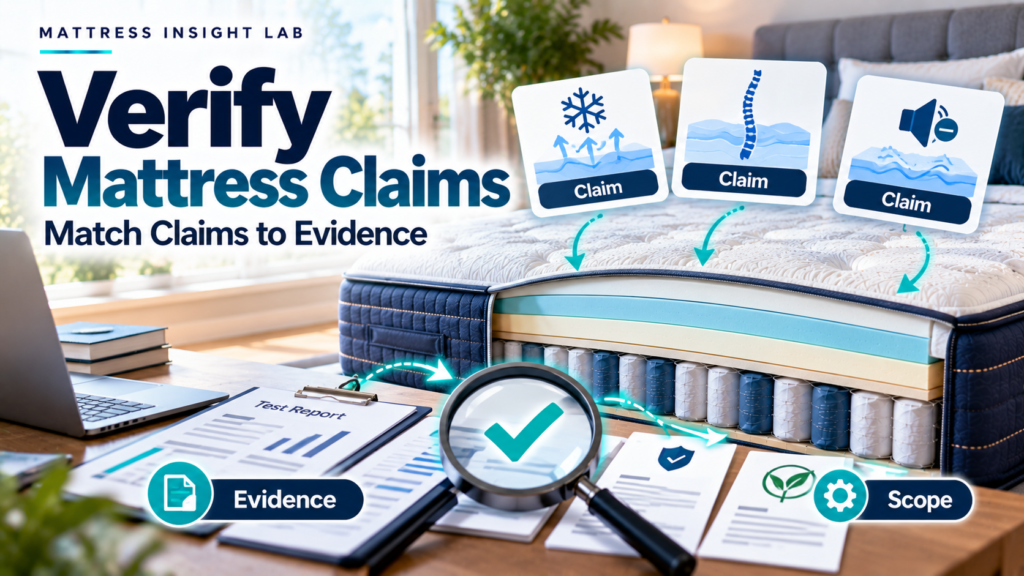
The verification flow: identify the claim → classify the claim type → identify the evidence type → verify the evidence applies to the exact product/component/version → check qualifications → resolve conflicts → decide whether the claim may influence the purchase.
What Does It Mean to Verify a Mattress Marketing Claim?
Verifying a mattress marketing claim means matching the exact proposition the advertisement communicates to evidence capable of supporting that specific proposition — not deciding whether the advertisement sounds trustworthy. FTC guidance evaluates advertising in context, considering express statements, implied representations, omissions, and the overall message a reasonable shopper would take from it. Objective claims require appropriate substantiation before dissemination, and different claim types require different evidence types.
This is why “verify the claim” is not the same instruction as “distrust the marketing.” A marketing statement is not automatically false merely because it is marketing. It is also not automatically true. The method is to identify what is actually being claimed and then ask what evidence would be capable of supporting that specific proposition.
What Exact Benefit, Material, Performance, Safety, Price, or Policy Is Being Claimed?
The first verification step is to identify the exact proposition the advertisement communicates — not the keyword, but the benefit, material, performance, safety, price, or policy assertion a reasonable shopper would understand. FTC evaluates advertising in context, considering express statements, implied representations, omissions, and the overall message. Objective claims require appropriate substantiation.
Rewriting the advertisement into a specific proposition before attempting to verify it is the practical move. “Cooling technology” is not yet a verifiable proposition. “This mattress keeps the sleeping surface at a lower temperature than a stated benchmark under a stated test method” is. The keyword is not the claim; the overall message is.
Is the Claim Expressly Stated or Implied by the Advertising?
FTC considers both express statements and implied representations, including omissions and overall context. A claim need not be stated in words to be a claim. Implied claims can arise from images, qualifications, surrounding wording, or the overall message.
The verification task is to identify both what the advertisement says and what it reasonably communicates. The boundary is equally important: do not invent an implied claim the advertisement would not reasonably communicate. FTC evaluates what reasonable consumers take from the advertisement, not what a suspicious reader could project onto it.
Is the Claim Subjective, Objective, Comparative, Health-Related, Environmental, or Contractual?
Claim type determines evidence type. Subjective feel descriptions, objective performance assertions, comparative claims, health-related claims, environmental claims, and contractual claims each require different evidence. FTC requires evidence appropriate to the particular claim, and health-related claims require stronger scientific support.
Classify the claim before checking evidence. Using one universal evidence standard for every claim is the most common verification error, because it either over-demands evidence for ordinary comfort language or under-demands evidence for a health or safety assertion.
What Evidence Type Could Actually Verify That Claim?
The evidence type must match the claim type. A material-content claim may be checked through specifications or certification; a quantified performance claim may require test data; a personal comfort claim may require individual use; a health claim needs stronger scientific evidence; a policy claim should be checked against the applicable written terms; an award requires the source, methodology, model, and relationship to be identified.
FTC requires evidence appropriate to the particular claim. Health claims require competent and reliable scientific evidence matched to product, benefit, population, and real-use circumstances. Endorsements cannot outrun the advertiser’s own substantiation. The boundary runs the other way too: requiring clinical evidence for ordinary non-health descriptive claims is not what the FTC health-claim standard requires.
Does the Evidence Apply to the Exact Mattress, Component, Model, and Version Being Sold?
Evidence must apply to the exact mattress, component, model, and version being sold. Component certification does not automatically extend to the finished mattress. A certification of one textile component does not certify every mattress component. Certification programs define their own scope, and CPSC flammability standards establish fire-performance criteria, not barrier material.
Verify the exact product, component, and version before accepting the evidence. This is where many otherwise legitimate certifications get stretched into claims they were never designed to support.
What Qualifications or Limitations Change the Meaning of the Claim?
Qualifications and limitations — including test conditions, product scope, policy terms, and promotion conditions — change the meaning of a claim. A headline policy claim must be reconciled with detailed written terms. A discount claim must be verified against the reference price and final cost. FTC evaluates advertising in context, including omissions and qualifications.
Identify qualifications before accepting the claim. Treating a headline as the complete claim is one of the most reliable ways to end up relying on something the seller never actually promised.
Why Is Verification About Matching Evidence to the Claim Rather Than Distrusting Every Advertisement?
Verification is about matching evidence to the claim, not distrusting every advertisement. FTC guidance requires appropriate substantiation for objective claims and evaluates advertising in context. A marketing statement is not automatically false merely because it is marketing.
The goal is to identify what is claimed and match it to evidence, not to reject all marketing. Teaching shoppers to “distrust marketing” produces a different failure mode: it discards supported claims along with unsupported ones, and it gives no method for telling them apart.
Which Mattress Claims Need Different Types of Evidence?
Different mattress claims require different evidence types. Subjective feel descriptions, objective performance assertions, health-related claims, material claims, certification claims, policy claims, price claims, and endorsement claims each follow a different verification path. The correct move is to determine the verification path before checking evidence, because the same evidence that answers one claim type may be irrelevant to another.
| Claim Type | What It Asserts | Evidence Type That Can Verify It |
|---|---|---|
| Subjective feel | Seller-defined comfort description | Personal evaluation; a stated measurement method if one is supplied |
| Objective performance | Quantified cooling, pressure relief, motion isolation, durability | Claim-specific test data identifying method, benchmark, and tested product |
| Health / safety | Pain relief, posture, medical benefit, non-toxic, chemical-free | Competent and reliable scientific evidence matched to product, benefit, population, and real-use circumstances |
| Material / construction | Foam type, latex process, coil design, textile fiber | Product specifications or component certification within its defined scope |
| Certification / organic | Certified status of a specific product or component | Exact certificate and product/component scope from the applicable certifier |
| Policy | Trial, return, warranty terms | Current written trial, return, and warranty documents |
| Price / urgency | Discount, reference price, deadline, scarcity | Reference price, promotion conditions, actual deadline, final transaction cost |
| Endorsement / social proof | Award, expert pick, review, testimonial | Source, methodology, tested product/version, evaluator qualifications, financial relationships |
Which Claims Are Primarily Subjective Feel or Preference Descriptions?
Subjective feel descriptions — such as “plush,” “luxurious,” or “comfortable” — describe seller-defined feel unless a measurement method is supplied. They do not make the same kind of verifiable assertion as objective performance claims. FTC requires appropriate substantiation for objective claims; subjective feel descriptions are not objective performance assertions.
The practical consequence is that “plush” and “firm” are not universal cross-brand measurements. Without an identified common method, they are seller-defined feel descriptions that require personal evaluation rather than objective evidence.
Which Claims Make Objective Performance Assertions?
Objective performance assertions — such as quantified cooling, pressure relief, motion isolation, or durability — require evidence appropriate to the specific claim. FTC requires advertisers to possess a reasonable basis for objective express and implied claims before dissemination.
Material presence is not proof of finished-product performance. A gel layer, a zoned support core, or a pocketed-coil unit can be described as a design feature, but the objective performance claim attached to it requires evidence appropriate to that claim.
Which Claims Imply Health or Safety Benefits?
Claims that imply health or safety benefits—such as pain relief, posture improvement, medical benefit, or safety—require stronger scientific support matched to the specific product and claimed outcome. FTC health-products guidance generally requires competent and reliable scientific evidence for health-related claims and notes that health-benefit substantiation often requires randomized controlled human clinical testing, depending on the claim. [8]
The boundary runs both ways. Requiring clinical trials merely because a mattress uses ordinary comfort terminology is not what the FTC health-claim standard requires. The stronger evidence requirement applies when the advertising actually claims health, pain-relief, treatment-like, or safety benefits.
Which Claims Describe Material Composition or Construction?
Material composition or construction claims — such as foam type, latex process, coil design, or textile fiber — describe what the product contains or how it is built. They may be verified through specifications or certification, but material presence does not automatically verify a claimed performance benefit. FTC requires evidence appropriate to the claim, and FTC distinguishes true bamboo fiber from rayon/viscose made from bamboo.
Verify material composition through specifications; do not infer performance from material presence. Composition and performance are separate claims with separate evidence requirements.
Which Claims Depend on Certification or Organic Status?
Certification and organic claims depend on the specific certifier’s scope. An organic cotton cover does not automatically convert the full composite mattress into an organic-certified mattress. CertiPUR-US certifies flexible polyurethane foam, not the mattress. GOLS can certify natural-rubber-latex materials, components, and qualifying finished products—including mattresses and bedding—depending on the exact certificate scope.
USDA and GOTS distinguish fiber and article scope. GOLS uses its own product and latex-related certification requirements. CertiPUR-US certifies flexible polyurethane foam. UL GREENGUARD evaluates products against defined chemical-emissions limits. Verify the exact certifier and certificate scope before accepting the claim.
Which Claims Concern Trials, Returns, Warranties, Prices, or Discounts?
Policy and price claims — such as “risk-free trial,” “easy return,” “lifetime warranty,” “50% off,” or “free shipping” — are contractual and commercial claims that must be checked against the actual written terms and final transaction cost. FTC requires written warranties to be available before purchase and advises shoppers to inspect return and refund terms. FTC deceptive-pricing guidance distinguishes genuine former-price comparisons from fictitious reference prices.
Treat policy headlines as summaries that must be reconciled with detailed written terms. “Risk-free” is not unconditional, and a crossed-out price is not proof of savings.
Which Claims Rely on Reviews, Awards, Experts, Doctors, or Other Endorsers?
Endorsement claims—such as “doctor recommended,” “expert pick,” “award-winning,” or customer testimonials—cannot substitute for substantiation the advertiser itself needs. FTC guidance requires expert endorsers to have relevant expertise and an evaluation/testing basis appropriate to the endorsement, while the Consumer Reviews and Testimonials Rule addresses fake/false reviews, sentiment-conditioned incentives, insider reviews, and review suppression. [9] [18] [19]
Verify both the endorser relationship and the evidence behind the endorsed claim. Endorsement context matters: not every doctor mention or expert quote is a clinical claim, and not every affiliate relationship makes a recommendation false.
Why Should the Verification Method Change When the Claim Type Changes?
The correct verification method depends on the exact claim. A material-content claim may be checked through specifications or certification; a quantified performance claim may require test data; a personal comfort claim may require individual use; a health claim needs stronger scientific evidence; a policy claim should be checked against the applicable written terms; an award requires the source, methodology, model, and relationship to be identified.
FTC requires evidence appropriate to the particular claim. Health claims require stronger scientific support. Endorsements cannot outrun the advertiser’s own substantiation. Match evidence type to claim type before evaluating sufficiency.
How Should Firmness, Pressure Relief, Cooling, Motion Isolation, and Durability Claims Be Verified?
Performance claims — firmness, pressure relief, cooling, motion isolation, and durability — require evidence appropriate to the specific claim. Construction features can explain a proposed mechanism, but material presence does not independently prove the finished-product benefit. No single standardized test method covers every mattress marketing claim. Recognized standardized methods do exist for certain mattress properties—including firmness, firmness retention, durability, effect of impact, and height change under ASTM F1566. [2] Other claims, such as cooling, pressure relief, motion isolation, or edge performance, must be evaluated using the specific method, benchmark, and tested product supporting the advertised claim.
| Performance Claim | What Would Support It | Common Limitation |
|---|---|---|
| Firmness | A stated test method with an identified benchmark | Without a common method, “plush” and “firm” are seller-defined feel descriptions |
| Pressure relief | Claim-specific test data identifying method, benchmark, and tested product | Contouring material presence does not independently prove measured pressure relief |
| Cooling | Evidence matched to the specific meaning of “cooling” in the advertisement | Initial surface temperature is not the same as overnight thermal performance |
| Motion isolation | A defined test or comparison identifying method and tested product | Pocketed coils alone do not prove a quantified motion-isolation claim |
| Durability / sag resistance | Long-term data identifying method, benchmark, and tested product | Foam density, coil count, or warranty length do not independently prove a lifespan |
Is a Firmness Claim a Seller-Defined Feel Description or a Result From a Stated Test Method?
A firmness claim may be a seller-defined feel description or a result from a stated test method. Without an identified common method, “plush,” “firm,” or “luxury firm” are seller-defined feel descriptions, not universal cross-brand measurements. FTC requires evidence appropriate to the claim, and subjective feel descriptions are not objective performance assertions.
Identify whether a test method is supplied before treating firmness as a measurable comparison.
What Evidence Supports a Quantified Pressure-Relief Claim?
A quantified pressure-relief claim requires evidence appropriate to that specific claim — typically test data identifying the method, benchmark, and tested product. Contouring material presence does not independently prove measured pressure relief. FTC requires evidence appropriate to the particular claim, and no universal mattress performance test method is established.
Require the method, benchmark, and tested product to be identified.
What Does “Cooling” Mean in the Exact Advertisement?
“Cooling” may refer to initial surface temperature, heat dissipation, airflow, or overnight sleeper experience. The exact meaning must be identified before evidence can be matched. FTC requires evidence appropriate to the particular claim, and no universal mattress performance test method is established.
Treating “cool-to-the-touch” as establishing full-night thermal regulation is a category error: initial surface temperature is not the same as overnight thermal performance.
Is a Cooling Claim About Initial Surface Temperature, Heat Dissipation, Airflow, or Overnight Sleeper Experience?
A cooling claim may concern initial surface temperature, heat dissipation, airflow, or overnight sleeper experience. Each requires different evidence. FTC requires evidence appropriate to the particular claim, and no universal mattress performance test method is established.
Classify the cooling claim before checking evidence. A breathable cover alone is not proof of whole-mattress cooling, because a component is not the assembly.
Does the Evidence Test the Finished Mattress or Only One Added Material?
Evidence must be checked for whether it tests the finished mattress or only one added material. Gel, copper, graphite, or phase-change material presence does not alone establish the finished mattress’s claimed overnight thermal performance. FTC requires evidence appropriate to the particular claim, and component is not assembly.
Identify the tested product scope before accepting the evidence.
What Method Supports a Motion-Isolation or Edge-Performance Comparison?
A quantified motion-isolation or edge-performance claim requires a defined test or comparison. Pocketed coils alone do not prove a quantified motion-isolation claim. FTC requires evidence appropriate to the particular claim, and no universal mattress performance test method is established.
Require the method, benchmark, and tested product to be identified.
What Test or Long-Term Data Supports a Durability or Sag-Resistance Claim?
A durability or sag-resistance claim requires evidence that actually addresses long-term performance. Foam density, coil design, latex quality, or support-core strength are potential durability-relevant variables, but they do not independently prove a “lasts X years” or “sag resistant” claim. FTC requires evidence appropriate to the particular claim, and no universal mattress performance test method is established.
Require the method, benchmark, and tested product to be identified. Material specification is not long-term performance.
Why Do Mechanism Features Such as Gel, Zoning, Coils, or Foam Density Not Independently Prove the Finished-Product Benefit?
Mechanism features can explain a proposed mechanism, but they do not alone establish the finished mattress’s claimed performance. Material presence is not finished-product performance. FTC requires evidence appropriate to the particular claim, and component is not assembly.
Distinguish mechanism description from measured outcome. A mechanism description explains how a feature is intended to work; it does not establish that the finished product achieves the claimed result.
Why Can a Sleep Trial Assess Personal Fit Without Substantiating an Objective Advertising Claim?
A sleep trial can establish whether the buyer personally likes a mattress. It does not substantiate an advertiser’s objective claim. Personal experience is not advertiser substantiation. FTC requires evidence appropriate to the particular claim, and testimonials cannot substantiate claims the advertiser itself could not substantiate.
Distinguish personal fit from objective claim substantiation. Both can be useful, but they answer different questions.
When Do Support, Orthopedic, Back, or Health Claims Need Stronger Evidence?
When mattress advertising moves from comfort language into claims about pain, health, safety, or treatment-like benefits, FTC guidance generally requires competent and reliable scientific evidence matched to the specific product, benefit, population, and real-use circumstances. The claim-strength ladder runs from design feature to functional claim to biomechanical claim to health or pain claim, and the evidence requirement rises as the claim moves up that ladder.
Is the Advertisement Describing Construction or Claiming a Health Outcome?
Construction language describes what the product contains or how it is built. Health-outcome language claims a health benefit. The two require different evidence. FTC generally requires competent and reliable scientific evidence for health-related advertising.
Distinguish construction description from health-outcome claim. Converting construction language into medical efficacy is the specific error this distinction prevents.
Does “Lumbar Support” Describe a Design Feature or a Demonstrated Biomechanical Effect?
“Lumbar support” may describe a design feature — such as zoning or lumbar reinforcement — or claim a demonstrated biomechanical effect. The presence of zoning or lumbar foam does not by itself prove a quantified biomechanical or health benefit. FTC generally requires competent and reliable scientific evidence for health-related advertising.
Distinguish design feature from demonstrated biomechanical effect. Design feature is not demonstrated biomechanical effect.
What Does “Orthopedic” Mean in the Specific Advertisement?
“Orthopedic” by itself does not establish a health benefit. The advertisement must be examined to determine what specific claim is being made. FTC generally requires competent and reliable scientific evidence for health-related advertising.
Identify what specific claim “orthopedic” is making in context. Health-related implications require evidence appropriate to the claimed outcome.
Does “Doctor Recommended” Identify Who Was Surveyed or What Was Recommended?
A “doctor recommended” claim must be supported at the level the advertising conveys. FTC substantiation policy says that when an ad expressly claims a particular level of support—for example, “doctors recommend”—the advertiser must possess at least that advertised level of substantiation. [1] [19] For verification, the buyer should look for who made the recommendation, what exact product or benefit was recommended, how the evidence was obtained, and whether relevant material relationships exist; those are verification questions, not a universal requirement that every ad disclose an entire survey methodology.
Verify both the endorser relationship and the evidence behind the endorsed claim. Expert endorsers need relevant expertise and an evaluation/testing basis appropriate to the endorsement, and unexpected material connections should be disclosed. [18] [19]
Does a Back-Pain or Therapeutic Claim Have Scientific Evidence for the Exact Product and Claimed Benefit?
A back-pain or therapeutic claim requires competent and reliable scientific evidence matched to the specific product, benefit, population, and real-use circumstances represented. FTC health-products guidance requires health-related advertising claims to have strong scientific substantiation relevant to the actual product and claimed benefit.
Require evidence matched to the exact product and claimed benefit. Construction features are not proof of health benefit.
Can Customer Testimonials Substitute for Health-Claim Evidence?
Customer testimonials cannot substitute for health-claim evidence. Testimonials and endorsements cannot substantiate claims the advertiser itself could not substantiate. FTC guidance states this directly.
Distinguish testimonial from substantiation. A testimonial can describe an individual experience; it cannot carry the evidentiary weight of a health claim.
Why Should Support Design and Medical Treatment Claims Remain Separate?
Support design describes construction. Medical treatment claims assert health outcomes. The two require different evidence, and construction features do not independently prove medical efficacy. FTC generally requires competent and reliable scientific evidence for health-related advertising.
Keep design description and medical claim separate. Health-related implications require evidence appropriate to the claimed outcome.
How Should Organic, Natural, Non-Toxic, and Environmental Claims Be Separated?
“Organic,” “natural,” “non-toxic,” and “chemical-free” are not interchangeable. Each communicates a different claim type with different evidence requirements and certification scopes. GOTS 8.0 can include qualifying finished mattresses; GOLS can include qualifying latex-based finished mattresses; OEKO-TEX STANDARD 100 can include finished mattresses within its certificate scope; and FTC Green Guides separately require substantiation for broad environmental and non-toxic assertions. [3] [4] [5] [6] [12] [13]
| Term | What It Asserts | What It Does Not Establish |
|---|---|---|
| Organic | Certified status of a specific fiber, article, or product under a named standard | That every component of a composite mattress is certified organic |
| Natural | An asserted source or composition concept | Organic certification or safety |
| Non-toxic | A safety claim for a represented human and environmental scope | That the claim follows from a narrow component certification |
| Chemical-free | An absolute composition claim | That it can be derived from an organic or foam certification |
Which Exact Material or Finished Product Is Being Called Organic?
The exact material or finished product being called organic must be identified. An organic cotton cover does not automatically make the full composite mattress certified organic. USDA distinguishes whole-product organic labeling from claims about specific organic fibers and states that textiles meeting GOTS may be sold as organic in the U.S. under its stated conditions. [12]
Identify exactly which material or product is certified. Certification scope is certificate-specific and may apply at material, component, article, or qualifying finished-product level.
Does the Organic Claim Apply to a Textile Fiber, Textile Article, Latex Component, or Certified Finished Product?
Organic claims may apply to a fiber, material, component, textile article, latex product, or qualifying finished product depending on the standard and certificate. GOTS 8.0 explicitly includes mattresses and bedding among final-product categories, while GOLS covers products made with organically grown natural-rubber latex and can include mattress and bedding products. [3] [4] [5]
Identify the exact scope of the organic claim. Extending an organic cover certification to foam, springs, adhesives, or other mattress components is not supported by the certification itself.
Which Certification Standard Supports the Organic Claim?
The certification standard supporting the organic claim must be identified. USDA, GOTS, and GOLS use different scopes and requirements. GOTS 8.0 includes mattresses and bedding within its final-product categories; Control Union states that GOLS can cover mattress and bedding products made with organically grown natural-rubber latex; USDA separately defines how textile products and organic-fiber claims may be marketed in the U.S. [3] [4] [12]
Identify the certifier and standard before accepting the organic claim. Assuming any mattress containing natural latex is GOLS certified is not supported, because GOLS certification is product- and component-specific.
Does “Natural” Identify a Specific Material and Composition?
“Natural” describes an asserted source or composition concept. It does not automatically establish organic certification or safety. FTC Green Guides caution against broad unqualified environmental-benefit claims.
Identify what specific material and composition “natural” is asserting. Treating “natural” as synonymous with “organic” or “non-toxic” is not supported, because these are distinct claim types with different evidence requirements.
Why Does Natural Not Automatically Establish Organic Certification or Safety?
“Natural” describes an asserted source or composition concept. Organic certification requires meeting a specific certifier’s requirements. Safety claims require competent and reliable scientific evidence for the represented scope. USDA and GOTS distinguish organic fiber and article claims, and FTC Green Guides require substantiation for broad environmental and non-toxic assertions.
Distinguish natural, organic, and safety claims. They are distinct claim types with different evidence requirements.
What Scientific Evidence Supports a Non-Toxic Claim?
A non-toxic claim requires competent and reliable scientific evidence for the represented safety scope. FTC Green Guides specifically state that a non-toxic claim requires competent and reliable scientific evidence that the product is safe for both people and the environment. [13]
Require evidence matched to the represented safety scope. Treating “natural” as synonymous with “non-toxic” is not supported, because non-toxic is a safety claim requiring competent and reliable scientific evidence.
Why Should “Chemical-Free” Be Treated as a Separate Absolute Claim Rather Than Inferred From an Organic or Foam Certification?
“Chemical-free” is an absolute claim that programs such as CertiPUR-US specifically prohibit marketers from deriving from that certification. It requires its own evidence. CertiPUR-US expressly says its certification may not be used to describe certified foam as “chemical-free,” “non-toxic,” “safe,” “green,” “eco-friendly,” “hypoallergenic,” or similar broader claims, and FTC Green Guides require substantiation for broad environmental and non-toxic assertions.
Treat “chemical-free” as a separate absolute claim requiring its own evidence.
Why Must the Claimed Scope Match the Certified Scope?
Certification applies only within its defined scope. An organic cotton cover certificate does not automatically certify the full mattress. CertiPUR-US stays at flexible-polyurethane-foam scope; GOLS can reach qualifying mattress/bedding products; GOTS 8.0 can certify qualifying mattresses as whole textile products; and OEKO-TEX STANDARD 100 can cover qualifying finished mattresses when the certificate scope does. [3] [4] [5] [6] [7]
Verify the exact certified scope before accepting the claim. Certification scope is defined by the certifier.
What Does CertiPUR-US Actually Verify—and What Does It Not Verify?
CertiPUR-US certifies flexible polyurethane foam—not the mattress, product line, company, or latex. Its current program rules explicitly prohibit deriving broader claims such as “chemical-free,” “non-toxic,” “safe,” “green,” or “eco-friendly” from that certification. [7]
| Statement | Supported by CertiPUR-US? |
|---|---|
| Qualifying flexible polyurethane foam meets CertiPUR-US requirements | Yes — within the program’s defined content, emissions, and durability criteria |
| The entire mattress is “CertiPUR-US certified” | No — the program certifies flexible polyurethane foam, not the mattress, product line, or company |
| CertiPUR-US certifies latex | No — latex is outside the program’s scope |
| The mattress is “chemical-free,” “non-toxic,” “safe,” “green,” or “eco-friendly” | No — the program expressly prohibits deriving these broader claims from its certification |
Which Material Does CertiPUR-US Certify?
CertiPUR-US certifies flexible polyurethane foam. The program expressly certifies flexible polyurethane foam rather than the mattress, product line, or company.
State that qualifying polyurethane foam meets CertiPUR-US requirements. Do not extend the certification to the mattress or to latex.
Does the Certification Apply to the Entire Mattress?
No. CertiPUR-US certifies flexible polyurethane foam, not the mattress, product line, or company. The program expressly certifies flexible polyurethane foam rather than the mattress, product line, or company.
State that qualifying polyurethane foam meets CertiPUR-US requirements. Calling an entire mattress “CertiPUR-US certified” is not supported by the program’s scope.
Does It Apply to Latex Foam?
No. Latex is outside the program’s scope. The program states that latex is outside its certification scope.
State that CertiPUR-US does not certify latex.
Which Content, Emissions, and Durability Statements Does the Program Allow?
CertiPUR-US approved claims concern defined content, emissions, and durability criteria for qualifying polyurethane foam. The program’s approved claims concern defined content, emissions, and durability criteria for qualifying polyurethane foam.
State that qualifying polyurethane foam meets CertiPUR-US requirements. Do not extend allowed claims beyond the certified foam.
Why Can CertiPUR-US Not Be Used to Call the Mattress Chemical-Free, Non-Toxic, Safe, Green, or Eco-Friendly?
CertiPUR-US expressly says its certification may not be used to describe certified foam as “chemical-free,” “non-toxic,” “safe,” “green,” “eco-friendly,” “hypoallergenic,” or similar broader claims. The program expressly prohibits deriving broad claims from its certification.
State that CertiPUR-US prohibits these broader claims. Using CertiPUR-US to call a mattress non-toxic, safe, green, or chemical-free is not supported by the program.
How Can the Buyer Check Whether the Manufacturer Participates in the Program?
The buyer can check whether the manufacturer participates in the program through the program’s verification method. The program maintains certification information.
Direct the reader to the program’s verification method. Do not invent a specific verification URL or certificate format; use the certifier’s actual verification method.
Why Should Other Mattress Materials Still Be Evaluated Separately?
CertiPUR-US certifies flexible polyurethane foam only. Other mattress materials — latex, textiles, adhesives, coils — are outside its scope and must be evaluated separately. The program expressly certifies flexible polyurethane foam rather than the mattress, product line, or company.
Evaluate each material separately. Extending CertiPUR-US certification to other materials is not supported by the program’s scope.
How Should Low-VOC, Low-Odor, and Off-Gassing Claims Be Verified?
Low VOC content, low VOC emissions, and low odor are three different claims. UL states that a product containing low VOCs does not necessarily emit low levels of VOCs. CertiPUR-US evidence remains limited to the certified polyurethane foam. The verification task is to determine what was actually tested and at what product scope.
| Claim | What It Concerns | What It Does Not Establish |
|---|---|---|
| Low VOC content | Chemical content of a material | Low VOC emissions |
| Low VOC emissions | Measured emissions under a defined protocol | Zero emissions or broad chemical safety |
| Low odor | Perceived odor strength | Low emissions concentration or toxicological safety |
Does the Claim Refer to VOC Content or VOC Emissions?
VOC content and VOC emissions are different claims. UL states that a product containing low VOCs does not necessarily emit low levels of VOCs. UL distinguishes low VOC content from low chemical emissions.
Distinguish chemical content from emissions testing. Confusing low VOC content with low VOC emissions is not supported by the UL guidance.
Was the Foam Component Tested or the Finished Mattress?
The tested product scope must be identified. CertiPUR-US evidence remains limited to the certified polyurethane foam. GREENGUARD certification evaluates products under defined chemical-emission requirements. CertiPUR-US applies at polyurethane-foam scope, and UL GREENGUARD evaluates products against defined chemical-emissions limits.
Identify the tested product scope before accepting the evidence. Component certification is not finished-product emissions.
Which Emissions Protocol or Certification Supports the Claim?
The emissions protocol or certification supporting the claim must be identified. UL GREENGUARD evaluates products against defined chemical-emissions limits. UL GREENGUARD certification evaluates products under defined chemical-emission requirements.
Identify the protocol or certification before accepting the claim. Claiming GREENGUARD proves that a mattress emits zero VOCs is not supported, because GREENGUARD evaluates against defined limits, not zero.
Can the Exact GREENGUARD-Certified Product Be Verified in UL’s Database?
UL’s SPOT database provides certification lookup for GREENGUARD-certified products. UL’s SPOT database provides certification lookup.
Direct the reader to UL’s SPOT database. Do not invent a specific verification URL; use the certifier’s actual verification method.
Why Does CertiPUR-US Evidence Remain Limited to the Certified Polyurethane Foam?
CertiPUR-US certifies flexible polyurethane foam only. Its evidence does not extend to the finished mattress or other materials. The program expressly certifies flexible polyurethane foam rather than the mattress, product line, or company.
Keep CertiPUR-US evidence at foam scope. Extending it to the finished mattress is not supported by the program’s scope.
Why Does Low Odor Not Establish Low VOC Emissions?
Odor perception is not a measurement of VOC emissions. UL distinguishes chemical content, emissions testing, and odor. UL states that a product containing low VOCs does not necessarily emit low levels of VOCs.
Distinguish odor perception from emissions measurement. Odor perception is not emissions concentration.
Why Does Strong Odor Not Identify a Specific Chemical Concentration or Toxicity Level?
Odor perception is not a measurement of chemical concentration or toxicity. UL distinguishes chemical content, emissions testing, and odor. UL states that a product containing low VOCs does not necessarily emit low levels of VOCs.
Distinguish odor perception from toxicological safety. Odor perception is not toxicological safety.
How Should Foam, Latex, Coil, Hybrid, and Textile Material Claims Be Checked?
Construction claims describe what the product contains or how it is built. The specification needed depends on the exact assertion being evaluated. Material presence does not automatically verify a claimed cooling, durability, antimicrobial, or environmental benefit. No reviewed authority establishes one universal mattress disclosure checklist, so the specification requested should match the claim being made.
Which Layer or Component Does the Material Claim Describe?
The material claim must be matched to the specific layer or component it describes. Component claims do not automatically extend to the finished mattress. GOLS certification is product- and component-specific, and FTC textile guidance addresses fiber classification.
Identify the specific layer or component before accepting the claim. Component is not assembly.
Is the Stated Foam, Latex, Coil, Textile, or Other Material Actually Identified in the Product Specifications?
The stated material should be identified in the product specifications. The specification needed depends on the exact assertion being evaluated. No reviewed authority establishes one universal mattress disclosure checklist.
Request the specification necessary for the claim. Turning a preferred spec list into a universal truthfulness standard is not supported, because no universal construction specification checklist is established.
Does “Natural Latex” Describe Latex Source Without Implying Organic Certification?
“Natural latex” describes latex source. It does not imply organic certification. GOLS provides a separate certification path for organic-latex products. GOLS sets requirements for products made with organically grown natural-rubber latex.
Distinguish natural latex source from organic certification. Assuming any mattress containing natural latex is GOLS certified is not supported, because GOLS certification is product- and component-specific.
If Organic Latex Is Claimed, What Certificate and Product Scope Support It?
If organic latex is claimed, the certificate and product scope supporting it must be identified. GOLS certification is product- and component-specific. GOLS sets requirements for products made with organically grown natural-rubber latex and maintains product and company certification information.
Verify the exact product or component and its GOLS scope. Assuming all latex in a mattress is organically certified is not supported, because GOLS certification is product- and component-specific.
Does “Hybrid” Describe the Actual Combination of Support and Comfort Components Rather Than Imply a Specific Industry-Wide Architecture?
“Hybrid” describes the actual combination of support and comfort components. It does not imply a specific industry-wide architecture. No reviewed authority establishes one universal mattress construction specification.
Verify the actual construction rather than assuming a standard architecture. Treating “hybrid” as a specific industry-wide architecture is not supported, because no universal construction specification is established.
Is a Fabric Really Bamboo Fiber—or Rayon/Viscose Made From Bamboo?
FTC states that textiles may be called bamboo only when made directly from actual bamboo fiber. Rayon or viscose manufactured using bamboo as the cellulose source should be identified as rayon or viscose made from bamboo. FTC distinguishes true bamboo fiber from rayon and viscose manufactured using bamboo cellulose.
Verify the generic fiber name and actual textile composition. Calling rayon or viscose made from bamboo simply bamboo fiber is not supported by the FTC guidance.
Why Does Material Presence Not Automatically Verify a Claimed Cooling, Durability, Antimicrobial, or Environmental Benefit?
Material presence describes composition. It does not automatically verify a claimed performance or environmental benefit. FTC warns against carrying the bamboo plant’s environmental or antimicrobial characteristics over to rayon without evidence.
Distinguish material presence from performance benefit. Inferring environmental or antimicrobial benefits from bamboo plant origin is not supported by the FTC guidance.
How Should Certification Logos and Seals Be Verified?
Certification programs use different standards and verification structures. There is no single universal “certificate number plus license number” audit format. Verification should check what product or component is covered, not merely whether a logo appears. Each certifier provides its own verification method, and the certified scope is defined by the certifier.
| Certifier | Typical Certified Scope | Verification Method |
|---|---|---|
| GOTS | Qualifying textile products, including whole finished mattresses/bedding when certified at that scope | GOTS/certifier records identifying certified entity, product scope, label grade, and certificate |
| GOLS | Natural-rubber-latex materials/components and qualifying finished mattress/bedding products, depending on scope | Control Union/GOLS scope and product certification information |
| CertiPUR-US | Flexible polyurethane foam | Program certification information |
| UL GREENGUARD | Products evaluated against defined chemical-emissions limits | UL SPOT database |
| OEKO-TEX STANDARD 100 | Materials, components, or qualifying finished articles including mattresses, according to certificate scope | Certificate/Label Check records identifying the certified article and scope |
Which Organization Issued the Certification?
The certifying organization must be identified. Different organizations use different standards and verification structures. GOTS, GOLS, CertiPUR-US, and UL GREENGUARD use different standards and verification structures.
Identify the certifier before verifying the claim. Assuming all certification programs use the same format is not supported, because certification programs use different verification structures.
What Verification Method Does That Certifier Provide?
Each certifier provides its own verification method. UL provides SPOT for GREENGUARD-certified products. GOLS maintains product and company certification information. UL’s SPOT database provides certification lookup, and GOLS maintains product and company certification information.
Use the certifier’s actual verification method. Inventing a universal verification method is not supported, because certification programs use different verification structures.
Which Product, Article, Foam, Textile, Latex, or Component Appears in the Certification Scope?
The certified scope must be identified. CertiPUR-US certifies flexible polyurethane foam—not the mattress or company. GOLS can cover natural-rubber-latex materials/components and qualifying finished mattress/bedding products. GOTS 8.0 explicitly includes mattresses and bedding as final-product categories, and its implementation manual says products certifiable as a whole, including mattresses, cannot simply be treated as component-only combined products. OEKO-TEX STANDARD 100 can cover finished mattresses, while GREENGUARD evaluates products against defined chemical-emissions criteria. [3] [4] [5] [6] [7] [10]
Verify the exact certified scope before accepting the claim. Extending certification beyond its defined scope is not supported, because certification scope is defined by the certifier.
Is the Exact Brand or Certified Entity Identified?
The exact brand or certified entity should be identified. GOTS labeling identifies the certification body and certified entity. GOTS labeling identifies the certification body and certified entity.
Verify the certified entity before accepting the claim. Assuming the brand is the certified entity without verification is not supported, because certification scope is defined by the certifier.
Is the Seller Using the Certification for a Claim Broader Than the Certificate?
The seller may be using the certification for a claim broader than the certificate. CertiPUR-US expressly prohibits deriving broad claims such as “chemical-free,” “non-toxic,” “safe,” “green,” or “eco-friendly” from its certification. CertiPUR-US expressly prohibits deriving broad claims from its certification, and certification scope is defined by the certifier.
Compare the claim to the certified scope. Extending certification beyond its defined scope is not supported, because certification scope is defined by the certifier.
What Does GOTS Verify in a Certified Textile Product?
GOTS 8.0, released in March 2026, includes mattresses and bedding among final-product categories. Its implementation manual states that a textile-fibre product can be certified and labelled as a whole and specifically notes that products certifiable as a whole—such as mattresses—cannot instead be treated merely as a combined product with one certified component. [4] [5] Verify the exact certificate version, label grade, certified entity, and finished-product scope.
A qualifying finished mattress can itself be GOTS-certified as a whole. A GOTS certificate held by a supplier or covering some other textile input does not automatically certify the mattress; verify the exact finished product, certified entity, certificate, and label grade.
What Does GOLS Verify in an Organic-Latex Product?
GOLS covers products made with organically grown natural-rubber latex, and Control Union expressly includes mattress and bedding products within the program's intended scope. Qualifying final products may contain approved additional materials/accessories under the standard's rules. [3]
GOLS scope can be material-, component-, or finished-product level. A GOLS-certified latex core does not automatically mean the whole mattress is GOLS-certified; verify the exact product and scope named on the certificate.
What Does OEKO-TEX STANDARD 100’s Certificate Scope Cover?
OEKO-TEX STANDARD 100 can cover materials, components, and qualifying finished articles. Its current standard explicitly lists mattresses in Product Class II (direct skin contact) and states that both finished articles and upstream materials/accessories may be certified. [6]
Verify whether the certificate covers the finished mattress, a specific component, or another article. Do not extend OEKO-TEX scope beyond the exact certified article(s).
What Does UL GREENGUARD Establish for the Certified Product?
UL GREENGUARD evaluates products against defined chemical-emissions criteria, and UL identifies SPOT as a database for checking certified products. [10] [11]
Verify the certified product in UL’s SPOT database. Claiming GREENGUARD proves that a mattress emits zero VOCs is not supported, because GREENGUARD evaluates against defined limits, not zero.
Why Should a Certification Seal Never Be Extended Beyond the Standard’s Defined Claim Scope?
Certification applies only within its defined scope. Extending it beyond that scope misrepresents what the certification actually verifies. Each certification program defines its own scope, and CertiPUR-US expressly prohibits deriving broad claims from its certification.
Verify the exact certified scope before accepting the claim. Certification scope is defined by the certifier.
How Should Mattress Fire-Safety and Flame-Barrier Claims Be Verified?
Ordinary consumer mattresses are generally subject to the federal smoldering-ignition and open-flame flammability standards in 16 C.F.R. parts 1632 and 1633. CPSC recognizes a narrow exemption for mattress sets regulated as FDA medical devices; simply making medical claims does not create that exemption. [14] These standards establish flammability-performance requirements, not the particular barrier material or a separate “no chemical flame retardants” composition claim.
| Claim | What It Concerns | What It Does Not Establish |
|---|---|---|
| Flammability compliance | Fire-performance criteria under 16 C.F.R. parts 1632 and 1633 | Barrier material or composition |
| Barrier composition | What material the barrier is made of | Broad chemical safety |
| Chemical-safety claim | Human and environmental safety for a represented scope | That it follows from fire compliance or barrier composition |
Does the Mattress Fall Under the Federal Mattress Flammability Standards?
Ordinary consumer mattresses are generally subject to 16 C.F.R. parts 1632 and 1633; CPSC recognizes a narrow exemption for qualifying mattress sets that are FDA-regulated medical devices. [14]
Identify the applicable regulatory standards. Inferring barrier composition from regulatory scope is not supported, because standards establish fire-performance criteria, not barrier material.
What Do 16 C.F.R. Parts 1632 and 1633 Actually Test?
These standards establish smoldering-ignition and open-flame fire-performance criteria. CPSC states that these standards establish fire-performance criteria.
Describe the standards as fire-performance criteria. Treating compliance as disclosure of barrier chemistry is not supported, because standards establish fire-performance criteria, not barrier material.
Does Flammability Compliance Identify the Barrier Material?
No. Flammability compliance does not identify the barrier material. The standards establish fire-performance criteria, not a universal mattress flame-barrier material. CPSC states that these regulations establish fire-performance criteria, not a universal mattress flame-barrier material.
Separate flammability compliance from barrier composition. Treating CPSC mattress flammability compliance as disclosure of fire-barrier chemistry is not supported.
If the Seller Says “No Chemical Flame Retardants,” What Exact Composition Claim Is Being Made?
“No chemical flame retardants” is a composition claim requiring product-specific composition evidence. Flammability compliance does not substantiate it. CPSC standards establish fire-performance criteria, not barrier material, and barrier composition as proof of broad chemical safety is not established.
Verify barrier composition and broad safety as separate claims. Treating federal fire compliance as proof of a “no chemical flame retardants” claim is not supported, because a separate composition claim requires separate evidence.
If the Seller Says “Fiberglass-Free,” What Product-Specific Evidence Supports It?
“Fiberglass-free” requires product-specific material evidence. Flammability compliance does not substantiate it. CPSC standards establish fire-performance criteria, not barrier material, and barrier composition as proof of broad chemical safety is not established.
Verify barrier composition and broad safety as separate claims. Inferring “fiberglass-free” from flammability compliance is not supported, because compliance is not composition.
Does a Wool, Silica-Based, Glass-Fiber, Rayon, or Other Barrier Description Match the Exact Mattress Specifications?
A barrier description must match the exact mattress specifications. Flammability compliance does not disclose barrier composition. CPSC standards establish fire-performance criteria, not barrier material, and barrier composition as proof of broad chemical safety is not established.
Verify barrier composition against the exact mattress specifications. Describing specific barrier materials unless supported for the exact mattress is not supported, because compliance is not composition.
Why Should Fire Compliance, Barrier Composition, and Chemical-Safety Claims Remain Separate?
Fire compliance establishes fire-performance criteria. Barrier composition is a separate composition claim. Chemical safety is a separate safety claim requiring its own evidence. CPSC standards establish fire-performance criteria, not barrier material, and barrier composition as proof of broad chemical safety is not established.
Verify each claim separately. Treating fire compliance as proof of barrier composition or chemical safety is not supported, because separate claims require separate evidence.
How Should “Risk-Free,” “Easy Return,” and Warranty Claims Be Verified?
FTC guidance requires applicable written consumer-product warranties to be available for pre-sale review and distinguishes express written warranties from separate implied warranties and other state-law rights. [15] Phrases such as “lifetime warranty” should therefore be checked against the detailed express warranty rather than interpreted from the headline alone. The detailed written warranty is the primary source for the manufacturer's express warranty terms, subject to applicable federal/state law and any separate implied or statutory rights.
| Marketing Phrase | What to Check in the Written Policy |
|---|---|
| “Risk-free trial” | Trial length, mandatory minimum-use period, return conditions, fees |
| “Easy return” | Pickup, transportation, shipping, or processing charges; refund method; eligibility conditions |
| “Lifetime warranty” | Covered defects, exclusions, support requirements, buyer costs, replacement structure |
| “Free shipping” | What is actually covered and what conditions attach |
What Does “Risk-Free” Mean Under the Actual Trial and Return Policy?
“Risk-free” must be checked against the actual trial and return policy. FTC advises shoppers to inspect return and refund terms, deadlines, fees, and seller conditions. FTC advises shoppers to inspect return and refund terms, deadlines, fees, and seller conditions.
Treat “risk-free” as a summary that must be reconciled with detailed terms. Treating “risk-free” as unconditional is not supported, because policy headlines must be checked against written terms.
Is There a Mandatory Minimum-Use Period?
The actual trial and return policy should be checked for a mandatory minimum-use period. FTC advises shoppers to inspect return and refund terms, deadlines, fees, and seller conditions.
Check the written policy for minimum-use requirements. Assuming no minimum-use period exists is not supported, because policy headlines must be checked against written terms.
Are Pickup, Transportation, Shipping, or Processing Charges Possible?
The actual policy should be checked for pickup, transportation, shipping, or processing charges. FTC advises shoppers to inspect return and refund terms, deadlines, fees, and seller conditions.
Check the written policy for possible fees. Treating “easy returns” as zero-cost returns is not supported, because policy headlines must be checked against written terms.
What Refund Method and Eligibility Conditions Apply?
The actual policy should be checked for refund method and eligibility conditions. FTC advises shoppers to inspect return and refund terms, deadlines, fees, and seller conditions.
Check the written policy for refund method and eligibility conditions. Assuming refund method or eligibility conditions is not supported, because policy headlines must be checked against written terms.
What Does “Lifetime Warranty” Mean Under the Exact Written Warranty?
“Lifetime warranty” must be checked against the detailed written warranty. FTC guidance requires pre-sale access to applicable written warranty terms and separately recognizes implied warranties created by state law. [15]
Check the written warranty for actual terms. Treating “lifetime warranty” as free lifetime replacement is not supported, because the detailed written warranty is the primary source for the manufacturer's express warranty terms, subject to applicable law.
Which Defects, Exclusions, Support Requirements, and Buyer Costs Apply?
Check the detailed written warranty for covered defects, exclusions, support requirements, remedies, and buyer costs. Long warranties can use different repair/replacement structures and cost allocations. The express warranty terms should be read together with any applicable federal/state and implied-warranty rights. [15]
Check the written warranty for actual terms. Assuming a specific warranty structure is not supported, because the detailed written warranty should be checked for the manufacturer's express terms, while separate implied/statutory rights may also apply.
Why Should a Headline Policy Claim Never Replace the Controlling Written Policy?
A headline policy claim is a summary. The applicable written policy contains the seller's stated terms, conditions, and limitations, subject to applicable law and any separate rights. FTC states that written warranties must be available for consumers to inspect before purchase.
Treat policy headlines as summaries that must be reconciled with detailed terms. Treating a headline policy claim as the complete policy is not supported, because the applicable written policy is the primary source for the seller's stated policy terms, subject to applicable law.
Why Should the Applicable Policy Be Saved Before Purchase?
The applicable policy should be saved before purchase to preserve the terms that will govern the transaction. FTC advises shoppers to inspect return and refund terms, deadlines, fees, and seller conditions.
Save the applicable policy before purchase. Relying on memory of policy terms is not supported, because the applicable written policy is the primary source for the seller's stated policy terms, subject to applicable law.
How Should Sale, Discount, “Free,” and Urgency Claims Be Checked?
FTC deceptive-pricing guidance distinguishes a bona fide former price from an artificially inflated reference price used to manufacture a supposed bargain, while FTC dark-pattern guidance warns about false countdown timers and other interface tactics that create misleading urgency. [16] [17] A crossed-out price or countdown timer is therefore a claim to verify, not proof of savings by itself.
| Price or Urgency Claim | What to Verify |
|---|---|
| Crossed-out reference price | Whether the reference price was a genuine selling or offering price |
| Percentage-off figure | Whether it reflects an actual economic difference, not a value score |
| Countdown timer | Whether the deadline is genuine or resets |
| Scarcity message | Whether the scarcity information is verifiable |
| “Free” offer | What is actually covered and what conditions attach |
What Price Is the Discount Being Compared Against?
The reference price must be identified. FTC deceptive-pricing guidance treats a former-price comparison as legitimate when based on a genuine prior offering price rather than a fictitious inflated reference price. FTC deceptive-pricing guidance distinguishes genuine former-price comparisons from fictitious reference prices.
Identify the reference price before accepting the discount claim. Treating a crossed-out reference price as proof of savings is not supported, because FTC distinguishes genuine former-price comparisons from fictitious reference prices.
Was the Reference Price a Genuine Selling or Offering Price Rather Than an Artificial Anchor?
The reference price should be a genuine selling or offering price rather than an artificial anchor. FTC deceptive-pricing guidance distinguishes genuine former-price comparisons from fictitious reference prices.
Verify the reference price before accepting the discount claim. Treating a crossed-out reference price as proof of savings is not supported.
What Is the Final Cost of the Exact Mattress Configuration?
The final cost of the exact mattress configuration should be identified, including any required products or conditions attached to the advertised deal. FTC advises shoppers to inspect the complete product description, total cost, return and refund terms, and conditions attached to advertised deals.
Calculate the actual transaction cost. Treating the advertised price as the final cost is not supported, because required products or conditions may apply.
Are Required Products or Conditions Attached to the Advertised Deal?
The advertised deal should be checked for required products or conditions. FTC advises shoppers to inspect the complete product description, total cost, return and refund terms, and conditions attached to advertised deals.
Check for required products or conditions. Assuming the advertised deal has no conditions is not supported.
What Does “Free” Actually Cover?
“Free” should be checked to determine what it actually covers. FTC advises shoppers to inspect the complete product description, total cost, return and refund terms, and conditions attached to advertised deals.
Verify what “free” actually covers. Treating “free shipping” as proof there are no other fulfillment charges is not supported.
Does a Countdown Timer Represent a Genuine Deadline—or Does It Reset?
A countdown timer should be checked to determine whether it represents a genuine deadline. FTC dark-pattern research identifies false countdown timers as potentially deceptive techniques.
Verify whether the countdown timer represents a genuine deadline. Treating a countdown timer as proof that a sale genuinely ends is not supported, because FTC dark-pattern research identifies false countdowns as potential deception.
Is Scarcity Information Verifiable?
Scarcity information should be checked for verifiability. FTC dark-pattern research identifies false scarcity as a potentially deceptive technique.
Verify scarcity information. Treating scarcity information as verified without checking is not supported, because FTC dark-pattern research identifies false scarcity as potential deception.
Why Should the Percentage-Off Figure Not Be Used as a Mattress-Value Score?
The percentage-off figure is a discount claim, not a value score. FTC deceptive-pricing guidance distinguishes genuine former-price comparisons from fictitious reference prices.
Do not treat the percentage-off figure as a value score. Treating a high percentage discount as evidence of mattress value is not supported.
How Should Awards, Expert Picks, Reviews, and Testimonials Be Used?
Endorsements must reflect honest experience or opinion, material relationships can require disclosure, and endorsers cannot legitimately convey unsupported product claims. Awards, reviews, and expert picks are source-dependent evidence whose methodology and relationships should be checked. The current Consumer Reviews and Testimonials Rule addresses fake reviews, sentiment-conditioned incentives, and review suppression.
| Social-Proof Claim | What to Check |
|---|---|
| Award or ranking | Source, criteria, tested product and version, methodology |
| Expert pick | Expertise relevant to the claim, financial relationships, disclosure |
| Customer review | Whether it is used as an experience report or as supposed substantiation |
| Testimonial | Whether it is being used to carry a claim the advertiser could not substantiate directly |
Who Gave the Award or Ranking?
The source of the award or ranking must be identified. Awards, reviews, and expert picks are source-dependent evidence. FTC endorsement guidance requires honest endorsements and appropriate disclosure of material relationships.
Identify the source before accepting the award claim. Treating an award as product superiority without checking criteria and scope is not supported, because rankings use different criteria, weighting, and methods.
What Exact Mattress and Version Were Evaluated?
The exact mattress and version evaluated must be identified. Rankings can use different tested products and versions. Rankings can use different criteria, weighting, tested products, affiliate relationships, and editorial methods.
Identify the exact evaluated product and version. Treating an award as universal product superiority is not supported, because rankings use different tested products and versions.
What Criteria or Test Method Produced the Ranking?
The criteria or test method producing the ranking must be identified. Rankings can use different criteria, weighting, and editorial methods. Rankings can use different criteria, weighting, tested products, affiliate relationships, and editorial methods.
Identify the methodology before accepting the ranking. Treating an award as universal product superiority is not supported, because rankings use different criteria and methods.
Is the Source Actually Independent of the Brand or Seller?
The source’s independence should be verified. Material relationships can require disclosure. FTC endorsement guidance requires appropriate disclosure of material relationships.
Verify the source’s independence. Treating an expert pick as independent without checking financial relationships is not supported, because material relationships can require disclosure.
Is an Affiliate, Sponsorship, Payment, Free Product, or Other Material Relationship Disclosed?
Material relationships should be disclosed. FTC endorsement guidance requires appropriate disclosure of material relationships.
Check for disclosure of material relationships. Treating affiliate status as proof that a recommendation is false is not supported, because material relationships can require disclosure, not automatic disqualification.
Does an Expert Endorser Have Expertise Relevant to the Claim Being Made?
Expert endorsers must possess appropriate expertise, and claims attributed to experts must be supported at the level conveyed by the advertisement. FTC guidance states that expert endorsers must possess appropriate expertise.
Verify the expert’s relevant expertise. Treating every doctor mention or expert quote as a clinical claim without examining context is not supported, because endorsement context matters.
Are Customer Reviews Being Used as Experience Reports or as Supposed Substantiation for an Objective Claim?
Customer reviews can describe subjective experiences. They cannot substantiate an advertiser’s objective claim. FTC guidance states that testimonials and endorsements cannot substantiate claims the advertiser itself could not substantiate. The current Consumer Reviews and Testimonials Rule addresses fake reviews, sentiment-conditioned incentives, and review suppression.
Distinguish experience reports from substantiation. Treating customer reviews as objective performance substantiation is not supported, because reviews are not substantiation.
Why Can Reviews and Testimonials Not Replace Evidence the Advertiser Would Otherwise Need?
Testimonials and endorsements cannot substantiate claims the advertiser itself could not substantiate. FTC guidance states that testimonials and endorsements cannot substantiate claims the advertiser itself could not substantiate.
Distinguish testimonial from substantiation. Treating customer reviews as objective performance substantiation is not supported, because reviews are not substantiation.
Why Should “Best Mattress” Be Treated as a Methodology-Dependent Ranking Rather Than Universal Product Proof?
“Best mattress” is a methodology-dependent ranking. Rankings can use different criteria, weighting, tested products, affiliate relationships, and editorial methods. Rankings can use different criteria, weighting, tested products, affiliate relationships, and editorial methods.
Report what the award actually evaluated; do not convert the title into universal superiority. Treating an award as universal product superiority is not supported, because rankings use different criteria and methods.
What Should You Do When the Seller’s Marketing Claim Conflicts With Another Source?
When a seller's marketing claim conflicts with another source, resolve the conflict before letting the claim materially affect the purchase. Getting a statement in writing preserves what was represented without automatically proving it true. Use the primary verification source appropriate to the claim: current manufacturer specifications and applicable labeling for construction claims, official certifier records for certification claims, applicable written transaction terms for trial/return claims, the detailed express-warranty document for warranty terms, and the actual transaction terms for final price.
| Conflict | Primary Verification Source |
|---|---|
| Salesperson statement vs. product construction claim | Current manufacturer specification plus applicable label/documentation |
| Product page vs. certification claim | Official certifier database/certificate scope |
| “Risk-free” marketing vs. written return terms | Written return policy |
| Warranty headline vs. express-warranty terms | Detailed written warranty, subject to applicable law and separate implied/statutory rights |
| Material claim vs. construction evidence | Current specification plus applicable physical label/documentation |
Does a Salesperson’s Statement Conflict With the Product Specifications?
A salesperson’s statement should be compared with the product specifications. A written salesperson statement preserves the representation but does not make it true. FTC requires objective claims to have appropriate support, and FTC recommends getting important warranty promises in writing.
Compare the salesperson’s statement with the product specifications. Treating a written salesperson statement as automatically accurate is not supported, because writing preserves the representation; it does not make it true.
Does a Product Page Conflict With the Certifier’s Database or Certificate Scope?
A product page should be compared with the certifier’s database or certificate scope. Certification applies only within its defined scope. FTC requires objective claims to have appropriate support, and certification scope is defined by the certifier.
Compare the product page with the certifier’s database or certificate scope. Extending certification beyond its defined scope is not supported, because certification scope is defined by the certifier.
Does “Risk-Free” Marketing Conflict With the Written Return Terms?
“Risk-free” marketing should be compared with the written return terms. Policy headlines must be checked against written terms. FTC advises shoppers to inspect return and refund terms, deadlines, fees, and seller conditions.
Compare “risk-free” marketing with the written return terms. Treating “risk-free” as unconditional is not supported, because policy headlines must be checked against written terms.
Does a Warranty Headline Conflict With the Detailed Warranty?
A warranty headline should be compared with the detailed warranty. Written warranties must be available for consumers to inspect before purchase. FTC states that written warranties must be available for consumers to inspect before purchase.
Compare the warranty headline with the detailed warranty. Treating “lifetime warranty” as free lifetime replacement is not supported, because the detailed written warranty is the primary source for the manufacturer's express warranty terms, subject to applicable law.
Does a Material Claim Conflict With the Textile or Component Labeling?
A material claim should be compared with the textile or component labeling. FTC requires evidence appropriate to the claim. FTC requires objective claims to have appropriate support.
Compare the material claim with the textile or component labeling. Treating a material claim as verified without checking labeling is not supported, because objective claims require appropriate support.
Can the Seller Provide a Specific Written Clarification?
The seller may be able to provide a specific written clarification. Getting a statement in writing preserves evidence without automatically proving the statement true. FTC recommends getting important warranty promises in writing.
Request a specific written clarification. Treating a written clarification as automatically true is not supported, because writing preserves the representation; it does not make it true.
Which Source Actually Governs the Product, Certification, Price, or Policy Question?
The primary verification source depends on the claim type. Current manufacturer specifications and applicable labels are primary sources for construction questions; official certifier records are primary sources for certification scope; applicable written terms are primary sources for seller policy claims; and actual transaction terms establish the price charged. FTC requires objective claims to have appropriate support, and written warranties must be available for consumers to inspect before purchase.
Identify the primary verification source for the specific claim type. There is no single universal primary source for every claim type; choose the source that is authoritative for the specific question and check for newer or conflicting official documentation.
Why Does Getting a Statement in Writing Preserve Evidence Without Automatically Proving the Statement True?
Writing preserves what was represented. It does not make the representation true. Written seller statements should still be compared with product specifications, certification records, and controlling policies. FTC requires objective claims to have appropriate support, and FTC recommends getting important warranty promises in writing.
Compare written statements with product specifications, certification records, and controlling policies. Treating a written salesperson statement as automatically accurate is not supported, because writing preserves the representation; it does not make it true.
When Should an Unresolved Contradiction Make the Buyer Stop Relying on That Claim?
An unresolved material contradiction should make the buyer stop relying on that claim until it is resolved. Unresolved contradictions are reasons not to rely on the claim. FTC requires objective claims to have appropriate support, and written warranties must be available for consumers to inspect before purchase.
Treat unresolved material contradictions as reasons not to rely on the claim until resolved. Automatically calling contradictions fraud is not supported, because unresolved contradictions are reasons not to rely on the claim until resolved.
What Is the Best Way to Verify Mattress Marketing Claims Before Choosing?
The best way to verify mattress marketing claims is to convert each claim into a specific verifiable question, classify it, identify the evidence type capable of answering it, confirm the evidence applies to the exact product, and exclude claims that remain materially unsupported. The workflow below turns the article into a reusable claim-verification worksheet.
Claim-verification worksheet: list material claims → rewrite each as a specific question → classify the claim type → identify the evidence type → confirm scope → check method, sample, timeframe, and limitations → verify certifications at the correct scope → verify policy and price claims against written terms → check social proof for methodology and relationships → resolve conflicts → save evidence → exclude unsupported claims → choose from the verified evidence package.
List Only the Marketing Claims That Could Materially Change Your Purchase Decision
List only the marketing claims that could materially change the purchase decision. Not every claim requires the same verification effort. FTC requires evidence appropriate to the particular claim.
Prioritize claims by materiality. Treating every claim as equally material is not supported, because verification effort should match claim materiality.
Rewrite Each Claim as a Specific Question That Could Be Verified
Rewrite each claim as a specific question that could be verified. FTC evaluates advertising in context, considering express statements, implied representations, omissions, and the overall message. FTC evaluates advertising in context, and FTC requires evidence appropriate to the particular claim.
Convert the claim into a specific verifiable question. Treating a keyword as the claim is not supported, because FTC evaluates the overall message.
Classify It as Subjective, Objective, Health/Safety, Material, Certification, Policy, Price, or Endorsement Evidence
Classify the claim as subjective, objective, health or safety, material, certification, policy, price, or endorsement evidence. Claim type determines evidence type. FTC requires evidence appropriate to the particular claim, health claims require stronger scientific support, and endorsements cannot outrun the advertiser’s own substantiation.
Classify the claim before checking evidence. Using one universal evidence standard for every claim is not supported, because evidence type must match claim type.
Identify the Evidence Type Capable of Answering That Question
Identify the evidence type capable of answering the question. A material-content claim may be checked through specifications or certification; a quantified performance claim may require test data; a health claim needs stronger scientific evidence; a policy claim should be checked against the applicable written terms. FTC requires evidence appropriate to the particular claim, and health claims require stronger scientific support.
Match evidence type to claim type. Requiring clinical evidence for ordinary non-health descriptive claims is not supported, because the FTC health-claim standard applies to health-related claims.
Confirm That the Evidence Applies to the Exact Mattress, Component, Model, and Version
Confirm that the evidence applies to the exact mattress, component, model, and version. Component certification does not automatically extend to the finished mattress. Certification programs define their own scope, and FTC requires evidence appropriate to the particular claim.
Verify the exact product, component, and version before accepting the evidence. Extending component certification to the finished mattress is not supported, because certification scope is component- and article-specific.
Check Test Method, Comparison Condition, Sample, Timeframe, and Stated Limitations Where Relevant
Check test method, comparison condition, sample, timeframe, and stated limitations where relevant. No single standardized test method covers every mattress marketing claim. Recognized standardized methods do exist for certain mattress properties—including firmness, firmness retention, durability, effect of impact, and height change under ASTM F1566. [2] Other claims, such as cooling, pressure relief, motion isolation, or edge performance, must be evaluated using the specific method, benchmark, and tested product supporting the advertised claim. FTC requires evidence appropriate to the particular claim, and no universal mattress performance test method is established.
Require the method, benchmark, and tested product to be identified. Inventing one universal performance threshold is not supported, because no universal mattress performance test method is established.
Verify Certifications Through the Issuing Organization at the Correct Product/Component Scope
Verify certifications through the issuing organization at the correct product or component scope. Each certifier provides its own verification method. UL provides SPOT for GREENGUARD-certified products, GOLS maintains product and company certification information, CertiPUR-US certifies flexible polyurethane foam, and GOTS can certify qualifying textile products as whole finished products, and GOTS 8.0 explicitly includes mattresses and bedding among its final-product categories.
Use the certifier’s actual verification method. Requiring the same certificate number, license, and date fields for every certification program is not supported, because certification programs use different verification structures.
Verify Organic, Bamboo, Non-Toxic, and Environmental Claims Without Treating Those Terms as Interchangeable
Verify organic, bamboo, non-toxic, and environmental claims without treating those terms as interchangeable. Each communicates a different claim type with different evidence requirements. USDA and GOTS distinguish organic fiber and article claims, FTC Green Guides require substantiation for broad environmental and non-toxic assertions, GOLS certifies specific latex products and components, and FTC distinguishes true bamboo fiber from rayon and viscose made from bamboo.
Verify each claim type separately. Treating “natural” as synonymous with “organic” or “non-toxic” is not supported, because these are distinct claim types with different evidence requirements.
Verify Policy Claims Against the Current Written Trial, Return, and Warranty Documents
Verify policy claims against the current written trial, return, and warranty documents. Written warranties must be available for consumers to inspect before purchase. FTC states that written warranties must be available for consumers to inspect before purchase.
Check the written policy for actual terms. Treating a headline policy claim as the complete policy is not supported, because the applicable written policy is the primary source for the seller's stated policy terms, subject to applicable law.
Verify Sale and Urgency Claims Against the Actual Reference Price, Deadline, and Final Transaction Cost
Verify sale and urgency claims against the actual reference price, deadline, and final transaction cost. FTC deceptive-pricing guidance distinguishes genuine former-price comparisons from fictitious reference prices. FTC deceptive-pricing guidance distinguishes genuine former-price comparisons from fictitious reference prices.
Verify the reference price, promotion conditions, actual deadline, and final cost. Treating a crossed-out reference price as proof of savings is not supported, because FTC distinguishes genuine former-price comparisons from fictitious reference prices.
Check Awards, Expert Picks, Reviews, and Testimonials for Methodology, Source, and Material Relationships
Check awards, expert picks, reviews, and testimonials for methodology, source, and material relationships. Endorsements must reflect honest experience or opinion, material relationships can require disclosure, and endorsers cannot legitimately convey unsupported product claims. FTC endorsement guidance requires honest endorsements and appropriate disclosure of material relationships, expert endorsers must possess appropriate expertise, and rankings can use different criteria, weighting, tested products, affiliate relationships, and editorial methods.
Report what the award actually evaluated; do not convert the title into universal superiority. Treating an award as universal product superiority is not supported, because rankings use different criteria and methods.
Resolve Material Conflicts Between Marketing, Specifications, Certificates, Policies, and Seller Statements
Resolve material conflicts between marketing, specifications, certificates, policies, and seller statements. The primary verification source depends on the claim type. FTC requires objective claims to have appropriate support, and written warranties must be available for consumers to inspect before purchase.
Identify the primary verification source for the specific claim type. Automatically calling contradictions fraud is not supported, because unresolved contradictions are reasons not to rely on the claim until resolved.
Save the Evidence Supporting Any Claim That Materially Influenced the Purchase
Save the evidence supporting any claim that materially influenced the purchase. FTC recommends retaining transaction records. FTC recommends getting important warranty promises in writing and retaining transaction records.
Save the evidence supporting material claims. Relying on memory of claim evidence is not supported, because written records preserve evidence.
Exclude Claims That Remain Materially Unsupported Rather Than Filling the Evidence Gap With Assumptions
Exclude claims that remain materially unsupported rather than filling the evidence gap with assumptions. FTC requires evidence appropriate to the particular claim. FTC requires evidence appropriate to the particular claim.
Exclude unsupported claims rather than assuming. Filling evidence gaps with assumptions is not supported, because objective claims require appropriate support.
Choose the Mattress From the Verified Evidence Package, Not From the Number or Intensity of Its Marketing Claims
Choose the mattress from the verified evidence package, not from the number or intensity of its marketing claims. FTC requires evidence appropriate to the particular claim. FTC requires evidence appropriate to the particular claim.
Base the decision on verified evidence. Treating the number or intensity of marketing claims as evidence is not supported, because objective claims require appropriate support.
The practical result is a decision that rests on claims whose evidence type matched the claim type, whose scope matched the exact product, and whose qualifications were checked. Claims that remained materially unsupported are excluded rather than filled in with assumptions. That is what verification means in practice: not distrusting every advertisement, and not accepting every advertisement, but matching each claim to evidence capable of supporting it.
Sources and References
- FTC — Policy Statement Regarding Advertising Substantiation. Reasonable-basis requirement for objective express and implied claims.
- ASTM F1566-14(2021). Standardized mattress methods for firmness, firmness retention, durability, impact effects, and height change.
- Control Union — Global Organic Latex Standard (GOLS). Organic natural-rubber-latex products, including mattress and bedding products and qualifying finished-product scope.
- GOTS Version 8.0. Current published GOTS standard; mattresses and bedding included in final-product categories.
- GOTS — Manual for the Implementation of Version 8.0. Whole-product treatment, including the rule that mattresses certifiable as a whole are not component-only combined products.
- OEKO-TEX — STANDARD 100. Product classes; finished articles and upstream materials/accessories; mattresses listed in Product Class II.
- CertiPUR-US — Program Rules. Flexible polyurethane foam scope and prohibited overclaims such as chemical-free, non-toxic, safe, green, or eco-friendly.
- FTC — Health Products Compliance Guidance. Health/safety substantiation and competent-and-reliable-scientific-evidence standard.
- FTC — Consumer Reviews and Testimonials Rule Q&A. Fake/false reviews, sentiment-conditioned incentives, insider reviews, and review suppression.
- UL Solutions — GREENGUARD Certification. Product chemical-emissions certification.
- UL Solutions — SPOT Product Database. Certified-product verification database.
- USDA AMS — Organic Textiles. Whole-product organic labeling, organic-fiber claims, and U.S. treatment of GOTS textiles.
- FTC — Green Guides. Broad environmental claims and non-toxic substantiation.
- CPSC — Mattresses, Mattress Pads, & Mattress Sets. 16 C.F.R. parts 1632/1633 and narrow FDA medical-device mattress-set exemption.
- FTC — Businessperson's Guide to Federal Warranty Law. Express written warranties, implied warranties, state-law rights, and pre-sale availability.
- FTC — Guides Against Deceptive Pricing / former-price comparison. Bona fide former prices versus fictitious inflated reference prices.
- FTC — Dark Patterns Report. False countdown timers and other deceptive interface tactics.
- FTC — Endorsement Guides Q&A. Expert qualifications, material relationships, affiliate disclosures, and endorsements.
- FTC — Advertising FAQ. Reasonable basis, “doctors recommend” substantiation, expert endorsements, and material connections.
- FTC Consumer Advice — Online Shopping. Price, return/refund terms, seller research, and transaction records.