What Firmness and Feel Should You Evaluate Before Buying a Mattress?
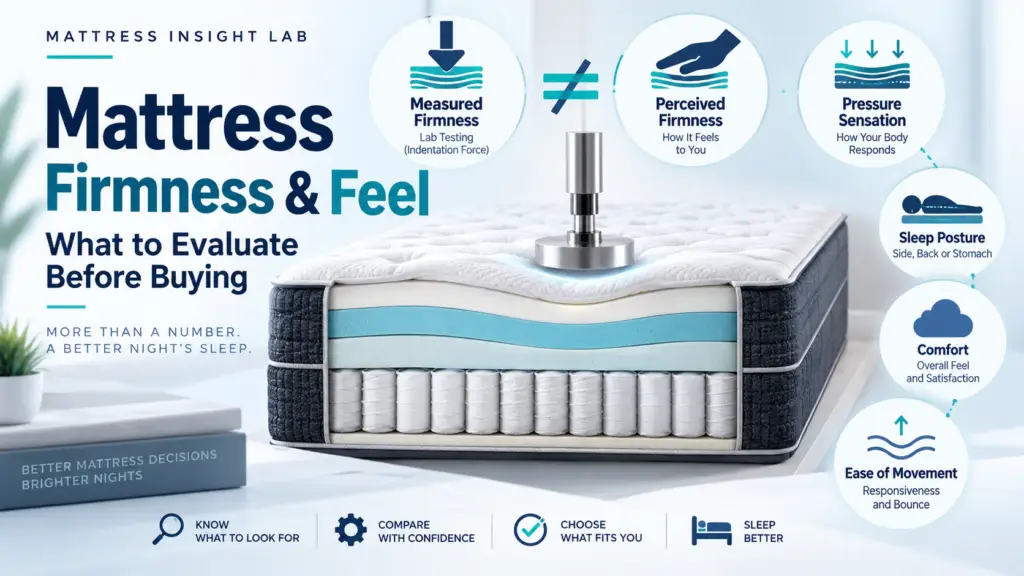
Firmness is a measurable mattress characteristic, but it is only one input into mattress evaluation. Before buying, evaluate measured firmness, your own perceived firmness, comfort, pressure sensation, posture-specific response, body interaction, and ease of movement — without treating any single label or first impression as proof of complete suitability.
Firmness is not the same as support, comfort, or quality. A mattress can be measurably firm and still feel wrong to you, or feel comfortable in one position and less so in another. This guide explains which firmness and feel characteristics matter, how to interpret them, and how to test them before you commit.
What Do Mattress Firmness and Comfort Feel Actually Describe?
Firmness and comfort feel are related but different concepts. Firmness can be measured as a technical characteristic, but a firmness rating does not demonstrate comfort or quality. Whole-mattress hardness can be determined using standardized test methods, yet the result describes the mattress’s resistance under defined conditions — not whether it will feel right to you.
Three distinct ideas are often collapsed into one: measured firmness, perceived firmness, and comfort feel. Measured firmness is a technical result. Perceived firmness is how firm a mattress feels to a specific person. Overall comfort is a broader subjective judgment, but pressure sensation and ease of movement should still be recorded as separate evaluation signals rather than treated as automatic components of comfort. These are distinct evaluation questions.
What Does a Technical Firmness or Hardness Measurement Describe?
A technical firmness or hardness measurement describes a mattress’s resistance to indentation or load under a defined test method. It is a measurable product characteristic. ISO 23769 specifies methods for determining durability, height loss, and hardness of qualifying adult mattresses at the complete-mattress level. [1] The measurement describes the mattress’s response under the test conditions, not personal comfort preference.
Because a standard method exists, firmness can be discussed as a technical characteristic rather than only a marketing description. But a hardness result does not equal comfort, suitability, pressure relief, medical support, or quality.
What Does Perceived Firmness Describe When a Person Lies on the Mattress?
Perceived firmness is how firm a mattress feels to a specific person lying on it. It is a subjective judgment that can correspond with objective firmness but is not identical to it. In one mattress-comparison study, objective firmness was positively correlated with perceived firmness. Perceived firmness is a human-mattress interaction, not a material number alone.
Because perceived firmness is subjective, personal testing remains relevant even when technical data exist. Perceived firmness is also not the same as comfort, pressure response, or ease of movement — those are separate measured perceptions.
Why Are Firmness, Comfort, and Mattress Quality Separate Evaluation Questions?
Firmness, comfort, and quality are separate evaluation questions. A firmness rating is a defined characteristic, but it cannot demonstrate comfort or quality. EN 1957 includes a firmness-rating method intended to correlate with subjective assessment, yet explicitly states the rating cannot demonstrate comfort or quality. [3]
Firmness is one input, not a proxy for the others. A higher or lower firmness rating does not mean a mattress is better, more comfortable, or higher quality.
How Is Mattress Firmness Measured, and What Are the Limits of Those Measurements?
Mattress firmness can be measured at the whole-mattress level, but foam indentation hardness is a separate material-level measurement. Each has its own scope and limits. Test conditions and system level matter when interpreting any firmness value.
How Do Whole-Mattress Standards Measure Hardness or Firmness?
Whole-mattress standards such as ISO 23769 and EN 1957 specify methods for determining hardness or firmness of complete mattresses. ISO 23769 specifies methods for determining durability, height loss, and hardness of qualifying adult mattresses. [1] EN 1957 includes a firmness-rating method for mattresses and complete beds within its scope. [3] Both operate at the complete-mattress or complete-bed level rather than as foam-layer hardness tests.
Because these standards exist, whole-mattress firmness is a technically measurable characteristic. But a whole-mattress hardness result does not equal comfort, suitability, or quality.
How Does Foam Indentation Hardness Differ From Whole-Mattress Firmness?
Foam indentation hardness is measured under a flexible-cellular-material hardness standard, not a whole-mattress firmness standard. ISO 2439 applies to qualifying flexible cellular materials and finished foam articles and specifies indentation-hardness methods under defined test conditions. [2] Its results must remain tied to the stated method and specimen scope rather than being treated as the complete mattress’s firmness or feel.
Because ISO 2439 is material-level and warns against extending results, a foam layer’s hardness cannot be treated as the complete mattress’s firmness or feel.
Why Must Test Conditions and System Level Be Preserved When Interpreting a Firmness Number?
A firmness number only has meaning within its test method and system level. A flexible-foam indentation-hardness number and a whole-mattress firmness rating are not interchangeable. ISO 2439 is a flexible-cellular-material hardness standard applicable to qualifying foam materials and finished foam articles; it is not a whole-mattress firmness standard. [2] ISO 23769 and EN 1957 operate at the complete-mattress or complete-bed level within their respective scopes. [1] [3] The system level, specimen, and test conditions define what the number describes.
What Can a Firmness Measurement Not Establish About Personal Comfort?
A firmness measurement cannot establish personal comfort, quality, suitability, or an ideal firmness for a particular sleeper. EN 1957 explicitly states its firmness rating cannot demonstrate comfort or quality. [3] [3] Firmness is one input into evaluation, not a substitute for a broader fit assessment.
How Should You Interpret Soft, Medium, Medium-Firm, and Firm Labels?
Soft, medium, medium-firm, and firm labels are descriptive terms, but the reviewed evidence does not establish universal numerical thresholds across all brands and constructions. When a manufacturer uses its own soft-to-firm scale, those labels should be interpreted within that rating system unless comparable standardized test information is provided.
Is the Label Based on a Defined Firmness Test or a Brand-Specific Rating System?
A firmness label may be based on a defined test method or a brand-specific rating system. The reader should identify which one produced the label. Formal firmness methods exist, but the reviewed sources do not establish one universal consumer-label threshold system applying to all brands and constructions.
What Does the Label Tell You About Relative Firmness Within the Product Range?
When a manufacturer uses its own rating system, a label can indicate relative firmness within that system, but it should not automatically be treated as an absolute value comparable across brands. The reviewed sources do not establish one universal consumer-label threshold system. A “medium” from one brand should not automatically be assumed equivalent to a “medium” from another.
What Does a Soft, Medium, or Firm Label Not Prove About Comfort or Quality?
A soft, medium, or firm label does not prove comfort, quality, or suitability for a particular sleeper. EN 1957 explicitly states its firmness rating cannot demonstrate comfort or quality. [3] A label is a description, not a quality verdict.
When Should an Objective Firmness Claim Be Checked Against Supporting Test Information?
An objective firmness claim should be checked against supporting test information when the claim is presented as a measurable fact rather than a subjective description. FTC guidance states advertisers must possess a reasonable basis — objective evidence appropriate to the claim — for objective advertising claims before making them. [7] Not every subjective feel descriptor is a laboratory claim, but objective claims require evidence appropriate to what is asserted.
How Closely Does Measured Firmness Match the Firmness a Sleeper Actually Feels?
Measured firmness can correspond with perceived firmness, but the relationship is not a simple identity. Perceived firmness is a human-mattress interaction, and comfort, pressure, and ease of movement are separate perceptions. Personal testing remains relevant even when technical data exist.
What Relationship Has Research Found Between Objective and Perceived Firmness?
In one mattress-comparison study, objective firmness was positively correlated with perceived firmness. The study compared four mattresses and separately evaluated perceived firmness, comfort, and usability/ease of movement. [4] This finding is limited to the study’s tested mattresses, participants, and short-term protocol.
Why Does Perceived Firmness Remain a Human-Mattress Interaction Rather Than a Material Number Alone?
Perceived firmness is how a specific person experiences the mattress, which depends on the interaction between the person and the mattress, not just the material’s properties. Perception involves the sleeper’s body and judgment. Because perception is subjective and person-dependent, personal testing remains relevant.
How Can Perceived Firmness Differ From Overall Comfort?
Perceived firmness and overall comfort are separate perceptions. A mattress can feel firm without being comfortable, or vice versa. The study measured firmness perception, comfort, and other variables as distinct outcomes. [4] They are related but not interchangeable.
Why Should Ease of Rolling Be Evaluated Separately From Firmness Perception?
Ease of rolling is a separate measured perception from firmness. A mattress’s firmness does not by itself determine how easy it is to roll and reposition. The study measured ease of movement/rolling as a distinct outcome alongside firmness perception and comfort. [4]
How Does Sleep Posture Change What You Should Evaluate About Firmness and Feel?
Sleep posture changes how a mattress responds to your body. Firmness effects on pressure and comfort can vary by posture and body region, but this does not create a universal firmness rule for any sleep position. Evaluate the mattress in the postures relevant to you.
How Can Pressure Distribution Change Between Supine and Side-Lying Positions?
Pressure distribution can change between supine and side-lying positions, and the effect of firmness on pressure can differ by posture. In the tested mattresses, firmness changed interface-pressure outcomes in region- and posture-specific ways in supine and lateral positions. [6] These findings are specific to the study’s tested mattresses and participants.
Why Can Different Body Regions Respond Differently to the Same Mattress Firmness?
Different body regions can respond differently to the same mattress firmness. A firmness level that feels acceptable in one region may not feel the same in another. Research found firmness-related pressure effects varied by region and posture, while a separate four-mattress biomechanical study found maximum pressure differed by anatomical region. [6] [5]
Why Does Posture-Specific Evidence Not Automatically Create a Universal Side-Sleeper or Back-Sleeper Firmness Rule?
The supplied verified evidence does not establish a universal firmness prescription for any sleep position. Posture is an evaluation variable. Firmness effects on pressure and comfort can vary by posture and body region in the tested mattresses. But the evidence does not establish that all side sleepers need one firmness, all back sleepers need another, and so on.
Evidence boundary: Fixed rules such as “side sleepers need soft” or “stomach sleepers need firm” are not supported by the verified evidence. Treat posture as an evaluation variable, not a firmness prescription.
Which Normal Sleeping Postures Should Be Included in Personal Testing?
Test the mattress in the sleeping postures you actually use. If you change positions during the night, test those positions too. Because posture changes mattress-body interaction, testing only one position may miss how the mattress feels in your normal positions.
How Can Body Size and Body Shape Change Mattress Firmness Perception and Response?
The reviewed studies more directly establish differences related to weight, BMI, posture, and anatomical region than they establish a specific body-shape-to-firmness relationship. Body weight alone does not establish the correct firmness category, and this evidence should not be converted into a universal body-shape rule.
What Has Research Found About Body Mass and Sensitivity to Firmness Changes?
Research has observed relationships involving BMI and sensitivity to firmness changes, but these findings are study-specific. In one mattress-comparison study, the authors reported a weak relationship between higher BMI and sensitivity to changes in objective firmness. [4] That finding was specific to its participants and tested mattresses and should not be converted into a universal body-size-to-firmness rule.
How Can Participant Weight Affect Mattress Interface Pressure?
Participant weight can affect mattress interface pressure, and the effect can vary by body region. In a biomechanical comparison of four mattresses, maximum pressure differed with weight group and anatomical region. [5] Weight can influence measured mattress-body interaction, but that finding does not determine a correct firmness category.
Why Can Body Region and Body Build Matter in Addition to Total Weight?
Anatomical region and weight group can matter in addition to a single overall body-weight number. The four-mattress biomechanical study found pressure differences by both anatomical region and weight group, while the firmness-perception study reported only a weak BMI-related firmness-sensitivity relationship. [5] [4] These findings do not directly establish a body-shape-specific firmness rule.
Why Does Body Weight Alone Not Establish the Correct Firmness Category?
The supplied verified evidence does not establish that body weight alone determines the correct mattress firmness. Body weight, body region, mattress construction, and posture can influence measured mattress-body interaction. But the observed relationships are study-specific and do not establish a universal weight-to-firmness rule.
Evidence boundary: The claim that heavier sleepers inherently need greater firmness — or that lighter sleepers inherently need softer mattresses — is not supported by the verified evidence. Treat body weight as one interaction variable, not a firmness prescription.
Which Feel Signals Should You Evaluate Alongside Firmness?
Firmness is only one feel signal. Evaluate surface compression, pressure sensation at high-contact regions, ease of rolling, and whether your comfort judgment matches your firmness judgment. These are separate evaluation dimensions.
How Much Surface Compression or Sink Do You Perceive in Your Normal Position?
Observe how much surface compression or sink you perceive in your normal sleeping position. This is a descriptive observation, not a diagnostic test. Sink is part of how a mattress feels, but the evidence does not establish that more sink is bad or less sink is good without defining the outcome and sleeper context.
How Does the Mattress Feel at High-Contact Body Regions?
Notice how the mattress feels at high-contact body regions such as shoulders and hips. Regional response can differ from overall firmness. Research found firmness-related pressure effects varied by region and posture, and a separate study found pressure differed by anatomical region. [6] [5]
How Easy or Difficult Is It to Roll and Reposition?
Evaluate how easy or difficult it is to roll and reposition on the mattress. This is a separate perception from firmness. The study measured ease of movement/rolling as a distinct outcome alongside firmness perception and comfort. [4]
Does Your Overall Comfort Judgment Match Your Firmness Judgment?
Compare your overall comfort judgment with your firmness judgment. They are separate perceptions and may not match. Research measured comfort and firmness perception as distinct outcomes, and the 2026 posture-specific study found weak pressure-comfort associations in some regions. [4] [6]
How Should Pressure Response, Body Position, and Firmness Be Evaluated Together?
Pressure response, body position, and firmness must be evaluated together, but no single signal is the complete fit test. Lower pressure is not automatically greater comfort, and body-position response should be considered separately from surface firmness.
Why Is Lower Pressure Not Automatically Equal to Greater Overall Comfort?
Lower pressure is not automatically equal to greater overall comfort. Pressure and comfort are related but distinct outcomes. The 2026 posture- and region-specific study found weak pressure-comfort associations in some regions. [6] A mattress with lower measured pressure is not automatically more comfortable.
Why Should Body-Position Response Be Considered Separately From Surface Firmness?
Body-position response should be considered separately from surface firmness because the same mattress can respond differently in different positions. Research has found posture-specific pressure effects, and the four-mattress biomechanical study separately evaluated supine pressure and side-posture spinal distortion. [6] [5]
Why Can Regional Pressure Responses Matter More Than a Single Whole-Body Pressure Number?
Regional pressure responses can matter more than a single whole-body pressure number because different body regions can respond differently to the same mattress. Research found firmness-related pressure effects varied by region, and a separate study found pressure differed by anatomical region. [6] [5] A single summary number may hide important regional differences.
What Should Remain Unresolved Until You Test the Complete Mattress With Your Own Body?
The supplied verified evidence does not establish a universal optimal firmness or a universal rule for any sleeper type. What remains unresolved is how a specific mattress will feel to you in your normal positions and movements. Personal testing can provide information about perceived firmness, comfort, pressure sensation, and ease of movement that technical labels alone do not capture. Technical measurements can inform the decision, but they do not directly predict an individual’s complete subjective experience.
What Should You Verify Before Relying on a Firmness or Feel Claim?
Before relying on a firmness or feel claim, verify what system level it describes, which test method produced it, whether it describes measured firmness or subjective feel, and whether comfort or quality is being inferred without separate evidence.
Is the Claim About a Foam Layer, a Mattress Component, or the Complete Mattress?
Determine whether the claim is about a foam layer, a mattress component, or the complete mattress. The system level changes what the claim can mean. ISO 2439 is a flexible-cellular-material hardness standard applicable to qualifying foam materials and finished foam articles; it is not a whole-mattress firmness standard. [2] ISO 23769 and EN 1957 operate at the complete-mattress or complete-bed level within their scopes. [1] [3] A foam-layer hardness claim is not a complete-mattress firmness claim.
Which Test Method or Rating System Produced the Firmness Value?
Identify which test method or rating system produced the firmness value. The method defines what the number means. Different standards measure different things at different system levels. A firmness value is not meaningful without knowing its method.
Does the Claim Describe Measured Firmness or Subjective Feel?
Determine whether the claim describes measured firmness or subjective feel. They are related but distinct. Research found objective firmness can correspond with perceived firmness, but they are separate outcomes. [4] A subjective feel descriptor is not a measured fact.
Is a Comfort, Support, or Quality Conclusion Being Inferred From Firmness Without Separate Evidence?
Check whether a comfort, support, or quality conclusion is being inferred from firmness without separate evidence. Firmness alone does not establish those outcomes. EN 1957 explicitly states its firmness rating cannot demonstrate comfort or quality.
Is an Objective Performance Claim Supported by Appropriate Evidence?
An objective performance claim should be supported by evidence appropriate to the claim being made. FTC guidance states advertisers must possess a reasonable basis — objective evidence appropriate to the claim — for objective advertising claims before making them. [7] One test does not substantiate every mattress-performance statement.
How Should You Test Mattress Firmness and Feel Before Committing?
Test the mattress in the postures you actually use, compare perceived firmness with pressure sensation and overall comfort, include rolling and repositioning, and recheck whether the same feel remains acceptable across your relevant positions. Do not treat one short showroom impression as proof of long-term suitability.
Test the Mattress in the Sleeping Postures You Actually Use
Test the mattress in the sleeping postures you actually use. If you change positions, test those positions too. Because posture changes mattress-body interaction, testing only one position may miss how the mattress feels in your normal positions.
Compare Perceived Firmness With Pressure Sensation and Overall Comfort
Compare your perceived firmness with your pressure sensation and overall comfort. They are separate perceptions that may not match. Research measured firmness perception and comfort as distinct outcomes, while the 2026 study found weak pressure-comfort associations in some regions. [4] [6]
Include Rolling and Repositioning Instead of Testing Only While Motionless
Include rolling and repositioning in your testing instead of testing only while motionless. Ease of movement is a separate perception from firmness. Research measured ease of movement/rolling as a distinct outcome alongside firmness perception and comfort. [4]
Recheck Whether the Same Feel Remains Acceptable Across Your Relevant Positions
Recheck whether the same feel remains acceptable across your relevant positions. A mattress that feels good in one position may not feel the same in another. Research found posture-specific pressure effects, while a separate biomechanical study evaluated supine pressure and side-posture spinal distortion. [6] [5]
Avoid Treating One Short Showroom Impression as Proof of Long-Term Suitability
The supplied verified evidence does not establish a universal minimum testing duration that guarantees long-term suitability. A short showroom impression is useful for evaluating immediate feel signals, but it does not prove long-term suitability. The evidence does not establish how long a shopper must test a mattress before firmness and feel can be judged reliably.
Practical takeaway: Use short testing to compare immediate feel signals across your normal postures and movements. Do not treat a brief impression as proof of how the mattress will feel over months of use.
Sources and References
- ISO 23769:2021 — Furniture — Mattresses — Test methods for the determination of functional characteristics. ISO.
- ISO 2439:2008 — Flexible cellular polymeric materials — Determination of hardness (indentation technique). ISO.
- NEN-EN 1957:2012 — Furniture — Beds and mattresses — Test methods for the determination of functional characteristics and assessment criteria. NEN.
- Objective firmness, average pressure and subjective perception in mattresses for the elderly. PubMed.
- Biomechanical evaluation of four different mattresses. PubMed.
- A region and posture specific analysis of effects on pressure distribution and perceived comfort. ScienceDirect.
- Advertising FAQ’s: A Guide for Small Business. Federal Trade Commission.