Why Durability and Sagging Risk Matter Before Buying a Mattress
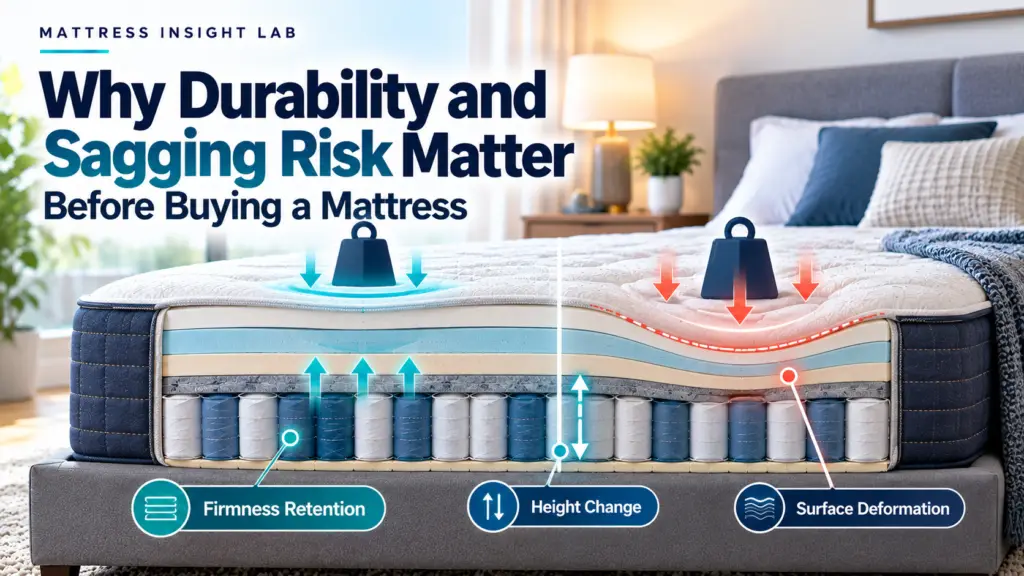
Durability and sagging risk matter because they describe The reviewed evidence does not establish a mattress retains its measured performance properties — firmness, height, surface condition, and structural integrity — under repeated loading and environmental exposure. These are not the same as mattress age, and they are not established by construction type, foam density, body weight, warranty length, or a single indentation threshold.
Before buying, the useful question is not “how many years will this last” but “which property changed, how was it measured, what was tested, and under what conditions” That framing matches how durability is actually evaluated in standards and laboratory work, and it protects you from marketing adjectives that carry no measurement behind them.
What Does Mattress Durability Actually Mean?
Mattress durability refers to how well a mattress retains specific measured properties under defined repeated-use or laboratory conditions — not simply how many years it has been owned. ASTM F1566 provides separate mattress/mattress-set methods for firmness, firmness retention, durability, impact effects, and height change, while EN 1957 separately evaluates durability, hardness/firmness-related characteristics, height loss, and bed-edge durability. [1] [3] Neither standard converts those measurements into one universal age-based lifespan number.
The properties that can change include firmness response, overall height, surface condition after unloading, and the integrity of internal components. A mattress can lose part of its firmness response without developing a large visible dip, and it can develop a visible dip without a corresponding change in component integrity. Treating “durability” as one thing hides those distinctions.
Why Is Mattress Age Not the Same as Measured Durability?
Age is a time measure; durability testing evaluates property change under a defined method. ASTM F1566 uses specific mattress or mattress-set measurements rather than elapsed ownership time. [1] A product’s age therefore does not by itself report firmness retention, height change, impact response, or other measured durability outcomes.
What Is Firmness Retention?
Firmness retention is a separate measurement of how a mattress’s firmness response changes after defined loading. ASTM F1566 lists firmness retention separately from durability, impact effects, and height change. [1] That separation is why visible dimensions and force-response change should not be treated as interchangeable measurements.
What Is Height Change or Height Loss?
Height change is a separate dimensional measurement after defined loading. ASTM F1566 lists height change as a distinct mattress/mattress-set method, and EN 1957 determines height loss after its durability procedure. [1] [3] Height change is therefore one measured property rather than a universal synonym for sagging.
What Is Permanent Surface Deformation?
Permanent surface deformation is unloaded surface displacement that persists after recovery — one possible durability outcome among several. Warranty thresholds reference visible unloaded indentation as one contractual measure. Firmness loss and general softening are other outcomes that can occur without it.
How Can Component Damage Be Different From Surface Softening?
Component damage — for example, a spring or structural failure — is a different outcome from surface softening, which is a change in comfort-layer response. ASTM F1566 evaluates components and finished mattresses through separate methods. Different system levels produce different failure modes, and softening does not automatically indicate component damage.
Why Should Long-Term Performance Be Described by the Property That Changed?
Because different properties are measured separately and can change independently. ASTM F1566 separates firmness, firmness retention, durability, impact effects, and height change. Property-specific description matches the measurement structure, and it lets you compare claims that are actually comparable.
Are Sagging, Body Impressions, Softening, and Firmness Loss the Same Thing?
Sagging, body impressions, softening, and firmness loss are often used interchangeably, but they describe different outcomes — and only some are measured or contractually defined. ASTM F1566 separates measured properties, and manufacturer warranties such as Purple’s separate localized firmness change from covered indentation. Using “sagging” as a catch-all term hides which property actually changed.
| Term | What it describes | How it is defined |
|---|---|---|
| Visible unloaded indentation | Surface displacement that persists when no load is applied | Contractual measure used by some warranties with brand-specific thresholds |
| Body impression | Visible surface depression associated with use | Warranty-scoped term with brand-specific thresholds |
| Localized firmness change | Change in firmness response in a specific area | May occur without a large visible indentation; excluded by some warranties |
| General material softening | Broad change in comfort-layer response | Often distinguished from a covered defect |
| Height loss | Dimensional change after defined loading | Measured separately in ASTM F1566 and EN 1957 |
| Component damage | Structural or spring failure | Different system level from surface change |
What Is a Visible Unloaded Indentation?
A visible unloaded indentation is surface displacement that persists when no load is applied — one contractual measure used by some warranties. Purple currently covers visible indentation greater than 1 inch compared with surrounding areas after full recovery from load. [11] That threshold is Purple-specific and contractual, not a universal engineering definition of sagging.
What Is a Body Impression?
A body impression is a visible surface depression associated with use — a term used in some warranties with brand-specific thresholds. Saatva currently covers body impressions greater than 1.5 inches. [12] The threshold belongs to Saatva’s warranty rather than serving as a universal technical definition.
What Is Localized Firmness Change?
Localized firmness change is a change in firmness response in a specific area without necessarily producing a large visible indentation. Purple currently lists localized firmness changes as normal and not covered under its limited warranty. [11] Firmness change and visible indentation are therefore different warranty concepts.
What Is General Material Softening?
General material softening is a broad change in comfort-layer response that can be distinguished from a covered indentation defect. Tempur-Pedic’s current care guidance notes that some increase in TEMPUR material softness over time is normal, while its warranty guidance uses defined indentation thresholds for qualifying defects. [10] [13]
Why Can a Mattress Feel Different Without Showing a Warranty-Qualifying Indentation?
Because firmness change and softening are separate outcomes from unloaded indentation, and warranties may exclude them. Purple excludes localized firmness change and comfort-preference change. Warranty coverage and physical change are separate questions, so the absence of a qualifying indentation does not mean nothing changed.
Why Should “sagging” Not Be Used as a Catch-All Term for Every Long-Term Change?
Because it conflates distinct outcomes — indentation, firmness loss, softening, height loss, and component damage. Warranty thresholds vary by brand and construction. Precise terminology matches the measurement structure and lets you compare claims that are actually comparable.
How Is Finished-Mattress Durability Tested Under ASTM F1566?
ASTM F1566 provides recognized methods for mattress components, finished mattresses, and mattress sets. Its mattress/mattress-set methods include firmness, firmness retention, durability, impact effects, and height change, and ASTM states that the resulting data are intended for comparative analysis with no pass/fail criteria applicable. [1] That makes F1566 useful for defined comparative measurements, not a universal lifespan certification.
Which Mattress Properties Does ASTM F1566 Evaluate?
Firmness, firmness retention, durability, impact effects, and height change are listed as separate mattress/mattress-set measurements in ASTM F1566. [1] The methods can be used separately or in combination; the standard does not collapse them into one universal durability score.
How Are Durability and Firmness Retention Treated Separately?
They are distinct measurements in F1566. The standard lists them as separate methods. Separate methods measure separate properties, so a result in one does not establish a result in the other.
Why Is Height Change a Separate Measurement?
Because dimensional change is a distinct outcome from firmness change. F1566 lists height change as a separate method. Dimensional and mechanical changes are measured separately, so height change does not equal firmness loss.
Why Are Results Intended for Comparative Analysis?
ASTM states that F1566 data are for comparative analysis and that no pass/fail criteria are applicable. [1] A comparative result should therefore not be presented as an absolute lifespan certification.
Why Does ASTM F1566 Not Give Every Mattress a Universal Pass/Fail Lifespan?
Because the standard produces comparative data and does not define a universal acceptance criterion. Comparative data is not a universal threshold, so an F1566 result does not mean “pass” or “durable” in an absolute sense.
What Does EN 1957 Add to Mattress Durability Evaluation?
EN 1957 specifies durability and hardness testing for mattresses and fully erected beds with mattresses, including height loss, load/deflection characteristics, firmness rating, and bed-edge durability. Its sequence includes 29,900 main durability cycles and 4,900 bed-edge cycles after initial conditioning/measurement steps. [3] The standard explicitly excludes ageing and degradation caused by air, light, humidity, and temperature, and states that results apply to the tested article unless representativeness is demonstrated.
How Does EN 1957 Evaluate Mattress Durability?
Through durability and hardness evaluation, including height loss and bed-edge durability. EN 1957 is a distinct standard from ASTM F1566 with a different scope, so the two should not be treated as interchangeable.
How Is Height Loss Determined After the Durability Procedure?
Height loss is measured after the durability procedure. It is a post-procedure measurement, and it is one measured property rather than a synonym for sagging.
How Does the Standard Evaluate Hardness or Firmness Characteristics?
Through load/deflection characteristics and firmness rating. Hardness/firmness is a measured property, not a comfort judgment.
How Does It Treat Bed-Edge Durability?
EN 1957 includes bed-edge durability as part of its evaluation. Edge durability is a distinct measured property, and it does not equal whole-mattress durability.
Which Environmental Ageing Mechanisms Are Outside Its Scope?
Ageing from air, light, humidity, and temperature is outside EN 1957’s scope. Environmental ageing is a separate consideration, so EN 1957 results do not cover all ageing.
Why Are Results Limited to the Article Tested?
Because EN 1957 states results are valid for the tested article. Article-specific results do not generalize, so EN 1957 results do not apply to all mattresses.
Why Does Firmness Retention Matter Even When No Large Dip Is Visible?
Firmness retention matters because a mattress can lose part of its load-bearing response without producing a large visible depression. ASTM F1566 separates firmness retention from other measurements, ASTM D3574 tests foam materials at the material level, and cyclic-fatigue studies measure IFD and thickness changes separately. A “no visible sag” claim does not establish that mechanical response is unchanged.
How Can Repeated Loading Change Force–Deflection Response?
Repeated loading can change the force–deflection response of foam materials, measurable as IFD change. A cyclic-fatigue study measured IFD before and after loading. Force–deflection response is a measurable property, and it is separate from visible sag.
Why Can Foam Lose Part of Its Load-Bearing Response Without Producing a Large Visible Depression?
Because firmness change and thickness change are measured separately. The cyclic-fatigue study measured IFD and thickness separately. Separate measurements can change independently, so no visible dip does not mean no change.
Why Are Thickness Change and Firmness Change Measured Separately?
Because they are distinct properties that can change independently. ASTM F1566 and the cyclic-fatigue study measure them separately. Separate measurements reflect separate properties, so thickness change does not equal firmness change.
Why Should a “no visible sag” claim Not Be Treated as Proof That Mechanical Response Is Unchanged?
Because firmness retention is measured separately from visible deformation. ASTM F1566 separates firmness retention from other measurements. The absence of visible sag does not establish firmness retention, so visual inspection has limits.
How Does Flexible Polyurethane Foam Fatigue Under Repeated Loading?
Flexible polyurethane foam can show measurable changes in IFD firmness and thickness after repeated cyclic loading. In the 2019 study, six polyether PU foams were evaluated after 8,000 and 80,000 fatigue cycles, and the magnitude of IFD loss depended on foam category and density; visual deformation was generally not observed. [4] ASTM D3574 is a material-level standard and explicitly limits interpretation to the conditions of the particular test. [2] Foam-sample fatigue is therefore not a direct mattress-lifespan measurement.
What Changes Can Be Measured Before and After Cyclic Loading?
The 2019 cyclic-fatigue study measured IFD and thickness before and after repeated loading, allowing force-response change and dimensional change to be tracked separately. [4]
How Can IFD Firmness Change After Repeated Compression?
IFD changed measurably after repeated compression in the tested foams. [4] IFD is a material-level force-response measurement and should not be relabeled as product-level sagging.
How Can Foam Thickness Change?
Thickness change was also measured after cyclic loading in the study. [4] Thickness and IFD are separate properties, so dimensional change should not be treated as identical to firmness loss.
Why Does Foam Formulation Matter Alongside Density?
Because fatigue behavior depends on formulation, hard-segment structure, and category — not density alone. The cyclic-fatigue study found category-dependent density effects, and ageing research identifies formulation dependence. Multiple factors contribute to fatigue, so density alone does not predict it.
How Can Temperature and Humidity Affect Ageing Behavior?
Accelerated temperature/humidity ageing has changed compression-related properties in tested mattress PU foams. One mattress-foam study exposed samples to 50°C and 95% relative humidity and documented changes in surface firmness, hysteresis loss, and resistance to bottoming out over the accelerated-weathering intervals. [5] Other PU work also reports conditioning-related mechanical changes. [6] These accelerated conditions should not be converted directly into a consumer lifespan number.
Why Does a Foam-Sample Fatigue Test Not Equal the Lifespan of a Complete Mattress?
Because material tests apply to the tested conditions and are not necessarily equivalent to other use environments. ASTM D3574 explicitly notes this limitation. Material-level evidence does not propagate to product-level outcomes, so a foam test does not predict mattress lifespan.
Does Higher Foam Density Automatically Mean Better Mattress Durability?
Higher foam density does not automatically mean better mattress durability. In the tested foams, density effects depended on foam category and formulation. Density can be reported as a material specification, but it does not establish mattress lifespan.
What Happened to Fatigue Loss as Density Increased in the Tested Normal Foams?
Among the tested normal foams, increasing density from 14 to 28 kg/m³ reduced 25% IFD loss from 30.7% to 21.5% after the study’s fatigue loading. [4] That finding is category-specific and should not be converted into a universal mattress-durability rule.
Why Did the Soft-Foam Group Not Follow the Same Simple Pattern?
The tested soft-foam group did not follow the same simple trend: increasing density from 24 to 32 kg/m³ was associated with an insignificant increase in 25% IFD loss from 20% to 23.6%. [4] Density alone therefore did not predict the fatigue response across both foam categories.
Why Are Density and Firmness Different Material Properties?
Density is mass per unit volume; firmness is a mechanical response. They are distinct properties. ASTM D3574 tests material properties separately, so density does not equal firmness.
Why Can Formulation and Foam Category Alter the Density–Fatigue Relationship?
Because fatigue depends on formulation, hard-segment structure, and category. The 2019 study and ageing research support this. Multiple factors contribute, so density alone does not determine fatigue.
Why Should Density Be Used as One Specification Rather Than a Standalone Lifespan Score?
Density can be reported as a material specification, but it does not establish mattress lifespan. The density-to-lifespan relationship is not established by the supplied evidence. Specification is not lifespan prediction, so higher density does not mean longer life.
Why Must Material Tests Be Separated From Complete-Mattress Durability?
Material tests and complete-mattress tests operate at different system levels and cannot be substituted for one another. ASTM D3574 tests flexible polyurethane foam materials, while ASTM F1566 tests finished mattresses and mattress sets. A material specification is not a mattress-lifespan guarantee.
What Does ASTM D3574 Test?
ASTM D3574-25 provides standardized test methods for slab, bonded, and molded flexible polyurethane foams. [2] ASTM explicitly states that results apply to the material under the conditions of the particular test and are not necessarily the same as in other use environments.
What Does ASTM F1566 Test at the Finished-Mattress Level?
Finished mattresses and mattress sets, including firmness, firmness retention, durability, impact effects, and height change. ASTM F1566-14(2021) is a finished-product standard. It tests finished mattresses, not foam materials.
Why Can a High-Performing Foam Still Be Part of a Poorly Performing Complete Mattress?
Because complete-mattress behavior depends on the assembly, not on one material alone. ASTM D3574 explicitly notes material-test results are not necessarily equivalent to other use environments. Material-level evidence does not propagate upward, so good foam does not mean good mattress.
Why Can Adhesives, Layer Architecture, Springs, Textiles, Quilting, and Perimeter Components Alter Whole-Product Behavior?
Because durability is a system outcome influenced by multiple components and their interaction. ASTM F1566 evaluates finished mattresses as systems. System-level outcomes depend on multiple components, so one component does not determine durability.
Why Should a Material Specification Not Be Presented as a Mattress-Lifespan Guarantee?
Because material tests apply to the tested conditions and are not necessarily equivalent to other use environments. ASTM D3574’s scope statement supports this. Material scope is not product scope, so a specification is not a lifespan guarantee.
Can Mattress Construction Type Predict Which Mattress Will Sag First?
The reviewed evidence does not establish a universal durability ranking across mattress construction families. The reviewed standards test products and components rather than assigning durability rank by taxonomy. A valid construction ranking would require representative standardized complete-mattress testing across controlled construction families.
Why Does “All Foam” Not Specify One Durability Profile?
The reviewed evidence does not establish that “all foam” corresponds to one durability profile. “All foam” is a broad label that can contain different materials, formulations, densities, and layer structures. Whether “all foam” construction corresponds to a single durability profile; representative standardized complete-mattress testing across controlled all-foam constructions would be needed to establish it.
Why Does “Hybrid” Not Establish One Sagging Risk?
The reviewed evidence does not establish that “hybrid” corresponds to one sagging risk. “Hybrid” is a broad label that can contain different core architectures, comfort layers, and perimeter designs. The reviewed evidence does not establish “hybrid” construction corresponds to a single sagging risk; representative standardized complete-mattress testing across controlled hybrid constructions would be needed to establish it.
Why Does “Innerspring” Not Reveal Comfort-Layer Fatigue?
The reviewed evidence does not establish that “innerspring” reveals comfort-layer fatigue. “Innerspring” describes a support-core category, not the comfort-layer materials above it. The reviewed evidence does not establish “innerspring” construction reveals comfort-layer fatigue; representative standardized complete-mattress testing across controlled innerspring constructions would be needed to establish it.
Why Does “Latex” Not Automatically Prove Superior Impression Resistance?
The reviewed evidence does not establish that “latex” automatically proves superior impression resistance. “Latex” is a broad material label that can contain different formulations, densities, and constructions. The reviewed evidence does not establish “latex” construction proves superior impression resistance; representative standardized complete-mattress testing across controlled latex constructions would be needed to establish it.
Why Do Air Chambers and Mechanical Components Require Product-Specific Evaluation?
The reviewed evidence does not establish a universal durability profile for air chambers or mechanical components. Air chambers and mechanical components are product-specific designs that require product-specific evaluation. The reviewed evidence does not establish they share a universal durability profile; representative standardized complete-mattress testing across controlled air-chamber and mechanical-component constructions would be needed to establish it.
What Finished-Product Evidence Would Be Needed for a Valid Construction Ranking?
The reviewed evidence does not establish a valid construction ranking. A valid construction ranking would require representative standardized complete-mattress testing across controlled construction families. Until such evidence exists, no construction ranking should be presented as established.
Does Sleeper Body Weight Determine Mattress Durability?
The reviewed evidence does not establish that body weight determines mattress durability. Applied load affects material stress in the tested foam protocols, but the relationship to real-world mattress lifespan is not established. A body-weight-to-lifespan recommendation would require long-term complete-mattress studies stratified by anthropometry.
Why Does Applied Load Matter to Material Stress?
The reviewed evidence does not establish a body-weight-to-lifespan relationship. Applied load affects material stress in the tested foam protocols. The reviewed evidence does not establish body weight determines mattress durability; long-term complete-mattress studies stratified by anthropometry would be needed to establish it.
Why Does That Not Establish a Universal “Heavier Sleeper = Faster Sagging” Rule?
The reviewed evidence does not establish a universal “heavier sleeper = faster sagging” rule. Laboratory foam studies show that repeated loading can change mechanical properties, but the reviewed evidence does not establish a residential body-weight-to-sagging-rate relationship. Long-term complete-mattress evidence stratified by relevant user/loading conditions would be needed for that kind of prescription.
What Does the Reviewed Polyurethane-Fatigue Experiment Actually Establish?
The verified 2019 experiment compared six polyether PU foams across foam categories/densities and measured changes after 8,000 and 80,000 fatigue cycles. [4] It supports the conclusion that repeated loading can change IFD firmness and thickness under a defined material-level protocol. It does not supply a verified multi-load-magnitude result that can be converted into a sleeper-body-weight rule.
How Can Load Distribution, Mattress Construction, Material Formulation, and Recovery Affect the Result?
The reviewed evidence does not establish a body-weight-to-lifespan relationship. Load distribution, construction, formulation, and recovery are contributing factors identified in the reviewed evidence. The reviewed evidence does not establish body weight determines mattress durability; long-term complete-mattress studies stratified by anthropometry would be needed to establish it.
What Human-Use Evidence Would Be Required to Create a Body-Weight-to-Lifespan Recommendation?
The reviewed evidence does not establish a body-weight-to-lifespan recommendation. Long-term complete-mattress studies stratified by anthropometry would be required. Until such evidence exists, no body-weight-to-lifespan recommendation should be published.
Does Sleep Position Create Predictable Sagging Zones?
The reviewed evidence does not establish that sleep position creates predictable sagging zones. Different sleep positions can concentrate body contact in different regions, but this does not establish a universal sagging pattern. A posture-specific durability hierarchy would require long-term complete-mattress studies stratified by posture.
Can Different Sleep Positions Concentrate Body Contact in Different Regions?
The reviewed evidence does not establish that sleep position creates predictable sagging zones. Different sleep positions can concentrate body contact in different regions. The reviewed evidence does not establish sleep position creates predictable sagging zones; long-term complete-mattress studies stratified by posture would be needed to establish it.
Why Does That Not Establish a Universal Shoulder, Hip, Pelvis, or Lumbar Sagging Pattern?
The reviewed evidence does not establish a universal shoulder, hip, pelvis, or lumbar sagging pattern. Contact concentration is not the same as a validated long-term failure pattern. The reviewed evidence does not establish sleep position creates predictable sagging zones; long-term complete-mattress studies stratified by posture would be needed to establish it.
Why Can Mattress Construction Redistribute Loads Differently?
The reviewed evidence does not establish that sleep position creates predictable sagging zones. Mattress construction can redistribute loads differently. The reviewed evidence does not establish sleep position creates predictable sagging zones; long-term complete-mattress studies stratified by posture would be needed to establish it.
Why Should No Side/Back/Stomach Durability Hierarchy Be Published Without Longitudinal Evidence?
The reviewed evidence does not establish a side/back/stomach durability hierarchy. A posture hierarchy would require longitudinal evidence. Until such evidence exists, no posture-specific durability hierarchy should be published.
Do Couples, Pets, Children, or Mattress Size Predict Faster Wear?
The reviewed evidence does not establish that couples, pets, children, or mattress size predict faster wear. Additional use can increase the number of loading events, but this does not establish a universal durability penalty. A use-pattern durability formula would require long-term complete-mattress studies stratified by sleeper count and use pattern.
Why Can Additional Use Increase the Number of Loading Events?
The reviewed evidence does not establish that additional use predicts faster wear. Additional use can increase the number of loading events. The reviewed evidence does not establish additional use predicts faster wear; long-term complete-mattress studies stratified by sleeper count and use pattern would be needed to establish it.
Why Does That Not Establish a Universal Couple-Versus-Solo Durability Penalty?
The reviewed evidence does not establish a universal couple-versus-solo durability penalty. Additional use is a use-context variable, not a deterministic durability category. The reviewed evidence does not establish couple use predicts faster wear; long-term complete-mattress studies stratified by sleeper count would be needed to establish it.
Why Does a Larger Mattress Not Automatically Distribute Wear More Effectively?
The reviewed evidence does not establish that a larger mattress distributes wear more effectively. Mattress size is a use-context variable, not a durability category. The reviewed evidence does not establish mattress size predicts wear distribution; long-term complete-mattress studies stratified by mattress size would be needed to establish it.
Why Should Pet, Child, Sitting, and Sleeping Patterns Be Treated as Use Context Rather Than Standardized Durability Categories?
The reviewed evidence does not establish these as standardized durability categories. These are use-context variables. The reviewed evidence does not establish use patterns predict durability; long-term complete-mattress studies stratified by use pattern would be needed to establish it.
Why Can Repeated Edge Sitting Create a Different Durability Load From Lying Down?
In the innerspring architecture disclosed by US6568014B1, sitting distributes body weight among relatively few perimeter coils compared with the broader coil-array loading described for lying, and the patent discusses increased edge loads/loading cycles. [7] This is a patent-specific localized loading mechanism, not a universal mattress-edge lifespan estimate.
Why Is a Sitting Load Concentrated Over a Smaller Perimeter Region?
Sitting concentrates load over fewer perimeter components than lying. The patent disclosure describes this. Load concentration is a structural consequence of contact area, and the patent scope is limited to the described innerspring perimeter structures.
How Can Perimeter Components Experience Additional Repeated Load Cycles?
Repeated edge sitting subjects perimeter components to additional load cycles. The patent disclosure describes this. Repeated use adds cycles, and localized loading does not equal whole-mattress failure.
Why Is Edge Wear a Local Durability Question Rather Than Proof of Center-Mattress Failure?
Because edge loading is a localized condition distinct from center-surface loading. The patent disclosure describes this. Localized loading does not equal whole-mattress outcome, so edge wear does not mean center failure.
Why Does Reinforcement Architecture Not Guarantee a Specific Lifespan?
Because the patent discloses structural design, not measured lifespan. The patent scope supports this. Design intention is not measured performance, so a reinforced edge does not guarantee a longer life.
Does Strong Edge Support Guarantee Better Long-Term Durability?
The reviewed evidence does not establish that strong edge support guarantees better long-term durability. Initial edge stiffness is a measured property; edge fatigue resistance is a separate question. A repeated edge durability test would measure edge response after defined loading, but no such test result is supplied here.
What Does Initial Edge Stiffness Tell You?
The reviewed evidence does not establish that initial edge stiffness predicts long-term durability. Initial edge stiffness is a measured property. The reviewed evidence does not establish initial edge stiffness predicts long-term durability; controlled complete-mattress durability testing across edge architectures would be needed to establish it.
What Would a Repeated Edge Durability Test Tell You Instead?
The reviewed evidence does not establish that strong edge support guarantees better long-term durability. A repeated edge durability test would measure edge response after defined loading. The reviewed evidence does not establish strong edge support guarantees better long-term durability; controlled complete-mattress durability testing across edge architectures would be needed to establish it.
Why Can a Reinforced Edge Still Use Materials That Change With Repeated Loading?
The reviewed evidence does not establish that reinforced edges resist fatigue. Reinforced edges can use materials that change with repeated loading. The reviewed evidence does not establish reinforced edges resist fatigue; controlled complete-mattress durability testing across edge architectures would be needed to establish it.
Why Should “Reinforced Edge” Not Be Converted Into a Universal Durability Claim?
The reviewed evidence does not establish that “reinforced edge” predicts durability. “Reinforced edge” describes a design feature, not a measured durability outcome. The reviewed evidence does not establish “reinforced edge” predicts durability; controlled complete-mattress durability testing across edge architectures would be needed to establish it.
Why Does the Foundation or Bed Base Matter to Durability Evaluation?
Mattress warranties can make support-system adequacy part of defect eligibility. Sealy excludes indentation associated with an improper or unsupportive foundation and damage associated with improper frames/foundations, while Tempur-Pedic warranty terms similarly condition coverage on appropriate support. [8] [9] These are contractual conditions; they do not quantify how much deformation a particular unsupported setup will cause.
Why Do Mattress Warranties Specify Acceptable Support Systems?
Because warranties tie qualifying coverage to adequate mattress support. Sealy and Tempur-Pedic warranties support this. Warranty eligibility requires adequate support, and warranty language is not mechanism proof.
Why Can an Inadequate Foundation Affect Warranty Eligibility?
Because warranties may exclude conditions associated with improper or inadequate foundations. Sealy and Tempur-Pedic warranties support this. Warranty eligibility is contractual, and warranty language is not mechanism proof.
Why Should the Foundation Be Inspected When a Mattress Appears Uneven?
Because warranties tie qualifying coverage to adequate support. Sealy and Tempur-Pedic warranties support this. Support compliance is a warranty consideration, and unevenness does not prove foundation failure.
Why Does Warranty Language Not Prove How Much Sagging a Particular Unsupported Configuration Will Cause?
Because warranty language addresses eligibility, not mechanism or magnitude. Sealy and Tempur-Pedic warranties support this. Contractual language is not causal proof, so warranty language does not prove causation.
Why Should Support Requirements Be Taken From the Exact Manufacturer?
Because support requirements vary by manufacturer. Sealy and Tempur-Pedic warranties support this. Manufacturer-specific requirements apply to their products, so one support rule does not fit all.
Do Wide Slat Gaps or Weak Center Support Automatically Cause Sagging?
The reviewed evidence does not establish that wide slat gaps or weak center support automatically cause sagging. Manufacturers specify slat and center-support requirements, and warranty noncompliance is different from measured mattress fatigue. Complete-system testing quantifying slat-spacing-induced deformation would be needed to establish a causal relationship.
What Slat and Center-Support Requirements Does the Exact Mattress Manufacturer Specify?
The reviewed evidence does not establish that wide slat gaps or weak center support automatically cause sagging. Manufacturers specify slat and center-support requirements in their warranties. The reviewed evidence does not establish slat gaps or center support automatically cause sagging; complete-system testing quantifying slat-spacing-induced deformation would be needed to establish it.
Why Can Those Requirements Vary Between Brands?
The reviewed evidence does not establish that wide slat gaps or weak center support automatically cause sagging. Support requirements vary between manufacturers. The reviewed evidence does not establish slat gaps or center support automatically cause sagging; complete-system testing quantifying slat-spacing-induced deformation would be needed to establish it.
Why Is Warranty Noncompliance Different From Measuring Actual Mattress Fatigue?
The reviewed evidence does not establish that warranty noncompliance equals measured fatigue. Warranty noncompliance is a contractual status; fatigue is a measured property change. The reviewed evidence does not establish warranty noncompliance equals measured fatigue; complete-system testing quantifying slat-spacing-induced deformation would be needed to establish it.
What Complete-System Testing Would Be Needed to Quantify Slat-Spacing-Induced Deformation?
The reviewed evidence does not establish that wide slat gaps or weak center support automatically cause sagging. Complete-system testing would be needed to quantify slat-spacing-induced deformation. Until such testing exists, no claim that slat gaps or center support automatically cause sagging should be published.
Are Warranty Indentation Thresholds a Scientific Definition of Sagging?
Warranty indentation thresholds are contractual eligibility rules, not scientific definitions of sagging. Thresholds vary by brand and construction, and each threshold should be quoted only within its exact warranty.
| Brand | Current threshold (as verified) | Scope note |
|---|---|---|
| Purple | Visible indentation greater than 1 inch after full recovery [11] | Purple-specific; localized firmness change and comfort preference are excluded |
| Tempur-Pedic | Non-quilted: >0.75 inch; quilted-top: >1.5 inches [10] | Tempur-Pedic-specific; measured without applied weight or pressure |
| Sealy | Flat top: >0.75 inch; quilted/tufted: >1.5 inches [8] | Sealy-specific; measured without applied weight or pressure |
| Saatva | Body impressions greater than 1.5 inches [12] | Saatva-specific |
What Threshold Does Purple Currently Use?
Purple currently covers a visible indentation greater than 1 inch compared with surrounding areas after full recovery from load. [11] The threshold is Purple-specific.
What Threshold Does Tempur-Pedic Use for Quilted and Non-Quilted Mattresses?
Tempur-Pedic’s current defect guidance uses different unloaded-indentation thresholds: greater than 0.75 inch for non-quilted mattresses and greater than 1.5 inches for quilted-top mattresses. [10] These are Tempur-Pedic warranty thresholds, not universal engineering definitions of sagging.
Why Does Sealy Use Different Thresholds for Quilted/Tufted and Flat-Top Mattresses?
Sealy currently covers visible indentation greater than 0.75 inch for flat-top panel mattresses and greater than 1.5 inches for quilted or tufted mattresses, subject to the warranty’s conditions and exclusions. [8]
What Threshold Does Saatva Currently Use for Body Impressions?
Saatva currently covers body impressions greater than 1.5 inches under its warranty terms. [12] That is a Saatva-specific contractual threshold.
Why Do Different Thresholds Prove That There Is No One Universal Warranty Definition of Sagging?
Because thresholds range from 0.75 to more than 1.5 inches depending on brand and construction. The variation demonstrates policy-specificity. There is no one universal threshold.
Why Should Each Threshold Be Quoted Only Within Its Exact Warranty?
Because each threshold is a contractual term specific to its warranty. Contractual terms are scope-bound. Thresholds are not interchangeable between brands.
Why Can Mattress Feel Change Even When the Warranty Does Not Apply?
Warranty coverage and physical change are separate questions. A mattress can change perceptibly while remaining outside an indentation threshold or an exclusion. Purple excludes localized firmness change and comfort-preference change; Tempur-Pedic distinguishes normal softness change from covered defects. Reading both coverage and exclusions is required for accurate interpretation.
Why Can Localized Firmness Change Be Excluded?
Purple excludes localized firmness change from coverage. The exclusion is contractual. Excluded does not mean harmless; coverage and physical change are separate.
Why Can Normal Softening Be Excluded?
Tempur-Pedic distinguishes normal softness change from covered defects. The exclusion is contractual. Excluded does not mean harmless; coverage and physical change are separate.
Why Is Comfort Preference Usually Different From a Manufacturing Defect?
Purple excludes comfort-preference change from coverage. Preference and defect are distinct categories. A preference change is not a defect.
Why Can a Mattress Change Perceptibly While Still Remaining Outside an Indentation Threshold?
Because firmness change and softening are separate outcomes from unloaded indentation. Purple and Tempur-Pedic warranties support this. Separate outcomes can change independently, so no qualifying indentation does not mean no change.
Why Should Shoppers Read Both Defect Coverage and Exclusions?
Because coverage and exclusions together define what the warranty actually addresses. Full warranty reading is required for accurate interpretation. Coverage alone does not tell the whole story.
Does a Longer Warranty Mean the Mattress Will Last Longer?
The reviewed evidence does not establish that a longer warranty means the mattress will last longer. Warranty length is a contractual duration; it does not establish physical service life. Independent durability testing, not policy duration, would be needed to establish a relationship.
What Does Warranty Length Actually Describe?
The reviewed evidence does not establish that warranty length predicts durability. Warranty length describes the duration of contractual coverage. The reviewed evidence does not establish warranty length predicts durability; independent durability testing, not policy duration, would be needed to establish it.
Why Can Two Warranties of Different Length Cover Different Defects and Remedies?
The reviewed evidence does not establish that warranty length predicts durability. Warranties can differ in covered defects, thresholds, exclusions, remedies, and fees. The reviewed evidence does not establish warranty length predicts durability; independent durability testing, not policy duration, would be needed to establish it.
Why Does a Lifetime Warranty Not Mean Every Performance Characteristic Remains Unchanged for Life?
The reviewed evidence does not establish that a lifetime warranty means unchanged performance. A lifetime warranty describes coverage duration, not physical performance. The reviewed evidence does not establish a lifetime warranty means unchanged performance; independent durability testing, not policy duration, would be needed to establish it.
Why Should Warranty Terms Be Evaluated by Covered Defect, Threshold, Exclusions, Remedy, and Cost Rather Than Duration Alone?
The reviewed evidence does not establish that warranty duration predicts durability. Warranty terms should be evaluated by covered defect, threshold, exclusions, remedy, and cost. The reviewed evidence does not establish warranty duration predicts durability; independent durability testing, not policy duration, would be needed to establish it.
Can a Sleep Trial Verify Mattress Durability?
A consumer sleep trial can provide short-term information about fit, comfort preference, ease of movement, and obvious early problems under the conditions in which the mattress is used. It is not equivalent to standardized long-duration cyclic-fatigue, firmness-retention, height-change, or environmental-ageing testing, so trial duration should not be presented as proof of multi-year durability.
What Can a Trial Reveal About Initial Comfort and Support Fit?
A trial can reveal how the mattress feels and functions for the user during the trial period. That is useful individual-use information, but it is different from standardized durability evidence.
Can a Trial Reveal an Obvious Early Defect or Abnormal Deformation?
It can reveal an obvious problem that appears during the trial period, including visible or functional changes the user notices. An early observation does not establish the mattress’s long-term fatigue or ageing behavior.
Why Can a 90-, 100-, or 365-Night Trial Not Simulate Years of Cyclic Loading?
A return period is a real-use window, not a standardized accelerated-fatigue protocol. ASTM F1566 and EN 1957 use defined laboratory procedures to measure specified durability-related properties. [1] [3] Trial length therefore should not be converted into an equivalent number of durability cycles or years.
Why Should Long-Term Durability Claims Still Require Separate Evidence?
Long-term durability claims should be supported by evidence relevant to the claimed property — for example, complete-mattress durability, firmness-retention, height-change, component, or material-fatigue data — rather than by return-policy duration alone.
Why Should Return Policy and Durability Evidence Be Evaluated Independently?
A return policy defines commercial rights during a stated period. Durability evidence measures physical or mechanical change under a stated method. They answer different questions and should be evaluated separately.
Should Every Mattress Be Rotated to Reduce Sagging?
Rotation guidance varies by product and manufacturer. Tempur-Pedic currently says rotation is optional; Sealy says rotation may be done if desired; Purple says rotation is optional/not necessary for its Purple mattresses; and the currently hosted Intellibed product warranty recommends monthly rotation for the first six months and every six months thereafter. [13] [14] [15] [16] Follow the instructions for the exact mattress.
What Does Tempur-Pedic Currently Say About Rotation?
Tempur-Pedic currently says its mattresses do not require rotation, although some owners choose to rotate them to promote even wear. [13]
What Does Sealy Currently Say?
Sealy’s current care guidance says rotation is not required but may be done if desired. [14]
What Does Purple Say About Purple Mattresses?
Purple’s current care guidance states that Purple mattresses do not need to be flipped and that rotation is optional/not necessary. [15]
How Does the Intellibed Warranty Demonstrate That Another Mattress Can Have a Different Rotation Schedule?
The currently hosted Intellibed product warranty recommends rotating the mattress once a month for the first six months and then once every six months. [16] It is a product-specific schedule and should not be generalized to other mattresses.
Why Should Rotation Guidance Come From the Exact Mattress Manufacturer?
Because rotation guidance varies by manufacturer. Manufacturer-specific guidance applies to their products. One rotation rule does not fit all.
When Should a Mattress Be Flipped?
Flipping depends on the exact mattress design. Follow the manufacturer’s instructions for the exact model. A one-sided mattress should not be flipped unless the manufacturer approves it, and a two-sided mattress should follow its own manufacturer instructions.
Why Should a One-Sided Mattress Not Be Flipped Unless Approved?
Because layer order makes the bottom unsuitable as a sleep surface. Manufacturer care guidance supports this. Design determines appropriate use, so not all modern mattresses should never be flipped.
Why Can Layer Order Make the Bottom Unsuitable as a Sleep Surface?
Because layer order is designed for one orientation. Manufacturer care guidance supports this. Design determines appropriate use, so layer order matters.
Why Should a Two-Sided Mattress Follow Its Own Manufacturer Instructions?
Because two-sided mattresses may have their own flipping guidance. Manufacturer care guidance supports this. Manufacturer-specific guidance applies, so not all modern mattresses should never be flipped.
Why Is “Check the Exact Model” Safer Than a Category-Wide Rule?
Because flipping guidance varies by product. Product-specific guidance applies. One flipping rule does not fit all.
How Should “Durable,” “Sag-Resistant,” or “Heavy-Duty” Mattress Claims Be Verified?
Verify durability claims by asking which property was measured, how it was measured, what was tested, and under what conditions. The claim-audit checklist below turns vague marketing adjectives into specific evidence questions.
Claim-audit checklist
- Was the complete mattress tested, or only one material?
- Which durability method was used — ASTM F1566, EN 1957, ASTM D3574, or another?
- How many loading cycles were applied?
- Which metrics changed — firmness, height, permanent indentation, edge response, or another measure?
- Was the foundation included in the test?
- Were environmental ageing conditions evaluated?
- Is the result comparative, or is it tied to a defined acceptance criterion?
Was the Complete Mattress Tested or Only One Material?
Determine whether the claim rests on material-level or complete-mattress evidence. ASTM D3574 and ASTM F1566 operate at different levels. Evidence level determines claim scope, so a material test does not prove mattress durability.
Which Durability Method Was Used?
Identify the specific test method — for example, ASTM F1566, EN 1957, or ASTM D3574. Method determines scope. Any test does not prove durability; the method matters.
How Many Loading Cycles Were Applied?
Identify the cycle count if reported. Cycle count is part of test scope. Cycle count does not equal years; no fixed conversion exists.
Which Metrics Changed — Firmness, Height, Permanent Indentation, Edge Response, or Another Measure?
Identify the specific measured properties. Property-specific claims require property-specific evidence. Durability is not one metric; it is a set of properties.
Was the Foundation Included in the Test?
Identify whether the test included a foundation or base. Test scope determines claim scope. A mattress test does not necessarily cover the foundation.
Were Environmental Ageing Conditions Evaluated?
Identify whether environmental ageing was included. EN 1957 excludes environmental ageing; ageing studies include it. Environmental scope determines claim scope, so a mechanical test does not cover ageing.
Is the Result Comparative or Tied to a Defined Acceptance Criterion?
Identify whether the result is comparative or tied to a defined criterion. ASTM F1566 is comparative. Result type determines claim type, so comparative data is not pass/fail.
Why Are Customer Reviews Useful as Experience Reports but Not Standardized Fatigue Measurements?
Because reviews are experience reports, not standardized measurements. The reviewed standards and studies support this. Experience reports are not standardized measurements, so reviews do not prove durability.
Sources and References
- ASTM F1566-14(2021) — Standard Test Methods for Evaluation of Innersprings, Boxsprings, Mattresses or Mattress Sets. ASTM record.
- ASTM D3574-25 — Standard Test Methods for Flexible Cellular Materials—Slab, Bonded, and Molded Polyurethane Foams. ASTM record.
- EN 1957:2012 — Furniture — Beds and mattresses — durability and hardness test methods. Standard record.
- Demirel S, Tuna BE. — Evaluation of the cyclic fatigue performance of polyurethane foam in different density and category. ScienceDirect article.
- Scarfato P, Di Maio L, Incarnato L. — Structure and physical-mechanical properties related to comfort of flexible polyurethane foams for mattress and effects of artificial weathering. ScienceDirect article.
- Effect of Conditioning on PU Foam Matrix Materials Properties. PubMed record.
- US6568014B1 — Edge support on a mattress. Google Patents record.
- Sealy — Mattress and Flat Foundation Warranty Information. Manufacturer warranty.
- Tempur-Pedic — Limited Warranty. Manufacturer warranty document.
- Tempur-Pedic — How do I know that my product is defective? Current defect/indentation guidance.
- Purple — Warranty. Manufacturer warranty.
- Saatva — Warranty. Manufacturer warranty.
- Tempur-Pedic — Do I need to rotate or flip my mattress? Manufacturer care guidance.
- Sealy — Do I need to flip or rotate my mattress? Manufacturer care guidance.
- Purple — Do you need to flip the Purple Mattress? Manufacturer care guidance.
- Purple Support — currently hosted Intellibed product warranty. Hosted Intellibed warranty.
Final Synthesis
Mattress durability is best evaluated property by property rather than as a single “years of life” score. Finished-product standards separate firmness, firmness retention, durability, impact effects, height change, hardness/firmness response, and edge durability, while material-level standards and foam-fatigue studies measure different properties under different conditions. A visible dip, firmness loss, thickness change, material softening, and component failure are not interchangeable outcomes.
The reviewed foam evidence supports several narrow conclusions: repeated cyclic loading can change IFD and thickness in tested PU foams; density effects can differ by foam category; environmental conditioning can alter mechanical behavior; and material-level results should not be converted directly into whole-mattress lifespan predictions. The reviewed evidence does not establish a universal construction-family ranking, a body-weight-to-sagging-rate formula, a posture-specific failure map, or a sleeper-count durability penalty.
Warranty thresholds should also remain contractual rather than scientific definitions. Purple, Tempur-Pedic, Sealy, and Saatva use different indentation/body-impression thresholds and exclusions, and support-system compliance can affect eligibility. For a buying decision, prefer clearly identified complete-mattress durability or firmness-retention evidence when available, treat material specifications as supporting evidence, follow the exact product’s support/rotation/flipping instructions, and treat sleep trials as short-term fit and early-problem checks rather than multi-year durability tests.
How Should Durability and Sagging Risk Influence the Final Mattress Decision?
Prioritize measurable long-term evidence over category stereotypes. The decision steps below convert durability into an evidence audit rather than a prediction based on mattress category.
Identify Which Long-Term Property You Actually Want Evidence For
Identify the specific property — firmness retention, height change, indentation, or edge response — you want evidence for. Property-specific evidence matches property-specific concerns. Durability is not one thing; it is a set of properties.
Prefer Complete-Mattress Durability or Firmness-Retention Data When Available
Prefer complete-mattress evidence over material-level evidence. Higher-level evidence matches higher-level claims. Material data does not equal product data.
Treat Material Specifications as Supporting Evidence Rather Than a Lifespan Guarantee
Material specs are supporting evidence, not lifespan guarantees. Material scope is not product scope. A spec does not equal lifespan.
Avoid Universal Construction, Body-Weight, Sleep-Position, and Mattress-Size Durability Rules
Avoid universal rules based on construction, body weight, sleep position, or mattress size. These relationships are not established by the supplied evidence. A “heavier sleepers sag faster” rule is not supported.
Verify the Required Foundation and Support System
Verify the required foundation and support system from the exact manufacturer. Manufacturer-specific requirements apply. Any foundation does not work for every mattress.
Read the Exact Warranty Indentation Threshold and Exclusions
Read the exact warranty indentation threshold and exclusions. Contractual terms are scope-bound. One threshold does not fit all.
Follow Product-Specific Rotation and Flipping Instructions
Follow product-specific rotation and flipping instructions. Manufacturer-specific guidance applies. One care rule does not fit all.
Treat the Sleep Trial as a Fit and Early-Problem Check, Not a Multi-Year Durability Test
Treat the trial as a fit and early-problem check, not a durability test. Trial duration is not durability verification. A trial does not prove durability.
Choose the Mattress With the Clearest Relevant Evidence Rather Than the Strongest “Long-Lasting” Marketing Language
Choose the mattress with the clearest relevant evidence. Evidence beats marketing adjectives. Marketing language does not prove durability.
Bottom line: Durability is a set of measured properties — firmness retention, height change, surface condition, and structural integrity — not a lifespan number. Evaluate claims by asking which property changed, how it was measured, what was tested, and under what conditions. Treat construction type, foam density, body weight, sleep position, warranty length, and trial length as inputs to that audit, not as stand-alone proof of durability.