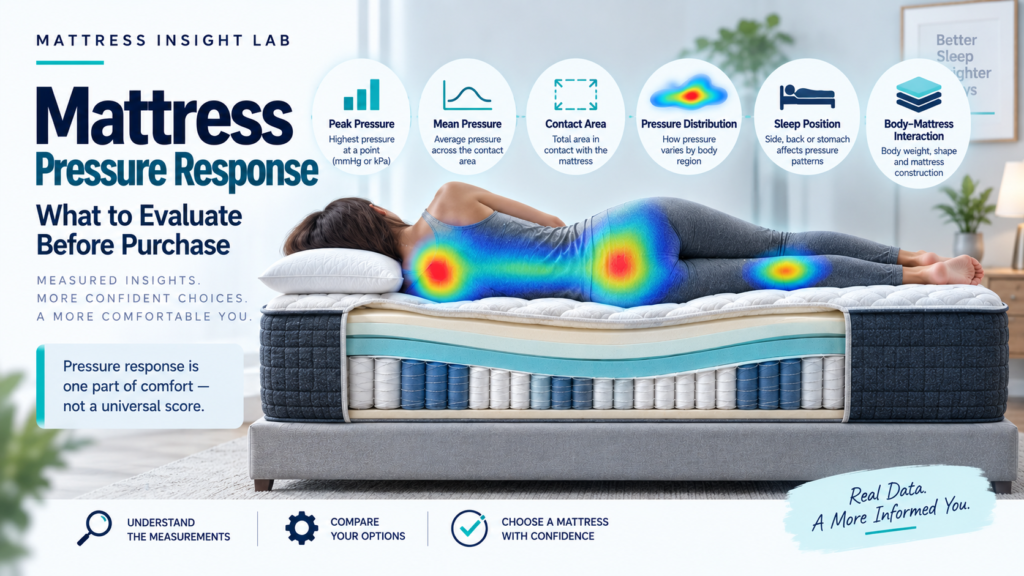
How Pressure Response Affects Mattress Comfort Before Purchase
Mattress pressure response refers to how interface pressure varies across the body–sleep-surface contact region, measured through variables such as peak pressure, mean pressure, contact area, and regional pressure patterns. Research shows pressure can contribute to perceived comfort, but the relationship is partial and individual, not a universal formula.
What Does Mattress Pressure Response Mean in Measurable Terms?
Mattress pressure response is best understood through measurable body–surface interaction variables rather than through marketing terms such as “pressure relief.” When a body lies on a mattress, load is transmitted across the area in contact with the surface. Interface pressure describes normal force divided by area at that interface, while a pressure-sensing mat measures the spatial distribution of local pressure values across the detected contact region. [1]
What Is Interface Pressure Between the Body and Mattress?
Interface pressure is the local normal force divided by area at the body–mattress interface. Pressure is therefore not the same physical quantity as total contact force. A pressure-sensing mat samples local pressure values across the detected contact region and can be used to describe their spatial distribution. [1] The reviewed mattress studies use interface-pressure measurement as a biomechanical research tool, with interpretation limited to each study's participants, surfaces, postures, and sensor conditions.
How Do Peak Pressure, Mean Pressure, Contact Area, and Pressure Distribution Describe Different Parts of the Response?
Peak pressure is the highest measured local pressure. Mean pressure is the average measured pressure over the defined contact region or active sensing area used by the measurement system. Contact area is the area over which contact is detected. Pressure distribution is the spatial pattern of local pressure values across that region. These variables describe different aspects of body–surface interaction and should not be collapsed into a single score.
Why Is Pressure Response More Specific Than Simply Calling a Mattress Soft or Plush?
Softness is a perceived surface descriptor; pressure response is described through measured interface-pressure variables. They are distinct concepts. A surface that feels soft may or may not produce a particular pressure pattern. In the mattress-purchase simulation, average pressure and perceived firmness were measured as separate outcomes. [9]
Why Is “Pressure Response” Best Treated as an Editorial Umbrella Rather Than One Standardized Mattress Measurement?
The supplied verified evidence does not establish that “pressure response” is a formally standardized mattress measurement with one accepted definition. Mattress studies use multiple interface-pressure metrics — peak pressure, mean pressure, contact area, pressure distribution — rather than one standardized consumer “pressure response” score. No applicable standard formally defining the term was identified in the reviewed evidence.
How Closely Is Mattress Pressure Distribution Related to Perceived Comfort?
Research shows pressure can contribute to perceived comfort, but the relationship is not one-to-one. Some studies find partial associations; another found no significant association between peak pressure and comfort. Across the reviewed studies, pressure and comfort do not show a uniform one-to-one relationship.
What Pressure Measures Were Associated With Comfort in the 2024 Smart-Bedding Study?
In a 2024 smart-bedding study of 400 participants, body pressure measures were partially associated with perceived comfort, but pressure and comfort did not always change in parallel after other variables were considered. Sleep posture and individual variables including height, weight, and BMI were also associated with perceived comfort in that study. [2]
Why Did Pressure and Comfort Not Always Change Together?
Comfort is multidimensional. In the 2024 study, pressure was one factor, but posture and individual variables such as height, weight, and BMI also contributed to perceived comfort. After other variables were considered, pressure and comfort did not always change in parallel. This means pressure is not the sole determinant of comfort.
What Did the 1998 Mattress Evaluation Find About Peak Pressure and Subjective Comfort?
In a 1998 study of 12 women, peak body-contact pressure was not significantly associated with subjective comfort ratings across the tested mattresses. Although mattresses were rated more comfortable than a rigid wooden reference, the tested mattress types showed few significant pressure differences, and peak pressure did not track comfort ratings. [8]
Why Should Pressure Be Treated as One Comfort Variable Rather Than the Whole Comfort Experience?
Across the reviewed studies, pressure and comfort do not show a uniform one-to-one relationship. One large smart-bedding experiment found partial pressure–comfort relationships, while an earlier mattress study found no significant association between peak pressure and comfort. Together they argue against a universal pressure-to-comfort formula. Pressure is one contributor and measurement dimension, not a complete comfort predictor.
How Do Body Region and Sleep Position Change Measured Pressure Distribution?
Published experiments document regional and posture-specific differences in interface pressure rather than one fixed set of pressure points for all sleeping positions. The same sleeper can load a mattress differently in different sleep positions.
How Did Pelvic and Thoracic Pressures Differ in a Four-Mattress Study?
In a four-mattress biomechanical study of 18 adult men, maximum supine pressure was higher in the pelvic region than in the thoracic region. The study measured supine pressure across three weight groups on four mattresses. This is a study-specific regional result, not a universal anatomical pressure law. [3]
How Do Pressure Patterns Change Between Supine, Side, and Prone Positions?
In a recent study of 20 participants, body pressure distribution varied across supine, prone, and side positions and across different sleep surfaces. The study also reported interactions involving body region and sex. These findings establish position- and condition-specific variation, not one universal pressure pattern for each sleep posture. [4]
Which Body Regions Were Measured in Recent Position-Specific Pressure Research?
The 20-participant study measured body pressure distribution across different sleep surfaces and positions and reported sex-related regional differences. Its pressure-sensing measurements captured regional variation across the tested conditions. [4]
Why Should a Pressure Pattern From One Sleep Position Not Be Applied Automatically to Another?
Pressure distribution is position-dependent. A pattern measured in one position does not automatically describe another. The 20-participant position study documented variation across supine, prone, and side conditions, while the four-mattress biomechanical study measured supine pressure separately from side-lying spinal distortion. [4] [3]
How Do Body Characteristics Change Mattress Pressure Response?
Weight, anthropometry, posture, and sex-related body differences have all been associated with pressure or comfort variation in specific studies, but the findings do not establish a universal mattress prescription based on one body variable.
What Did the Four-Mattress Study Find About Weight Group and Maximum Pressure?
In the four-mattress biomechanical study, maximum supine pressure differed with weight group. The study tested 18 adult men in three weight groups on four mattresses. This documents an association within the tested sample and mattresses, not a comfort or firmness prescription. [3]
What Has Recent Research Found About Sex-Related Regional Pressure Differences?
In the 20-participant position study, sex-related differences in regional pressure patterns were observed across the tested supine, prone, and side conditions. The study reported interactions involving sleep surface, body region, position, and sex. It does not validate universal sex-specific mattress recommendations. [4]
How Do Height, Weight, and BMI Enter Perceived-Comfort and Pressure Research?
Height, weight, and BMI have been associated with comfort or pressure-related outcomes in specific studies, but they are evaluation variables rather than deterministic mattress rules. The 2024 smart-bedding study reported associations involving height, weight, BMI, posture, pressure, and perceived comfort. [2] In the mattress-purchase simulation, objective firmness and average pressure showed several associations with perceived firmness, comfort, and ease of rolling; higher BMI showed only a weak relationship with sensitivity to objective-firmness changes. [9] The four-mattress study separately found weight-group differences in maximum pressure. [3]
Why Does Individual Variation Prevent a Universal Body-Weight Pressure-Relief Chart?
Individual variation in body build, posture, and other characteristics means no single body variable establishes an ideal mattress pressure profile. In an earlier study of eight hospital mattress surfaces and four subjects with different body builds, pressure-distribution performance differed among individuals; one surface that met the study's criteria for three subjects did not do so for the tall/heavy subject. [6] The four-mattress study found weight-group differences in maximum pressure but did not validate a consumer prescription. [3]
Why Are Pressure Distribution, Mattress Support, and Spinal Alignment Different Outcomes?
Pressure distribution, mattress support and spinal alignment are distinct outcomes that require separate measurements. A pressure mat measures the spatial distribution of interface pressure, while spinal-distortion or alignment measurement evaluates body position.
What Does a Pressure Mat Measure?
A pressure mat measures the spatial distribution of interface pressure across the body–sleep-surface contact region. Depending on the system and analysis, it can report metrics such as peak pressure, mean pressure, contact area, and regional pressure patterns. Pressure is force divided by area; the pressure map itself should not be described simply as a map of force. [1] It does not directly measure spinal alignment or subjective comfort.
What Does a Spinal-Distortion Measurement Evaluate Instead?
A spinal-distortion measurement evaluates body position, specifically how the spine is positioned while lying. The four-mattress biomechanical study measured side-lying spinal distortion separately from supine pressure distribution, and the two outcome types did not provide an interchangeable measure of mattress response. [3]
How Can Regional Lumbar Support Redistribute Pressure Without Proving a Universal Alignment Outcome?
In a lumbar-support experiment, inflating the support decreased pelvic interface pressure and increased lumbar-region pressure, redistributing the measured pressure pattern among body regions. The study compared supine pressure distribution with and without the inflatable lumbar support. It did not establish a universal comfort, alignment, or medical-support outcome. [5]
Why Does Lower Interface Pressure Not Automatically Prove Better Spinal Support?
Interface pressure and spinal alignment or support-related outcomes require different measurements. Lower interface pressure does not automatically prove better spinal support. The four-mattress study measured pressure and spinal distortion separately, while the lumbar-support study measured pressure redistribution without establishing a universal alignment outcome. [3] [5]
| Measurement | What It Evaluates | What It Does Not Evaluate |
|---|---|---|
| Pressure mat | Interface-pressure distribution | Spinal position, comfort, clinical outcomes |
| Spinal-distortion measurement | Body position while lying | Interface pressure, comfort |
| Subjective comfort rating | Personal perceived comfort | Objective pressure, spinal alignment |
How Can Mattress Surface Design and Material Change Measured Pressure Profiles?
Mattress construction can change measured pressure profiles, but the evidence is design-specific, not material-category-wide. The evidence comes from actual comparative measurements rather than material stereotypes.
What Did the Tested Latex and Polyurethane Mattresses Show in Back, Side, and Prone Positions?
In a comparative study of 20 participants, the tested latex mattress produced lower mean peak pressures in the measured torso/buttock regions and a greater proportion of lower-pressure areas than the tested polyurethane mattress across the tested back, side, and prone positions. The result applies to those two specific mattress designs and study conditions. [7]
Why Does That Study Support a Difference Between Those Two Mattresses Rather Than a Universal Latex-versus-Foam Rule?
The study compared two specific mattresses. It does not establish that every latex design provides better pressure relief than every polyurethane, memory-foam, coil, or hybrid mattress. Mattress pressure performance depends on the whole design — materials, geometry, and construction — not on one material label.
How Did Eight Different Mattress Surfaces Perform Across Different Body Builds in Earlier Pressure Research?
In an earlier study of eight hospital mattresses and four subjects representing different body builds, pressure-distribution performance differed among individuals. One surface considered suitable for three subjects was not suitable for the tall/heavy subject under the study's criteria. This is a four-person study; it does not validate consumer body-type recommendations. [6]
Why Must Whole-Mattress Pressure Performance Be Evaluated at the Design Level Rather Than From One Material Label?
Whole-mattress pressure performance depends on the complete design, not on one material label. The latex-versus-polyurethane study compared two specific mattresses, while the earlier hospital-mattress study found pressure-distribution performance varied across eight surfaces and four body builds. [7] [6] Neither study supports inferring whole-mattress pressure performance from a material name alone.
Why Is “More Pressure Relief” Not Automatically Better?
Pressure and comfort do not show a uniform one-to-one relationship across the reviewed studies, so pressure measurements should be interpreted in context rather than optimized toward one universal minimum.
Why Is Peak Pressure Only One Part of a Pressure Profile?
Peak pressure is the highest measured local pressure, but it does not describe mean pressure, contact area, or the full spatial distribution. Different studies report different combinations of pressure metrics because each describes a different part of body–surface interaction.
Why Can Contact Area and Regional Distribution Matter Alongside Peak Pressure?
Contact area describes the extent of detected body–surface contact, while regional pressure distribution describes how measured pressure values vary spatially. These add information beyond a single peak value. The lumbar-support experiment, for example, showed that changing regional support changed the measured pelvic and lumbar pressure pattern. [5]
Why Does Lower Pressure Not Guarantee Greater Subjective Comfort?
Lower measured pressure does not guarantee greater subjective comfort because comfort is multidimensional and the pressure–comfort relationship is not uniform. The 2024 smart-bedding study reported partial associations rather than a one-to-one relationship, while the 1998 mattress evaluation found no significant association between peak body-contact pressure and comfort ratings. [2] [8]
Why Is There No Verified Universal Consumer Pressure Number That Defines the Most Comfortable Mattress?
The supplied verified evidence does not establish a universal pressure number or distribution that defines the most comfortable mattress for all sleepers. The reviewed studies use different pressure measures and report differing pressure–comfort relationships. Some find partial associations while another found no significant association between peak pressure and comfort.
What Can Pressure Mapping Tell You About a Mattress—and What Can It Not Tell You?
Pressure mapping objectively measures the spatial distribution of interface pressure across a sensing surface. Pressure is force divided by area, so a pressure map should not be described simply as an interface-force map. [1] Comfort, spinal position, and clinical outcomes require separate measurements and evidence.
What Does a Pressure Map Show About Where Interface Pressure Is Higher or Lower?
A pressure map shows where measured interface pressure is higher or lower across the body–surface contact region. It visualizes a spatial pressure pattern; it does not directly show subjective comfort.
How Can Pressure Maps Compare Regional Patterns Between Surfaces?
Pressure maps can compare regional pressure patterns between surfaces under comparable measurement conditions. The latex-versus-polyurethane study compared two mattresses, the four-mattress biomechanical study compared four mattresses, and the earlier hospital-mattress study compared eight surfaces. [7] [3] [6] A pressure comparison is not automatically a comfort comparison.
Why Does a Pressure Map Not Directly Measure Comfort?
A pressure map measures interface pressure; comfort is a subjective experience that requires separate measurement. The 2024 smart-bedding study found only partial pressure–comfort associations, while the 1998 mattress evaluation found no significant peak-pressure/comfort association. [2] [8]
Why Does a Pressure Map Not Directly Measure Spinal Alignment?
A pressure map measures interface pressure, not spinal position. Spinal alignment requires a separate measurement. The four-mattress biomechanical study measured pressure distribution and side-lying spinal distortion as separate outcomes. [3]
Why Does a Pressure Map Not Diagnose Pain, Numbness, Circulation Problems, or Tissue Injury?
A pressure map measures interface pressure; it does not diagnose pain, numbness, circulation problems, or tissue injury. The reviewed mattress-pressure studies measure pressure-related biomechanical outcomes and, in some cases, subjective comfort under controlled conditions. They do not validate symptoms as specific diagnostic indicators of mattress pressure performance.
| Pressure Mapping Can Tell You | Pressure Mapping Cannot Tell You |
|---|---|
| Where measured interface pressure is higher or lower | Whether the mattress is comfortable |
| How regional patterns compare between surfaces | Whether the spine is aligned |
| How pressure varies by position and region | Whether pain or numbness is caused by pressure |
| Objective interface-pressure distribution | Clinical or medical suitability |
How Should a Shopper Evaluate Pressure Comfort Before Purchase?
A shopper can evaluate personal pressure comfort by lying on a mattress in the positions they actually use, but this process is not a validated biomechanical test.
Why Is Lying on the Mattress More Informative Than Pressing It With a Hand Alone?
Whole-body lying creates a body–mattress interaction that hand pressing cannot replicate. In the mattress-purchase simulation, participants evaluated mattresses through short hand-pressure, sitting, supine, and side-lying trials, with perceived firmness, comfort, and ease of movement assessed as separate outcomes. [9] A brief lie-down does not establish long-term suitability, but it can provide subjective information that hand pressing alone cannot capture.
Why Should a Shopper Evaluate the Mattress in the Positions They Actually Use?
Pressure distribution is position-dependent, so evaluating a mattress in the positions a shopper actually uses can provide relevant personal observations. The position study documented pressure variation across supine, prone, and side conditions, while the smart-bedding study found posture was associated with perceived comfort. [4] [2]
Which Areas of the Body Feel Locally Comfortable or Uncomfortable During the Trial?
The shopper can notice which body regions feel locally comfortable or uncomfortable in each tested position. Regional pressure patterns differed across conditions in the four-mattress and position-specific studies, but local comfort remains a personal observation rather than a pressure measurement or diagnostic test. [3] [4]
Why Should Pressure Comfort Be Evaluated Separately From Firmness, Support, and Ease of Movement?
Pressure comfort, firmness, support-related response, and ease of movement are distinct evaluation dimensions. The mattress-purchase simulation measured objective firmness, average pressure, perceived firmness, comfort, and ease of rolling as separate outcomes, while the four-mattress study measured pressure distribution and spinal distortion separately. [9] [3]
What Can a Longer At-Home Trial Reveal Without Becoming a Clinical Pressure Test?
A longer at-home trial can provide personal observations about comfort, pressure sensation, movement, and perceived fit over time, but it is not a clinical pressure test. The mattress-purchase simulation shows that short trials can reveal differences in perceived firmness, comfort, and ease of movement; it does not establish that a brief test predicts long-term satisfaction. [9]
- Lie on the mattress in the positions you actually use.
- Notice which body regions feel locally comfortable or uncomfortable.
- Evaluate pressure comfort separately from firmness, support, and ease of movement.
- Compare local pressure comfort across mattresses without assuming the softest surface is best.
- Treat material labels as construction clues, not proof of pressure performance.
- Use personal trial experience to assess perceived fit without treating it as a medical test.
Which Pressure-Related Warning Claims Should Shoppers Avoid Treating as Diagnoses?
Local discomfort and repositioning are subjective experiences; the reviewed evidence does not validate them as specific diagnostic signs of mattress pressure failure.
Why Does Local Discomfort Not Prove That Interface Pressure Is the Only Cause?
Local discomfort is a subjective experience that can have multiple contributing factors; the reviewed evidence does not isolate interface pressure as the only cause. The 2024 smart-bedding study associated comfort with pressure, posture, and individual variables, while the 1998 mattress evaluation found no significant association between peak body-contact pressure and comfort ratings. [2] [8]
Why Does Repositioning During Sleep Not Automatically Diagnose Excess Mattress Pressure?
Repositioning during sleep is a normal behavior; the reviewed evidence does not establish that it is specifically caused by excess mattress pressure. The original premise that concentrated pressure directly causes tossing or restless repositioning was not established by the reviewed mattress-pressure studies.
Why Should Numbness or Tingling Not Be Assigned to Mattress Pressure Without Medical Evaluation?
Numbness or tingling should not be assigned to mattress pressure without medical evaluation; the reviewed evidence does not validate these symptoms as specific indicators of mattress pressure performance. The reviewed mattress-pressure studies do not validate numbness or tingling as diagnostic markers of pressure distribution.
Why Should Pressure-Injury Research Not Be Converted Into Ordinary Consumer Comfort Claims?
Pressure-injury research addresses clinical outcomes that are outside the scope of ordinary consumer mattress comfort evaluation. The reviewed consumer mattress-pressure studies measure interface-pressure patterns and, in some cases, subjective comfort; they do not validate pressure-injury prevention claims for ordinary consumer mattresses.
How Should Pressure Response Influence the Final Mattress Decision?
Pressure response is one relevant comfort dimension, but it should be weighed alongside support, firmness, movement, and personal trial experience.
Treat Pressure Comfort as Individual and Position-Dependent
Pressure comfort is individual and position-dependent, so comparing mattresses in the positions a shopper actually uses can provide relevant personal observations. The smart-bedding study associated comfort with posture and individual variables; the position-specific pressure study found variation across position, surface, body region, and sex; and the earlier hospital-mattress study found pressure-distribution performance varied across four body builds. [2] [4] [6]
Compare Local Pressure Comfort Without Assuming That the Softest Surface Is Best
The shopper can compare local pressure comfort across mattresses without assuming the softest surface is best. Softness and pressure response are distinct concepts. The mattress-purchase simulation measured perceived firmness separately from average pressure. [9]
Evaluate Pressure Response Separately From Spinal Support and Ease of Movement
Pressure response, spinal support-related outcomes, and ease of movement are distinct evaluation dimensions. The four-mattress study measured pressure distribution and spinal distortion separately, while the mattress-purchase simulation treated ease of rolling as a separate subjective outcome. [3] [9]
Treat Material Labels as Construction Clues Rather Than Proof of Pressure Performance
Material labels are construction clues, not proof of pressure performance. The latex-versus-polyurethane study found differences between two specific mattresses, while the earlier hospital-mattress study found pressure-distribution performance varied across eight surfaces. [7] [6] Neither result establishes a universal material-family ranking.
Use Personal Trial Experience to Assess Perceived Fit Without Treating It as a Medical Test
Personal trial experience can help assess perceived fit, but it is not a medical test or a validated clinical pressure assessment. The mattress-purchase simulation found that short trials could reveal differences in perceived firmness, comfort, and ease of movement, but it did not validate a brief test as a long-term or clinical predictor. [9]
Sources and References
- NIST — pressure as force divided by area. NIST Guide to the SI.
- Bai et al. — Determinants of Perceived Comfort: Multi-Dimensional Thinking in Smart Bedding Design. PubMed record.
- DeVocht et al. — Biomechanical evaluation of four different mattresses. PubMed record.
- Mohamadi et al. — Sex-specific variations in body pressure distribution across different sleep surfaces and positions. PubMed record.
- Normand et al. — Biomechanical effects of a lumbar support in a mattress. PubMed record.
- Nicol & Rusteberg — Pressure distribution on mattresses. PubMed record.
- Low et al. — Effects of Mattress Material on Body Pressure Profiles in Different Sleeping Postures. PubMed record.
- Mattress evaluation — assessment of contact pressure, comfort and discomfort. PubMed record.
- López-Torres et al. — Objective firmness, average pressure and subjective perception in mattresses for the elderly. PubMed record.
Final Synthesis
Mattress pressure response is best evaluated as a set of measurable interface-pressure variables rather than as a single consumer score. Pressure is force divided by area; peak pressure, mean pressure, contact area, and spatial pressure distribution therefore describe different aspects of body–surface interaction. A pressure map can show where measured interface pressure is higher or lower, but it does not directly measure comfort, spinal alignment, pain, circulation, or clinical suitability.
The reviewed studies show that pressure patterns can vary with mattress design, sleep position, body region, body characteristics, and regional support configuration. They also show that pressure and comfort are related only imperfectly: lower measured pressure does not automatically mean greater subjective comfort. Material-family labels likewise do not establish whole-mattress pressure performance; comparative findings remain tied to the specific mattresses and participants tested.
For a shopper, pressure comfort is one evaluation dimension alongside firmness, support-related response, ease of movement, and overall comfort. Personal trials can provide observations about local comfort, pressure sensation, movement, and perceived fit over time, but they are not clinical pressure tests or medical diagnoses. Compare complete mattresses in the positions you actually use, keep biomechanical measurements separate from subjective outcomes, and avoid turning pressure numbers into universal prescriptions.