Why Motion Isolation Is Important When Sharing a Mattress
Motion isolation matters when sharing a mattress because movement at one sleeper’s location can propagate through the mattress and reach the other sleeper. Controlled sleep research shows that experimentally transferred lateral mattress motion can alter aspects of sleep architecture, while a 2026 systematic review found evidence of partner disturbance across the reviewed healthy co-sleeping studies. [1] [2] However, mattress-transmitted motion is only one possible pathway for partner disturbance — noise, sheet pulling, physical touch, and external stimuli also matter — so motion isolation is an important shared-bed variable but not a complete predictor of couple sleep.
What Does Mattress Motion Isolation Actually Mean?
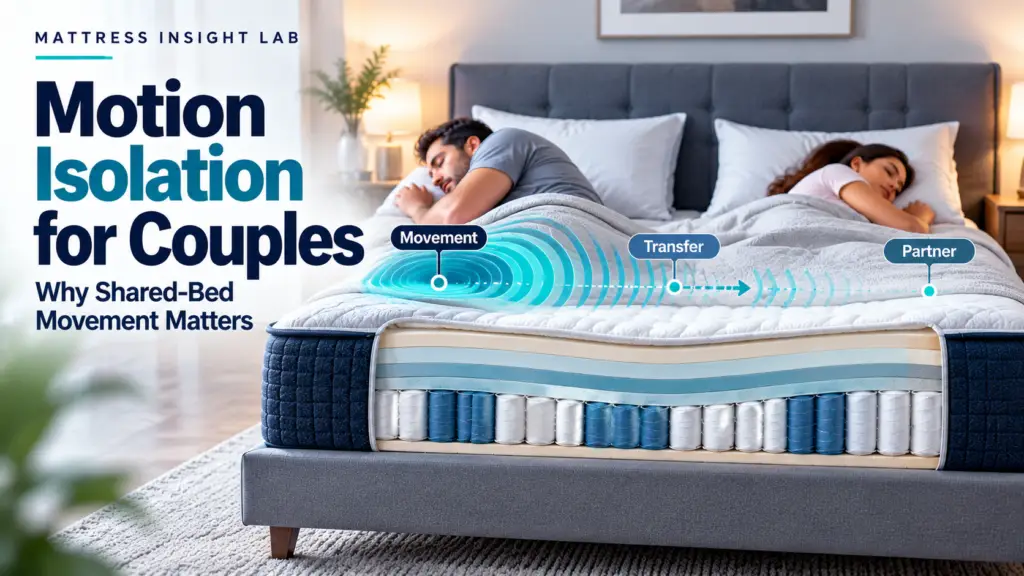
Motion isolation is best understood as the mattress’s ability to limit lateral transmission of movement or vibration from one location on the sleep surface to another. It is not a synonym for all partner disturbance. When a sleeper moves, the mattress deforms locally. That deformation can propagate through connected components — springs, foam layers, cushioning sheets — and produce motion at a distance from the original input. The amount of propagation depends on the complete assembly, not on any single material.
What Is Lateral Motion Transfer Across a Mattress?
Lateral motion transfer is the propagation of movement or vibration from one location on the mattress surface to another location, typically from one sleeper’s position toward the partner’s position. The controlled sleep experiment used lateral mattress motion generated by an artificial bed partner as the relevant stimulus. [1] It is important not to treat “absorption” as the only mechanical pathway; the evidence identifies multiple possible pathways for partner disturbance, and absorption is only one possible mechanical description.
How Can Movement at One Location Create Measurable Motion Elsewhere on the Sleep Surface?
Movement at one location can create measurable motion elsewhere because mattress components are mechanically connected. Springs can be linked to neighboring springs, and continuous cushioning layers can bridge otherwise independent elements. Patent literature describes conventional open coils connected through rigid helical wire lacing, providing a pathway for deflection to influence neighboring springs. The patent literature describes individually pocketed springs as allowing greater movement independence than traditional helically laced open-coil assemblies, while also noting that pocket strings can be joined and that an overlying foam/cushioning sheet can create a bridging effect. [6] The pathway exists through documented mechanical connections; the magnitude depends on the specific assembly.
Why Is Motion Isolation Different From Firmness, Support, Bounce, and Mattress Size?
Motion isolation describes lateral transmission of movement. Firmness describes surface indentation resistance. Support describes how the mattress distributes body load. Bounce describes local recovery or responsiveness. Mattress size describes physical dimensions. These are distinct properties; one does not uniquely determine another. A mattress can be firm yet transmit little lateral motion, or soft yet transmit substantial motion. The variables are mechanically distinct. Use “distinct” or “different,” not “independent” or “unrelated,” unless evidence supports those stronger claims.
Why Should “Motion Isolation” Be Treated as a Whole-Mattress Dynamic Response Rather Than One Material Property?
Complete-mattress transfer depends on interaction among support-core architecture, connections between components, cushioning layers, geometry, preload/body load, frequency content of the movement, and assembly construction. A mattress cannot safely be ranked from one material name or spring label alone. Even with independent pocketed springs, an overlying cushioning sheet can bridge regions. Connected open coils provide a pathway for neighboring influence. Foam dynamic response depends on multiple variables. The complete assembly determines the outcome.
Does Lateral Mattress Motion Actually Matter to Sleep?
A controlled sleep-laboratory experiment found that experimentally transferred lateral mattress motion was associated with more Stage 1 sleep and less Stage 3/4 sleep, with the changes more pronounced on the mattresses that transferred more motion. [1] This is limited-scope evidence: 24 subjects, three mattresses, and an artificial mechanical roller. It does not establish a universal disturbance threshold.
How Was Lateral Mattress Motion Introduced in the Controlled Sleep Study?
In the study, 24 subjects were assigned among three mattresses with different motion-transfer properties. On experimental nights, a 240-pound artificial bed-partner roller intermittently rocked laterally for brief periods totaling about 13% of sleep time. [1] The roller generated lateral mattress motion as a controlled stimulus. This is an artificial stimulus, not a human sleeper’s natural movement.
Which Sleep Stages Changed When the Roller Generated Motion?
Roller-on conditions significantly increased Stage 1 sleep and decreased Stage 3/4 sleep. [1] The study measured sleep stages via laboratory polysomnography. The changes indicate a shift toward lighter sleep under the transferred-motion condition. The roller did not cause a significant change in the number of awakenings.
Which Sleep Measures Did Not Change Significantly?
Sleep efficiency, number of awakenings, and wake after sleep onset did not significantly change overall in the experiment. [1] These are standard sleep measures. The absence of significant change means the transferred-motion stimulus did not produce detectable changes in these specific outcomes in this study. This does not mean motion isolation doesn’t matter — sleep-architecture changes still occurred.
Why Were Sleep-Architecture Changes More Noticeable on Mattresses That Transferred More Motion?
In the study, changes in sleep architecture were more notable on mattresses that transferred more motion. [1] The study compared three mattresses with different motion-transfer properties. The mattresses that transmitted more lateral motion showed more pronounced sleep-architecture changes under the roller stimulus. This supports the relevance of motion-transfer properties as a variable, but it does not prove that all mattresses with more transfer will disturb sleep — only three specific mattresses were tested.
Why Does One Laboratory Experiment Not Establish a Universal Disturbance Threshold?
The study used 24 subjects, three specific mattresses, and an artificial mechanical roller. It does not establish a universal disturbance threshold for all mattresses or all sleepers. Sleep response depends on many variables — movement type, frequency, mattress construction, sleeper arousal threshold, and more. A single laboratory experiment cannot capture all of these. No universal standardized score or threshold is established.
Why Is Partner Disturbance Broader Than Mattress Motion Transfer?
A 2026 systematic review found evidence of partner disturbance in healthy co-sleeping populations, but it cautions that movement concordance can arise through multiple pathways rather than one mechanism alone. The review discusses mattress force transfer, noise, sheet pulling, physical touch, and shared external disruption as possible explanations. [2] Motion isolation addresses only the mattress-force pathway. Other pathways remain regardless of mattress performance.
What Does the 2026 Systematic Review Establish About Partner Disturbance?
The 2026 systematic review found evidence of partner disturbance in all four studies addressing whether disturbance occurs in healthy co-sleepers. [2] It also found substantial methodological heterogeneity. The review synthesized published co-sleeping literature through September 7, 2025. The review does not prove that mattress motion causes disturbance — it identifies multiple possible pathways.
How Can Mattress Force Transfer Contribute to Movement Concordance?
Mattress force transfer is one possible pathway through which one partner’s movement can influence the other. When one sleeper moves, the mattress can transmit force or vibration to the partner’s location. This is the pathway that motion isolation addresses. The review treats mattress force transfer as one possible mechanism rather than the sole mechanism and does not assign quantitative shares to the different pathways. [2]
How Can Noise, Sheet Pulling, Physical Touch, or External Stimuli Also Affect Both Sleepers?
The 2026 review notes that movement concordance could reflect noise, sheet pulling, physical touch, or common external disturbance in addition to mattress force transfer. [2] Noise can wake both partners. Sheet pulling can transmit movement through bedding. Physical touch is direct contact. External disturbances (e.g., a shared alarm or environmental noise) affect both sleepers simultaneously. The review does not quantify their relative contributions.
Why Can Excellent Mattress Motion Isolation Still Leave Other Sources of Partner Disturbance?
Because partner disturbance has multiple possible pathways, a mattress with excellent motion isolation cannot eliminate noise, sheet pulling, physical touch, or external stimuli. Motion isolation addresses only the mattress-force pathway. The review explicitly cautions against treating mattress motion as the sole explanation for partner disturbance.
| Disturbance Pathway | What It Involves | Does Motion Isolation Address It? |
|---|---|---|
| Mattress force transfer | Movement or vibration transmitted through the mattress structure | Yes — this is the pathway motion isolation targets |
| Noise | Sounds from movement, breathing, or external sources | No — a separate pathway |
| Sheet pulling | Bedding movement that transfers motion between partners | No — a separate pathway |
| Physical touch | Direct contact between partners | No — a separate pathway |
| Common external stimuli | Shared alarms, environmental noise, or other outside events | No — a separate pathway |
How Common Is Movement Concordance Between Bed Partners?
In a classic study of 46 couples monitored over eight nights, about one-third of recorded movement epochs were concordant between partners, and partnered sleepers showed more movement than comparison sleepers sleeping alone. [3] This is observational evidence — it shows temporal association, not mattress causation.
What Did Eight Nights of Monitoring in 46 Couples Show?
Forty-six couples were monitored for eight nights using wrist actimetry and morning sleep logs. [3] The study found substantial temporal concordance in nocturnal movement and more movement in partnered sleep. Actigraphy records movement epochs. The study compared partnered sleepers to matched individuals sleeping alone. The study does not identify the transmission pathway.
What Proportion of Recorded Movement Epochs Occurred in Both Partners?
Approximately one-third of recorded movement epochs occurred within the same 30-second epoch in both partners. [3] This is a descriptive finding from actigraphy data. It does not establish that one-third of movements were caused by the mattress.
How Did Movement Frequency Change When a Partner Was Present Versus Absent?
Participants moved more when sleeping with a partner than comparison subjects sleeping alone. The study compared partnered sleepers to matched individuals sleeping alone. The study does not identify the cause of the extra movement.
Why Does Concordant Movement Not Prove That Mattress Vibration Caused Every Partner Movement?
Concordant movement shows temporal association, not causation. The 2026 review identifies multiple possible pathways — mattress force transfer, noise, sheet pulling, physical touch, and external stimuli — so concordance alone cannot be attributed to the mattress. Two people may move at similar times because of a shared external stimulus, because one wakes the other through touch or noise, or because of independent but coincidental timing.
Is There One Standardized Mattress Motion-Isolation Score?
The current ASTM F1566 mattress evaluation standard lists firmness, firmness retention, durability, impact effects, and height change among its recognized methods. Its publicly stated scope does not list lateral motion transfer or “motion isolation” as one of those standardized performance measurements. This does not mean no motion-transfer standards exist anywhere in the world — it describes the reviewed ASTM scope.
Which Performance Measures Are Listed in the Current ASTM F1566 Mattress Test Standard?
ASTM F1566-14(2021) lists evaluation methods for firmness, firmness retention, durability, impact effects, and height change in mattress or mattress-set testing. [4] These are the publicly listed measures in the standard’s scope.
Is Lateral Motion Isolation Included in the Publicly Listed F1566 Test Set?
The publicly stated scope of ASTM F1566-14(2021) does not list lateral motion transfer or “motion isolation” among its listed test measurements. [4] This is a scope statement about the reviewed standard, not a claim that no motion-isolation standard exists anywhere.
Why Can Different Review Labs Use Different Weights, Accelerometers, Drop Heights, Movement Routines, or Scoring Scales?
Because ASTM F1566 does not prescribe a lateral-motion-transfer test, third-party mattress-test results should be interpreted within each lab’s disclosed protocol rather than assumed to use the F1566 methods. For example, NapLab currently describes a protocol using a 12-pound medicine-ball drop on one side of the mattress and accelerometer measurements on the other. [4] [5] Different excitation methods, sensors, distances, loads, and scoring systems should be compared only when their methods are sufficiently similar and transparent.
Why Should Two Retailer “Motion Isolation Scores” Not Be Assumed to Be Directly Comparable?
Two retailer “motion isolation scores” should not be assumed to be directly comparable unless the test methods, excitation, load, distance, and metric are the same. Different methods can produce different scores. Without methodological transparency, a higher score from one lab may not mean better isolation than a lower score from another lab.
How Can Motion Transfer Be Measured More Precisely Than by Watching an Object on the Bed?
Motion transfer can be described quantitatively by separating the input (movement or force applied to the mattress) from the output (resulting vibration or displacement measured at a distance). This conceptual framework helps explain why informal object tests are only rough demonstrations.
What Is the Movement or Force Input Applied to the Mattress?
The input is the movement or force applied to the mattress — for example, a person rolling over, getting in or out of bed, or a mechanical device generating a controlled stimulus. The input excites the mattress, creating local deformation and vibration that can propagate. The controlled sleep study used a mechanical roller as the input. Different movements have different frequency content and force.
Where Should Resulting Vibration or Displacement Be Measured Relative to the Input?
The response should be measured at a defined distance from the input location — ideally at the position where a partner would lie. The distance between input and measurement point affects the measured response. Measuring at different distances produces different results.
How Can Acceleration, Displacement, Frequency Response, or Transmissibility Describe Different Aspects of Motion?
Acceleration measures how quickly velocity changes; displacement measures how far the surface moves; frequency response describes how the mattress responds at different frequencies; transmissibility describes the ratio of output to input motion. Each metric captures a different aspect of the dynamic response. Foam dynamic response depends on frequency and other variables, so frequency content matters.
Why Must the Loading Method, Distance, Sleeper Preload, and Mattress Condition Be Reported?
These variables affect the measured response. Foam dynamic response depends on preload and other conditions. Distance affects propagation. Mattress condition (new vs. broken-in) can affect behavior. Without reporting these conditions, results cannot be reproduced or compared.
Why Is a Household Object Test Only a Rough Demonstration Rather Than a Standard Measurement?
A household object test (e.g., a wine glass or coin) is a rough visual demonstration, not a standardized measurement. It lacks controlled excitation, defined measurement location, calibrated sensors, and a reproducible scoring system. The object’s movement depends on many uncontrolled variables — how it is placed, how the movement is applied, the object’s own properties, and the viewer’s perception. The reviewed ASTM standard does not provide a motion-isolation score, and a household object demonstration should not be treated as equivalent to an instrumented, reproducible test.
How Does Spring Connectivity Influence the Path of Mattress Motion?
Spring connectivity can influence how movement propagates. Conventional helically laced open coils are mechanically connected, providing a pathway for deflection to influence neighboring springs. Individually pocketed coils can increase local spring independence relative to traditional helically laced open-coil assemblies. However, greater independence does not mean zero transfer through the complete mattress.
How Do Helically Laced Open Coils Mechanically Connect Adjacent Springs?
Conventional open coils are connected through rigid helical wire lacing, which mechanically links adjacent springs. The helical lacing creates a physical connection between coils, so deflection of one coil can influence its neighbors. Connection design varies, so not all open-coil mattresses transfer the same amount.
Why Can Loading One Connected Spring Influence Neighboring Springs?
Because the springs are mechanically connected, loading one spring can pull or push its neighbors through the connection. The helical lacing transmits force between coils, so deflection in one region can cause deflection in adjacent regions.
How Do Individually Pocketed Coils Increase Local Spring Independence?
Individually pocketed coils are enclosed in fabric pockets and can provide greater local spring independence than traditional helically laced open-coil assemblies. Individual fabric pockets reduce direct spring-to-spring coupling, but adjacent strings or rows may still be joined by fabric, adhesive, welding, or other assembly methods, and overlying cushioning layers can bridge neighboring regions. [6] Pocketed construction therefore reduces some coupling pathways without guaranteeing mechanical independence or zero transfer.
Why Does Greater Spring Independence Not Mean Zero Motion Transfer Through the Complete Mattress?
Greater spring independence reduces direct spring-to-spring influence, but other connected mattress components can still provide pathways for load transfer. An overlying foam/cushioning sheet can act as a bridge, coupling regions even when springs are independent. The complete assembly determines the outcome.
Do Pocketed Coils Automatically Guarantee Better Motion Isolation?
A pocketed-spring patent published in 2023 describes conventional pocketed spring cores as allowing greater spring independence and less motion transfer than traditional helically laced open-coil assemblies. [6] However, the same source notes that an overlying foam/cushioning sheet can act as a bridge, so spring type alone is insufficient. This is a patent disclosure, not a controlled independent comparison.
What Does the Pocketed-Spring Patent Say About Spring Independence?
The patent states that conventional pocketed spring cores provide greater spring independence and less motion transfer than traditional helically laced open-coil constructions. [6] This is the patent’s description of its disclosed architecture. It is a patent disclosure, not a comparative trial, so it does not prove all pocketed mattresses are better.
How Can an Overlying Cushioning Sheet Act as a Mechanical Bridge Across Otherwise More Independent Springs?
A continuous foam/cushioning sheet above pocketed springs can act as a mechanical bridge, so loading one region can influence another. [6] The cushioning sheet is a continuous layer. When one region is loaded, the sheet can deform and transmit some of that deformation to adjacent regions, even if the springs below are independent. The patent does not quantify bridging magnitude.
How Can Joining Methods Between Pocket Strings Influence Local Independence?
Pocket strings or adjacent rows can be joined during assembly, including by gluing, welding, or other conventional methods described in the patent. [6] Those connections can provide additional coupling pathways, but the patent does not quantify how much each joining method changes whole-mattress motion transfer.
Why Must a Pocket-Coil Mattress Be Tested as a Complete Assembly?
Because the complete assembly — springs, cushioning layers, and connections — determines the final transfer behavior. Spring type alone is insufficient. Even with independent springs, a cushioning sheet can bridge regions. The complete assembly must be evaluated.
What Can Foam Damping Tell You About Motion Isolation?
Polymeric foams can exhibit viscoelastic and damping behavior relevant to vibration attenuation. Experimental engineering research on a polyurethane elastomeric foam shows that dynamic properties vary with frequency, temperature, and preload under the tested conditions. [7] This is material-level evidence and should not be converted directly into a finished-mattress ranking. This is material-level evidence only — it does not prove finished-mattress superiority.
How Can Viscoelastic Foam Dissipate Mechanical Energy During Cyclic Loading?
Viscoelastic foam can dissipate mechanical energy during cyclic loading, which is relevant to vibration attenuation. Viscoelastic materials combine viscous and elastic behavior. During cyclic loading, some of the mechanical energy is converted to heat rather than being returned as motion. Damping depends on conditions — not all foam absorbs all motion.
Why Does Foam Dynamic Response Depend on Frequency and Material Properties?
Foam dynamic response can vary with frequency, preload, temperature, and material properties; the cited polyurethane-foam study directly tested frequency, temperature, and preload effects. [7] These variables change how the foam deforms and dissipates energy. A foam that dampens well at one frequency or temperature may behave differently at another. Foam response is not a single fixed property.
How Can Preload Change the Dynamic Response of a Foam?
Preload can change the dynamic response of a foam. The engineering study characterized the foam over preloads from 2 to 12 N and found preload-dependent changes in several dynamic parameters under the tested conditions. [7] Preload changes the foam’s initial compression state, which can alter its stiffness and damping behavior. This does not establish a body-weight disturbance formula.
Why Does Evidence That Foam Can Dampen Vibration Not Prove That Every Memory-Foam Mattress Is Better at Motion Isolation?
Material-level damping evidence does not validate the retail rule “memory foam always isolates best.” Complete-mattress transfer depends on the entire assembly. A foam layer’s damping capability is one variable. The complete mattress — springs, connections, other layers, and geometry — determines the final outcome. No universal material ranking is established.
Can Mattress Material or Construction Labels Predict Motion Isolation by Themselves?
Material and construction labels — “memory foam,” “latex,” “hybrid,” “innerspring” — do not by themselves specify a complete mattress’s dynamic response. Each label describes a category, not a complete construction. Comfort layers can alter how a spring core’s movement reaches the surface.
Why Does “Memory Foam” Not Specify the Complete Mattress’s Dynamic Response?
“Memory foam” describes a material category, not a complete mattress construction. The complete mattress includes other layers, a support core, and connections that all affect transfer. Foam response is condition-dependent. A memory-foam layer’s behavior depends on its formulation, density, thickness, and the layers around it.
Why Does “Latex” Not Automatically Mean More Motion Transfer?
“Latex” does not automatically mean more motion transfer. No supplied evidence establishes a universal latex transfer behavior. Latex is a material category with multiple formulations and constructions. Its behavior in a complete mattress depends on the assembly.
Why Does “Hybrid” Not Establish One Motion-Isolation Behavior?
“Hybrid” describes a combination of materials (typically foam and coils), but the specific construction — coil type, connections, foam layers, thicknesses — determines the behavior. Two different “hybrid” mattresses can have very different constructions and therefore different transfer behavior.
Why Can Comfort Layers Alter How a Spring Core’s Movement Reaches the Surface?
Comfort layers can alter how a spring core’s movement reaches the surface. A continuous cushioning sheet can bridge otherwise independent springs. The comfort layer sits between the sleeper and the spring core. It can dampen, transmit, or bridge movement depending on its properties and construction. Thickness-to-performance is not established.
What Direct Comparative Testing Would Be Needed to Rank Whole Construction Families?
Ranking whole construction families would require standardized complete-mattress comparisons across representative constructions using identical excitations, loads, distances, and metrics. Without identical test conditions, results are not comparable. No such universal ranking is established.
Is Motion Isolation Necessarily Opposed to Ease of Movement or Responsiveness?
Lateral motion transfer and local recovery/repositioning response are different mechanical outcomes. The reviewed evidence does not establish a universal inverse relationship between them. They should not be presented as automatic opposites.
What Does Lateral Motion Transfer Measure?
Lateral motion transfer measures how much movement or vibration propagates from one location on the mattress to another. It describes the spatial propagation of motion across the surface. It is distinct from responsiveness.
What Does Local Recovery or Repositioning Response Measure Instead?
Local recovery or repositioning response describes how quickly and easily the mattress returns to shape after being compressed at a specific location — how it feels when you shift your weight or change position. This is a local, time-dependent response, distinct from spatial propagation. Slow recovery does not always mean good isolation.
Why Can Both Outcomes Depend on Different Layers and Mechanical Variables?
Lateral transfer depends on spatial propagation through the assembly, while local recovery depends on the time-dependent response at the compressed location. Different layers and mechanical variables can influence each. Foam dynamic response depends on multiple variables. A layer that dampens lateral propagation may or may not also slow local recovery, depending on the specific construction.
Why Should “Better Isolation = More Stuck” and “More Responsive = More Partner Disturbance” Not Be Published as Universal Rules?
The reviewed evidence does not establish a universal inverse relationship between motion isolation and ease of movement. These should not be published as automatic opposites. A mattress could potentially achieve both outcomes through different design features, but the evidence does not establish this either way.
Does Partner Body Weight Determine Motion Transfer or Disturbance?
Applied load can change the dynamic state of a cushioning material, but the reviewed evidence does not establish a universal “heavier partner = more disturbance” rule. Material-level preload effects do not translate to a body-weight rule.
Why Can Applied Load Change the Dynamic State of a Cushioning Material?
Applied load (preload) can change the dynamic response of a cushioning material. The engineering study found the foam’s dynamic properties changed with preload. Preload changes the foam’s initial compression state, altering its stiffness and damping behavior. This does not prove heavier people cause more disturbance.
Why Does That Not Establish a Universal “Heavier Partner = More Disturbance” Rule?
Material-level preload effects do not establish a human body-weight-to-disturbance formula. Real partner disturbance depends on movement type, speed, mattress construction, sleeping location, noise, touch, and the receiving sleeper’s arousal response. Body weight is one input variable. The complete system — mattress, movement, and sleeper response — determines the outcome.
Why Can Movement Speed, Movement Type, Mattress Architecture, and Partner Arousal Threshold Also Matter?
Movement speed, movement type, mattress architecture, and the receiving sleeper’s arousal threshold can all influence whether a movement disturbs a partner. A slow shift and a sudden drop produce different forces and frequencies. Different mattresses transmit differently. Different sleepers wake more or less easily. Their relative contributions are not quantified in the supplied evidence.
What Controlled Evidence Would Be Needed to Quantify Body-Weight Difference as a Motion-Isolation Buying Rule?
Controlled human experiments stratified by partner-weight difference, measuring generated mattress motion, received motion, and sleep response, would be needed. Such studies would need to control movement type, mattress construction, and sleeping location while varying partner weight. No such body-weight formula is established.
Are Mattress Size and Edge Support Part of Motion Isolation?
Mattress size, usable sleep area, edge support, and motion isolation are separate shared-bed criteria. Greater partner separation may alter how much mattress-transmitted movement is experienced by the other sleeper, but that is not equivalent to changing the mattress’s intrinsic dynamic properties. The 2026 review discusses greater separation as one possible explanation for reduced force transfer or contact, not as a validated universal attenuation law. [2]
How Is Mattress Size Different From the Mattress’s Mechanical Transfer Behavior?
Mattress size describes physical dimensions. Mechanical transfer behavior describes how movement propagates through the materials. These are distinct properties. A larger mattress changes available separation between sleepers; the reviewed evidence does not establish that mattress size itself changes the material’s intrinsic transfer behavior.
Why Can More Physical Separation Between Partners Matter Without Changing the Material’s Intrinsic Transfer Properties?
Greater separation may reduce the amount of mattress-transmitted movement experienced by the other sleeper because the partners are farther apart, and the 2026 review discusses force dissipation and reduced physical contact as possible explanations. [2] However, the reviewed evidence does not establish a universal attenuation-versus-distance relationship for mattresses.
Why Is Edge Support a Local Load-Bearing Characteristic Rather Than the Definition of Motion Isolation?
Edge support describes how well the mattress supports weight near its edges. Motion isolation describes lateral transfer across the surface. These are distinct characteristics. A mattress can have strong edge support and still transmit substantial lateral motion, or vice versa. The variables are mechanically distinct.
Why Should Size, Edge Support, and Motion Isolation Be Compared as Separate Shared-Bed Criteria?
Size, edge support, and motion isolation address different shared-bed needs. They should be evaluated separately unless direct testing establishes their interaction. Each variable affects the shared-bed experience differently. Combining them into one score obscures their distinct contributions.
How Should Motion-Isolation Claims Be Verified Before Purchase?
Before trusting a motion-isolation claim, ask what movement or impact excited the mattress, whether motion was measured objectively, at what distance, under what load, and which metric was used. “Great for couples” is broader than “low measured lateral transfer.”
What Movement or Impact Was Used to Excite the Mattress?
Ask what movement or impact was used to excite the mattress — a mechanical roller, a dropped weight, a person rolling over, or something else. Different stimuli produce different forces and frequencies, affecting the measured response. The controlled sleep study used a mechanical roller; the stimulus matters.
Was Motion Measured Objectively or Only Rated by a Tester?
Ask whether motion was measured with sensors (e.g., accelerometers) or only rated subjectively by a tester. Objective sensors provide quantitative data. Subjective ratings depend on the tester’s perception. Subjective ratings can still be informative, but they are not objective measurements.
At What Distance From the Movement Source Was the Response Measured?
Ask at what distance from the movement source the response was measured. Distance affects the measured response. A measurement taken close to the source will differ from one taken at a partner’s position.
Was the Mattress Tested Unloaded, Preloaded, or With a Second Sleeper Present?
Ask whether the mattress was tested unloaded, preloaded with a weight, or with a second sleeper present. Preload changes foam dynamic response. The load condition affects the measured transfer.
Which Measurement — Acceleration, Displacement, Peak Response, Decay, or Subjective Perception — Supports the Claim?
Ask which metric supports the claim — acceleration, displacement, peak response, decay time, or subjective perception. Different metrics capture different aspects of motion. A claim based on one metric may not hold for another.
Why Should “Great for Couples” Be Treated as a Broader Marketing Claim Than “Low Measured Lateral Transfer”?
“Great for couples” is a broad marketing claim that can include many factors — size, comfort, edge support, and more. “Low measured lateral transfer” is a specific, testable claim about one variable. Partner disturbance has multiple pathways. A mattress can be “great for couples” for many reasons beyond motion isolation.
How Can Two People Compare Motion Isolation During a Mattress Trial?
During a mattress trial, two people can compare motion isolation by using the same natural movements on each mattress, keeping locations and distance similar, and distinguishing felt mattress movement from noise, sheet pulling, and direct contact. This provides personal comparative observations, not a standardized score.
Compare the Same Natural Movements Across Candidate Mattresses
Use the same natural movements — rolling over, shifting position, getting in and out of bed — on each candidate mattress. Consistent movements make comparisons more meaningful. One movement is not enough because different movements produce different forces.
Have One Sleeper Remain Still While the Other Rolls, Changes Position, and Gets In or Out of Bed
Have one sleeper remain still while the other performs the movements, so the still sleeper can feel what transfers. This isolates the transferred motion for the still sleeper. The still sleeper’s perception is subjective, not an objective measurement.
Keep Sleeper Locations and Distance Similar When Comparing Mattresses
Keep sleeper locations and the distance between them similar when comparing mattresses. Distance affects how much transferred motion reaches the partner.
Distinguish Felt Mattress Movement From Noise, Sheet Pulling, and Direct Contact
When testing, distinguish felt mattress movement from noise, sheet pulling, and direct contact. Multiple disturbance pathways exist. The trial should isolate the mattress pathway. Any disturbance during the trial is not necessarily mattress motion.
Repeat the Comparison During the At-Home Trial Under Normal Sleep Conditions
Repeat the comparison during the at-home trial under normal sleep conditions. Real sleep involves many variables not present in a short store test. One night in a store is not enough.
Why Should This Be Treated as Personal Comparative Observation Rather Than a Standardized Motion-Isolation Score?
The trial provides personal comparative observations rather than a standardized motion-isolation score. It reflects your perception under the conditions you used, not a calibrated measurement. It can inform your decision without becoming a universal metric.
How Should Motion Isolation Influence the Final Shared-Mattress Decision?
Motion isolation deserves more weight when mattress-transmitted movement is a real source of disturbance for you, but it should be evaluated alongside other shared-bed criteria and without universal material, partner-weight, or responsiveness rules.
Give Motion Isolation More Weight When Mattress-Transmitted Movement Is a Real Source of Disturbance
Give motion isolation more weight when you are personally sensitive to mattress-transmitted partner movement or regularly notice your partner’s movements through the mattress. Transferred motion can alter sleep architecture, and partner disturbance occurs. If mattress motion is your specific disturbance source, isolation matters more. Individual circumstances differ.
Separate Mattress Motion From Noise, Sheets, Touch, and Other Partner Disturbances
Separate mattress motion from noise, sheets, touch, and other partner disturbances when deciding. Multiple pathways exist. If your disturbance is mostly noise or sheet pulling, a mattress with excellent motion isolation may not solve it.
Compare Complete-Mattress Performance Rather Than Relying on Foam or Coil Labels
Compare complete-mattress performance rather than relying on foam or coil labels. Cushioning layers can bridge springs. Connections matter. Foam response is condition-dependent. The complete assembly determines the outcome.
Treat Pocket-Coil Independence as a Structural Clue Rather Than Proof of Zero Transfer
Treat pocket-coil independence as a structural clue rather than proof of zero transfer. Pocketed springs have greater independence, but cushioning layers can bridge them.
Use Objective Test Details When Available and Personal Trial Experience for Final Fit
Use objective test details when available — excitation, load, distance, metric — and personal trial observations for final fit. Objective tests provide data within their method. Personal trials reflect your specific experience. Both have value and limits.
Avoid Universal Material, Partner-Weight, or Responsiveness Rules
Avoid universal material, partner-weight, or responsiveness rules. The evidence does not establish them. No universal material ranking exists. No universal isolation-responsiveness trade-off exists. No body-weight formula exists. Evaluate each mattress individually.
Sources and References
- Wellman JJ, Bohannon M, Vogel GW. — Influence of lateral motion transfer on sleep. PubMed record.
- Rayward L, Green D, Little JP. — Partner disturbance in co-sleeping and effects on sleep architecture: A systematic review. PubMed record.
- Pankhurst FP, Horne JA. — The influence of bed partners on movement during sleep. PubMed record.
- ASTM F1566-14(2021) — Standard Test Methods for Evaluation of Innersprings, Boxsprings, Mattresses or Mattress Sets. ASTM record.
- NapLab — How We Test & Score Mattresses. Testing methodology.
- U.S. Patent Application 20230088072 — Pocketed Spring Assembly Including Liquid Pods. Patent record.
- Cortazar-Noguerol J, et al. — Preload Influence on the Dynamic Properties of a Polyurethane Elastomeric Foam. Polymers article.
Final Synthesis
Motion isolation is best treated as a whole-mattress dynamic response: movement at one location creates deformation and vibration that can propagate through spring connections, fabric or adhesive joining, continuous cushioning layers, foam, and other parts of the assembly. Pocketed coils can reduce direct spring-to-spring coupling compared with traditional helically laced open-coil systems, but pocket strings, joining methods, and overlying layers can still transmit motion.
The sleep evidence supports taking mattress-transmitted motion seriously without treating it as the only source of partner disturbance. A controlled 24-person laboratory study found lighter sleep architecture under experimentally transferred mattress motion, while the 2026 systematic review identifies mattress force transfer, noise, sheet pulling, physical touch, and shared external disruption as possible pathways in co-sleeping. Movement concordance therefore does not prove mattress causation.
For shoppers, compare complete mattresses and ask how a motion-isolation result was produced: what excitation was used, what load or preload was present, where the response was measured, and which metric was reported. ASTM F1566 does not itself prescribe a lateral-motion-transfer test, so third-party results should be interpreted within the disclosed protocol. Personal trials can add useful comparative observations, but they are not standardized measurements.
Final evaluation checklist for shared-bed motion isolation:
- Identify whether mattress-transmitted movement is actually your disturbance source, or whether noise, sheets, touch, or external stimuli play a larger role.
- Compare complete mattresses, not material or spring labels alone.
- Ask what excitation, load, distance, and metric support any motion-isolation claim.
- Treat pocket-coil independence as a structural clue, not proof of zero transfer.
- Use consistent movements and positions during at-home trials.
- Reject universal rules about material families, partner weight, or isolation-versus-responsiveness trade-offs.