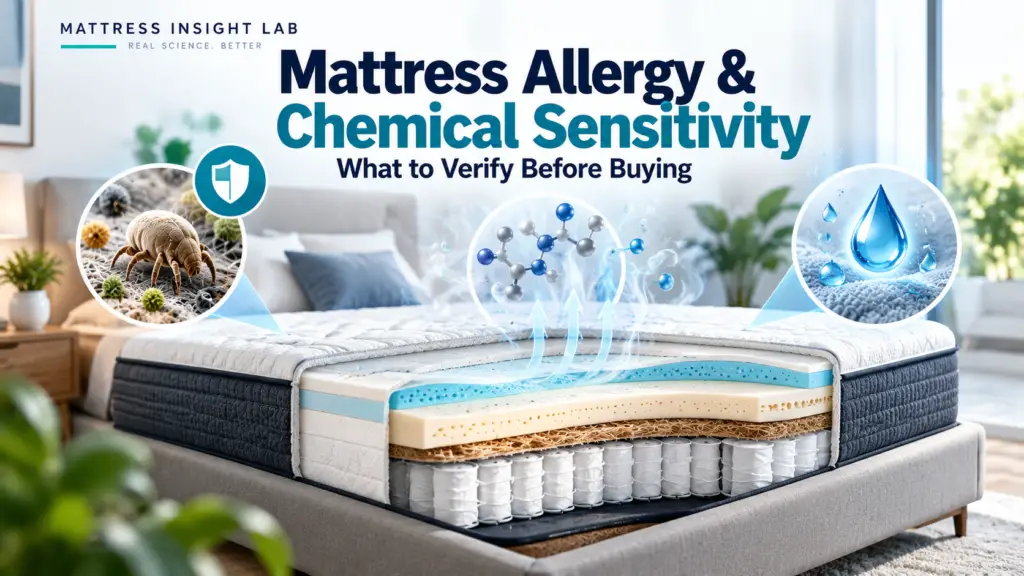
Why Allergy and Chemical Sensitivity Concerns Matter Before Purchase
Allergy and chemical-sensitivity concerns matter before purchase because they require different evidence paths. An immune-mediated allergy — for example to dust mites or natural-rubber latex — is not the same as an odor, VOC, or irritation concern, and no single mattress label resolves all of them. MedlinePlus lists dust mites, mold, animal dander, pollen, and natural latex among recognized allergens. [1] The practical task is to identify the exact concern first, then verify evidence that actually matches it.
This guide treats allergy and chemical-sensitivity concerns as a pre-purchase verification problem. It does not diagnose symptoms, does not rank materials by risk, and does not promise that any mattress is universally safe. It explains what each concern actually is, where the relevant evidence lives, and which certifications or disclosures address which question.
Medical boundary. Allergy is an immune-mediated response. Identifying the actual trigger requires clinical history and, when appropriate, testing; a mattress guide cannot diagnose the cause of symptoms. If you have a known diagnosed allergy, use product information as material for discussion with a qualified clinician rather than as a substitute for medical advice. Difficulty breathing, throat or facial swelling, faintness, or other signs of a severe allergic reaction may require emergency medical care. MedlinePlus describes anaphylaxis as an emergency requiring immediate medical attention. [17]
What Allergy and Chemical-Sensitivity Concerns Should Be Separated Before Choosing a Mattress?
Before comparing mattresses, separate the concern into one of three evidence paths: an immune-mediated allergy, an odor/VOC/emissions concern, or a moisture-related environmental issue. Each path points to different product information, different certifications, and different questions to ask a seller.
An allergy is an immune-system response to a substance that generally does not cause problems for most people. Recognized allergens include dust mites, mold, animal dander, pollen, and natural latex. [1] VOC/odor concerns follow a different evidence path, and moisture/dampness can create conditions that support biological contaminants such as mold and dust mites. [4] [9]
These categories are distinct evidence pathways. They are not interchangeable, and treating them as one vague “sensitive sleeper” problem is what leads shoppers to buy a label instead of verifying a concern.
What Is an Allergic Reaction?
An allergy is an immune-system response to a substance that generally does not cause problems for most people. Because the mechanism is immune-mediated, it cannot be identified from mattress symptoms alone. A reaction to a mattress is not by itself evidence of an allergy, and an allergy is not established by irritation, odor intolerance, or discomfort.
Which Common Indoor Allergens Include Dust Mites, Mold, Pet Dander, Pollen, and Natural Latex?
MedlinePlus identifies dust mites, mold, animal dander, pollen, and natural latex among recognized allergens. [1] This is a general allergen list, not a claim that all of them originate in the mattress. Mattress relevance depends on the trigger and on whether the mattress or bedding acts as a source or reservoir for that exposure.
Why Are Odor, VOC, Fragrance, or Material-Irritation Concerns Not Automatically Allergies?
VOCs are emitted gases, and odor is not a reliable measurement of VOC concentration or health risk. Some VOCs can have noticeable odors at low concentrations while others may have little noticeable smell. Because odor is not a measurement, it cannot substitute for an allergy diagnosis. Odor, fragrance, and irritation concerns follow a different evidence pathway from immune-mediated allergy.
Why Should the Exact Trigger Concern Be Identified Before Comparing Mattresses?
Different triggers require different evidence. A dust-mite allergy directs attention toward bedding reservoirs and encasement. A known natural-rubber latex allergy directs attention toward latex content. Odor or VOC concerns direct attention toward emissions testing. Moisture or mold concerns direct attention primarily toward room and building moisture.
No single “sensitive sleeper mattress” specification resolves all of these pathways. Matching evidence to the identified trigger is the only way to verify the right product attribute.
Why Can a Mattress Guide Evaluate Product Evidence but Not Diagnose the Reader’s Symptoms?
Allergy is an immune-mediated response, and identifying the actual trigger requires clinical history and testing. A mattress guide can evaluate product evidence — certifications, disclosures, test scopes, and policy terms — but it cannot determine a reader’s medical mechanism from symptoms. Product marketing cannot substitute for clinical diagnosis.
Which Allergy Triggers Come From the Mattress—and Which May Come From the Bedroom Around It?
One of the best-established mattress-specific allergen concerns is house-dust-mite exposure. AAAAI identifies mattresses and bedding as major sources/reservoirs of mites and mite allergens. [2] Pet dander originates from animals, pollen originates from plants, and mold growth is driven by moisture; these exposures can also accumulate on bedroom surfaces and bedding. [4] [16]
Why Are Mattresses and Bedding Important Reservoirs for House-Dust-Mite Allergens?
AAAAI’s dust-mite practice parameter states that mattresses and bedding are major sources of mites and mite allergens and strongly recommends mite-allergen-proof mattress, box-spring, and pillow encasements to decrease exposure. [2] This supports treating mattress/bedding exposure as relevant for people sensitized to dust mites; it does not establish problematic mite levels in every mattress.
How Can Pet Dander, Pollen, and Household Dust Be Present Throughout the Bedroom Rather Than Originate in the Mattress?
EPA identifies animal dander, pollen, and house dust among indoor biological contaminants generally, not as mattress-specific sources. These are room-level sources that can accumulate on bedding and surfaces. Treating them as mattress-specific would overstate the mattress’s role.
Why Is Mold Primarily a Moisture and Dampness Question Rather Than a Mattress-Material Label?
EPA states that moisture control is the key to mold control and recommends keeping indoor relative humidity below 60%, ideally about 30–50%. [4] Mold growth is primarily a moisture-management issue rather than a mattress-construction category. A persistently damp mattress can itself become affected, but replacing a mattress without correcting the moisture source does not solve the underlying problem.
Why Should the Source Be Identified Before Replacing the Mattress?
Different sources require different interventions. Dust-mite allergen directs attention toward bedding reservoirs and encasement. Moisture and mold direct attention toward room and building moisture. Replacing the mattress without identifying the source may not address the actual exposure.
Why Does a New Mattress Alone Not Eliminate Allergens Already Present in Pillows, Bedding, Carpets, Pets, or the Room?
EPA identifies dander, pollen, mites, mold, and other biological contaminants as wider indoor sources, and AAAAI emphasizes the wider bedroom environment. Allergens can persist in pillows, bedding, carpets, pets, and the room. Mattress replacement addresses one potential reservoir, not all sources.
What Can an Allergen-Proof Mattress Encasement Actually Do?
Mite-impermeable encasements can reduce mattress dust-mite allergen, but allergen reduction and clinical outcome are separate questions. The evidence concerns tested mite-impermeable encasements in a specific study population, not all covers and not all allergens.
How Does a Mite-Allergen-Impermeable Encasement Separate the Sleeper From Mattress Dust-Mite Allergen?
Mite-impermeable encasements physically separate the sleeper from mattress dust-mite allergen. The barrier fabric excludes mite allergen from the sleep surface. This is the documented mechanism in the tested encasements, and it is dust-mite-specific.
What Have Controlled Studies Found About Reductions in Mattress Mite Allergen?
In the PIAMA study, 810 children with allergic mothers participated. Active allergen-impermeable mattress encasings significantly reduced dust and mite-allergen levels relative to placebo covers; after 12 months, mattresses with active encasings had about half the Der 1 per square metre of placebo-covered mattresses, although baseline allergen levels were generally low and the treatment effect was described as modest. [3] The finding applies to the tested encasements and population.
Why Is an Allergen-Proof Encasement Different From a Normal Removable Mattress Cover?
The evidence concerns mite-impermeable encasements specifically. A normal removable cover is not established as an allergen barrier. Barrier properties differ by design, and washable covers should not be treated as equivalent to allergen-impermeable encasements.
Why Does Lower Dust-Mite Allergen Not Guarantee Symptom Improvement for Every Person?
Trials found substantial reductions in mattress mite allergen, but effects on airway responsiveness, symptoms, quality of life, or development of allergic disease were inconsistent or limited. Allergen reduction and clinical outcome are separate questions. An encasement should not be presented as preventing or treating asthma or allergy.
Why Should Encasements Be Treated as One Part of a Broader Allergy-Control Strategy When Clinically Appropriate?
AAAAI notes that covers alone are often unlikely to provide clinical benefit without broader exposure-control measures. Encasements address one exposure pathway. They are best understood as one part of a broader approach when clinically appropriate.
How Should Moisture, Dust Mites, and Mold Affect Mattress Evaluation?
Elevated indoor humidity can support mold growth and can favor dust mites. EPA recommends keeping indoor relative humidity below 60% and ideally between 30% and 50%; lower humidity may also discourage dust mites. [4] This is indoor-environment guidance, not a mattress certification or a guarantee that a particular mattress cannot become damp or contaminated.
Why Does Elevated Indoor Humidity Favor Dust Mites and Mold?
EPA recommends controlling indoor moisture because elevated humidity supports biological contaminants. Warm, humid conditions favor dust mites and mold. Humidity is a room-level variable, not a property of a specific mattress.
Why Is Water Intrusion or Dampness More Important to Mold Risk Than the Mattress Marketing Category?
Moisture control is central to mold control. [4] A wet or persistently damp mattress or bedding can itself become affected, but a construction-category or “breathable” marketing label does not substitute for controlling leaks, condensation, humidity, and other moisture sources.
Why Should Existing Moisture Problems Be Corrected Rather Than Solved Only by Replacing the Mattress?
Replacing the mattress does not address the moisture source. Moisture correction addresses the underlying condition. EPA’s guidance treats moisture control as the primary intervention for biological contaminants.
Why Does “Breathable Mattress” Not Automatically Prove Mold Prevention?
EPA identifies moisture control as central to mold control. Breathability is not established as a mold-prevention property. Mold risk depends on moisture, not on a mattress marketing label.
Why Should Indoor Humidity Guidance Be Kept Separate From a Mattress-Specific Allergy Guarantee?
EPA’s humidity guidance is general indoor-environment guidance, not a mattress-certification rule. Room-level guidance addresses environmental conditions, not product properties. Buying a mattress does not satisfy or replace room-level moisture control.
What Should a Shopper With Natural-Rubber Latex Allergy Verify Before Choosing a Latex Mattress?
Natural rubber latex contains proteins associated with allergic reactions. Synthetic rubber does not contain the same natural-rubber proteins. A person with known latex allergy should verify natural-rubber latex content and obtain individual medical guidance.
What Is Natural Rubber Latex?
Natural rubber latex contains naturally occurring plant proteins, including antigenic proteins that can trigger immune responses and allergic reactions in susceptible people. [5] Natural-rubber latex is therefore medically distinct from synthetic materials that may also be marketed with the word “latex.”
Which Natural-Rubber Proteins Can Be Relevant to Latex Allergy?
Natural rubber latex contains proteins associated with allergic reactions. These proteins are the allergenic component. The supplied evidence does not establish that all natural-rubber proteins cause reactions in everyone.
Why Is Synthetic Rubber Called “Latex” Not Equivalent to Natural-Rubber Latex for Protein Allergy?
Synthetic rubber products called “latex” do not contain the same natural-rubber proteins responsible for immediate latex allergy. The allergenic proteins are specific to natural rubber. Synthetic “latex” foam should not be treated as natural-rubber latex. This distinction does not classify every synthetic foam as risk-free.
Have Latex Allergens Been Detected in Natural-Latex Mattresses?
A mattress-specific laboratory study detected Hev b 1 in tested natural-latex mattress extracts. [6] That establishes that a latex allergen was detectable in the tested products; it does not establish a universal exposure dose or reaction probability for every natural-latex mattress.
Why Does GOLS or Organic Latex Status Not Remove the Latex-Allergy Question?
GOLS covers products made from organically grown natural-rubber latex and can include mattress and bedding products. [7] GOLS does not certify the absence of latex-allergenic proteins and does not establish suitability for a person with natural-rubber latex allergy. Organic-origin certification and individual allergy safety are different questions.
Why Should a Person With Known Latex Allergy Discuss Material Exposure Questions With Their Clinician Rather Than Relying on Mattress Marketing?
Natural-rubber latex contains proteins associated with allergic reactions, and individualized risk decisions require clinical evaluation. Product marketing cannot substitute for clinical assessment. No mattress should be described as safe for latex-allergic people on the basis of a label alone.
Can You Predict Latex-Allergy Risk From the Mattress Label Alone?
The reviewed evidence does not establish a universal finished-mattress latex-allergen exposure threshold that predicts a reaction for every latex-allergic person. Hev b 1 was detectable in tested natural-latex mattresses, but FDA-recognized antigenic-protein methods caution that antigen measurements are not themselves a direct measure of allergenic proteins or individual clinical reaction thresholds. [6] [8]
Does “Natural Latex” Establish That Natural-Rubber Latex Proteins May Be Relevant?
Natural-rubber-latex content establishes that latex proteins may be relevant, but the reviewed evidence does not convert material presence into a universal probability or severity of reaction for a particular finished mattress. [5] [6] [8]
Does That Tell You the Amount of Allergen Reaching the Sleeper Through the Finished Mattress?
The reviewed evidence does not establish the amount of allergen reaching the sleeper through a finished mattress. Latex allergens have been detected in tested natural-latex mattresses, and exposure from a complete mattress depends on product construction, coverings, allergen accessibility, sleeper sensitization, and other factors. No universal latex-mattress exposure rule is published here.
How Could Covers, Quilting, Layer Placement, and Product Construction Affect Actual Exposure?
The reviewed evidence does not establish how covers, quilting, layer placement, and product construction affect actual exposure. Exposure from a complete mattress depends on product construction, coverings, allergen accessibility, sleeper sensitization, and other factors. This is not established by the reviewed evidence.
Why Is There No Universal Mattress-Latex Exposure Threshold That Predicts a Reaction for Every Latex-Allergic Person?
The reviewed evidence does not establish a universal mattress-latex exposure threshold that predicts a reaction for every latex-allergic person. Latex allergens have been detected in tested natural-latex mattresses, and exposure from a complete mattress depends on product construction, coverings, allergen accessibility, sleeper sensitization, and other factors. No universal threshold is published here.
Why Should the Article Not Recommend a Personal Exposure Test for a Known Severe Latex Allergy?
The reviewed evidence does not authorize recommending a personal exposure test for a known severe latex allergy. Natural-rubber latex content is relevant information for a person with known latex allergy, and individualized risk decisions should be directed to a qualified clinician. A personal exposure test is not a reliable risk determination and should not be recommended.
How Should Odor and VOC Concerns Be Evaluated Separately From Allergy?
VOC emissions and odor are chemical and air-quality variables, not substitutes for an allergy diagnosis. Odor is not a reliable measurement of VOC concentration or health risk, and low odor does not establish low emissions. This page owns allergy and sensitivity verification; VOC and odor depth belongs to the separate off-gassing evaluation factor page.
What Are Volatile Organic Compounds?
VOCs are emitted gases, and their health relevance depends on the individual compounds and exposure. VOCs encompass many chemicals with differing toxicological properties. VOC presence is not a complete safety assessment, and VOC emission is not the same evidence type as allergenicity.
Why Is Odor Perception Not a Measurement of VOC Concentration?
Odor is not a reliable measurement of VOC concentration or health risk. Some VOCs can have noticeable odors at low concentrations while others may have little noticeable smell. Odor perception cannot substitute for measurement.
Why Can Some VOCs Have Odor While Others May Not Be Noticeable?
Some VOCs can produce noticeable odors at low concentrations while others may have no noticeable smell. Odor detectability varies by compound. Odor presence or absence does not indicate VOC presence or absence.
Why Does Strong Mattress Odor Not Automatically Prove an Allergic Reaction?
Odor is not a reliable measurement of VOC concentration or health risk, and allergy is an immune-mediated response. Odor and allergy follow different evidence pathways. A strong odor should not be used to diagnose an allergy.
Why Does No Odor Not Prove That a Mattress Has Zero Emissions?
Some VOCs may have little noticeable smell, and odor absence does not establish emission absence. Odor detectability varies by compound. Low odor should not be equated with low emissions.
When Should This Page Refer Readers to the Separate Off-Gassing Evaluation Factor?
When the reader’s concern is VOC emissions or odor evaluation depth, the separate off-gassing evaluation factor page owns that detail. This page owns allergy and sensitivity verification. Keeping the ownership boundary clear prevents this page from overstating what odor can and cannot tell a shopper.
Which Mattress Materials and Treatments Are Worth Identifying Before Purchase?
Identifying materials is useful for matching a known concern to product information. It does not establish that any material will trigger a reaction. No verified evidence supports a universal material sensitivity ranking, so this section is a disclosure checklist rather than a risk ranking.
Which Foam Types Are Present?
Identify foam types present, such as polyurethane foam and memory foam, as a disclosure item. Identification supports matching a known concern to product information. Foam type alone does not establish a risk ranking.
Is Natural-Rubber Latex Present Anywhere in the Mattress?
Natural-rubber latex content is relevant information for a person with known latex allergy. Verify whether natural-rubber latex is present anywhere in the mattress as a disclosure item. Natural-latex presence does not by itself predict a reaction.
Which Textile Fibres Are Used in the Cover or Quilting?
Identify textile fibres used in the cover or quilting as a disclosure item. Textile identification supports matching a known concern to product information. Fibre type alone does not establish a risk ranking.
Which Adhesives or Bonding Systems Are Disclosed?
Identify adhesives or bonding systems as a disclosure item. Adhesive identification supports matching a known concern to product information. Adhesive presence does not by itself establish a sensitivity risk.
What Fire-Barrier Materials Are Identified?
Identify fire-barrier materials as a disclosure item. Fire-barrier identification supports matching a known concern to product information. The existence of a fire-barrier material does not by itself establish a sensitivity risk.
Are Antimicrobial, Stain-Resistant, Cooling, Fragrance, or Other Surface Treatments Disclosed?
Identify surface treatments as a disclosure item. Treatment identification supports matching a known concern to product information. Treatment presence does not by itself establish a sensitivity risk.
Why Does Identifying a Material Not Automatically Prove That It Will Trigger a Reaction?
Different concerns involve different mechanisms — latex proteins, individual textile or contact allergens, measured VOC emissions, odor perception, and other exposures. Broad material names do not contain enough information for one universal ranking. Identification is not prediction.
Why Should Material Avoidance Be Based on a Known Concern or Appropriate Professional Advice Rather Than a Generic “Chemical-Free Mattress” Rule?
Different concerns involve different mechanisms, and “chemical-free” requires extremely specific substantiation. Generic rules do not match specific triggers. Material avoidance is best based on a known concern or appropriate professional advice rather than a blanket marketing category.
Which Certifications Match Allergy, Material, and Emissions Questions?
Each certification has a different scope. Certification may be material-, component-, finished-product-, process/supply-chain-, or attribute-specific depending on the program and certificate. None of the programs reviewed here establishes that a mattress is universally hypoallergenic or medically suitable for every individual allergy. The useful question is: what exactly is certified, for which attribute, and does that evidence match the concern?
| Certification | What it covers | What it does not establish |
|---|---|---|
| CertiPUR-US | Flexible polyurethane foam, including memory foam, against chemical-content, emissions, and physical-performance criteria | Does not certify the mattress, product line, or company; does not establish hypoallergenic performance |
| UL GREENGUARD / GREENGUARD Gold | Specifically listed products, including mattresses, against chemical-emission test criteria | Does not establish allergy-free status; emissions scope only |
| OEKO-TEX STANDARD 100 | Textile materials, accessories, intermediate articles, and qualifying finished articles — including mattresses — within the exact certificate scope, tested against STANDARD 100 harmful-substance criteria [10] [11] | Does not establish organic status, hypoallergenic performance, or individual allergy safety |
| GOTS | Organic textile products and operations within defined scope; qualifying finished mattresses can be certified as a whole under GOTS [12] [13] | Does not establish universal hypoallergenic performance or individual allergy safety |
| GOLS | Products made from organically grown natural-rubber latex, including qualifying mattress and bedding products [7] | Does not certify absence of latex-allergenic proteins or individual suitability for natural-rubber latex allergy |
What Does CertiPUR-US Establish About Certified Flexible Polyurethane Foam?
CertiPUR-US applies to flexible polyurethane foam, including memory foam. The program explicitly states that it certifies only flexible polyurethane foam, not the finished mattress, product line, or company. [15] A mattress claim should therefore say that it contains CertiPUR-US-certified foam when that use is verified.
What Does GREENGUARD or GREENGUARD Gold Establish About a Specifically Certified Product’s Chemical Emissions?
UL GREENGUARD establishes chemical-emission limits for multiple product groups, explicitly including mattresses. GREENGUARD Gold uses lower VOC-emission limits and additional requirements intended for more sensitive environments. [14] This is emissions evidence for the exact listed product, not an allergy-safety certification.
What Does OEKO-TEX STANDARD 100 Establish About the Exact Certified Article?
OEKO-TEX STANDARD 100 applies across production levels and the 2026 standard explicitly states that it is applicable to mattresses and foams; mattresses are listed in Product Class II. [10] [11] The certificate scope identifies the certified article/components. A finished mattress can therefore be STANDARD 100 certified when the certificate covers that mattress. This certification does not by itself establish organic status, hypoallergenic performance, or individual allergy safety.
What Does GOTS Establish About Certified Organic Textile Goods?
GOTS covers qualifying organic textile products and supply-chain operations within defined scope. Version 8.0 explicitly includes mattresses and bedding among final product categories, and its implementation manual states that a certifiable textile-fibre product such as a mattress is certified and labelled as a whole, not as only one component. [12] [13] Verify the exact Scope Certificate. GOTS does not establish individual allergy safety.
What Does GOLS Establish About Certified Organic Natural-Rubber Latex Products?
GOLS covers products made from organically grown natural-rubber latex and can include mattress and bedding products. [7] Use it to verify the organic-latex/product claim within the certified scope. GOLS does not certify the absence of latex-allergenic proteins or establish suitability for a person with natural-rubber latex allergy.
Why Does None of These Certifications Automatically Mean “Allergy-Safe for Everyone”?
Each certification has a different scope, and none of the programs reviewed here should be equated with universal allergy safety. Certification scope may be material-, component-, finished-product-, process/supply-chain-, or attribute-specific depending on the program and the exact certificate.
Why Must the Exact Component or Finished Product Within the Certification Scope Be Confirmed?
Scope must be confirmed program by program. CertiPUR-US is foam-only; OEKO-TEX STANDARD 100 can cover materials, components, foams, or a finished mattress; GOTS can certify a qualifying mattress as a whole; GOLS can cover qualifying mattress/bedding products; and GREENGUARD can certify a specifically listed finished mattress for chemical emissions. [7] [10] [11] [12] [13] [14] [15] A component certificate does not automatically extend to an assembled mattress, but a genuine finished-product certificate should not be incorrectly downgraded to component-only status.
Why Are “Hypoallergenic,” “Organic,” “Natural,” “Low-VOC,” and “Non-Toxic” Different Claims?
Each marketing claim must stand on its own evidence. The standards and certification programs reviewed here do not define one universal mattress-performance metric for “hypoallergenic.” Objective allergy-reduction and health/safety claims require claim-specific substantiation. [18]
What Trigger or Exposure Is a “Hypoallergenic” Claim Supposed to Address?
The standards and certification programs reviewed here do not define one universal mattress-performance metric for “hypoallergenic.” A meaningful claim must identify the trigger or exposure being reduced and provide evidence for that specific outcome. [18]
Why Does “Organic” Describe Material Origin and Processing Rather Than Guaranteed Individual Allergy Tolerance?
Organic certification establishes material-origin and processing requirements within its scope. It does not certify universal allergy tolerance. Organic should not be equated with hypoallergenic.
Why Does “Natural” Not Establish Lower Allergy or Irritation Risk by Itself?
“Natural” is not a synonym for allergy-safe, and objective claims require substantiation. Natural origin does not establish allergy tolerance. Natural should not be used as a synonym for allergy-safe.
Why Does “Low-VOC” Address Emissions Rather Than Dust-Mite, Pet, Mold, or Latex Allergy?
VOC emissions and biological allergens are separate evidence types. Low-VOC addresses chemical emissions, not biological allergens. Low-VOC should not be equated with allergy coverage.
Why Does “Non-Toxic” Require Independent Substantiation Rather Than Being Inferred From Another Certification?
FTC guidance requires advertisers to have a reasonable basis for objective claims, with health or safety claims generally requiring competent and reliable scientific evidence. [18] A broad “non-toxic” claim therefore requires claim-specific support and should not be inferred merely from another certification.
Why Should a Shopper Ask for the Specific Evidence Behind Any Claimed Reduction in Allergy or Sensitivity Risk?
FTC guidance requires objective claims to have substantiation and generally expects competent and reliable scientific evidence for health or safety claims. [18] Ask what measurable attribute the seller is claiming and what evidence supports that exact claim.
Does “Hypoallergenic Mattress” Have One Universal Performance Meaning?
The standards and certification programs reviewed here do not define one universal mattress-performance metric for “hypoallergenic.” The term therefore has to be unpacked into the actual claimed outcome — for example dust-mite-allergen reduction, a harmful-substance criterion, latex content, or emissions performance — and that outcome requires its own evidence. [18]
Is the Claim About Dust-Mite Allergen?
Objective allergy-reduction claims require substantiation, and the claim must be unpacked into the specific claimed mechanism. The reviewed evidence does not establish that “hypoallergenic” has one universal mattress performance meaning, and it does not establish universal dust-mite allergen reduction. A claim-specific test method identifying the allergen, the product tested, the comparison condition, and the population is needed before any such claim can be treated as established.
Is It About the Textile Cover?
OEKO-TEX STANDARD 100 certifies textile articles against harmful-substance criteria. That is not the same as a universal “hypoallergenic” claim. The reviewed evidence does not establish that “hypoallergenic” has one universal mattress performance meaning, and it does not establish universal textile-cover allergy safety.
Is It About Latex Content?
Natural-rubber latex content is relevant information for a person with known latex allergy. “Hypoallergenic” does not establish latex-allergy safety. The reviewed evidence does not establish that “hypoallergenic” has one universal mattress performance meaning, and it does not establish universal latex-allergy safety.
Is It About Chemical Emissions?
GREENGUARD certifies specifically listed products for low chemical emissions. That is not the same as a universal “hypoallergenic” claim. The reviewed evidence does not establish that “hypoallergenic” has one universal mattress performance meaning, and it does not establish universal low-emissions safety.
Is It Merely General Marketing Language?
Objective claims require substantiation, and vague terminology does not establish a specific outcome. The reviewed evidence does not establish that “hypoallergenic” has one universal mattress performance meaning, and it does not establish a specific performance outcome.
What Test, Standard, Certification, or Study Supports the Claimed Benefit?
Ask what test, standard, certification, or study supports the claimed benefit. The reviewed evidence does not establish that “hypoallergenic” has one universal mattress performance meaning, and it does not establish a substantiated benefit from the term alone. A claim-specific test method is needed before the claim can be treated as established.
Why Should “Hypoallergenic” Never Replace Identification of the Shopper’s Actual Trigger?
Different triggers require different evidence. “Hypoallergenic” cannot substitute for trigger identification. The reviewed evidence does not establish that “hypoallergenic” has one universal mattress performance meaning, and it does not establish coverage of all triggers.
How Should Bedroom Conditions Be Evaluated Without Blaming the Mattress for Every Trigger?
Indoor-allergen management involves the wider bedroom and home environment rather than a mattress alone. The mattress is one potential reservoir among several, and the surrounding environment often determines whether a trigger is present at all.
Is Indoor Humidity High Enough to Favor Dust Mites or Mold?
EPA recommends residential relative humidity around 30–50% and below 60% to discourage mold and some pests such as dust mites. Elevated humidity supports biological contaminants. Humidity is a room-level variable, not a mattress property.
Is There Visible Dampness, Condensation, or a Water-Intrusion Problem?
EPA recommends controlling indoor moisture because elevated humidity supports biological contaminants. Moisture control is central to mold control. Visible dampness is a moisture-control signal, and a new mattress does not fix dampness.
Are Pets Regularly in the Bedroom or on the Bed?
Pets are the biological source of pet dander; mattresses and bedding can act as surfaces or reservoirs where that dander accumulates, especially when pets use the bed. AAAAI treats pet allergens as indoor allergens that can persist on household surfaces and in the environment. [16]
Could Pillows, Bedding, Carpets, or Upholstered Furniture Be Additional Allergen Reservoirs?
AAAAI identifies mattresses, box springs, and pillows as major sources of mites and mite allergens, and EPA identifies wider indoor sources. Multiple reservoirs can exist. Pillows, bedding, carpets, and upholstered furniture should be considered alongside the mattress.
Why Does Replacing the Mattress Not Automatically Remove These Other Sources?
EPA identifies dander, pollen, mites, mold, and other biological contaminants as wider indoor sources. Other sources persist independently. Mattress replacement addresses one potential reservoir.
Why Should Ventilation for VOC Concerns and Humidity Control for Biological Allergens Be Treated as Different Actions?
VOC emissions and biological allergens are separate evidence types. Ventilation can reduce indoor concentrations of some emitted pollutants, while humidity and moisture control can reduce conditions that support biological contaminants such as mold and dust mites. [4] [9] These are different exposure-management actions, not substitutes for each other.
How Should Medical Allergy Concerns Change the Mattress-Buying Process?
A known diagnosed allergen should be treated differently from an unidentified odor concern. Medical diagnosis and management stay outside the buying guide. The buying process can verify product information; it cannot determine a reader’s medical mechanism.
Why Should a Known Diagnosed Allergen Be Treated Differently From an Unidentified Odor Concern?
Allergy is an immune-mediated response, and odor concerns follow a different evidence pathway. A diagnosed allergen directs attention to specific material verification; an unidentified odor requires different evaluation. Different concerns require different evidence.
Why Can Allergy Testing Be Needed to Identify the Actual Trigger?
Allergy is an immune-mediated response, and identifying the actual trigger requires clinical history and testing. Product marketing cannot substitute for clinical diagnosis. Testing may be needed to identify the actual trigger.
Why Should Significant Breathing, Swelling, Hives, or Other Serious Reactions Not Be Evaluated Through Mattress Marketing Claims?
Difficulty breathing, throat or facial swelling, faintness, or other signs of a severe allergic reaction may require emergency medical care. MedlinePlus describes anaphylaxis as an emergency requiring immediate medical attention and advises calling the local emergency number. [17] Do not use mattress testing, a sleep trial, or continued product exposure to evaluate a potentially severe reaction.
Why Should a Person With Known Natural-Rubber Latex Allergy Verify Latex-Containing Materials Before Purchase?
Natural rubber latex contains proteins associated with allergic reactions, and natural-rubber latex content is relevant information for a person with known latex allergy. Verification supports informed decision-making. Verification does not predict a reaction.
Why Can a Mattress Material List or Certificate Be Useful Information to Bring to a Clinician?
Natural-rubber latex content is relevant information for a person with known latex allergy, and individualized risk decisions require clinical evaluation. Material information supports clinical discussion. A certificate does not determine safety.
Why Is the Clinician—Not the Mattress Article—the Appropriate Source for Individual Medical Exposure Advice?
Allergy is an immune-mediated response, and individualized risk decisions require clinical evaluation. Product marketing cannot substitute for clinical assessment. Individual medical exposure advice belongs with a clinician.
How Should Trial and Return Policies Be Used When Sensitivity Tolerance Is Uncertain?
Trial and return policies are commercial risk controls. They are not medical tests. No verified evidence supports a universal symptom or return threshold, and no verified evidence supports a universal protector airflow or heat trade-off.
When Does the Trial or Return Window Begin?
Verify the trial or return window start date with the seller. Policy terms vary by seller. Confirm the start date before purchase.
Is There a Mandatory Minimum Use Period?
Verify whether the seller imposes a mandatory minimum use period. Policy terms vary by seller. Confirm minimum use period terms before purchase.
Are Pickup, Exchange, or Restocking Fees Applied?
Verify pickup, exchange, and restocking fees with the seller. Policy terms vary by seller. Confirm fee terms before purchase.
Does Adding an Allergen Encasement or Protector Affect Return Eligibility?
Verify with the seller whether adding an allergen encasement or protector affects return eligibility. Policy terms vary by seller. Confirm encasement-related return terms before purchase.
Are Packaging or Mattress-Condition Requirements Imposed?
Verify packaging and mattress-condition requirements with the seller. Policy terms vary by seller. Confirm packaging and condition terms before purchase.
What Should the Shopper Document if a Product Cannot Be Used Normally?
Document the issue and contact the seller early if the product cannot be used normally. Documentation supports the return process. Early seller contact is appropriate when normal use is not possible.
Why Is Returning a Personally Intolerable Mattress Different From Proving the Mattress Is Medically Unsafe?
Personal intolerance does not itself establish the mattress’s objective medical safety. Medical questions require individual clinical assessment. Commercial return and medical safety are separate questions.
What Is the Best Way to Evaluate Allergy and Chemical-Sensitivity Concerns Before Purchase?
Identify the exact concern first, then verify evidence that matches it. The workflow below converts the earlier sections into a trigger-specific buying process. It is not a self-diagnosis tool, and it does not replace clinical evaluation.
First Identify Whether the Concern Is a Known Allergen, an Emissions/Odor Concern, a Moisture Issue, or an Unidentified Reaction
Identify the concern category first. Different concerns require different evidence paths. Trigger identification determines which evidence to demand.
Identify Which Mattress, Bedding, or Bedroom Source Could Plausibly Contain or Accumulate That Trigger
Identify plausible sources. Source identification determines the correct intervention. The mattress is not always the source.
For Dust-Mite Allergy, Evaluate Allergen-Impermeable Encasement Compatibility Rather Than a Generic “Hypoallergenic Mattress” Label
Mite-impermeable encasements can reduce mattress dust-mite allergen, and “hypoallergenic” has no universal meaning. Encasement evidence is dust-mite-specific. Evaluate encasement compatibility rather than a generic label.
For Known Latex Allergy, Verify Natural-Rubber Latex Content and Obtain Individual Medical Guidance Where Needed
Natural-rubber latex content is relevant information for a person with known latex allergy, and individualized risk decisions require clinical evaluation. Verify content and obtain medical guidance where needed. Verification does not predict a reaction.
For VOC or Odor Concerns, Verify Emissions Evidence Rather Than Using Smell as a Chemical Measurement
Odor is not a reliable measurement of VOC concentration or health risk. Emissions evidence is the correct pathway. Verify emissions evidence rather than smell.
Match Certifications to Their Exact Material or Emissions Scope
Certification scope may be material-, component-, finished-product-, process/supply-chain-, or attribute-specific depending on the program and certificate. Match the exact certified scope and measured attribute to the shopper’s actual concern.
Treat Organic, Natural, Hypoallergenic, and Non-Toxic Claims as Separate Claims Requiring Separate Evidence
Each claim requires its own evidence. Claims are not interchangeable. Treat each claim as requiring separate evidence.
Check Bedroom Moisture and Other Environmental Sources Before Attributing Every Trigger to the Mattress
EPA identifies dander, pollen, mites, mold, and other biological contaminants as wider indoor sources. Environmental sources may be the actual trigger. Check environmental sources before attributing a trigger to the mattress.
Verify Trial and Return Terms Before Purchase if Personal Tolerance Remains Uncertain
Verify trial and return terms before purchase if personal tolerance remains uncertain. Policy verification supports informed decision-making. The trial is not a medical test.
Keep Medical Diagnosis and Treatment Outside the Mattress-Buying Decision Framework
Allergy is an immune-mediated response, and diagnosis and treatment require clinical evaluation. Product marketing cannot substitute for clinical assessment. Medical diagnosis and treatment stay outside the buying framework.
Sources and References
- MedlinePlus — Allergen. MedlinePlus Medical Encyclopedia.
- AAAAI — Environmental assessment and exposure control of dust mites: practice parameter. AAAAI practice parameter PDF.
- van Strien RT et al. — Mattress encasings and mite allergen levels in the PIAMA study. PubMed record.
- U.S. EPA — A Brief Guide to Mold, Moisture and Your Home. EPA guidance.
- U.S. FDA — Latex in Cosmetics / natural-rubber-latex protein information. FDA guidance.
- Chardin H et al. — Identification of Hev b 1 in natural latex mattresses. PubMed record.
- Control Union — Global Organic Latex Standard (GOLS). Program scope.
- FDA-recognized ASTM D6499 antigenic-protein test method. FDA standards record.
- U.S. EPA — Volatile Organic Compounds’ Impact on Indoor Air Quality. EPA VOC guidance.
- OEKO-TEX — STANDARD 100 program page. Official program page.
- OEKO-TEX STANDARD 100 — Edition 01.2026. Official 2026 standard PDF.
- GOTS — Manual for the Implementation of Version 8.0. Official 2026 implementation manual.
- Global Organic Textile Standard Version 8.0. Official standard PDF.
- UL Solutions — GREENGUARD Certification. Official certification page.
- CertiPUR-US — Frequently Asked Questions. Current program scope.
- AAAAI — Indoor Allergens. Patient/allergen guidance.
- MedlinePlus — Anaphylaxis. Emergency medical guidance.
- FTC — Advertising FAQs: substantiating objective health and safety claims. FTC business guidance.
- FTC — Mattress VOC/chemical/odor advertising enforcement. FTC enforcement record.
Final synthesis. Allergy and chemical-sensitivity concerns matter before purchase because they change what evidence a shopper should demand. Identify the exact concern — immune-mediated allergy, odor/VOC emissions, moisture, or an unidentified reaction — then verify evidence that matches it. Dust-mite allergy points toward allergen-reservoir management and, when clinically appropriate, mite-impermeable encasements. Known natural-rubber latex allergy makes latex-content verification and individualized medical guidance relevant. Odor/VOC concerns require emissions evidence rather than smell as a chemical measurement. Mold and mite control depend heavily on moisture management. Certification scope may range from a material or component to a finished product or process, so the exact certificate controls the claim. Trial/return policies are commercial risk controls, not medical tests, and severe allergic-reaction signs may require emergency care.