Mattress Discomfort Evidence Log: 14-Day Sleep Pattern Tracker
Scope Note: This guide is educational and focused on sleep-surface evidence tracking. It does not provide medical assessment, sleep-disorder evaluation, spinal-condition assessment, hyperhidrosis evaluation, or mattress-defect proof.
Method Note: The 14-day tracker, pattern labels, reliability rating, and next-action routing are article-created operational methods. They are not validated clinical or materials-testing protocols.
Taxonomy Honesty Note: Pressure Pattern, Heat Pattern, Surface-Layer Pattern, Environment Pattern, Mixed Pattern, and Inconclusive Pattern are house labels used for practical organization.
Site Role Note: This page is an evidence-log template. It supports future use of mattress tools, but it is not itself a final mattress replacement recommendation.
Mention Here vs Explain There: This page mentions mattress firmness, heat retention, sink depth, bedding layers, room conditions, and discomfort location only to support tracking. It does not fully explain mattress construction, sleep ergonomics, or medical causes of pain.
What Evidence Does This Template Actually Use?
This page separates directly logged user evidence from article-created interpretation so the reader understands what the tracker can and cannot prove.
Exact Evidence Lanes
- Lane 1 — User-Logged Sleep Pattern Data: sleep position, pain area, heat level, tossing level, sink feel, surface setup, room condition, and morning comfort score.
- Lane 2 — Pattern Aggregation Logic: the tracker summarizes repeated signals across 14 days, such as repeated hip pain, repeated high heat, or repeated poor comfort scores.
- Lane 3 — Reliability Logic: the tracker checks whether enough days were filled, whether sleep position was consistent, and whether results are stable or mixed.
- Lane 4 — House Routing Labels: the final labels are practical routing labels, not clinical or laboratory findings.
Bridge to next step: once the evidence boundaries are clear, the template can explain what the 14-day log is designed to capture.
What Is the 14-Day Mattress Discomfort Evidence Log?
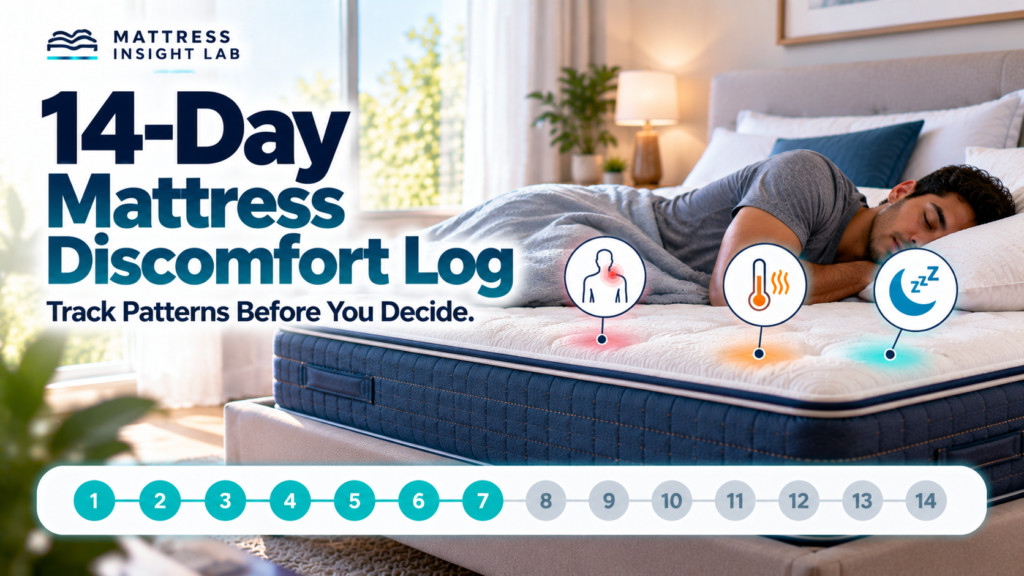
The 14-day evidence log is a structured way to record how your mattress feels across repeated nights. Instead of making a mattress decision from one bad night, the template helps you observe whether the problem repeats under similar conditions.
Section source routing: Lane 1 for user-logged data. Lane 4 for house labels.
Why Track Evidence Before Taking Action?
Mattress discomfort can come from several sources: mattress support, comfort-layer pressure, heat retention, protector or topper effects, pillow mismatch, room conditions, or mixed causes. A short evidence log helps separate repeated patterns from random bad nights.
What Counts as a Useful Pattern?
A useful pattern is a repeated signal across multiple nights. Examples include repeated hip pressure on side-sleeping nights, repeated heat scores above 7, repeated low morning comfort scores, or discomfort that appears only when a protector or topper is used.
Fig A: The log turns repeated observations into practical next-action routing.
Bridge to next step: after defining the evidence log, the next job is explaining how to use it without overclaiming the result.
How Should You Use the 14-Day Log?
Use the log once each morning. Record the sleep position, main discomfort area, heat level, tossing level, mattress sink feel, surface setup, room condition, and morning comfort score. The goal is not perfect measurement. The goal is consistent observation.
Section source routing: Lane 1 for daily entries. Lane 3 for reliability logic.
What Should Stay Consistent During the Test?
- Use the same pillow if possible.
- Do not switch toppers halfway through unless you are intentionally testing a surface change.
- Record room condition honestly, especially if heat or humidity changes.
- Do not judge the mattress from one night only.
What Makes the Result More Reliable?
The result becomes more useful when at least 7 days are filled, the same sleep position appears repeatedly, and the pattern is not randomly scattered across unrelated symptoms.
Bridge to next step: once the use rules are clear, the tracker can collect evidence and generate a practical interpretation.
14-Day Mattress Discomfort Evidence Tracker
Fill the log for each day. The result panel updates automatically and saves in this browser. Use the final output as a routing guide, not as a medical or warranty conclusion.
Interactive 14-Day Evidence Log
Every change updates the result, reliability, and next action.
Keyboard note: move through each day with Tab. On mobile, each day appears as a stacked card to avoid horizontal table friction.
Live Progress
0/14 days logged
Start with Day 1. The full result will appear below the log after you enter enough days.
| Day | Sleep Position | Main Discomfort | Heat Level | Tossing | Sink Feel | Surface Setup | Room Condition | Morning Comfort | Signal | Notes |
|---|
Primary Pattern
Not enough data yet
Fill at least a few days to see whether your discomfort pattern points toward pressure, heat, surface layers, environment, mixed causes, or an inconclusive pattern.
Evidence Summary
Next Action
Start logging. After several filled days, this panel will suggest whether to use the Master Sleep Environment Analyzer, Heat Retention Checker, Firmness Estimator, Replacement Checker, or repeat the test with tighter conditions.
Reliability Warning
Low reliability until enough days are filled.
Bridge to next step: after the tracker identifies a pattern, the reader should review missed variables before making a mattress decision.
How Should You Review the Pattern?
The result should be treated as a next-test guide. A pressure pattern should lead to alignment or firmness review. A heat pattern should lead to heat-retention or surface-layer testing. An environment pattern should lead to room and bedding checks before blaming the mattress.
Section source routing: Lane 2 for aggregation logic. Lane 4 for house routing labels.
What If the Result Is Mixed?
A mixed result means the mattress may not be the only source of discomfort. In that case, isolate one variable at a time: surface layer first, then room condition, then mattress support or replacement risk.
What If the Result Is Inconclusive?
An inconclusive result usually means too few days are filled, the sleep position changes too much, or symptoms are scattered. Repeat the log for another week using the same pillow, similar bedding, and similar surface setup.
Summary & Next Steps
This template helps users avoid one-night mattress decisions by collecting repeated evidence over 14 days. The honest output is a routing signal, not a final medical conclusion. Use it to decide which tool or test should come next.
Named Background References
- MattressInsightLab 14-Day Evidence Log House Method v1.0. Used for daily tracking structure, pattern grouping, reliability logic, and next-action routing.
- MattressInsightLab House Labels v1.0. Used for Pressure Pattern, Heat Pattern, Surface-Layer Pattern, Environment Pattern, Mixed Pattern, and Inconclusive Pattern.