How Customer Reviews and Feedback Should Be Used Before Buying
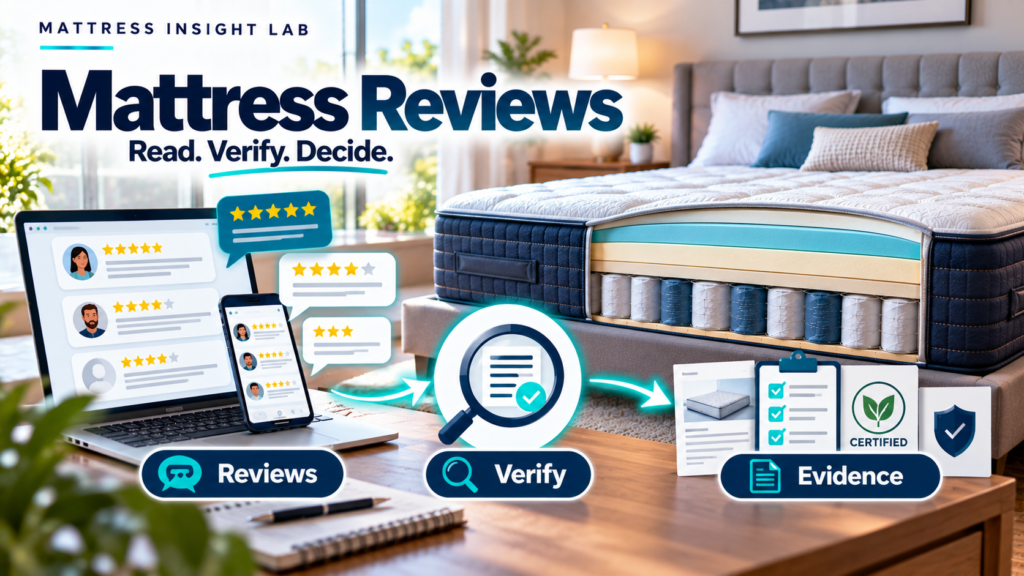
Customer reviews are best used as experience reports and hypothesis-generating evidence — not as direct measurements of mattress quality, defect rates, biomechanics, chemical emissions, or future durability. Use them to identify questions worth verifying against specifications, policies, certifications, and independent testing.
This page is a review-evidence audit. It separates what reviews can reasonably contribute from what requires a more appropriate evidence source. The goal is not to weight reviews more cleverly; it is to route each claim to the evidence best suited to evaluate it. FTC guidance, enforcement material, the Review Rule, RTI mattress research, and review-selection-bias literature were checked September 15, 2026. [1] [2] [3] [4] [5] [6]
What Can Customer Reviews Actually Tell You About a Mattress?
A customer review can tell you what one person experienced; it cannot tell you what the mattress objectively is. Reviews describe perception under one person’s conditions. They are not measurements, and they do not propagate upward into component, assembly, or measured-performance claims.
That distinction is the foundation of the audit. Reviews are useful for identifying what to investigate. Technical, certification, performance, and contractual questions should then be evaluated with evidence appropriate to the specific claim rather than inferred from review anecdotes alone.
Which Parts of a Review Describe a Buyer’s Personal Experience?
Statements about how the mattress felt, how the reviewer slept, and what they noticed are personal experience reports. They describe a user’s perception under their own conditions. Experience reports are useful for identifying what to investigate; they do not establish objective properties.
Which Review Claims Are Subjective Fit or Preference Reports?
Firmness feel, comfort, pressure sensation, warmth sensation, motion sensation, edge feel, odor perception, and perceived change over time are subjective fit or preference reports. These describe the reviewer’s experience, not a measured property. Subjective reports are useful for pattern identification; they do not establish objective values.
Which Claims Would Require Product Specifications, Testing, Certification, or Policy Evidence?
Claims about firmness value, spinal alignment, interface pressure, thermal performance, VOC/toxicity, motion-isolation value, edge-load performance, defect prevalence, lifespan, return policy, and warranty coverage require evidence appropriate to the claim. Each claim type has a matching evidence type — specification, test, certification, or policy. Reviews can surface the question; the appropriate evidence answers it.
Why Can Reviews Reveal Questions and Patterns Without Proving Their Cause?
Recurring experiences can identify a question worth investigating; they do not establish the cause of the experience. Reviews are uncontrolled observations. The cause of a reported experience may involve scale differences, expectations, model variation, bedding, body characteristics, or measurement conventions. Pattern identification is a hypothesis-generation step; verification requires appropriate evidence.
Why Should Reviews Support Rather Than Replace the Rest of the Mattress Evaluation?
FTC consumer guidance recommends reading reviews critically and checking several sources alongside broader product and seller research. [1] [9] Reviews can identify questions; specifications, testing, certifications, and applicable written policies provide more appropriate evidence for evaluating those specific questions. None of those evidence types should be treated as automatically proving more than its defined scope.
What Do Star Ratings and Review Counts Leave Out?
A star average is a summary of posted ratings; it is not a measurement of mattress quality. The average compresses the underlying corpus, and the corpus is the evidence. Review count is a volume indicator, not a confirmed owner count.
Why Should the Average Star Rating Not Be Used Alone?
FTC consumer guidance advises people not to rely on star ratings alone because reviews and ratings can be fake, deceptive, or misleading, and recommends checking several sources plus reviewer history and timing. [1] A star average is therefore a navigation aid, not a mattress-quality measurement.
What Does the Rating Distribution Add Beyond the Average?
The distribution shows how ratings are spread; it can reveal patterns the average hides. Distribution shape is still a summary of posted ratings, not a measurement of quality. Treat it as a pattern-locator, not a quality score.
Why Does a Large Review Count Not Confirm That Every Review Reflects Meaningful Product Use?
In the FTC's Sitejabber matter, ratings and reviews were collected at the time of purchase before customers had received or had the opportunity to experience the products or services, and the FTC approved a final order in January 2025. [2] That enforcement matter is Sitejabber-specific; the narrower lesson is that a review count does not by itself prove meaningful product use.
How Can Self-Selection Affect Which Customers Leave Reviews?
Online-review populations can be affected by self-selection. Li and Hitt's peer-reviewed analysis examines how differences among consumers who self-select into purchase/review behavior can bias online product-review information. [5] Voluntary review submission should therefore not be treated as a random sample of all owners, and the direction or magnitude of bias should not be assumed without evidence.
How Can Review Collection or Moderation Affect the Displayed Rating?
In the FTC's Fashion Nova matter, the agency alleged that four- and five-star reviews were automatically posted while lower-star reviews were held for approval; the FTC later finalized the order. [3] That case is Fashion-Nova-specific, but it illustrates why moderation practices can affect the displayed review corpus.
Why Should Rating Numbers Be Used to Locate Review Patterns Rather Than Declare Mattress Quality?
Rating numbers are useful for locating patterns in the underlying corpus; they are not quality measurements. Use ratings to navigate; use the corpus to interpret.
What Does a “Verified Purchase” Label Really Establish?
A verified-purchase label may indicate that the review satisfied the platform's purchase-verification criteria. What was actually verified—purchase, buyer/user status, product identity, fulfillment, or something else—depends on the platform's definition. FTC guidance distinguishes open review systems from closed systems limited to verified buyers/users and notes that neither is immune to fake reviews. [7] The label does not by itself establish truthful content or meaningful product use.
Does the Label Verify a Purchase Through That Platform?
The label may indicate that platform-defined verification criteria were satisfied. Check the platform’s definition before inferring what was actually verified; treat the badge as provenance context, not a truth claim.
Does It Verify That the Reviewer Received the Exact Product?
Purchase verification does not by itself establish that the reviewer received the exact product version being evaluated. Purchase occurrence and product receipt are distinct events, and product identity requires separate verification.
Does It Verify How Long the Reviewer Used the Mattress?
Purchase verification does not establish duration of use. Purchase occurrence and meaningful product use are distinct events. Duration requires separate evidence, such as a stated ownership duration.
Does It Verify That the Review Is Honest or Factually Accurate?
Purchase verification does not establish that the review is honest or factually accurate. Verification is about provenance, not content truth. Honesty and accuracy require separate evidence.
Can Purchase-Verification Information Still Add Useful Context?
Yes — purchase verification can provide useful provenance information where the platform’s definition is clear. Provenance is one input among several. Use verification as context, not as an automatic credibility multiplier.
Why Should the Meaning of the Platform’s Verification Label Be Checked Before Giving It Extra Weight?
Verification systems differ by platform; the label’s meaning depends on the platform’s rules. A badge is only as informative as the platform’s definition. Check the definition before weighting.
How Should Review Date, Mattress Version, and Ownership Duration Be Used?
Review date, mattress version, and ownership duration are three separate clocks; each answers a different question. No verified source establishes a universal “newer is better” or “older is better” rule. Temporal relevance is question-dependent.
When Was the Review Posted?
The post date establishes when the review was published; it does not establish how long the reviewer owned the mattress. Use post date to assess relevance to current product or policy questions.
Which Mattress Model or Version Was the Reviewer Describing?
Reviews should be matched to the exact model and version. The same model name does not guarantee identical construction across years. Verify version identity before applying the review.
How Long Had the Reviewer Actually Owned or Used the Mattress?
Stated ownership duration establishes elapsed-use context; it does not establish product lifespan or failure probability. Ownership duration is one reviewer’s elapsed time, not a controlled durability cohort. Use it to interpret the review’s scope.
Is a Recent Review More Relevant to Current Product or Policy Questions?
A recent review may better match a current model or policy; it is not automatically superior for all questions. Recency is question-dependent. Match recency to the question being investigated.
Can an Older Review Provide Longer-Use Context if the Mattress Version Is Still Comparable?
An older review may contain longer-duration ownership information if the mattress version is still comparable. Older reviews can carry longer elapsed-use context. Use them for longer-use context when version identity is comparable, without treating them as durability evidence.
Why Should First-Week Feedback Not Be Used as Long-Term Durability Evidence?
First-week feedback describes initial experience; it cannot establish long-term durability. Durability assessment requires suitable evidence such as standardized repeated-load or fatigue testing, longitudinal field data, warranty/service data, or other appropriately designed reliability evidence.
Why Should Long-Ownership Feedback Still Remain an Individual Experience Rather Than a Lifespan Estimate?
Long-ownership feedback describes one reviewer’s experience; it does not establish product lifespan or failure probability. Review populations are not controlled durability cohorts. Use long-ownership feedback as individual experience, not as a lifespan estimate.
How Much Should Reviewer Sleep Position, Body Characteristics, and Household Context Matter?
Reviewer context helps you interpret an experience; it does not predict your own. In RTI's study of 128 healthy adults using seven innerspring mattress conditions, mattress firmness affected sleep-related outcomes and individuals varied widely in which firmness performed best for them. [6] That study-specific finding does not create a validated reviewer-similarity formula.
Does the Reviewer State Their Normal Sleep Position?
Stated sleep position helps contextualize the reviewer’s experience. Sleep position is one context field among several. Use it to interpret, not to predict.
Do They Provide Relevant Body-Size or Loading Context?
Body-size or loading context helps interpret the reviewer’s experience. Loading context is one context field among several. Use it to interpret, not to predict.
Is the Mattress Shared With a Partner?
Partner use is a context field that can affect the reviewer’s experience. Shared use is one context field among several. Use it to interpret, not to predict.
Are Bedding, Room Conditions, or Support Base Relevant to the Complaint?
Bedding, room conditions, and support base can affect the reviewer’s experience. Environmental and support context are context fields among several. Use these fields to interpret, not to predict, and avoid attributing a complaint to the mattress without considering context.
Does the Reviewer’s Context Help Explain the Experience Without Predicting Yours?
Reviewer context helps explain the reviewer's experience; it does not predict your own. RTI found wide individual variation in firmness-related sleep outcomes among 128 healthy adults. [6] Use context to interpret, not to predict.
Why Should Similar Sleeper Characteristics Increase Context Rather Than Create an Automatic Recommendation?
Similarity cues contextualize an experience; they do not establish outcome equivalence. Individual mattress response varies substantially. Use similarity as context, not as a recommendation, and do not build a similarity score.
Which Product-Experience Patterns Should You Look for Across Mattress Reviews?
Product-experience patterns are recurring subjective reports; they identify questions, not measurements. No verified source establishes that reviews measure firmness, pressure, thermal performance, motion isolation, edge-load performance, odor chemistry, or durability. Every theme below is subjective user experience.
| Experience theme | What reviewers report | What it can identify | What it cannot establish |
|---|---|---|---|
| Perceived firmness and general comfort | Subjective feel and comfort impressions | A question about firmness feel | Objective firmness value |
| Pressure or support sensation | Subjective pressure and support impressions in normal sleeping positions | A question about pressure or support feel | Interface pressure or spinal alignment |
| Overnight warmth or temperature comfort | Subjective warmth impressions | A question about thermal comfort | Measured thermal performance |
| Partner movement or repositioning | Subjective disturbance impressions in shared beds | A question about motion feel | Motion-isolation value |
| Edge behavior | Subjective impressions of sitting or sleeping near the edge | A question about edge feel | Standardized edge-load performance |
| Initial or persistent odor | Subjective odor impressions | A question about odor perception | VOC concentrations or chemical safety |
| Perceived change over time | Subjective impressions of softness, impressions, support feel, or edge behavior in longer-ownership reviews | A question about perceived change | Durability, failure rate, or lifespan |
What Do Reviewers Repeatedly Say About Perceived Firmness and General Comfort?
Reviewers report perceived firmness and general comfort as subjective experiences. Perceived firmness and comfort are subjective fit reports. Use these reports to identify questions, not to establish objective firmness. “Too firm” and “too soft” are not objective firmness measurements.
What Do They Report About Pressure or Support Sensations in Their Normal Sleeping Positions?
Reviewers report pressure or support sensations as subjective experiences. Pressure and support sensations are subjective fit reports. Use these reports to identify questions, not to establish pressure or alignment. Subjective pressure complaints are not objective pressure-map data.
What Do They Report About Overnight Warmth or Temperature Comfort?
Reviewers report overnight warmth or temperature comfort as subjective experiences. Warmth reports are subjective experience reports. Use these reports to identify questions, not to establish thermal performance. “Slept hot” is not a measured thermal conductivity or airflow value, and “hot sleeper” is not a standardized user category.
What Do Shared-Bed Reviewers Report About Partner Movement or Repositioning?
Shared-bed reviewers report partner movement or repositioning as subjective experiences. Motion reports are subjective experience reports. Use these reports to identify questions, not to establish motion-isolation values. Partner-disturbance anecdotes are not objective motion-isolation measurements.
What Do Users Report About Sitting or Sleeping Near the Mattress Edge?
Users report edge behavior as subjective experiences. Edge reports are subjective experience reports. Use these reports to identify questions, not to establish edge-load performance. Edge complaints are not standardized edge-load test results.
What Do Reviewers Report About Initial or Persistent Odor?
Reviewers report odor as a subjective experience. Odor reports are subjective experience reports. Use these reports to identify questions, not to establish VOC concentrations or toxicity. Odor descriptions, duration, or intensity do not establish chemical safety.
What Changes Do Longer-Ownership Reviews Describe in Softness, Impressions, Support Feel, or Edge Behavior?
Longer-ownership reviews describe perceived changes in softness, impressions, support feel, or edge behavior. These are subjective perceptions of change over time. Use these reports to identify questions, not to establish durability or failure rates. Perceived change is not a durability measurement or lifespan estimate.
Are Similar Experiences Appearing Across More Than One Review Source?
FTC consumer guidance recommends checking several review sources. However, “multiple sources” is not mechanical — syndicated, copied, or shared review feeds are not necessarily independent corroboration. Cross-source agreement increases attention; it does not establish defect prevalence or causation. Use cross-source agreement to prioritize questions.
Why Does a Recurring Experience Pattern Identify a Question to Investigate Rather Than Prove an Engineering Cause?
A recurring experience pattern identifies a question; it does not establish the cause. Reviews are uncontrolled observations. The cause may involve scale differences, expectations, model variation, bedding, body characteristics, or measurement conventions. Use patterns to generate verification questions.
Which Mattress Claims Can Customer Reviews Not Prove?
Reviews can surface a question about a technical claim; they cannot answer it. No verified source establishes review-based technical measurement. Each claim below requires evidence appropriate to that claim.
| Claim | What reviews can provide | Evidence that can answer it |
|---|---|---|
| Firmness value | Perceived firmness reports | Specifications or appropriate test methods |
| Spinal alignment or mattress-caused pain | User-reported experiences | Appropriate clinical or biomechanical evidence |
| Interface pressure | Pressure sensation reports | Appropriate instrumentation |
| Thermal performance | Warmth reports | Appropriate thermal measurement |
| VOC concentration or chemical safety | Odor reports | Appropriate chemical testing |
| Motion-isolation value | Partner-disturbance anecdotes | Standardized motion testing |
| Edge-load performance | Edge-feel reports | Standardized edge-load testing |
| Defect prevalence | Recurring complaint themes | Defined population/denominator, exposure time, reliable failure definition, and representative data |
| Lifespan or failure rate | Long-ownership reports | Validated longitudinal studies or representative field data |
Can Reviews Objectively Measure Mattress Firmness? No — reviews report perceived firmness; they do not measure firmness. Firmness measurement requires appropriate test methods. Use reviews to identify firmness questions; use specifications or tests to answer them.
Can Reviews Prove Spinal Alignment or Diagnose Mattress-Caused Pain? No — reviews report user experiences; they do not establish spinal alignment or diagnose mattress-caused pain. Alignment and pain causation require appropriate clinical or biomechanical evidence. Treat pain reports as user experiences requiring appropriate evidence, not as diagnostic findings.
Can Reviews Measure Interface Pressure? No — reviews report pressure sensations; they do not measure interface pressure. Interface pressure measurement requires appropriate instrumentation. Use reviews to identify pressure questions; use appropriate measurement to evaluate them.
Can “Sleeping Hot” Reports Prove a Cooling Mechanism Works or Fails? No — warmth reports are subjective experiences; they do not establish thermal performance. Thermal performance requires appropriate measurement. Use warmth reports to identify questions; use appropriate thermal evidence to evaluate them.
Can Odor Reports Establish VOC Concentrations or Chemical Safety? No — odor reports are subjective; they do not establish VOC concentrations or chemical safety. Chemical safety requires appropriate testing. Use odor reports to identify questions; use appropriate chemical/emissions evidence to evaluate them.
Can Motion or Edge Reviews Replace Standardized Performance Testing? No — motion and edge reviews are subjective experiences; they do not replace standardized performance testing. Motion-isolation and edge-load performance require appropriate testing. Use reviews to identify questions; use evidence appropriate to the claim to evaluate them.
Can Sagging Complaints Establish a Manufacturing Defect or Warranty Qualification? No — sagging complaints are user reports; they do not establish a manufacturing defect or warranty qualification. Warranty qualification requires checking the warranty threshold and support conditions. Use sagging complaints to identify questions; check the warranty terms to answer them.
Can Review Frequency Establish the Percentage of Mattresses That Will Fail? No—review frequency cannot establish a mattress failure percentage. Estimating failure incidence requires a defined population or denominator, appropriate exposure time, reliable failure definitions, and data sufficiently representative of the population being evaluated. Review counts alone do not provide those elements reliably.
Why Should Technical Claims Be Cross-Checked With the Evidence Appropriate to That Claim? FTC consumer guidance recommends checking reviews alongside product and seller research. Technical claims require evidence appropriate to the claim. Each claim type has a matching evidence type. Route each claim to the appropriate evidence.
How Should Mattress Feedback Be Separated From Delivery, Return, and Warranty Feedback?
A review may involve the manufacturer, retailer, marketplace seller, warehouse, carrier, or setup contractor; attribution must be checked before drawing a product conclusion. Seller-service complaints are not product-performance proof, and return or warranty complaints should be checked against written policy.
Is the Review About the Mattress Itself? Some reviews concern the mattress itself; others concern the seller, carrier, or setup. Attribution must be checked before drawing a product conclusion. Classify the review by subject before using it.
Is It About the Retailer or Marketplace Seller? Some reviews concern the retailer or marketplace seller. Seller feedback is distinct from product feedback. Classify seller feedback separately, and do not attribute retailer problems automatically to the manufacturer.
Is It About Shipping or the Delivery Carrier? Some reviews concern shipping or the delivery carrier. Carrier feedback is distinct from product feedback. Classify carrier feedback separately, and do not attribute delivery problems to mattress design.
Is It About In-Home Setup? Some reviews concern in-home setup. Setup feedback is distinct from product feedback. Classify setup feedback separately, and do not attribute setup problems to the mattress.
Is It About Return Pickup or Refund Processing? Some reviews concern return pickup or refund processing. Return feedback is distinct from product feedback. Classify return feedback separately, and check the written policy. A return complaint does not by itself prove the current policy is weak.
Is It About a Warranty Claim? Some reviews concern warranty claims. Warranty feedback is distinct from product feedback. Classify warranty feedback separately, and check the written policy. A warranty complaint does not by itself prove the claim should have been approved.
Does the Review Describe the Current Written Policy or an Older One?
A historical review may describe terms that applied to that customer's transaction rather than today's policy. Where records are available, compare the complaint with the policy and other terms applicable to that transaction. For your own purchase, use the current applicable written policy and retain a dated copy, subject to applicable law and any separate statutory, warranty, or payment rights. FTC guidance recommends keeping receipts, warranties, contracts, communications, and related transaction records. [8]
Why Should a Seller-Service Complaint Not Be Used as Product-Performance Proof? Seller-service complaints concern the seller, not the mattress. Attribution must be checked before drawing a product conclusion. Classify the review by subject before using it.
Why Should a Customer’s Interpretation of a Return or Warranty Dispute Be Checked Against the Applicable Written Terms?
A customer's interpretation of a dispute should be checked against the terms and records applicable to that transaction where available. A complaint alone does not establish breach, and written policy is not necessarily the only relevant source because representations, warranty rights, payment protections, and applicable law can also matter. [8]
How Should Positive, Negative, and Incentivized Reviews Be Interpreted?
Sentiment is not evidence; content and disclosed relationships are. Review credibility research spans source, review, consumer, interpersonal and platform, and product characteristics; credibility is a consumer assessment, not direct proof of factual truth.
What Specific Information Does the Review Provide Regardless of Star Rating? Focus on the specific information the review provides, regardless of star rating. Credibility is multifactorial. Use content, not sentiment, as the primary signal.
Does the Reviewer Explain the Relevant Product, Timing, and Circumstances?
Reviews that explain product, timing, and circumstances are easier to interpret. Context improves interpretability. Use context to interpret the review, without treating context as proof of truthfulness.
Why Is Emotional Language Not Enough to Dismiss a Negative Review? Emotional language does not automatically make a negative review weak; fake reviews can be positive or negative. Sentiment is not a credibility signal. Evaluate content, not tone.
Why Is Detailed Praise Not Proof That a Positive Review Is Authentic? Detail improves interpretability; it does not establish truth. Credibility is multifactorial, and fake reviews can use less-than-perfect ratings to appear authentic. Evaluate content, not detail alone.
Was a Free Product, Discount, Payment, Commission, or Other Material Relationship Disclosed?
Material incentives can affect how consumers weigh a review and may require appropriate disclosure. Disclosure is a context field. Check for disclosure.
Is the Content Actually a Customer Review — or an Affiliate, Influencer, or Sponsored Endorsement?
Customer reviews and affiliate or sponsored endorsements are distinct evidence types; both may require disclosure. Different content types have different disclosure rules. Classify the content type before weighting.
Why Is an Incentivized Review Not Automatically Fake or Illegal? The FTC Review Rule does not categorically prohibit incentives for honest consumer reviews when compensation is not expressly or implicitly conditioned on positive or negative sentiment; separate disclosure obligations can still apply. [4] [10] Incentive status is relevant context, not an automatic verdict.
Why Does an Incentive Still Matter When Deciding How Much Weight to Give the Endorsement?
Material incentives can affect how consumers weigh a review. Incentive status is a context field. Use incentive status as context, not as an automatic authenticity verdict.
How Should Fake or Manipulated Review Risk Be Handled Without Pretending You Can Detect Every Fake?
Fake reviews often cannot be reliably identified from appearance; use risk indicators to trigger verification, not accusation. FTC consumer guidance says it can be nearly impossible to tell for sure whether a review is real or fake just by looking at it. [1]
Does the Platform Explain How Reviews Are Collected?
Verify what a platform’s review collection process actually establishes. Collection transparency is a risk indicator. Use transparency to interpret the corpus, without assuming that transparency guarantees authenticity.
Can Reviewers Post Before Receiving or Meaningfully Using the Product?
In the FTC’s Sitejabber matter, some ratings were collected at checkout before customers had received or used the products. That matter is Sitejabber-specific and should not be read as a general rule about mattress review platforms. The general point is that purchase occurrence and meaningful product experience are distinct, so check whether the platform allows pre-experience posting.
Is There an Unusual Burst or Timing Pattern That Deserves More Checking?
Unusual bursts are a reason for additional scrutiny, not proof of manipulation. Bursts are a risk indicator. Use bursts to trigger verification.
Does the Reviewer Have a Broader Review History?
FTC consumer guidance recommends checking reviewer history. Reviewer history is a context field. Use reviewer history as context, not as a conclusive signal.
Is the Seller Presenting Its Own Review Content as Independent?
The FTC Consumer Reviews and Testimonials Rule addresses misrepresentation of company-controlled entities as independent review sources. Independence is a context field. Check whether the source is independent, without accusing a seller of violation solely because reviews appear suspicious.
Could Negative Reviews Have Been Selectively Suppressed?
In the FTC’s Fashion Nova matter, lower-starred reviews were alleged to have been withheld while higher-starred reviews were published. That matter is Fashion-Nova-specific and does not establish that seller websites generally suppress negative reviews. The general point is that suppression is a corpus-level risk; compare seller-hosted reviews with other sources when possible.
Are Review Incentives or Insider Relationships Disclosed Where Required?
The FTC Rule addresses specified insider reviews and sentiment-conditioned incentives; material incentives may require disclosure. Disclosure is a context field. Check for disclosure, without treating undisclosed incentives as automatically illegal without checking the rule’s scope.
Why Should Wording, Grammar, Emotion, or Rating Alone Never Be Treated as Conclusive Fake-Review Evidence?
FTC consumer guidance warns that appearance alone is unreliable: fake positive reviews may use less-than-perfect ratings to seem authentic, and fake negative reviews can target competitors. [1] Treat wording, grammar, emotion, and rating as risk indicators—not proof.
Why Should Suspicion Trigger Cross-Checking Rather Than a Declaration That the Review Is Fake?
Suspicion should trigger cross-checking, not a declaration that the review is fake. Fake reviews often cannot be reliably identified from appearance. Use suspicion to prioritize verification.
How Should Reviews Be Cross-Checked With Other Evidence Before Buying?
Cross-checking converts review patterns into verifiable purchase questions. FTC consumer guidance recommends checking several review sources alongside product and seller research, exact-product identification, and policy review.
Compare Reviews From More Than One Review Source
FTC consumer guidance recommends checking several review sources. Multiple sources can reveal patterns one source hides. Use multiple sources to prioritize questions, without treating multiple sources as automatically independent.
Check Whether Different Sources Are Actually Independent or Simply Syndicating the Same Reviews
Syndicated, copied, or shared review feeds are not necessarily independent corroboration. Independence is a context field. Check source independence before counting corroboration.
Match the Review to the Exact Mattress Model and Version
Match the review to the exact model and version before applying it. Model names can persist across construction changes. Verify version identity.
Compare Firmness and Construction Feedback With the Manufacturer’s Actual Specifications
Compare review feedback with the manufacturer’s actual specifications. Specifications are the appropriate evidence for declared product attributes. Use reviews to identify questions; use specifications to answer them.
Compare Certification Claims With the Certifier’s Own Records
Compare certification claims with the certifier’s own records. Certifications are the appropriate evidence for certification claims. Use reviews to identify questions; use certifier records to evaluate certification claims.
Compare Return, Trial, and Warranty Complaints With the Current Written Policy
For historical complaints, compare the review with the policy and transaction terms that applied at the time when those records are available. For your own purchase, use the current applicable written policy and save a dated copy, while recognizing that warranty, statutory, and payment rights can also matter. [8]
Compare Objective Performance Claims With Independent Testing Where Suitable Evidence Exists
Compare objective performance claims with independent testing where suitable evidence exists. Objective performance requires appropriate testing. Use reviews to identify questions; use appropriate testing to evaluate objective performance claims.
Use Review Patterns to Decide Which Questions Matter Most During the Sleep Trial
Use review patterns to decide which questions matter most during the sleep trial. Reviews generate hypotheses; the trial tests them. Use patterns to prioritize trial observations, not as trial outcomes.
Why Should Agreement Across Several Sources Increase Attention Without Becoming Proof of Defect Prevalence or Causation?
Cross-source agreement increases attention; it does not establish defect prevalence or causation. Review counts lack a controlled denominator, and reviews do not establish causation. Use agreement to prioritize questions.
What Is the Best Way to Use Customer Reviews Before Buying a Mattress?
Use reviews to identify questions; use the appropriate evidence to answer them; make the purchase decision from the combined evidence package. The workflow below is a reusable review-evidence audit, not a review-weighting algorithm.
Start With the Exact Mattress Model and Current Version
Start with the exact mattress model and current version. Version identity anchors the review corpus. Match reviews to the exact model and version, and do not assume the same model name means identical construction.
Look Beyond the Average Star Rating to the Underlying Review Content
Look beyond the average star rating to the underlying review content. Averages compress the corpus. Use the corpus as the evidence.
Check What Any Verified-Purchase or Reviewer Badge Actually Means
Check what the platform's verification label actually means. FTC guidance shows that review systems use different collection/verification structures. [7] Use the label as provenance context, not as a truth badge.
Record Review Date Separately From Claimed Ownership Duration
Record review date separately from claimed ownership duration. Post date and ownership duration are separate clocks. Use each clock for its own question.
Use Sleep Position, Body Context, Partner Use, and Environment Only to Interpret Relevance — Not to Predict Identical Results
Use reviewer context to interpret relevance, not to predict identical results. Individual mattress response varies substantially. Use context to interpret, not to predict, and do not build a similarity score.
Group Reviews Into Product Experience, Delivery, Seller Service, Returns, and Warranty Categories
Group reviews into product experience, delivery, seller service, returns, and warranty categories. Attribution must be checked before drawing conclusions. Classify by subject.
Look for Recurring Experiences Without Treating Their Frequency as a Defect Rate
Look for recurring experiences without treating their frequency as a defect rate. Review counts lack a controlled denominator. Use frequency to prioritize questions.
Separate Subjective Fit Reports From Claims Requiring Technical Evidence
Separate subjective fit reports from claims requiring technical evidence. Each claim type has a matching evidence type. Route each claim to the appropriate evidence.
Check Incentives and Material Relationships
Check incentives and material relationships. Material incentives may require disclosure. Use incentive status as context, not as an automatic verdict.
Treat Suspicious Review Patterns as Reasons for Additional Verification Rather Than Automatic Proof of Manipulation
Treat suspicious patterns as reasons for additional verification, not as automatic proof of manipulation. Fake reviews often cannot be reliably identified from appearance. Use suspicion to trigger verification.
Compare Several Genuinely Distinct Sources Where Possible
Compare several genuinely distinct sources where possible. Syndicated feeds are not independent corroboration. Check source independence.
Verify Material Specifications, Certifications, Policies, and Technical Claims Outside the Review Corpus
Verify material specifications, certifications, policies, and technical claims outside the review corpus. Each claim type has a matching evidence type. Route each claim to the appropriate evidence.
Use Unresolved Review Concerns to Decide What to Observe During the Sleep Trial
Use unresolved review concerns to decide what to observe during the sleep trial. Reviews generate hypotheses; the trial tests them. Use concerns to prioritize trial observations, not as trial outcomes.
Make the Purchase Decision From the Combined Evidence Package, Not From Review Sentiment Alone
Make the purchase decision from the combined evidence package, not from review sentiment alone. Reviews are one input among several. Combine reviews with specifications, tests, certifications, and policies. Reviews inform what might happen; return, trial, and warranty policy determines what the buyer can do. These are separate risk dimensions and do not mathematically offset.
The core discipline: reviews are experience reports and hypothesis-generating evidence. They can tell you what one person experienced and what questions are worth investigating. They cannot measure firmness, alignment, pressure, thermal performance, VOC concentration, motion isolation, edge-load performance, defect prevalence, or lifespan. Route each claim to the evidence type that can actually answer it, and make the purchase decision from the combined evidence package.
Sources and References
- FTC Consumer Advice — How To Evaluate Online Reviews. Star ratings, multiple sources, reviewer history, review bursts, incentives, and limits of visual fake-review detection.
- FTC — Final Sitejabber Order (January 2025). Ratings/reviews collected before customers received or experienced products/services.
- FTC — Final Fashion Nova Order. Suppression of lower-star reviews and review-display practices.
- FTC — Consumer Reviews and Testimonials Rule: Questions & Answers. Fake/false reviews, insider reviews, incentives, sentiment conditioning, suppression, and rule scope.
- Li, X. & Hitt, L. M. — Self-Selection and Information Role of Online Product Reviews. Peer-reviewed review self-selection bias framework.
- RTI Press — Choosing a Mattress: Using Actigraphy and Diary Reports. 128 healthy adults, seven innerspring mattress conditions, firmness effects, and wide individual variation.
- FTC — Featuring Online Customer Reviews: A Guide for Platforms. Open versus closed review systems, verified-buyer/user systems, moderation, and incentivized reviews.
- FTC Consumer Advice — Solving Problems With a Business. Return policies, receipts, warranties, contracts, communications, and transaction records.
- FTC Consumer Advice — Online Shopping. Use of reviews alongside broader product/seller research and record retention.
- FTC — Final Rule Banning Fake Reviews and Testimonials. Rule scope, fake/false reviews, sentiment-conditioned incentives, insider reviews, and review suppression.