What Temperature Regulation and Airflow Factors Matter Before Buying?
Mattress temperature regulation is not one standardized property. It involves multiple heat-transfer and moisture-transfer mechanisms interacting with bedding, room conditions, and the sleeper’s body. Before buying, evaluate specific measurable properties and product-specific evidence rather than relying on material stereotypes or “cooling” buzzwords.
Reviews of sleep environments treat the mattress as one part of a thermal microclimate that also includes the sleeper’s body, bedding or sleepwear, and ambient conditions. [1] [11] A mattress participates in that system, but it does not act alone. Similarly, a 2025 systematic review and meta-analysis of randomized bedding-cooling studies found very-low- to low-certainty evidence: acute body cooling was observed in the qualitative evidence, but pooled analyses did not show consistent improvement across several major sleep outcomes. [8] That distinction—between changing body temperature and improving sleep—runs through everything below.
What Does Mattress “Temperature Regulation” Actually Mean?
“Temperature regulation” is not one standardized mattress score. It describes how the mattress participates in the body–bedding–room thermal system through multiple transfer mechanisms. The mattress is one component of a thermal microclimate that also includes the sleeper’s body heat, bedding, sleepwear, and ambient conditions. Reviews of sleep environments identify body temperature, bedding or sleepwear properties, and ambient conditions as interacting influences on the sleeping thermal microclimate. [1] [11]
How Do Body Heat, Mattress Materials, Bedding, and Room Conditions Form the Sleep Thermal Environment?
The mattress is one part of a thermal microclimate that also includes the sleeper’s body heat, bedding, sleepwear, and ambient conditions. The sleep-environment literature identifies body temperature, bedding or sleepwear, and ambient conditions as interacting influences on the sleeping thermal microclimate. [1] [11] The mattress participates but does not act alone.
Heat and moisture are exchanged among the sleeper, mattress surface, bedding, and surrounding air, forming a local microclimate that contributes to thermal perception. The mattress is one component of that system, not the sole determinant.
Why Is “Cooling” Different From One Measurable Thermal Property?
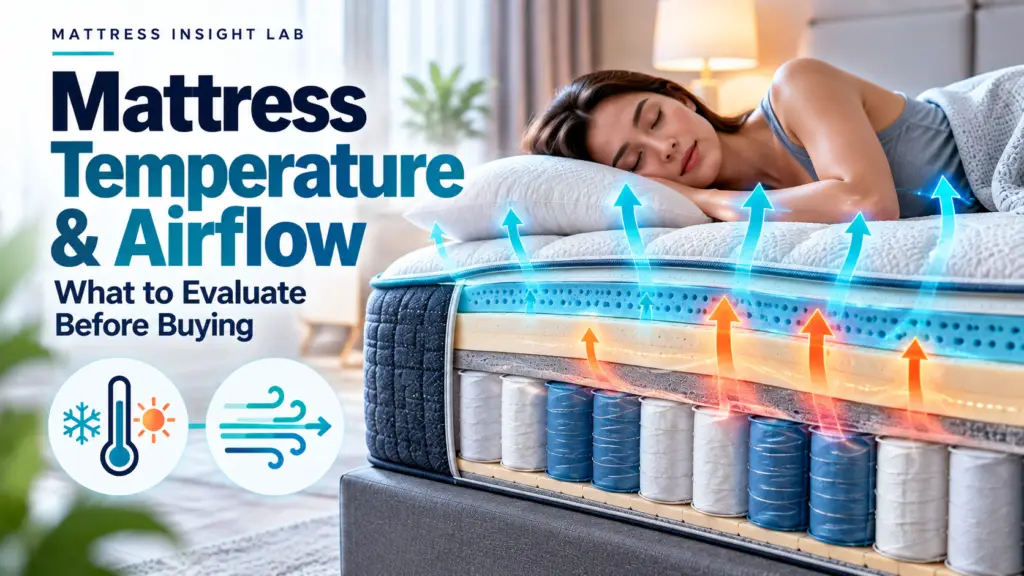
“Cooling” is a broad outcome that can reflect different heat-transfer processes, moisture-transfer processes, and thermal/transport properties. Conduction, convection, and radiation are heat-transfer modes; heat capacity, thermal conductivity, thermal resistance, air permeability, and water-vapor resistance describe different properties or resistances. [12] ISO 11092:2026 defines thermal resistance and water-vapor resistance as separate steady-state measurable properties for specified textile or textile-like materials and assemblies. [3] Experimental work on open-cell polyurethane foam separately measures pressure-drop/permeability-related flow behavior and heat-transfer behavior, showing that transport through porous foam cannot be reduced to one generic “breathability” value. [4] Human trials of specific engineered sleep surfaces show that high heat capacity and high thermal conductivity can alter body heat exchange under their tested conditions, but these are different physical properties and different interventions. [5] [7]
Different mechanisms lead to different measurements, which lead to different claims. “Breathable” is not a standardized technical synonym for all thermal mechanisms.
Which Quantities Can Be Measured—Surface Temperature, Core Temperature, Thermal Resistance, Moisture Transfer, or Subjective Thermal Comfort?
Measurable quantities and outcomes include surface temperature, core body temperature, thermal resistance, water-vapor resistance, and subjective thermal comfort. These describe different aspects of the system and should not be conflated. Human trials have measured skin and core body temperatures directly, while ISO 11092:2026 defines steady-state methods for measuring thermal and water-vapor resistance. [3] [5] [7] Subjective thermal comfort is a separate perceptual outcome.
Each measurement answers a different question about the thermal system. Surface temperature does not prove comfort; they are distinct outcomes.
Why Should Mattress Cooling Not Be Evaluated in Isolation From the Rest of the Sleep Environment?
Reviews of sleep thermal physiology treat bedding and the surrounding environment as interacting parts of the sleeping microclimate rather than assigning thermal comfort to the mattress alone. The sleep-environment literature treats bedding, sleepwear, body temperature, air temperature, humidity, airflow, and the bed microclimate as interacting variables rather than mattress-only effects. [1] [2] [11]
Mattress plus bedding plus room plus body produces the thermal experience. A mattress cooling claim must be interpreted within the full sleep environment, not as an isolated property.
Which Heat-Transfer Processes and Thermal Properties Matter Inside and Around a Mattress?
Fundamental heat transfer occurs by conduction, convection, and radiation. In and around a mattress, bulk air movement can contribute to convective heat transport, while water-vapor movement is a separate moisture-transfer process. Heat capacity, thermal conductivity, thermal resistance, air permeability, and water-vapor resistance are material or system properties—not additional heat-transfer modes. These processes and properties should be measured and interpreted separately. [12]
How Does Conduction Move Heat Between the Body and the Mattress Surface?
Conduction transfers heat through matter because of a temperature difference; at the body–mattress interface, direct contact permits conductive heat exchange. [12] A specifically engineered mattress can alter conductive body heat loss. In a controlled double-blind comparison involving 32 healthy middle-aged men, the high-heat-capacity mattress produced a greater decline in core body temperature through greater conductive heat transfer than the comparison mattress. [5]
Direct body–mattress contact permits conductive heat transfer. The direction and magnitude depend on the temperature gradient and the thermal properties of the contacting surfaces. In the cited high-heat-capacity mattress experiment, net conductive heat transfer increased away from the sleeper under the tested conditions. [5] Engineered differences can therefore change conductive heat exchange without implying that heat always flows away from the body.
What Does Heat Capacity Change About How a Surface Absorbs Heat Over Time?
Heat capacity describes how much thermal energy an object or system can absorb for a given temperature change. Greater effective heat capacity can allow a surface to absorb more energy before its temperature rises substantially, which can help sustain a temperature gradient and alter conductive heat exchange under suitable conditions. In the cited experiment, the high-heat-capacity mattress was associated with greater conductive heat loss and a larger decline in core body temperature than the comparison mattress. [5]
For a given temperature change, greater heat capacity means a body or material can absorb more heat; how that affects a sleeper depends on the complete intervention and boundary conditions. This is one intervention-specific finding, not a universal comfort rule.
How Is Air Movement Through Porous Material Different From Heat Conduction Through the Material?
Bulk airflow through connected pores can transport thermal energy by convection/advection, while conductive heat transfer can occur through both the foam's solid polymer skeleton and the gas occupying its pores. These contributions are physically distinct from bulk airflow and are measured differently. Laboratory work on open-cell polyurethane foam demonstrates measurable pressure drop and heat-transfer behavior and reports relationships involving foam geometry and permeability-related parameters. [4] ISO 11092:2026 separately defines thermal resistance and water-vapor resistance. [3]
Air permeability, conductive transport, and overall heat-transfer behavior should therefore be treated as separate properties or processes. More airflow does not automatically mean more cooling because the complete thermal response also depends on temperature gradients, material properties, geometry, radiation, moisture transfer, and boundary conditions.
How Is Water-Vapor Transfer Different From Airflow?
Water-vapor transfer moves moisture through a material, while airflow moves air. They are separate measurable properties. ISO 11092:2026 defines water-vapor resistance as a distinct measurable property from thermal resistance. Water-vapor transport is a separate property from air permeability and thermal resistance; the relevant measurement method and material/assembly scope should be stated when such a claim is made. [3]
Air permeability describes bulk air movement through a structure, whereas water-vapor resistance describes resistance to moisture-vapor transfer. Water vapor can move through diffusion and can also be carried by moving air, so the two concepts are distinct but not mutually exclusive. “Breathable” is not a standardized synonym for either property. [3]
Why Can Two Materials Transfer Heat Differently Even When Both Are Described as “Breathable”?
“Breathable” is not a standardized technical property. Two materials labeled breathable can differ in thermal conductivity, air permeability, and water-vapor resistance. Experimental work on open-cell polyurethane foam shows that geometry-related parameters are associated with pressure-drop and heat-transfer behavior. [4] ISO 11092:2026 provides separate measurement methods for thermal and vapor resistance. Open-cell structure alone does not specify chemistry, pore geometry, permeability, or thermal transport.
Same label can mean different measured properties, which means different thermal behavior. “Breathable” requires specification of which property is meant.
What Is the Bed Microclimate, and Why Does It Matter?
The bed microclimate is the immediate temperature and humidity environment around the sleeper, formed by the mattress, bedding, and room air together. It is a multi-component system, not a mattress-only effect.
How Do Bedding and the Mattress Create a Local Thermal Environment Around the Body?
Bedding and the mattress together form the local thermal environment around the sleeper, interacting with body heat and room air. Sleep-environment reviews identify bedding, sleepwear, ambient temperature, humidity, airflow, and the bed microclimate as relevant thermal variables. [1] [2] [11]
Body plus mattress plus bedding plus room air produces the local microclimate. The mattress alone does not create it.
How Can Ambient Heat Change the Thermal Load the Mattress Must Manage?
Higher ambient heat increases the thermal load on the sleeper and the mattress, changing how much heat must be managed. A review of thermal environment effects reports heat exposure can increase wakefulness and reduce some sleep stages. A randomized double-blind crossover trial in 15 healthy active adults found that the effects of a high-heat-conductivity mattress topper differed between 22°C and 32°C test conditions. [7]
Changing ambient temperature changes the thermal boundary conditions, so a result measured in one room condition should not automatically be generalized to another. A cooling mattress does not fix a hot room; ambient heat is a separate variable.
Why Can Humidity Alter Thermal Comfort Even When Air Temperature Is Unchanged?
Humidity can alter thermal comfort because moisture affects how the body and bedding exchange heat, even at the same air temperature. A thermal-environment review reports that humid heat increases thermal load during sleep and can alter sleep and thermoregulatory responses. [2] Material studies and ISO 11092:2026 show moisture transfer is a measurable, distinct property of materials.
Humidity changes the moisture environment and evaporative conditions around the sleeper; its effect should be interpreted together with temperature, airflow, bedding, and physiology. Humidity is not the same as temperature; they are distinct environmental variables.
Why Should a Mattress Be Evaluated Under Realistic Bedroom and Bedding Conditions?
A mattress’s thermal behavior can differ by ambient condition and bedding, so claims should be interpreted under the conditions in which they were tested. The 2025 topper trial showed effects differed between 22°C and 32°C. The sleep-environment and thermal-environment reviews identify bedding and ambient conditions as significant variables.
Different conditions produce different thermal results, so claims must specify conditions. A claim that applies to every room is not supported by the evidence.
What Does Foam Cell Structure Tell You About Air and Heat Movement?
Open-cell foam structure can permit airflow, and cell geometry can change permeability and heat transfer. But these are material-level findings, not proof of a complete mattress’s overnight temperature.
How Can Air Move Through an Open-Cell Polyurethane-Foam Network?
Air can move through the porous network of open-cell polyurethane foam. Experimental work forced air through open-cell polyurethane foams and measured pressure drop and permeability-related behavior. Connected pore pathways permit through-flow under the laboratory pressure conditions used. [4]
This does not mean open-cell foam breathes like a fan. The experiment used forced airflow in laboratory samples, not natural overnight airflow through a complete mattress.
How Do Cell Size and Morphology Change Permeability and Heat Transfer?
Cell size and morphology materially affect permeability and heat transfer in foam. Experimental work found geometry-related foam parameters were important to pressure-drop and heat-transfer behavior. Open-cell morphology by itself does not establish the complete transport behavior of a mattress. [4]
Different pore geometry produces different transport behavior. All open-cell foams do not behave the same; structure and composition matter.
Why Does “Open Cell” Not Tell You the Whole Mattress’s Overnight Temperature?
“Open cell” describes a material structure, not a complete mattress’s overnight thermal behavior. The full mattress includes covers, multiple layers, and a core that interact with bedding and room conditions. The foam airflow experiment is a material-level finding. Human trials show whole-mattress and topper effects require finished-product testing.
Material property leads to component behavior, which does not automatically become whole-product performance. Open-cell is a material feature, not a cooling guarantee.
Why Should Foam Density Not Be Used as a Stand-Alone Cooling Score?
Foam density alone does not determine sleeping temperature. Density is a bulk property; thermal behavior also depends on cell structure, composition, and the full mattress system. Material studies show foams can share open-cell morphology but differ chemically and functionally. The reviewed foam transport study supports a role for pore/strut geometry and permeability-related variables; it does not justify using bulk density alone as a cooling score. [4]
Density is not cell structure, which is not thermal conductivity, which is not whole-mattress temperature. No reviewed evidence establishes that higher-density foam sleeps hotter.
How Can Mattress Covers and Near-Surface Materials Affect Heat and Moisture Transfer?
Covers and near-surface materials can be evaluated using measurable thermal resistance and water-vapor resistance, rather than vague “breathable” language. These are distinct, measurable properties.
What Is Thermal Resistance?
Thermal resistance measures how strongly a material resists heat flow through it. ISO 11092:2026 specifies steady-state methods for measuring thermal resistance in fabrics, films, coatings, foams, leather, and multilayer assemblies within its stated scope. [3] Higher resistance means more insulation and less heat transfer through the material.
This is a measurement standard, not a comfort guarantee. Low thermal resistance does not automatically mean cooler sleep.
What Is Water-Vapor Resistance?
Water-vapor resistance measures how strongly a material resists moisture vapor passing through it. ISO 11092:2026 specifies steady-state methods for measuring water-vapor resistance within its stated material and apparatus scope. [3] Material studies show mattress foams can have measurable water-vapor permeability.
Higher vapor resistance means less moisture transfer through the material. Low vapor resistance does not automatically mean cooler sleep; vapor transfer is one mechanism.
How Can These Properties Be Measured in Fabrics, Foams, and Multilayer Assemblies?
ISO 11092:2026 specifies steady-state methods for measuring thermal resistance and water-vapor resistance in fabrics, films, coatings, foams, leather, and multilayer assemblies for textile or textile-like applications. The standard explicitly states that its test conditions are not intended to represent specific comfort situations. [3]
A standardized method enables comparable measurement and meaningful property values. ISO 11092 does not prove a mattress sleeps cool; it is a material and assembly measurement standard, not a complete-mattress sleep test.
Why Does a “Moisture-Wicking” or “Breathable” Label Not Automatically Prove Cooler Overnight Sleep?
“Moisture-wicking” and “breathable” are not standardized thermal-performance claims. They do not specify which property was measured or whether it affects overnight body temperature. ISO 11092:2026 shows thermal and vapor resistance are separate measurable properties. Material studies show composition affects vapor transfer. Neither establishes whole-mattress overnight comfort.
A label does not specify a measured thermal outcome. “Breathable” requires specification of which property is meant.
Can Mattress Construction Type Predict Which Bed Sleeps Cooler?
The supplied verified evidence does not establish a universal cooling ranking across innerspring, hybrid, latex, memory foam, polyfoam, or air-based mattresses. Material physics supports differences in heat-transfer pathways, but representative controlled overnight human comparisons across all major construction families are lacking.
What Can Open Space or Porous Structure Tell You About Potential Air Pathways?
Open space or porous structure can indicate potential air pathways, but it does not establish a complete mattress’s overnight temperature. Experimental work shows open-cell foam can permit airflow with transport dependent on pore geometry. This is a material-level finding.
Structure offers clues, not proof. Open space does not mean cooler sleep.
Why Does a Coil Core Not by Itself Prove a Cooler Sleeping Surface?
The supplied verified evidence does not establish that a coil core by itself proves a cooler sleeping surface. Coil cores may create open space, but the reviewed evidence does not provide representative whole-mattress comparisons proving coils sleep cooler than other constructions.
The relationship between coil core and cooler sleeping surface remains unverified. The reviewed evidence used for this article does not establish a universal whole-mattress cooling advantage from coil presence alone.
Why Does an All-Foam Label Not by Itself Prove Higher Overnight Temperature?
The supplied verified evidence does not establish that an all-foam label by itself proves higher overnight temperature. Foam structure affects measurable transport properties, but the reviewed evidence does not establish that all-foam mattresses universally sleep warmer than other constructions.
The relationship between all-foam construction and higher overnight temperature remains unverified. The reviewed evidence used for this article does not establish that all-foam or memory-foam mattresses universally produce higher overnight temperatures.
Why Does a Latex or Hybrid Label Not Establish a Universal Cooling Advantage?
The supplied verified evidence does not establish that latex or hybrid labels provide a universal cooling advantage. Material and structural properties can influence heat-transfer pathways, but the reviewed evidence does not provide representative whole-mattress comparisons ranking latex or hybrids above other constructions.
The relationship between latex or hybrid labels and universal cooling advantage remains unverified. The reviewed evidence used for this article does not establish a universal cooling ranking that places latex or hybrid constructions above foam constructions.
What Whole-Mattress Evidence Would Be Needed for a Construction-Type Cooling Ranking?
A construction-type cooling ranking would require matched whole-mattress experiments controlling firmness, cover, bedding, environment, body contact, and construction while measuring thermal outcomes. The reviewed evidence does not provide such representative comparisons across all major construction families.
Construction type alone predicting cooling rank remains unverified. The reviewed evidence does not contain representative matched whole-mattress experiments across all major construction families.
What Do Directly Tested Cooling Mattresses and Toppers Actually Show?
Controlled studies show that specifically engineered mattress surfaces can measurably increase heat loss or reduce body temperature, but the findings remain intervention-, population-, and environment-specific.
What Happened When Healthy Men Slept on a High-Heat-Capacity Mattress?
In 32 healthy middle-aged men, a high-heat-capacity mattress produced greater conductive body heat loss, a larger decline in core body temperature, and increases in N3 sleep and slow-wave energy compared with the lower-heat-capacity comparison mattress. [5] The controlled experiment documented these measured outcomes.
Engineered high heat capacity led to increased conductive loss, which led to lower core temperature and sleep-stage changes. This is one study in one population; it does not prove all high-heat-capacity mattresses work for everyone.
What Did the Larger Multicenter High-Heat-Capacity Study Find?
A later three-center study in 72 participants using the same general high-heat-capacity cooling approach reported increased N3 sleep and lower heart rate, with greater cooling associated with some of the sleep-stage changes. [6] This replication strengthens the finding but does not universalize it.
The same general approach produced a replicated body-cooling finding with increased N3 sleep and lower heart rate. The finding remains intervention- and population-specific.
What Happened With a High-Conductivity Mattress Topper During a 32°C Heat Night?
In 15 healthy active adults, a high-heat-conductivity mattress topper was associated with lower skin/core temperatures and better several measured sleep outcomes during the 32°C heat-night condition compared with the control mattress. [7] The randomized double-blind crossover experiment tested conditions at 22°C and 32°C, and effects differed by ambient condition.
The high-conductivity topper led to lower body temperature during the heat night and improved sleep outcomes, but the effect depended on room temperature. This is one intervention in one population under specific conditions.
Why Should These Results Not Be Generalized to Every Product Advertised as “Cooling”?
These results come from specific engineered interventions tested in specific populations under specific conditions. They do not establish that every product labeled “cooling” produces the same effect. The 2025 systematic review and meta-analysis found very-low- to low-certainty evidence and no pooled improvement across several major sleep outcomes, although acute body-cooling effects were reported in the qualitative synthesis. [8]
Specific interventions produce specific results, not a universal product rule. The aggregate evidence does not support a universal sleep benefit from cooling products.
Does a Cooler Mattress Automatically Improve Sleep?
A cooler mattress does not automatically improve sleep. Individual trials report sleep changes, but the broader evidence base does not establish consistent improvement across major sleep outcomes.
Which Individual Mattress Studies Reported Changes in Sleep Measures Alongside Cooling?
The high-heat-capacity mattress study reported changes in N3 sleep and slow-wave energy. The multicenter study reported increased N3 sleep and lower heart rate. The high-conductivity topper study reported improved several sleep outcomes during the heat-night condition.
These are individual findings in specific populations, not universal rules. Cooling does not always improve sleep.
What Did the 2025 Systematic Review Find Across Bedding-Cooling Trials?
The 2025 systematic review and meta-analysis included nine randomized studies and found very-low- to low-certainty evidence with no overall significant improvement in several major sleep outcomes. [8] Qualitative evidence suggested some bedding interventions could acutely increase body cooling.
Aggregate evidence shows low certainty and no consistent sleep improvement. Bedding cooling is not proven to improve sleep.
Why Does Lower Body Temperature Not Guarantee Better Sleep for Every Sleeper?
Lower body temperature does not guarantee better sleep for every sleeper because sleep outcomes depend on many individual and environmental factors beyond temperature. The systematic review found no pooled improvement across several major sleep outcomes despite evidence of acute body cooling in some included interventions. [8] The sleep-environment and thermal-environment reviews identify multiple interacting variables in sleep thermal physiology.
Temperature change does not automatically become sleep improvement. Cooler is not always better for sleep.
Why Must Cooling Claims and Sleep-Improvement Claims Be Treated as Separate Propositions?
A product can alter body cooling without producing a consistent sleep improvement. These are distinct claims requiring distinct evidence. The systematic review shows body-cooling effects without overall sleep improvement. Individual trials show specific sleep changes in specific trials.
Cooling evidence supports a cooling claim; sleep evidence supports a sleep claim. A cooling mattress does not automatically equal better sleep.
What Can “High Heat Capacity” and “High Thermal Conductivity” Claims Mean?
“High heat capacity” and “high thermal conductivity” describe different thermal properties that can both affect body-to-mattress heat exchange, but in different ways. They are properties, not separate fundamental heat-transfer modes. [12]
What Does Heat Capacity Describe?
Heat capacity describes how much heat a material can absorb as its temperature changes. The high-heat-capacity mattress study observed increased conductive heat loss and a larger decline in core body temperature.
Greater heat capacity means more heat is required for a given temperature rise. Whether that produces greater conductive body heat loss depends on the complete surface and test conditions. Heat capacity is one property, not a complete comfort score.
What Does Thermal Conductivity Describe?
Thermal conductivity describes how readily heat is conducted through a material under a temperature gradient. [12] The high-conductivity topper study observed lower body temperatures during a heat-night condition. [7]
Higher thermal conductivity means a material conducts heat more readily under a given temperature gradient. Conductivity is one property, not a complete comfort score.
Why Can Both Properties Affect Body-to-Mattress Heat Exchange in Different Ways?
Heat capacity affects how much heat a surface absorbs before warming, while conductivity affects how readily heat moves through the material. Both can influence body heat exchange, but through different mechanisms. The high-heat-capacity study demonstrates heat-capacity effects; the high-conductivity topper study demonstrates conductivity effects.
Heat capacity relates to absorption over time; conductivity relates to transfer rate. They are distinct measurable properties, not the same thing.
Why Must a Product Claim Specify Which Property Was Measured and Under What Conditions?
A claim must specify which property was measured and under what conditions because different properties produce different effects, and results can depend on ambient conditions. The two studies tested different properties. The topper study showed results differed by ambient temperature.
Different property means different claim; different condition means different result. A claim must specify the property, product, and conditions.
How Should Gel, Graphite, Copper, Phase-Change, and “Cooling Fabric” Claims Be Evaluated?
The supplied verified evidence does not establish that adding gel, graphite, copper, or phase-change material to a mattress reliably improves all-night thermal comfort. The physical properties of these substances can be studied, but ingredient presence does not establish the magnitude, duration, or human overnight effect of the complete mattress.
Is the Claim About Initial Surface Temperature, Heat Transfer Rate, Body Temperature, or Full-Night Comfort?
The supplied verified evidence does not establish that additive claims reliably deliver any specific thermal outcome. A claim should specify whether it addresses initial surface temperature, heat transfer rate, body temperature, or full-night comfort.
The relationship between additive presence and specific thermal outcome remains unverified. Product-specific evidence measuring the claimed outcome would be needed to substantiate such a claim.
Was the Exact Finished Mattress Tested or Only the Ingredient?
The supplied verified evidence does not establish that ingredient-level testing proves finished-mattress performance. Ingredient presence does not establish the finished mattress’s thermal behavior; the exact finished product should be tested.
The relationship between ingredient property and finished-mattress performance remains unverified. Finished-product evidence using the additive in its actual configuration would be needed to substantiate a finished-mattress claim.
How Long Was the Claimed Cooling Effect Measured?
The supplied verified evidence does not establish that additive cooling effects persist for a full night. A claim should specify the duration over which the cooling effect was measured.
The relationship between additive cooling effect and full-night duration remains unverified. Full-night or realistic-duration finished-product evidence would be needed to substantiate an all-night duration claim.
Were Realistic Body Load, Bedding, and Room Conditions Included?
The supplied verified evidence does not establish additive effects under realistic body load, bedding, and room conditions. A claim should specify whether realistic body load, bedding, and room conditions were included in testing.
The relationship between additive effect under laboratory conditions and effect under realistic conditions remains unverified. Evidence under conditions representative of the advertised use would strengthen substantiation for a real-world claim.
Why Should Ingredient-Level Evidence Not Be Extrapolated Automatically to the Complete Mattress?
For ordinary objective product-performance claims, FTC advertising guidance requires a reasonable basis—objective evidence that supports the claim being made. [10] When a cooling claim extends to a health or sleep benefit, FTC Health Products Compliance Guidance adds more specific expectations for scientifically reliable evidence and cautions against extrapolating across materially different formulations, use conditions, populations, or measured outcomes. [9] Evidence from a different ingredient, configuration, population, or outcome should not automatically be treated as proof for the advertised mattress benefit.
Ingredient evidence does not automatically become finished-product evidence. The ingredient working does not mean the mattress works; evidence must match the actual product.
Does “Cool to the Touch” Prove Better Overnight Temperature Regulation?
The supplied verified evidence does not establish that a lower initial surface temperature or cool-touch sensation predicts cooler sleep for the full night. Initial heat flux and sustained thermal equilibrium occur on different timescales.
What Does Initial Surface Heat Transfer Tell You?
The supplied verified evidence does not establish that initial surface heat transfer predicts sustained overnight cooling. Initial surface heat transfer describes what happens at first contact; it does not establish full-night behavior.
The relationship between initial heat transfer and sustained overnight cooling remains unverified. Studies measuring both initial and sustained thermal outcomes in the same products would be needed to establish that relationship.
Why Can a Material’s Temperature Change as It Absorbs Heat From the Body?
The supplied verified evidence does not establish a universal relationship between initial surface temperature and sustained behavior. A material’s temperature can change as it absorbs heat from the body, but the reviewed evidence does not establish a universal conversion from initial touch to overnight comfort.
The relationship between initial surface temperature and sustained thermal comfort remains unverified. Time-series measurements under relevant body-load conditions would be needed to establish sustained surface behavior.
What Evidence Would Be Needed to Support an “All-Night Cooling” Claim?
The supplied verified evidence does not establish all-night cooling for cool-to-touch products. An all-night cooling claim would require studies measuring initial touch, sustained surface/microclimate temperatures, body temperature, and subjective overnight thermal comfort in the same products.
The relationship between cool-to-touch and all-night cooling remains unverified. Full-night human testing or a validated realistic thermal protocol measuring sustained outcomes would be needed to substantiate an all-night claim.
Why Should Shoppers Distinguish Touch Sensation From Overnight Body or Microclimate Measurements?
The supplied verified evidence does not establish that touch sensation predicts overnight body or microclimate measurements. Shoppers should treat touch sensation and overnight measurements as separate claims requiring separate evidence.
The relationship between touch sensation and overnight thermal outcome remains unverified. Studies measuring both touch sensation/initial heat transfer and overnight outcomes in the same products would be needed to establish predictive validity.
How Do Room Temperature and Bedding Change Mattress Thermal Performance?
Room temperature and bedding can change how a mattress performs thermally. The same mattress can behave differently in a cool room and a heat-night condition.
Why Can the Same Mattress Behave Differently in a Cool Room and a Heat-Night Condition?
The same mattress can behave differently under different ambient conditions because the thermal load changes. The high-conductivity topper trial showed effects differed between 22°C and 32°C conditions.
Different ambient temperature means different thermal load, which means different mattress behavior. A mattress does not sleep the same in every room.
How Can Duvets, Sheets, and Sleepwear Change the Thermal Microclimate?
Duvets, sheets, and sleepwear can change the thermal microclimate by adding insulation and affecting moisture transfer. The sleep-environment review identifies bedding and sleepwear as relevant to the sleeping microclimate. The thermal-environment review notes bedding and clothing modify thermal effects.
Bedding and sleepwear add insulation or moisture barriers, changing the microclimate. The mattress alone does not determine sleep temperature.
Why Can Humid Heat Increase Thermal Load During Sleep?
Humid heat can increase thermal load during sleep. A thermal-environment review reports that humid heat increases thermal load during sleep and can alter sleep and thermoregulatory responses. [2]
Humid heat means higher thermal load, which places greater demand on the thermal system. Humidity is not the same as temperature; they are distinct environmental variables.
Why Should Mattress Cooling Claims Be Interpreted Under the Conditions in Which They Were Tested?
Mattress cooling claims should be interpreted under the conditions in which they were tested because results can differ by ambient condition. The topper trial showed condition-dependent results. The sleep-environment and thermal-environment reviews identify ambient conditions as significant variables.
Tested condition produces an applicable result; different condition produces a different result. A claim does not apply to every room.
Can Mattress Thickness, Sink Depth, Body Weight, or Sleep Position Predict How Hot a Mattress Will Feel?
The supplied verified evidence does not establish that mattress thickness, sink depth, body weight, or sleep position can predict how hot a mattress will feel. These variables can alter body–surface contact and thermal experience, but no reviewed evidence validates deterministic consumer mattress-cooling prescriptions from them.
Why Does More Body Contact Not Automatically Establish a Specific Overnight Temperature Outcome?
The supplied verified evidence does not establish that more body contact automatically produces a specific overnight temperature outcome. Body contact can affect heat exchange, but the reviewed evidence does not validate a deterministic temperature prediction from contact area alone.
The relationship between more body contact and specific overnight temperature remains unverified. Controlled studies measuring both contact area and overnight thermal outcomes would be needed to establish a predictive relationship.
Why Does Mattress Thickness Not Reveal Its Thermal Conductivity or Microclimate Performance?
The supplied verified evidence does not establish that mattress thickness reveals thermal conductivity or microclimate performance. Thickness is a dimension, not a thermal property; it does not reveal conductivity, heat capacity, or microclimate behavior.
The relationship between thickness and thermal performance remains unverified. Controlled studies that vary thickness while holding relevant competing variables constant would be needed to isolate a thickness effect.
Why Should Body Weight Not Be Converted Into a Universal “Hot Sleeper” Mattress Rule?
The supplied verified evidence does not establish that body weight can be converted into a universal “hot sleeper” mattress rule. Body weight can affect body–surface contact, but the reviewed evidence does not validate a deterministic mattress-cooling prescription from weight alone.
The relationship between body weight and specific mattress thermal design requirement remains unverified. Controlled thermal mattress studies stratified by anthropometry would be needed to validate a weight-based prescription.
Why Should Side, Back, Prone, and Combination Positions Not Be Assigned Universal Cooling Requirements?
The supplied verified evidence does not establish that side, back, prone, or combination positions have universal cooling requirements. Sleep position can affect body–surface contact, but the reviewed evidence does not validate deterministic cooling prescriptions from position.
The relationship between sleep position and specific cooling requirement remains unverified. Controlled thermal mattress studies stratified by posture would be needed to validate a posture-based prescription.
What Product-Level Measurements Would Be Needed to Validate These Relationships?
The supplied verified evidence does not validate body-weight, sink-depth, or sleep-position thermal prescriptions. Validation would require controlled thermal mattress studies stratified by anthropometry and posture using standardized finished products and overnight outcomes.
The relationship between anthropometry or posture and mattress thermal design requirement remains unverified. Stratified controlled thermal mattress studies with standardized products and overnight outcomes would be needed to validate such prescriptions.
How Should a Shopper Verify Mattress Cooling Claims Before Buying?
A shopper can verify mattress cooling claims by identifying the exact claim, asking which product was tested, looking for the measured property and conditions, separating laboratory properties from human testing, and using personal trial experience appropriately.
Identify the Exact Thermal Claim Rather Than Accepting “Cooling” as a Complete Explanation
A shopper should identify the exact thermal claim rather than accepting “cooling” as a complete explanation. FTC substantiation principles require objective advertising claims to have an adequate evidentiary basis, with the evidence relevant to the claim being made. [10] ISO 11092:2026 shows thermal and vapor properties are distinct measurable variables.
A specific claim creates a specific evidence requirement. “Cooling” is not a single standardized property.
Ask Which Finished Product or Component Was Tested
A shopper should ask which finished product or component was tested. FTC's general advertising guidance requires objective evidence supporting the specific product-performance claim. [10] If the advertised claim extends to a health or sleep benefit, the Health Products Compliance Guidance provides additional expectations for the relevance and quality of supporting research. [9] The high-heat-capacity and high-conductivity studies tested specific finished interventions.
Finished product tested means applicable result; component only means limited applicability. Ingredient tested does not mean the mattress works.
Look for the Measured Property, Test Duration, Comparator, and Environmental Conditions
A shopper should look for the measured property, test duration, comparator, and environmental conditions. The human trials specify their measured outcomes, comparators, and conditions. ISO 11092:2026 defines measurable properties. The topper trial shows condition dependence.
Specified property plus duration plus comparator plus conditions produces an interpretable result. A number alone does not prove comfort; context is required.
Separate Laboratory Thermal Properties From Overnight Human Testing
Laboratory thermal properties and overnight human testing answer different questions; a shopper should not treat one as proof of the other. ISO 11092:2026 measures material properties. The human trials measure human outcomes. The systematic review synthesizes human trials.
Laboratory property indicates material behavior; human test indicates human outcome. A lab test does not prove human comfort.
Use Personal Trial Experience to Assess Thermal Comfort Without Treating It as Scientific Proof of the Mechanism
Personal trial experience can help assess thermal comfort, but it does not prove the mechanism behind that comfort. The human trials used controlled measurements; personal experience lacks that control.
Personal experience provides subjective assessment, not mechanism proof. A personal report of feeling cool does not by itself establish the mechanism or substantiate a general product-performance claim.
Treat Customer Reviews as Experience Reports Rather Than Controlled Thermal Evidence
Customer reviews are experience reports, not controlled thermal evidence. The human trials used controlled conditions; reviews lack comparators and controlled environments.
A review reflects individual experience, not controlled evidence. A large number of uncontrolled reviews does not substitute for controlled evidence of a specific thermal-performance claim.
How Should Temperature Regulation Influence the Final Mattress Decision?
Temperature regulation should be treated as part of the complete sleep microclimate, evaluated through measurable properties and product-specific evidence rather than material stereotypes.
Treat Mattress Temperature as Part of the Complete Sleep Microclimate
Mattress temperature should be treated as part of the complete sleep microclimate, not as an isolated property. The sleep-environment and thermal-environment reviews identify the full thermal system. The topper trial shows condition dependence.
Mattress plus bedding plus room plus body produces the thermal experience. The mattress alone does not determine temperature.
Compare Measured Thermal Properties Rather Than Material Stereotypes
Shoppers should compare measured thermal properties rather than relying on material stereotypes. ISO 11092:2026 defines measurable properties. Material studies show structure affects transport. Human trials show engineered properties can change outcomes.
Measured property enables meaningful comparison; stereotype relies on unsupported assumption. No reviewed evidence establishes that memory foam is hot and latex is cool.
Separate Air Permeability, Water-Vapor Resistance, Conductivity, and Heat Capacity
Air permeability, water-vapor resistance, conductivity, and heat capacity are distinct properties that should be evaluated separately. Experimental work shows air permeability. ISO 11092:2026 defines thermal and vapor resistance. The high-heat-capacity study shows heat capacity. The high-conductivity study shows conductivity.
Each property produces a distinct measurement and a distinct claim. “Breathability” does not cover all of these.
Require Product-Specific Evidence for Strong Cooling Claims
Strong cooling claims should be supported by evidence relevant to the actual product and the specific claimed outcome. [9] [10] FTC guidance requires evidence to match the product and benefit. The human trials demonstrate product-level testing.
Strong claim requires strong product-specific evidence. The ingredient does not prove the claim.
Consider the Room and Bedding Conditions Under Which the Mattress Will Actually Be Used
Shoppers should consider the room and bedding conditions under which the mattress will actually be used. The topper trial shows condition-dependent results. The sleep-environment and thermal-environment reviews identify bedding and ambient conditions as significant variables.
Actual conditions determine relevant thermal behavior. One claim does not fit all rooms.
Avoid Assuming That One Material or Construction Family Is Universally Cooler
The supplied verified evidence does not establish that one material or construction family is universally cooler. Material and structural properties can influence heat-transfer pathways, but the reviewed evidence does not provide representative whole-mattress comparisons ranking construction families.
The relationship between material or construction family and universal cooling rank remains unverified. Matched whole-mattress experiments across standardized examples of each family are required. No universal material or construction cooling ranking is supported by the reviewed evidence.
Sources and References
- [1] Troynikov O, Watson CG, Nawaz N. Sleep environments and sleep physiology: A review. Journal of Thermal Biology. 2018;78:192–203. PMID 30509635. DOI 10.1016/j.jtherbio.2018.09.012. PubMed record.
- [2] Okamoto-Mizuno K, Mizuno K. Effects of thermal environment on sleep and circadian rhythm. Journal of Physiological Anthropology. 2012;31:14. PMID 22738673. DOI 10.1186/1880-6805-31-14. PubMed record.
- [3] ISO 11092:2026. Textiles — Physiological effects — Measurement of thermal and water-vapour resistance under steady-state conditions (sweating guarded-hotplate test). ISO record.
- [4] Hayrullin A, Sinyavin A, Haibullina A, Ilyin V. Experimental investigation of the heat transport and pressure drop in open-cell polyurethane foams. International Journal of Heat and Mass Transfer. 2023;217:124709. DOI 10.1016/j.ijheatmasstransfer.2023.124709. ScienceDirect record.
- [5] Herberger S, Kräuchi K, Glos M, et al. Effects of sleep on a high-heat capacity mattress on sleep stages, EEG power spectra, cardiac interbeat intervals and body temperatures in healthy middle-aged men. Sleep. 2020;43(5):zsz271. PMID 31679018. DOI 10.1093/sleep/zsz271. PubMed record.
- [6] Herberger S, Penzel T, Fietze I, et al. Enhanced conductive body heat loss during sleep increases slow-wave sleep and calms the heart. Scientific Reports. 2024;14:4669. PMID 38409133. DOI 10.1038/s41598-024-53839-x. PubMed record.
- [7] Pasquier F, Monin J, Tardo-Dino P-E, et al. Protective Effect of a High Heat Conductivity Mattress Topper on Sleep During Heat Night. Journal of Sleep Research. 2026;35(2):e70137. PMID 40704570. DOI 10.1111/jsr.70137. PubMed record.
- [8] Pasquier F, Chauvineau M, Castellini G, et al. Does body cooling facilitated by bedding compared to control condition improve sleep among adults (18–64 years old)? A systematic review and meta-analysis. Journal of Thermal Biology. 2025;127:104030. PMID 39708549. DOI 10.1016/j.jtherbio.2024.104030. PubMed record.
- [9] Federal Trade Commission. Health Products Compliance Guidance. 2022. FTC guidance.
- [10] Federal Trade Commission. Advertising FAQs: A Guide for Small Business. FTC guidance.
- [11] Bai Z, Han Y, Zhuang D, Sun C. How do we create a healthier thermal environment for sleep? A review of sleep thermal comfort and sleep quality. Building and Environment. 2025;267:112214. DOI 10.1016/j.buildenv.2024.112214. ScienceDirect record.
- [12] OpenStax. Mechanisms of Heat Transfer. University Physics Volume 2, Section 1.6. OpenStax text.
Final Synthesis
Mattress temperature regulation is not one standardized property. The thermal experience emerges from interactions among the sleeper, mattress, bedding or sleepwear, room temperature, humidity, airflow, and moisture transfer. Thermal resistance, water-vapor resistance, heat capacity, conductivity, air permeability, body temperature, and subjective thermal comfort are distinct variables and should not be treated as interchangeable meanings of “cooling.”
Specific engineered sleep surfaces can alter body heat exchange under controlled conditions. High-heat-capacity mattresses and a high-heat-conductivity topper have produced measurable temperature and sleep-stage changes in particular populations and environments, while the broader 2025 meta-analysis found very-low- to low-certainty evidence and no pooled improvement across several major sleep outcomes. Product-specific findings therefore should remain product-, population-, duration-, and environment-specific.
For shoppers, the strongest approach is to identify the exact thermal claim, ask what property or human outcome was measured, check the comparator and test duration, and note the room and bedding conditions. Material labels, additive names, “breathable,” “cool to the touch,” and construction-family stereotypes are not substitutes for product-specific evidence of the outcome being advertised.