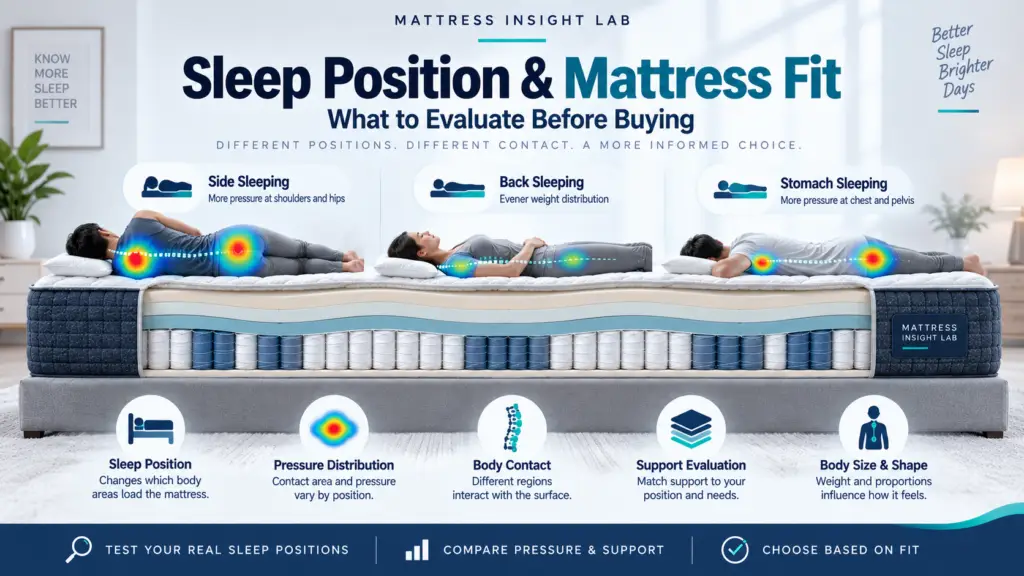
Why Sleep Position Should Guide Mattress Buying Decisions
Sleep position matters because it changes how your body contacts and loads a mattress, which measurably affects pressure distribution and, in some studied postures, spinal alignment. This makes it a valuable guide for what to evaluate on a mattress, but it does not by itself dictate a specific firmness or material.
What Does Sleep Position Change About the Way a Mattress Is Evaluated?
Changing your sleep position changes which parts of your body contact and load the mattress, which in turn changes the pressure distribution and, in some studied postures, the measured spinal position. Sleep position is therefore a body–mattress interaction variable: it determines which body regions press into the surface and how the load is spread across them.
How Does Changing From Supine to Side or Prone Lying Change Body Contact With the Surface?
Changing posture changes which body regions are in contact with the mattress and how the body’s weight is distributed across that contact area. In supine lying, the posterior trunk is the primary contact area. In side lying, the contact shifts to the lateral aspect of the body, including the shoulder and hip. In prone lying, the anterior trunk is the primary contact area. This changes the load distribution across the surface.
How Can Sleep Position Change Interface-Pressure Distribution?
Measured interface-pressure patterns differ between supine, side, and prone positions. Because the body’s contact area and weight distribution change with posture, the pressure at the interface between the body and the mattress also changes. A recent 20-participant pressure-distribution study found that pressure patterns varied with position, body region, surface, and sex. [7] A separate controlled comparison found different regional pressure profiles between two tested mattresses across back, side, and prone postures. [8]
How Can Mattress-Related Spinal Measurements Differ by Lying Posture?
Mattress-related spinal measurements have been shown to differ by posture, but the evidence is not equal across all positions. Studies have measured spinal alignment in lateral and supine postures. One study of 25 male volunteers measured lateral spinal alignment under different stiffness conditions. [1] An MRI study of 20 healthy adults measured lumbar alignment in supine lying on a mattress versus a rigid surface. [2] The reviewed evidence does not include a prone spinal-alignment study.
Why Does This Make Sleep Position Relevant Without Making It the Only Mattress-Fit Variable?
Sleep position is relevant because it changes measurable body–mattress interactions, but it is one variable among several, including body dimensions and weight, and mattress design. The evidence shows that posture, body characteristics, and mattress configuration interact. For example, the lateral-sleep study modeled different stiffness configurations across weight-dimensional groups, while the four-mattress study found maximum pressure differed with weight group. [1] [3] Because the evidence demonstrates interaction between multiple variables, no single variable, including sleep position, can be isolated as the sole determinant of fit.
How Does Sleep Position Change Pressure Distribution Across the Mattress?
Measured interface pressure changes with sleep position, and the specific body regions that carry the load also change. The position-dependent nature of interface pressure means that the same mattress can produce different pressure patterns depending on how the sleeper lies on it.
What Pressure Differences Have Been Measured Between Supine, Side, and Prone Positions?
Studies have measured different interface-pressure patterns between supine, side, and prone positions. The change in body contact area and weight distribution across postures leads to different pressure distributions at the body–mattress interface. The 20-participant pressure-distribution study found that pressure patterns varied with position, body region, surface, and sex. [7] A controlled comparison of two mattresses found different regional pressure profiles across back, side, and prone postures. [8]
Which Body Regions Are Loaded Differently as Position Changes?
As posture changes, the load shifts to different body regions. In supine lying, the posterior trunk is loaded. In side lying, the shoulder and hip become primary load-bearing regions. In prone lying, the anterior trunk is loaded. The 20-participant pressure-distribution study reported regional variation across its tested conditions. [7] The four-mattress biomechanical study found that supine maximum pressure was higher in the pelvic than thoracic region in its tested participants. [3]
How Can Mattress Surface Design Change Those Position-Specific Pressure Patterns?
Yes, the design and construction of the mattress can change the pressure profile within the same sleep posture. Different mattress constructions distribute pressure differently. The material, layering, and support structure all contribute to how the surface responds to the body’s load. In a controlled comparison of one latex and one polyurethane mattress, the tested latex mattress produced lower peak pressures in measured regions across back, side, and prone postures. [8] This finding is specific to the two tested mattresses and does not generalize to all latex or all polyurethane products.
Why Does a Pressure Difference Not Automatically Mean One Position Is More or Less Comfortable?
A measured pressure difference is a biomechanical finding, not a direct measure of comfort. Comfort is a subjective, multi-dimensional experience that is not solely determined by interface pressure. Other factors, such as spinal alignment, temperature, and personal preference, also contribute. The evidence establishes that pressure patterns differ, but it does not measure comfort as an outcome. Therefore, we cannot infer a comfort conclusion from a pressure measurement.
What Does Side-Lying Research Establish About Mattress Stiffness and Spinal Alignment?
The reviewed evidence includes direct experimental studies of mattress stiffness and measured spinal alignment in side lying, but those findings do not create a universal rule for all side sleepers. [1]
How Did Soft, Firm, and Customized Surfaces Change Measured Lateral Spinal Alignment?
In a study of 25 male volunteers, soft, firm, and customized stiffness configurations produced significantly different measured spinal alignments in lateral lying. [1] The stiffness distribution of the surface affects how the body is supported in side lying, which in turn influences the position of the spine. The study found significant differences, not a single optimal configuration.
Why Did Body Dimensions Matter to the Modeled Stiffness Requirement?
Modeling in the same study indicated that appropriate stiffness varied with weight-dimensional characteristics. Different body shapes and sizes distribute weight differently in side lying, which means the surface stiffness needed to support the spine in a particular position can vary. This is a modeling result, not a clinical prescription.
What Did the Four-Mattress Study Find When It Measured Side-Lying Spinal Distortion?
In a biomechanical comparison of four mattresses involving 18 male adults, side-lying spinal distortion was measured independently and did not consistently differentiate the mattresses across most spinal regions. [3] This finding suggests that the relationship between mattress and spinal distortion in side lying is complex and not simply a matter of one mattress being universally “better.” The study did not find a consistent difference, but it also did not prove no difference exists.
Why Does Side-Lying Evidence Not Create a Universal Soft-Mattress Rule for Side Sleepers?
The side-lying evidence shows that stiffness matters and that body dimensions matter, but it does not show that one firmness category is correct for every side sleeper. Because the appropriate stiffness varied with body dimensions in one study, and because another study did not find a consistent mattress effect on spinal distortion, the evidence supports individualization rather than a one-size-fits-all rule.
What Does Supine Research Establish About Mattress Support?
Supine research shows that the support surface can measurably change lumbar alignment and pressure distribution, but it does not establish a single firmness for all back sleepers.
What Lumbar Alignment Changes Were Measured on a Mattress Versus a Rigid Surface?
An MRI study of 20 healthy adults found small but statistically significant differences in several lumbar-alignment measures when lying supine on a mattress versus a rigid surface. [2] The support surface changes the contour of the body’s support, which can influence the position of the lumbar spine. The study measured differences, not superiority.
How Does Supine Pressure Distribution Vary Across Mattresses and Body Regions?
Supine pressure distribution varies across body regions and can be influenced by the mattress. In supine lying, the posterior trunk is the contact area, and pressure is not uniform across this region. The 20-participant pressure-distribution study found regional variation across the tested conditions. [7] The four-mattress study found that supine maximum pressure was higher in the pelvic than thoracic region in its tested participants. [3]
How Does Body Weight Affect Measured Supine Peak Pressure?
In a biomechanical comparison of four mattresses involving 18 male adults in three weight groups, supine peak pressures were associated with participant weight group. In that experiment, higher weight groups were associated with higher maximum supine pressure. The study does not establish a universal weight-to-pressure or weight-to-firmness rule. [3]
Why Does This Evidence Not Establish One Universal Firmness for Back Sleepers?
The supine evidence shows that the surface matters and that weight matters, but it does not show that one firmness category is correct for every back sleeper. Because the evidence demonstrates interaction between posture, weight, and mattress design, a single firmness rule cannot account for all the relevant variables.
What Does the Evidence Establish About Prone Sleeping and Mattress Fit?
The supplied verified evidence does not establish a universal mattress firmness or support prescription for prone sleepers. The evidence does include pressure measurements in the prone position and a sleep-response finding related to prone preference, but it does not define an ideal mattress-support configuration for prone sleeping.
How Has Pressure Distribution Been Measured in the Prone Position?
Pressure distribution has been measured in the prone position, and it differs from other postures. In prone lying, the anterior trunk is the primary contact area, which changes the pressure distribution compared to supine or side lying. A pressure-distribution study found that pressure patterns varied with position, including prone. Another study measured pressure in the front/prone posture and found different regional profiles between the two tested mattresses.
What Did the Sagging-Support Study Report About Participants Who Preferred Prone Sleeping?
In a study of 17 healthy sleepers, a sagging-support condition affected sleep differently depending on posture preference, with particularly negative effects among lateral and prone sleepers. [4] The study suggests that a degraded support condition can have a more negative impact on sleep for people who prefer certain postures. This finding is specific to an experimental sagging condition.
What Does the Reviewed Evidence Not Establish About “Preventing Pelvic Sink” in Every Prone Sleeper?
The supplied verified evidence does not establish that a specific mattress firmness is required to “prevent pelvic sink” in every prone sleeper. The evidence includes prone pressure measurements and a posture-preference finding related to sagging support, but it does not define a universal rule for pelvic support in prone sleeping. Any claim that prone sleepers need a firm mattress to “prevent pelvic sink” or “control midsection support” is not established by the reviewed evidence.
Why Should Universal Stomach-Sleeper Firmness Rules Be Treated Cautiously?
The supplied verified evidence does not establish a universal mattress firmness for all stomach sleepers. The evidence shows that posture affects pressure and that posture preference can affect response to support conditions, but it does not validate a specific firmness prescription for prone sleeping. Any claim that stomach sleepers need a firm mattress is not supported by the reviewed evidence.
What Changes When a Sleeper Uses More Than One Position During the Night?
Many sleepers change position during the night, and the evidence shows that posture preference and changes are individual behaviors. This means a multi-position sleeper should evaluate more than one posture on the same mattress.
What Do Sleep Studies Show About Position Preference and Position Changes?
Sleep studies show that sleeping-position preference is an individual behavior and that people can change position during the night. A 2025 study of 41 mature-aged adults measured actual sleeping positions and found that position preference and sleep disruption were related. [6] This indicates that position is a dynamic, individual behavior. A person’s stated favorite position is not proof of how they remain positioned all night.
How Has Active Bedding Research Detected Posture Changes During Sleep?
An active-support study used mattress-indentation sensing to detect body movements and posture changes and dynamically alter eight support zones. [5] The system was designed to respond to changes in the sleeper’s position by adjusting support in different zones. This study tested a specific experimental system with 11 sleepers, not a commercial mattress.
Why Should a Multi-Position Sleeper Evaluate More Than One Posture on the Same Mattress?
If you sleep in more than one position, you should evaluate the mattress in all the positions you actually use. Because pressure distribution and support needs change with posture, a mattress that feels good in one position may not feel good in another. This is an evaluation strategy, not a prescription for a specific type of mattress.
Why Does Changing Position Not by Itself Prove That a More Responsive Mattress Material Is Required?
The supplied verified evidence does not establish that people who change positions necessarily require a mattress with greater responsiveness or less contouring. The evidence shows that posture changes occur and that support can be adjusted dynamically in an experimental system, but it does not validate a commercial “responsiveness” requirement. Any claim that combination sleepers need a “responsive” or “less contouring” mattress is not established by the reviewed evidence.
How Do Body Weight and Body Shape Interact With Sleep Position?
Body dimensions, weight distribution, and sleep position can change measured body–mattress interaction. In specific lateral-sleep modeling, the stiffness configuration associated with the studied alignment response also varied across body groups. [1]
How Did Weight Group Affect Measured Interface Pressure?
In a biomechanical comparison of four mattresses involving 18 male adults in three weight groups, supine peak pressures were associated with participant weight group. In that experiment, higher weight groups were associated with higher maximum supine pressure. The study does not establish a universal weight-to-pressure or weight-to-firmness rule. [3]
How Did Body Dimensions and Contour Affect Lateral-Stiffness Modeling?
Modeling in the lateral-sleep study indicated that appropriate stiffness varied with weight-dimensional characteristics. Within that lateral-sleep modeling framework, the stiffness configuration associated with the studied alignment response varied across weight-dimensional groups. This is a model-specific result, not a general consumer prescription. [1]
How Can Regional Pressure Patterns Differ Between Individuals in the Same Position?
Regional pressure patterns can differ between individuals even in the same position. Individual differences in body shape, weight distribution, and composition can alter how pressure is distributed across the body–mattress interface. The 20-participant pressure-distribution study found regional and sex-related variation across the tested conditions. [7] The four-mattress study found maximum pressure differed with weight group. [3] This illustrates individual variation, not a predictive rule.
Why Does Sleep Position Plus Body Weight Still Not Create a Universal Firmness Formula?
The supplied verified evidence does not establish a universal formula that combines sleep position and body weight to determine a mattress firmness. The evidence shows that posture, weight, and mattress design interact, but it does not provide a validated algorithm for selecting a firmness. Any position × weight → firmness chart or formula is not supported by the reviewed evidence.
Why Should Sleep Position Not Be Converted Directly Into a Mattress Firmness Rule?
Sleep position is a relevant evaluation variable, but it cannot be converted directly into a universal firmness rule because the evidence shows that body characteristics and mattress design also matter.
Why Can the Same Firmness Produce Different Responses for Different Bodies?
The same firmness can produce different responses for different bodies because body dimensions, weight, and contour affect how the body interacts with the surface. A mattress’s firmness is a single label, but the body’s response to it depends on how the body’s weight is distributed and how it contours to the surface. The lateral-sleep modeling study found that the stiffness configuration associated with its studied alignment response varied across weight-dimensional groups. [1] The four-mattress study found maximum pressure differed with weight group. [3]
Why Is Mattress Stiffness Distribution Different From a Single Firmness Label?
A firmness label is a single, simplified descriptor, while mattress stiffness distribution is a more complex, engineered property that can vary across the surface. A mattress can have different stiffness characteristics in different zones or layers, which a single “firm” or “soft” label does not capture. One study tested “soft, firm, and customized stiffness configurations,” implying that stiffness is not a single value but a configuration.
Why Does Side-Lying Research Support Individualization Rather Than a One-Firmness Rule?
The side-lying research supports individualization because it found that appropriate stiffness varied with body dimensions. Because the evidence shows that body characteristics matter, a single firmness rule cannot account for all the relevant variables. This is an implication of the evidence, not a direct finding that a specific firmness is correct for any individual.
Why Should Firmness Be Evaluated Together With Posture, Body Characteristics, and Construction?
Firmness should be evaluated as one variable among several, including posture, body characteristics, and mattress construction. The evidence shows that these variables interact to determine the body–mattress interface. Firmness is one part of a multi-variable evaluation, not the most important variable.
Can Mattress Material Be Chosen From Sleep Position Alone?
The evidence does not support choosing a mattress material from sleep position alone. Material performance is construction-specific, not category-wide.
What Did the Latex-versus-Polyurethane Study Measure Across Back, Side, and Prone Positions?
A controlled comparison of one latex and one polyurethane mattress measured body-contact pressure in back, side, and front/prone postures. [8] The study was designed to compare pressure profiles between two specific mattress constructions across three postures. It tested one specific latex and one specific polyurethane mattress, not all products in those categories.
How Did Pressure Profiles Differ Between Those Two Specific Mattresses?
The tested latex mattress produced lower peak pressures in measured regions and a larger proportion of low-pressure areas than the tested polyurethane mattress. The specific construction of the tested latex mattress resulted in a different pressure distribution than the specific polyurethane mattress tested. This finding is specific to the two tested mattresses.
Why Does That Comparison Not Prove That One Material Family Is Best for a Particular Sleep Position?
The comparison only tested two specific mattresses, so it cannot prove that one material family is best for any sleep position. A material name like “latex” or “polyurethane” encompasses many different constructions, densities, and designs. The performance of one product does not predict the performance of all products in that category.
Why Should Complete Mattress Design Be Evaluated Rather Than One Material Name?
The shopper should evaluate the complete mattress design, including its construction, layering, and how it feels in their relevant positions, rather than relying on a material name. A mattress is an assembly of materials and components. Its performance depends on the whole design, not just one material. Material names can be a starting point, but they are not a complete predictor.
What Does Sagging-Support Research Add to Position-Based Mattress Evaluation?
Research on sagging support shows that posture can modify the response to a degraded support condition, but it does not establish a universal threshold for when a mattress impression becomes harmful.
How Were Personalized and Sagging Support Conditions Compared?
In a sleep-laboratory study, 17 healthy sleepers spent nights on personalized-support and sagging-support configurations. [4] The study was designed to compare the effects of a personalized support condition against a deliberately degraded sagging condition. The sagging condition was an experimentally controlled condition, not representative of all mattress wear.
Why Did Preferred Sleep Posture Matter to the Observed Response?
The negative response to the sagging condition depended partly on posture preference. The study found that the effect of the sagging support was not uniform; it was related to the participant’s preferred sleeping posture. Posture preference was one factor among others, not the only factor that mattered.
Which Posture Groups Showed More Negative Effects in That Study?
In the study, lateral and prone sleepers showed particularly unfavorable responses to the sagging condition. The study reported that the negative effects of the sagging support were more pronounced for participants who preferred lateral or prone sleeping. This finding is specific to the experimental condition and does not mean all side or stomach sleepers are harmed by all mattress sagging.
Why Does This Not Mean Every Visible Mattress Impression Is Harmful?
The supplied verified evidence does not establish a universal threshold at which ordinary mattress impressions become harmful. The sagging-support study found posture-dependent effects from an experimentally sagging support setting, but it does not provide a rule for evaluating visible impressions on a retail mattress. Any claim that a visible mattress impression is harmful or indicates biomechanical failure is not established by the reviewed evidence.
How Should a Shopper Test a Mattress Using Their Actual Sleeping Positions?
The most practical way to use sleep position in a mattress purchase is to test the mattress in the positions you actually sleep in, using your own comfort and support perception as the guide.
Which Sleep Positions Does the Shopper Actually Spend Meaningful Time In?
The shopper should identify the positions they actually spend meaningful time in during the night. Because posture changes body–mattress interaction, the shopper should evaluate the mattress in the positions that matter for their sleep. This requires self-reflection on actual sleep behavior, not just stated preference, because a person’s stated favorite position is not proof of how they remain positioned all night.
How Does Local Pressure Comfort Change Between Those Positions?
The shopper should pay attention to how local pressure feels in different body regions as they change position. Because pressure distribution changes with posture, the shopper should notice whether they feel pressure points in different areas in different positions. This is a subjective evaluation, not a clinical measurement.
Does Support Feel Stable Across the Positions the Shopper Uses?
The shopper should assess whether they feel supported in each of their relevant positions. Because support needs can change with posture, the shopper should check that the mattress feels supportive in all the positions they use. Support perception is subjective; there is no single “correct” feeling of support.
Can the Shopper Reposition Naturally Without Assuming That Movement Ease Proves Better Biomechanics?
The shopper can check whether they can reposition naturally, but they should not assume that ease of movement proves better biomechanics. Movement ease is a subjective feel, not a validated measure of support or alignment. The evidence does not link movement ease to biomechanical outcomes.
What Can an At-Home Trial Reveal Without Becoming a Clinical Alignment Test?
The supplied verified evidence does not establish a standardized consumer procedure that can objectively determine whether a mattress is correct for a person’s position. An at-home trial can provide personal observations about comfort, support perception, movement, and fit across the positions you actually use, but it is not a validated clinical or biomechanical alignment test. Any claim that a store test or at-home trial is a validated clinical or biomechanical test is not supported by the reviewed evidence.
How Should Sleep Position Influence the Final Mattress Decision?
Sleep position should guide which postures you evaluate on a mattress, but the final decision should combine position with body size, shape, personal comfort, and an understanding that firmness and material labels are starting information, not proof.
Use Sleep Position to Decide Which Postures the Mattress Must Accommodate
Use your sleep position to decide which postures the mattress must accommodate. Evaluate the mattress across the sleep positions you actually use rather than basing the decision on one posture alone. This is one part of the decision, not a complete answer.
Evaluate Pressure and Support Within Those Relevant Positions
Evaluate pressure and support within those relevant positions. Because pressure and support change with posture, the shopper should assess these factors in each of their relevant positions. This is a subjective evaluation; there is no single “correct” pressure or support feeling.
Combine Position With Body Size, Shape, and Personal Comfort
Combine position with body size, shape, and personal comfort. The evidence shows that body characteristics interact with posture and mattress design to influence pressure and support. One study found that body dimensions mattered, and another found that weight group affected pressure. This is an interaction, not a formula.
Treat Firmness and Material Labels as Starting Information Rather Than Position-Specific Proof
Treat firmness and material labels as starting information, not as position-specific proof. A firmness label is a simplified descriptor, and a material name does not predict performance. The actual construction and design matter. Labels can be a starting point, but they are not a conclusion.
Avoid Universal Side-, Back-, Stomach-, or Combination-Sleeper Mattress Rules
The supplied verified evidence does not establish universal mattress rules for side, back, stomach, or combination sleepers. The evidence supports posture-specific evaluation, but it does not validate any universal prescription. Any universal “side sleeper = soft,” “back sleeper = medium-firm,” “stomach sleeper = firm,” or “combination sleeper = responsive” rule is not supported by the reviewed evidence.
Sources and References
- Leilnahari et al. — Spine alignment in men during lateral sleep position: experimental study and modeling. PubMed record.
- Vitale et al. — Effect of a mattress on lumbar spine alignment in supine position in healthy subjects: an MRI study. PubMed record.
- DeVocht et al. — Biomechanical evaluation of four different mattresses. PubMed record.
- Verhaert et al. — Ergonomics in bed design: the effect of spinal alignment on sleep parameters. PubMed record.
- Van Deun et al. — Biomechanics-based active control of bedding support properties and its influence on sleep. PubMed record.
- Rayward et al. — Sleep disruption and sleep position: Increased wake frequency in supine predicts lateral position preference. PubMed record.
- Mohamadi et al. — Sex-specific variations in body pressure distribution across different sleep surfaces and positions. PubMed record.
- Low et al. — Effects of Mattress Material on Body Pressure Profiles in Different Sleeping Postures. PubMed record.
Final Synthesis
Sleep position is an evidence-supported evaluation variable because changing posture changes body–mattress contact and interface-pressure patterns, and studied lateral and supine conditions show that mattress stiffness or support surface can also alter measured spinal position. The reviewed evidence does not convert those findings into universal side-, back-, stomach-, or combination-sleeper firmness rules.
Body dimensions, weight distribution, mattress design, and posture interact. In the lateral-sleep modeling study, the stiffness configuration associated with the studied alignment response varied across weight-dimensional groups, while the four-mattress study found maximum pressure differed with weight group. Those findings remain study-specific and do not create a validated position × body size → firmness formula.
Use sleep position to decide which postures to evaluate on a mattress, then compare pressure comfort, support perception, movement, and overall comfort across the positions you actually use. Personal trials can provide observations about perceived fit, but they are not clinical alignment tests. Firmness and material labels are starting information, not proof that a mattress is correct for a particular sleep position.