What Mattress Construction Type Should You Consider Before Purchase?
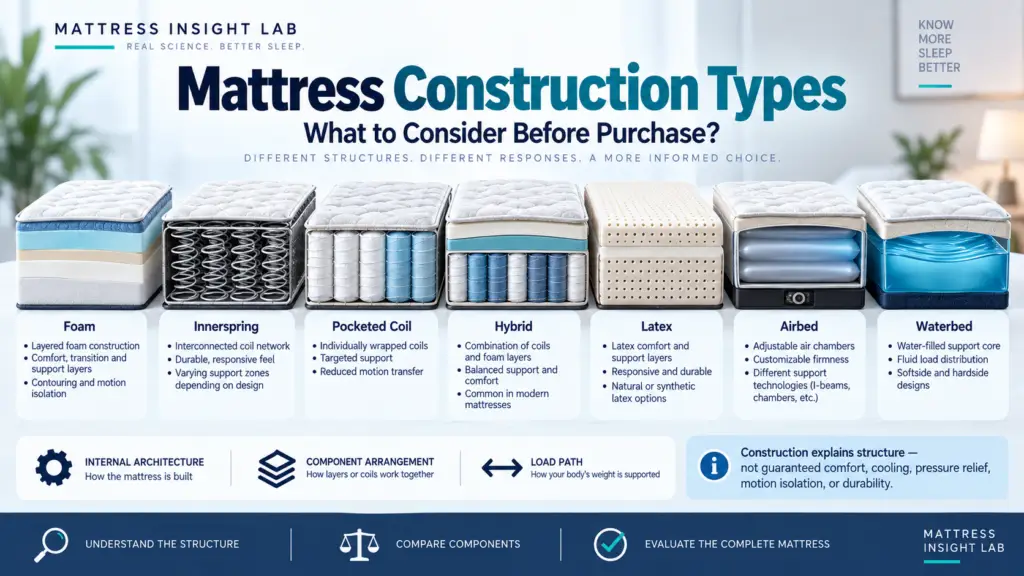
Mattress construction type describes the internal architecture that carries and distributes a sleeper’s load. The most useful way to evaluate construction is to ask what actually supports the body and how the major components are arranged, rather than assuming the category name alone predicts comfort, cooling, motion isolation, durability, or pressure relief.
What Does “Mattress Construction Type” Actually Describe?
Mattress construction type refers to the internal architecture of the complete mattress — how its layers, support units, chambers, or fluid systems are arranged to receive and distribute a sleeper’s load. A mattress is an assembly of interacting components, not a single material object. Understanding construction requires a clear view of the hierarchy from material to complete product:
- Material — the substance family, such as foam, latex, steel, or water.
- Component — a discrete part, such as a foam layer, a coil, or an air chamber.
- Layer / Support Unit — how components are arranged, such as a comfort layer or a spring network.
- Mattress Assembly — the complete combination of layers and support units.
- User–Mattress Response — how the complete assembly behaves under a sleeper’s body.
Construction type is not the same as firmness, thickness, brand, or a single material name. A material name like “foam” or “latex” identifies a material family, not an architecture. A brand name identifies a product line, not a construction. Firmness and thickness are measurable attributes that can vary within the same construction type.
Which Components Actually Carry and Distribute Load Inside a Mattress?
Mattresses carry load through different internal systems: layered foam cores, spring networks, combined coil-and-foam assemblies, pressurized air chambers, or fluid-filled envelopes. The specific arrangement determines the architecture. In the disclosed all-foam assembly, load transfers from the comfort layer through the transition layer to the engineered core. In interconnected spring systems, neighboring coils are mechanically linked. In pocketed systems, individual coils are enclosed separately. In hybrid assemblies, coil and foam layers coexist. In air systems, chamber pressure changes the support condition. In waterbeds, fluid displacement carries the reclining load.
Each documented architecture has a distinct load-bearing mechanism; the mechanism is structural, not a performance guarantee. Component-level architecture does not independently determine complete-product performance.
How Do Comfort Layers, Transition Components, and Support Structures Fit Into the Architecture?
In a documented all-foam assembly, a comfort layer receives the body at the surface, a transition layer receives load from the upper layer, and an engineered core carries load toward the base. These are distinct structural roles within one mattress. The disclosed all-foam mattress uses at least one foam comfort layer, at least one foam transitional layer, and a foam engineered core; loads are transferred from the comfort layer through the transition layer to the engineered core and deck. [1]
The layer roles are documented in the disclosed assembly; they demonstrate that an all-foam mattress is not necessarily one homogeneous block. This does not mean every all-foam mattress uses this exact layer sequence, geometry, materials, densities, or load response.
Why Is Construction Type Different From Firmness, Thickness, Brand, or One Material Name?
Construction type describes the internal architecture — how components are arranged to carry load. Firmness, thickness, brand, and material names describe different attributes that do not uniquely determine the architecture. A material name like “foam” or “latex” identifies a material family, not an architecture. A brand name identifies a product line, not a construction. Firmness and thickness are measurable attributes that can vary within the same construction type.
This distinction is definitional; it clarifies the meaning of terms rather than asserting a performance relationship. Materials can appear in multiple architectures.
What Can a Construction Label Tell You—and What Can It Not Prove?
A construction label can tell you the primary load-bearing mechanism — whether the mattress uses layered foam, interconnected or pocketed springs, a coil-and-foam hybrid, pressurized air chambers, or fluid displacement. It cannot by itself prove pressure relief, motion isolation, cooling, edge strength, comfort, or durability.
Large structural differences are verifiable from architecture; performance can vary within a type because geometry, materials, and component combinations also vary. The structural information is documented; the performance limits follow from the absence of matched cross-category comparative evidence.
Why Are Foam, Latex, Spring, Hybrid, Air, and Water Labels Not Perfectly Parallel Categories?
Foam, latex, spring, hybrid, air, and water labels do not form six perfectly parallel categories. Some labels identify materials, some identify load-bearing architectures, and some identify component integration. “Foam” is a broad cellular-material category; latex foam is one specific foam family, while polyurethane foam is another. “Spring,” “air,” and “water” can identify load-bearing architectures, while “hybrid” identifies component integration. Foam materials can appear in all-foam, hybrid, spring, and air systems.
Shopper-facing categories are practical labels, not formal engineering taxonomy. The supplied verified evidence does not establish a formal universal taxonomy of consumer mattress construction types.
Why Can Latex Be Both a Foam Material and the Dominant Material in a Mattress?
Latex used in mattresses is a cellular foam material, but latex foam and polyurethane foam are chemically distinct material families. Latex foam can form the principal core of a mattress or be integrated with other components. [4] “Latex mattress” is partly a material-defined label rather than an architecture that is always mutually exclusive with foam or hybrid construction. The disclosed latex-core mattress uses a latex foam rubber core with synthetic urethane foam border sections; the patent also discusses latex used in all-latex mattresses and in topper assemblies placed over other mattress structures.
The evidence documents latex as both a complete core material and a component within a mixed assembly. This does not mean all latex mattresses are structurally identical or that the category automatically has specific durability, bounce, cooling, pressure relief, or movement properties.
How Can Foam Appear in All-Foam, Hybrid, Spring, and Air-Chamber Systems?
Foam can be the complete support architecture in an all-foam mattress, a component above coils in a hybrid, or part of the load-bearing system in an adjustable air mattress. A documented all-foam assembly uses comfort, transition, and core layers. A documented hybrid combines a coil layer with a viscoelastic foam layer. A documented adjustable foam-air mattress uses foam and inflated chambers that can both participate in supporting the user.
The same material family appears in different structural roles across documented architectures. The presence of foam does not automatically identify the construction type.
Why Does “Hybrid” Describe Component Integration Rather Than One Material?
“Hybrid” describes the integration of different component types — specifically, in the documented example, a coil spring layer combined with a viscoelastic foam layer. It is not a single material. The documented hybrid assembly contains at least one coil spring layer disposed with a viscoelastic foam layer in a multilayer core. [5]
The hybrid label identifies component integration, not a material category. This is one documented example, not a universal formula for every marketed hybrid.
Why Should Shopper-Facing Categories Be Treated as Practical Labels Rather Than Perfect Engineering Taxonomy?
The supplied verified evidence does not establish a formal universal taxonomy of consumer mattress construction types. Shopper-facing categories are practical labels that help organize products, but they overlap and do not form perfectly mutually exclusive engineering families. The overlap is documented: latex is foam; foam appears in multiple architectures; hybrid identifies integration.
These practical labels are useful, but they are not formal engineering standards.
How Does an All-Foam Mattress Carry Load Through Multiple Foam Layers?
A documented all-foam mattress can use multiple foam layers with different structural roles: a comfort layer at the surface, a transition layer beneath it, and an engineered core that carries load toward the base. “All-foam” does not mean every layer has the same material properties or geometry. This is one documented architecture, not a universal all-foam formula.
What Role Can a Foam Comfort Layer Have at the Sleeping Surface?
In the disclosed all-foam assembly, the foam comfort layer is positioned at the sleeping surface and receives the body’s load first. The disclosed assembly includes at least one foam comfort layer; loads are transferred from the comfort layer through the transition layer to the engineered core.
The comfort layer’s role is documented as receiving and transferring load in the disclosed assembly. This does not mean the comfort layer independently determines comfort, pressure relief, or cooling.
How Can a Foam Transition Layer Receive Load From the Upper Layer?
In the disclosed all-foam assembly, the foam transition layer receives load from the comfort layer and transfers it toward the engineered core. The disclosed assembly includes at least one foam transitional layer positioned between the comfort layer and the engineered core; loads are transferred from the comfort layer through the transition layer.
The transition layer’s role is documented as part of the load-transfer path. This does not mean the transition layer independently determines support, durability, or comfort.
How Can a Foam Engineered Core Carry Load Toward the Mattress Base?
In the disclosed all-foam assembly, the foam engineered core carries load toward the mattress base and deck. The disclosed assembly includes a foam engineered core; loads are transferred from the comfort layer through the transition layer to the engineered core and deck.
The engineered core’s role is documented as the final load-bearing element in the disclosed assembly. This does not mean the engineered core independently determines whole-mattress support or durability.
Why Does “All-Foam” Not Mean Every Layer Has the Same Material Properties or Geometry?
“All-foam” identifies the material family of the core components, not their uniformity. The disclosed all-foam assembly uses distinct layers with different structural roles. The disclosed assembly separates comfort, transition, and engineered-core functions into different foam layers; the patent title itself references thermoplastic and thermoset materials in engineered cores.
The documented assembly demonstrates that all-foam construction can involve multiple layers with different roles. This does not mean every all-foam mattress uses the same layer sequence, geometry, materials, densities, or load response.
How Do Interconnected and Pocketed Spring Cores Differ Structurally?
Interconnected and pocketed spring cores differ in how neighboring springs are mechanically related. In interconnected Bonnell architectures, neighboring springs are joined by helical wires; in pocketed constructions, individual coils are enclosed in separate fabric pockets. This is a structural distinction, not a whole-mattress performance ranking.
How Are Bonnell Springs Connected With Helical Lacing?
In conventional Bonnell spring mattresses, neighboring coil springs are joined using spiral or helical securing wires. The patent describes Bonnell spring mattresses in which neighboring coil springs are joined using spiral/helical securing wires; because neighboring spring turns are mechanically connected, loading one spring can also deflect neighboring springs. [2]
The mechanical linkage is documented; the coupling of deflection follows from the physical connection. This does not mean every interconnected mattress has identical motion transfer, comfort, support, durability, or firmness.
How Does Loading One Interconnected Spring Affect Its Mechanical Relationship With Neighboring Springs?
Because neighboring springs are mechanically connected, loading one spring can also deflect neighboring springs to some degree. The helical securing wires physically link neighboring spring turns, so deflection is coupled across the network.
The coupling is a direct mechanical consequence of the documented helical-wire connection. This does not convert into a universal motion-transfer, comfort, or support ranking.
How Are Individual Coils Enclosed in Pocketed-Spring Construction?
In pocketed-spring construction, individual coil springs are enclosed in separate casing compartments rather than linked as bare neighboring turns in a Bonnell network. The patent describes individual coil springs enclosed in separate casing compartments. It also describes pocketed-spring assemblies in which strings of those pockets can be joined by gluing, clipping, welding, or similar methods to form the complete spring unit. [3]
The individual enclosure is documented; the structural distinction from Bonnell lacing follows from the separate-pocket design. This does not mean pocketed coils universally provide better comfort, support, durability, motion isolation, or pressure relief across complete mattresses.
Why Does Coil Connection Architecture Matter Without Automatically Proving Whole-Mattress Comfort or Motion Performance?
Coil connection architecture is a real structural difference. Bonnell coils can be mechanically linked at the spring network by helical lacing, whereas pocket coils are individually enclosed in fabric pockets; those pockets or strings may still be joined together to form the complete spring unit. [2] [3] But the complete mattress response depends on many other factors, including comfort layers, geometry, and materials, so the spring architecture alone does not prove whole-mattress comfort or motion performance.
Architecture is verifiable; performance is not automatically derivable from architecture alone. No matched comparative evidence in the reviewed evidence pack supports ranking interconnected versus pocketed construction by motion isolation, bounce, comfort, or durability.
What Makes a Documented Hybrid Mattress a Mixed Construction?
A documented hybrid mattress combines at least one coil spring layer with a viscoelastic foam layer in a single mattress assembly. “Hybrid” describes component integration, not a single material. This is one documented example, not a universal hybrid formula.
How Can a Coil-Spring Layer Be Combined With a Viscoelastic Foam Layer?
The documented hybrid assembly uses a multilayer core that includes at least one coil spring layer disposed with a viscoelastic foam layer. The patent application explicitly describes hybrid mattress assemblies with a multilayer core including at least one coil spring layer disposed with a viscoelastic foam layer.
The component combination is documented in the disclosed assembly. This does not define every marketed hybrid using this exact layer geometry.
Why Must the Coil and Foam Components Both Be Considered When Evaluating the Assembly?
Because the documented hybrid is a mixed assembly, both the coil layer and the foam layer are part of the same load-bearing system. Evaluating only one component would ignore the other’s structural role. The disclosed hybrid contains both a coil spring layer and a viscoelastic foam layer in a multilayer core; both are structural components of the assembly.
The assembly-level view follows from the documented presence of both component types. The hybrid’s behavior should not be assigned to only the coil layer or only the foam layer.
Why Does One Documented Hybrid Construction Not Establish a Universal Hybrid Formula?
The documented hybrid is one specific disclosed construction. It does not establish a mandatory industry-wide formula for all products marketed as hybrids. The patent application describes a specific assembly; it does not define a universal standard for every hybrid product.
A single patent disclosure documents one construction; it cannot establish a universal category definition. Not all hybrids use the same layer geometry, materials, or proportions.
Why Should “Hybrid” Not Be Treated as a Guaranteed Performance Package?
The supplied verified evidence does not establish that every hybrid provides a specific performance package. “Hybrid” describes component integration, not a guaranteed combination of comfort, support, cooling, or durability advantages.
The architecture is documented; the performance guarantee is not. No matched comparative evidence in the reviewed evidence pack supports a claim that hybrids provide “the best of both worlds” or any universal combined-performance advantage.
How Should Latex-Dominant Mattress Construction Be Classified?
Latex is a foam material that can form the principal core of a mattress, appear as a comfort component, or be integrated with other mattress components. “Latex mattress” is partly a material-defined label rather than an architecture that is always mutually exclusive with foam or hybrid construction.
How Can Latex Foam Form the Main Core of a Mattress?
Latex foam can form the principal core of a mattress, as documented in the disclosed latex-core construction. The disclosed mattress uses a latex foam rubber core with synthetic urethane foam border sections; the patent also discusses latex used in all-latex mattresses.
The latex-core role is documented in the disclosed construction. This does not mean all latex mattresses are structurally identical.
How Can Latex Be Combined With Urethane Foam or Other Mattress Components?
Latex can be combined with other foam materials or mattress components, as documented in the disclosed composite construction. The disclosed mattress uses a latex foam rubber core with synthetic urethane foam border sections; the patent also discusses latex used in topper assemblies placed over other mattress structures.
The composite role is documented in the disclosed construction. Latex is a cellular foam material, but latex foam and polyurethane foam are chemically distinct material families. The cited patent itself distinguishes a latex foam-rubber core from synthetic urethane-foam border sections. [4]
Why Can Latex Also Appear as a Comfort Component Rather Than the Complete Support Architecture?
Latex can appear as a comfort component, such as in a topper assembly placed over another mattress structure, rather than as the complete support architecture. The patent discusses latex used in topper assemblies placed over other mattress structures.
The comfort-component role is documented in the disclosed construction. A latex label does not necessarily mean latex is the complete support architecture.
What Does a Latex Label Not Tell You About the Complete Mattress Response?
A latex label does not tell you the complete mattress response. It does not reveal whether latex is the core, one layer, or one component; it does not establish universal durability, bounce, cooling, pressure relief, or movement properties.
The evidence documents latex in different structural roles; the performance limits follow from the absence of matched cross-category comparative evidence. The reviewed evidence does not establish a universal latex performance hierarchy.
How Does an Adjustable Air-Chamber Mattress Change Its Support Condition?
Adjustable-air construction uses one or more inflatable chambers connected to pressure-control systems. Changing the chamber pressure changes the firmness condition experienced by the user in the documented designs, and foam can remain part of the load-bearing system.
How Does Air Pressure Within a Chamber Change the Firmness Condition in the Documented Systems?
In the documented adjustable-air system, changing the air pressure within the chamber changes the firmness condition experienced by the user. The patent describes air chambers connected to pressure-adjustment systems; when chambers are inflated, the foam can be compressed and the inflated chambers can carry part of the user's load. [6]
The pressure-firmness relationship is documented in the disclosed system. This does not mean all airbeds have identical adjustment behavior, chamber counts, or electronics.
How Can Multiple Chambers or Zones Be Controlled Separately?
The documented adjustable-air system uses one or more inflatable chambers connected to pumping and pressure-control systems, which can allow separate control of different chambers or zones. The patent describes air chambers connected to pressure-adjustment systems; the plural “chambers” and “pressure-control systems” support the possibility of separate control.
The disclosed system includes pressure-control architecture that can manage chamber pressure. This does not mean every airbed has multiple independently controlled zones.
How Can Foam Remain Part of the Load-Bearing System in an Air-Adjustable Mattress?
In the documented adjustable foam-air mattress, foam and inflated chambers can both participate in supporting the user. The patent describes air chambers connected to pressure-adjustment systems and foam inserts integrated into the mattress; when chambers are inflated, the foam can be compressed and the inflated chambers can carry part of the user’s load; when deflated in disclosed embodiments, foam can continue to support the user.
The foam-and-air load-sharing is documented in the disclosed system. This does not mean all airbeds use foam in the load-bearing system.
Why Does “Airbed” Not Necessarily Mean the Sleeper Is Supported by Air Alone?
“Airbed” does not necessarily mean the sleeper is supported by air alone, because documented adjustable-air systems can integrate structural foam into the load-bearing system. The disclosed adjustable foam-air mattress uses both foam inserts and air chambers; the foam can continue to support the user when chambers are deflated. [6]
The foam-and-air combination is documented in the disclosed system. Not every airbed is foam-free.
How Does a Water-Filled Mattress Differ From Solid and Pneumatic Support Architectures?
A waterbed uses liquid displacement as a principal part of its load-support mechanism, which differs from solid foam, spring, and pneumatic air architectures. Additional structures such as frames, foam components, or baffles can be added around or inside the fluid system.
How Does a Flexible Water-Filled Envelope Carry a Reclining Load Through Fluid Displacement?
A waterbed supports a reclining person through displacement of the contained fluid within a flexible envelope. The patent describes waterbeds as fluid-filled envelopes on which a reclining person is supported through displacement of the contained fluid. [8]
The fluid-displacement mechanism is documented in the disclosed architecture. This does not mean every waterbed has the same motion response, surface construction, or fill depth.
What Roles Can Frames, Foam Components, or Baffles Have Around or Inside the Water Bladder?
Frames, foam structures, and baffles can perform additional structural or motion-control functions around or inside the fluid system. The patent describes a free-floating internal baffle structure for controlling water movement; frames and other components may be added around or inside the fluid system.
The baffle’s motion-control role is documented; the frame and foam roles are described as additional structural components. This does not mean every waterbed uses the same baffle, frame, or foam configuration.
Why Is a Waterbed Not Simply an Airbed Filled With a Different Fluid?
A waterbed is not simply an airbed filled with a different fluid because the support mechanisms differ: waterbeds rely on liquid displacement, while air systems rely on pressurized gas within chambers. The waterbed patent describes support through displacement of contained liquid, while the adjustable-air patent describes support behavior involving pressurized chambers whose pressure can be changed. [8] [6]
The two mechanisms are documented as distinct: liquid displacement vs pressurized gas. Waterbeds and airbeds do not have identical support behavior.
Why Does Internal Baffle Design Matter Separately From the Basic Water-Filled Architecture?
Internal baffle design is a separate structural consideration because baffles control water movement within the bladder, which is a distinct function from the basic fluid-displacement support mechanism. The patent describes a free-floating internal baffle structure for controlling water movement within the fluid-filled envelope. [8]
The baffle’s motion-control function is documented as a distinct structural role. This does not mean all waterbeds use the same baffle design or that baffle design determines complete mattress performance.
Which Mattress Behaviors Can Construction Type Suggest Without Guaranteeing Them?
Construction type can suggest the primary load-bearing mechanism and whether major components are mechanically linked, individually pocketed, solid, pneumatic, or fluid-filled. It cannot by itself prove pressure relief, motion isolation, cooling, edge strength, comfort, or durability.
Why Can Construction Reveal the Primary Load-Bearing Mechanism?
Construction reveals the primary load-bearing mechanism — whether the mattress uses layered foam, interconnected or pocketed springs, a coil-and-foam hybrid, pressurized air chambers, or fluid displacement. Each documented architecture has a distinct load-bearing mechanism: foam layers transfer load through the core; springs support through coil networks; hybrids combine both; air systems use chamber pressure; waterbeds use fluid displacement.
The structural mechanisms are documented in the supplied patents. This does not convert the load-bearing mechanism into a performance guarantee.
Why Can Construction Reveal Whether Major Components Are Mechanically Linked, Individually Pocketed, Solid, Pneumatic, or Fluid-Filled?
Construction can reveal whether the spring network uses helical lacing, whether coils are individually pocketed within an assembled pocket unit, or whether the primary support architecture is solid, pneumatic, or fluid-filled. The documented architectures show these distinct component arrangements: helical-wire-linked springs, individually enclosed coils, layered foam cores, pressurized air chambers, and fluid-filled envelopes.
The component arrangements are documented in the supplied patents. These structural facts do not automatically determine comfort, motion isolation, or durability.
Why Can It Not by Itself Prove Pressure Relief, Motion Isolation, Cooling, Edge Strength, Comfort, or Durability?
The supplied verified evidence does not establish that construction type alone proves pressure relief, motion isolation, cooling, edge strength, comfort, or durability. Performance can vary within a type because geometry, materials, and component combinations also vary.
The structural variation is documented; the performance outcomes are not. No matched comparative evidence in the reviewed evidence pack supports ranking construction types by pressure relief, cooling, motion isolation, durability, or edge support.
Why Must Complete Product Geometry and Component Properties Be Evaluated Alongside the Category Name?
Complete product geometry and component properties should be considered alongside the category name because mattresses within the same broad family can vary in geometry, layer arrangement, material properties, coil connection, zoning, border design, chamber pressure, and component combinations. The supplied patents document substantial within-category structural variation across foam, spring, hybrid, and air systems.
The within-category variation is documented; therefore, the category name alone cannot predict complete performance.
What Does the Latex-versus-Polyurethane Pressure Study Show About Construction Claims?
A controlled study compared one latex mattress with one polyurethane mattress and found different body-pressure profiles, with lower peak pressures on the tested latex mattress. The finding belongs to those two tested mattresses and does not establish universal latex-versus-polyurethane superiority.
Which Two Mattresses Were Directly Compared?
The study compared one latex mattress with one polyurethane mattress. Twenty participants lay on one latex and one polyurethane mattress in back, side, and prone positions. [10]
The comparators are documented in the study description. The study did not compare multiple latex and polyurethane mattresses.
What Pressure Differences Were Measured?
The tested latex mattress produced lower peak body pressures in measured regions and a greater proportion of lower-pressure areas than the tested polyurethane mattress. [10] The study measured body-pressure profiles in back, side, and prone positions on the two mattresses.
The measured differences are documented in the study. These pressure differences are not equivalent to comfort, preference, or sleep-quality claims.
What Does That Study Support About Those Specific Constructions?
The study supports that the two tested mattress constructions produced different pressure profiles under the measured conditions. The measured outcome is specific to the two tested mattresses, the 20 participants, the three lying postures, and the measured body regions.
The supported scope is exactly what the study measured. The finding does not extend to other latex or polyurethane mattresses.
Why Does It Not Prove That Every Latex Mattress Outperforms Every Polyurethane or Other Foam Mattress?
The study does not prove that every latex mattress outperforms every polyurethane or other foam mattress because it compared only two specific products under specific conditions. A single two-product comparison cannot establish a category-wide hierarchy.
The study’s scope is limited to its two tested mattresses. The reviewed evidence does not support a universal latex superiority claim.
Which Specifications Help Verify What Is Actually Inside a Mattress?
Useful specifications identify the actual materials, layers, support architecture, coil arrangement, chamber design, and component integration inside a mattress. They help verify construction details, but they do not automatically grade quality.
Which Materials and Layers Form the Comfort and Support Structure?
The shopper should look for which materials form the comfort and support structure and how many layers are present, because the documented all-foam assembly shows that different layers can have different structural roles. The disclosed all-foam assembly separates comfort, transition, and core functions into different layers; specifications should identify these layers.
The layer-role distinction is documented; the specification guidance follows from the need to verify actual construction. Layer count or material names are not automatic quality scores.
Is the Spring Unit Interconnected, Continuous-Wire, or Individually Pocketed?
The shopper should verify whether the spring unit is interconnected (mechanically linked), continuous-wire, or individually pocketed, because these are structurally distinct architectures. A documented interconnected Bonnell spring uses helical lacing; a documented pocketed coil is individually enclosed in a separate compartment.
The spring-architecture distinction is documented; the specification should identify which type is present. Spring type is not a whole-mattress performance score.
Does a Hybrid Specification Identify Both the Spring and Non-Spring Components?
A hybrid specification should identify both the spring and non-spring components, because the documented hybrid combines a coil layer with a viscoelastic foam layer. The documented hybrid assembly contains both a coil spring layer and a viscoelastic foam layer; a complete specification should identify both.
The hybrid’s mixed nature requires identifying both component types. The “hybrid” label alone is not sufficient without identifying both components.
Does an Airbed Specification Identify Chamber Arrangement and Pressure-Control Architecture?
An airbed specification should identify the chamber arrangement and pressure-control architecture, because the documented system uses chambers connected to pressure-adjustment systems. The disclosed adjustable-air system uses one or more inflatable chambers connected to pumping and pressure-control systems. [6] [7]
The chamber and pressure-control architecture is documented; the specification should identify it. Chamber count or electronics are not automatic quality scores.
Does a Latex Label Identify Whether Latex Is the Core, One Layer, or One Component of a Mixed Construction?
A latex label should identify whether latex is the core, one layer, or one component of a mixed construction, because latex can appear in different structural roles. The disclosed latex-core mattress uses latex as the principal core; the patent also discusses latex in topper assemblies and composite constructions.
The different latex roles are documented; the specification should identify which role is present. The latex label alone is not sufficient without identifying the structural role.
Why Are Density, Gauge, Thickness, Coil Count, and Similar Numbers Specifications Rather Than Automatic Quality Grades?
The supplied verified evidence does not establish that any single specification such as density, gauge, thickness, coil count, zoning, chamber count, or certification automatically grades whole-mattress quality. Complete assembly behavior depends on multiple interacting components and geometries.
The multi-factor nature of assembly behavior is documented; no single metric is validated as a quality score. Higher density, lower gauge, or higher coil count does not automatically mean better quality.
Should Sleep Position or Body Profile Decide the Construction Type?
The supplied verified evidence does not establish that sleep position or body profile alone can prescribe a construction type. Sleep position and body profile can guide complete-mattress testing, but they do not automatically select foam, spring, hybrid, latex, or air construction.
Why Does a Construction Label Not Automatically Establish Pressure Fit for a Side, Back, or Stomach Sleeper?
The supplied verified evidence does not establish that a construction label automatically determines pressure fit for a side, back, or stomach sleeper. Sleep position is one factor in evaluating a mattress, but the construction label alone does not prove how the complete mattress will fit a specific sleeper.
The relationship between construction type and pressure fit for a specific sleep position is not verified. Claims such as “side sleepers need foam” or “back sleepers need innerspring” are not supported.
Why Does Body Weight Not Automatically Select Foam, Spring, Hybrid, Latex, or Air Construction?
The supplied verified evidence does not establish that body weight alone can select a construction type. Body weight is one factor in evaluating a mattress, but it does not automatically determine which construction architecture will perform best.
The relationship between body weight and construction-type selection is not verified. Claims such as “heavier sleepers need X construction” are not supported.
Why Should Complete Mattress Response Be Tested Instead of Assuming a Category Will Fit?
The supplied verified evidence does not establish that a category label can replace complete-mattress testing. Because construction labels do not automatically determine complete performance, direct evaluation of the complete mattress can provide additional information about how that specific mattress feels and responds for the shopper.
The relationship between category label and personal fit without testing is not verified. A construction label alone cannot establish personal fit; direct evaluation can add product-specific information.
What Additional Evidence Would Be Needed for Construction-Type Prescriptions by Sleeper Profile?
The supplied verified evidence does not establish construction-type prescriptions by sleeper profile. Large comparative studies across representative construction types, sleeper profiles, and meaningful pressure, alignment, comfort, movement, and sleep outcomes would be needed.
The relationship between sleeper profile and construction-type prescription is not verified. No sleeper-profile-to-construction prescription table or checklist is supported.
How Should Construction Type Influence the Final Mattress Decision?
Construction type should influence the final decision by helping you understand the mattress’s primary load-bearing architecture, compare actual components within the type, separate architecture from performance claims, and evaluate personal fit at the complete-mattress level.
Use Construction Type to Understand the Mattress’s Primary Load-Bearing Architecture
Use construction type to identify the primary load-bearing architecture — whether the mattress uses layered foam, interconnected or pocketed springs, a coil-and-foam hybrid, pressurized air chambers, or fluid displacement. Each documented architecture has a distinct load-bearing mechanism; identifying it is the first step in evaluating the mattress.
The structural mechanisms are documented; identifying them is evidence-safe. Do not stop at the architecture identification without evaluating the complete product.
Compare the Actual Components Within the Type Rather Than Trusting the Category Name Alone
Compare the actual components within the type — layer materials, spring architecture, chamber design, and component integration — rather than trusting the category name alone. The supplied patents document substantial within-category structural variation; comparing actual components is necessary to evaluate the specific product.
The within-category variation is documented; component-level comparison follows. Two mattresses with the same category label are not necessarily structurally identical.
Separate Architecture From Firmness, Comfort, Pressure, Cooling, and Durability Claims
The supplied verified evidence does not establish that architecture alone determines firmness, comfort, pressure, cooling, or durability. The shopper should treat these as separate considerations requiring their own evaluation.
The performance outcomes are not established by the supplied evidence; they require separate evaluation. Architecture should not be converted into a firmness, comfort, pressure, cooling, or durability claim.
Evaluate Personal Fit at the Complete-Mattress Level
The supplied verified evidence does not establish that construction type alone can determine personal fit. The shopper should evaluate the complete mattress response.
The absence of validated sleeper-profile prescriptions means a construction label alone cannot establish personal fit; complete-mattress evaluation can provide additional shopper-specific information. Do not prescribe a construction type from sleep position or body weight.
Avoid Assuming That One Construction Family Is Universally Better
The supplied verified evidence does not establish that any construction family is universally better. Each architecture has distinct structural characteristics, but performance depends on the complete product.
The absence of matched comparative evidence prevents any universal superiority claim. The reviewed evidence does not establish any construction family as universally superior for comfort, pressure response, cooling, durability, motion behavior, or other complete-mattress outcomes.
Sources and References
- US20140130265A1 — All-foam mattress assemblies with foam engineered cores. Google Patents record.
- GB2215199A — Mattress (helical-wire-linked spring architecture). Google Patents record.
- EP2789267B1 — Individually pocketed coil springs and pocket spring mattresses. Google Patents record.
- US5701623A — Composite mattress and mattress topper having a latex foam core. Google Patents record.
- EP3300633A1 — Hybrid mattress assemblies. Google Patents record.
- US9271579B2 — Adjustable mattress with foam inserts and air chambers. Google Patents record.
- US20140298588A1 — Adjustable mattress with foam inserts and air chambers. Google Patents record.
- US4663789A — Hydraulic baffle for waterbed mattress. Google Patents record.
- US4901383A — Modular frame for a water bed. Google Patents record.
- Low et al. — Effects of Mattress Material on Body Pressure Profiles in Different Sleeping Postures. PubMed record.
Final Synthesis
Mattress construction type is most useful as a description of internal architecture: layered foam, linked or pocketed spring units, mixed coil-and-foam assemblies, adjustable pneumatic chambers, or fluid-filled systems. These labels help identify how major components are arranged and how load can move through the assembly, but they do not by themselves establish complete-mattress comfort, pressure response, cooling, motion behavior, edge performance, or durability.
The reviewed sources also show why shopper-facing categories overlap. Latex foam and polyurethane foam are chemically distinct foam families; pocketed coils are individually enclosed but their pocket strings can still be assembled into a connected spring unit; hybrids integrate multiple component types; and documented air mattresses can combine foam and pressurized chambers rather than relying on air alone. Waterbeds use contained-fluid displacement as part of their support mechanism while baffles can perform separate motion-control functions.
Use construction type to understand the product's primary architecture, then inspect the actual component arrangement and specifications of the complete mattress. A category label alone cannot establish personal fit or universal superiority. Direct evaluation of a specific mattress can add shopper-specific information, but it should not be presented as a clinically validated requirement or as proof that one construction family is best.