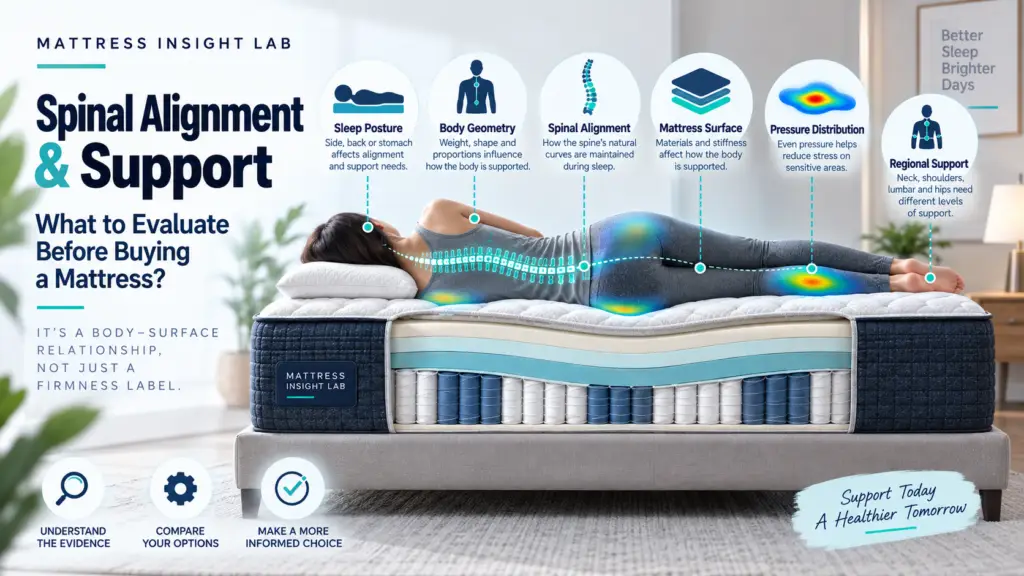
Mattress support and lying spinal alignment matter because sleep-surface characteristics can measurably alter body position and pressure distribution. But the effect depends on the individual sleeper, sleep position, and support configuration—not on a firmness label alone. This guide explains what the research actually shows, what remains unproven, and how to evaluate support without turning mattress selection into a medical diagnosis.
What Does Spinal Alignment Mean When Evaluating a Mattress?
When researchers evaluate spinal alignment during sleep, they measure how the body’s position changes in relation to the sleep surface—not against one universal “ideal” angle or perfectly straight line. Alignment is a posture-dependent, individual evaluation concept. Research studies use defined postures and measurement methods, and their findings apply only to the populations and configurations tested.
How Is Spinal Shape Measured During Side-Lying Mattress Research?
In a study of 25 men lying laterally, soft, firm, and customized stiffness arrangements produced different measured spinal alignments. The study measured spinal alignment under different surface stiffness conditions. The modeling component also found that required support stiffness varied across weight and dimension groups. [1] This means surface stiffness distribution can alter measured lateral spinal alignment, and the configuration producing the studied alignment response can depend on body dimensions and contour.
These findings are limited to the tested population and configurations. They do not establish that one stiffness is universally best, and they should not be transferred directly to every sex, posture, age, or mattress design.
What Changes in Lumbar Alignment Have Been Measured in the Supine Position?
A 2023 MRI study of 20 healthy adults found small but statistically significant changes in several lumbar alignment measures when participants lay supine on a mattress versus a rigid surface. [2] The study compared supine lumbar alignment on a mattress versus a rigid control surface using MRI. This demonstrates that mattress support conditions can produce measurable changes in lumbar alignment during supine lying.
The study measured alignment changes, not health outcomes. Observed angle changes should not be labeled as universally better, healthier, or pain-reducing.
Why Should “Good Alignment” Not Be Reduced to One Universal Angle or Perfectly Straight Line?
The reviewed primary studies use different postures, measurement methods, alignment variables, and individualized configurations rather than one common universal target. No single exact “ideal spine” geometry is universal. Alignment is an individual, posture-dependent evaluation concept.
The reviewed evidence does not establish a validated universal numerical alignment target that every mattress should maintain for every sleeper. A biomechanical review likewise concluded that proposed desirable target values for spinal alignment and pressure distribution could not yet be justified because of insufficient evidence. [9] “Neutral spine” should not be presented as one visually obvious or numerically standardized mattress position.
Why Is Lying Alignment Different From Diagnosing a Spinal Condition?
Measuring how the body lies on a sleep surface is a biomechanical evaluation. Diagnosing a spinal condition requires clinical assessment beyond mattress research. The reviewed studies measure alignment or pressure outcomes in defined populations; they do not diagnose or treat spinal disorders.
Mattress research evaluates body–surface interaction. It does not establish medical diagnoses or treatment prescriptions. This page does not provide medical advice.
Why Is Mattress Support More Than a Firmness Label?
A firmness label describes a surface stiffness category; it does not by itself prove that a mattress provides the right support for a particular sleeper. Stiffness influences alignment, but the response depends on the sleeper and support configuration. Soft, medium, or firm is not universally superior.
How Can Different Surface Stiffnesses Produce Different Spinal Shapes?
Experimental work using soft, medium, and hard mattresses found different changes in cervical and lumbar curvature depending on surface stiffness. [8] The response was not simply “firmer equals better alignment.” Different stiffness conditions altered regional spinal-curvature measurements, and the direction of change differed by spinal region and configuration.
These findings are limited to the study’s participants, pillow condition, tested stiffnesses, postures, and computational model. They do not convert into a universal firmness ranking or clinical treatment recommendation.
Why Can Individually Distributed Stiffness Matter More Than a Single Overall Firmness Category?
In the lateral-sleep study, soft, firm, and customized stiffness arrangements produced different measured spinal alignments. Modeling indicated that required support stiffness varied across weight and dimension groups. [1] The configuration of stiffness across the surface, rather than a single overall firmness category, influenced the measured alignment response in the studied population.
This does not mean customized stiffness is universally superior. The evidence is limited to the tested population and configurations.
Why Does “Firmer” Not Automatically Mean “Better Aligned”?
The reviewed studies show that spinal response changes with surface stiffness, but the direction of change can differ by spinal region and configuration. No simple “firmer is always better” pattern emerges. The soft/medium/hard stiffness study found different cervical and lumbar responses across tested stiffnesses, while the lateral-sleep study found different measured alignments under soft, firm, and customized arrangements. [8] [1]
The reviewed findings do not support a simple “firmer = better aligned” rule; responses differ by spinal region and configuration. The firmest tested condition should not automatically be treated as the best support condition for every sleeper.
What Can a Firmness Label Tell a Shopper—and What Can It Not Verify?
A firmness label communicates a surface stiffness category. It does not verify that the mattress provides correct alignment or support for a specific individual. Because the response to stiffness varies by individual and configuration, a firmness label alone cannot establish individual fit.
The reviewed evidence does not establish a universal body-weight-to-firmness prescription. Body weight alone cannot prescribe firmness.
How Does the Mattress Change the Position of Different Body Regions Under Load?
When a body lies on a mattress, different regions—pelvis, thorax, lumbar area—load the surface differently, and the mattress can change how those regions are positioned. Regional pressure changes must be kept separate from claims about pain or treatment.
Why Do the Pelvic, Thoracic, and Lumbar Regions Load the Surface Differently?
In a four-mattress biomechanical experiment, pelvic pressures exceeded thoracic pressures, and participant weight group affected maximum contact pressure. [3] Different body regions can load the surface differently because force, geometry, and contact area vary. In the cited experiment, the measured pelvic and thoracic pressures differed in the tested participants.
Pressure measurements describe contact, not alignment. Lower peak pressure does not automatically mean better spinal alignment or greater comfort for every sleeper.
How Can Regional Support Change Pressure Distribution Around the Pelvis and Lumbar Area?
A 10-participant supine study found that adding an inflatable lumbar support redistributed contact force from the pelvic toward the lumbar region. [4] Inflating the lumbar support reduced pelvic contact pressure and increased lumbar-region pressure, producing a more homogeneous regional pressure distribution in the experiment.
This measured pressure redistribution does not prove that lumbar support prevents pain, corrects spinal pathology, or is appropriate for every sleeper.
How Can Mattress Deformation Alter Measured Lumbar or Lateral Spinal Position?
The 2023 MRI study found measurable changes in lumbar alignment during supine lying on a mattress versus a rigid surface, and the lateral-sleep study found that different surface stiffness arrangements altered measured lateral spinal alignment. [2] [1] The mattress deforms under body load, changing how the body is positioned. These changes are measurable as alignment differences.
Sleep-surface characteristics can alter measured spinal alignment, but the direction and magnitude depend on the configuration and population. Observed angle changes are not universally better, healthier, or pain-reducing.
Why Must Regional Pressure Changes Be Kept Separate From Claims About Pain or Treatment?
Pressure redistribution is a measured biomechanical outcome. It does not by itself establish pain relief, treatment efficacy, or spinal alignment. The reviewed studies measured pressure distribution and alignment as separate outcomes; neither study established a medical benefit from the measured changes.
A biomechanical measurement describes body–surface interaction. It does not automatically translate into a clinical outcome.
How Does Sleep Position Change the Way Mattress Support Is Evaluated?
The biomechanical question changes with sleep position: side-lying, supine, and prone postures load the surface differently, and the evidence for each posture comes from different studies. The studies cannot be collapsed into one universal sleep-position prescription.
| Sleep Position | What Was Measured | Study Scope |
|---|---|---|
| Side-lying (lateral) | Spinal alignment under different stiffness arrangements | 25 men; soft, firm, and customized configurations |
| Supine | Lumbar alignment on mattress vs. rigid surface | 20 healthy adults; MRI measurement |
| Lateral and prone (sagging support) | Sleep parameters under personalized vs. sagging support | 17 healthy sleepers; adjustable sleep system |
| Supine and side-posture | Pressure distribution and spinal distortion | 18 men; four tested mattresses |
What Has Side-Lying Research Shown About Surface Stiffness and Spinal Alignment?
In a study of 25 men lying laterally, soft, firm, and customized stiffness arrangements produced different measured spinal alignments. Modeling indicated that required support stiffness varied across weight and dimension groups. Sleep-surface stiffness distribution can alter measured lateral spinal alignment, and the configuration producing the studied alignment response can depend on body dimensions and contour.
These findings are limited to the tested population and configurations. They do not establish that one stiffness is universally best.
What Has Supine MRI Research Shown About Mattress-Related Lumbar Position?
A 2023 MRI study of 20 healthy adults found small but statistically significant changes in several lumbar alignment measures when participants lay supine on a mattress versus a rigid surface. [2] The study compared supine lumbar alignment on a mattress versus a rigid control surface using MRI.
The study measured alignment changes, not health outcomes. The observed changes are not universally better, healthier, or pain-reducing.
What Did the Sagging-Support Study Find About Lateral and Prone Sleepers?
In 17 healthy sleepers using adjustable sleep systems, personalized support was compared with a sagging configuration. [5] The effect of sagging support on sleep depended partly on posture preference, with negative sleep-quality effects particularly reported for lateral and prone sleepers in that study.
This finding is limited to a small healthy-sleeper sample and a specific experimental sleep system. It does not prove that every visible mattress impression causes poor alignment, pain, or poor sleep.
Why Are Simple Universal Rules for Side, Back, Stomach, and Combination Sleepers Not Yet Established by These Studies?
The reviewed studies use different postures, subjects, mattresses, measurements, and outcomes. They do not establish one universal sleep-position prescription. Because the studies differ in method and population, they cannot be collapsed into one universal rule for side, back, stomach, or combination sleepers.
The reviewed evidence does not establish a validated universal numerical alignment target or a universal body-weight-to-firmness prescription.
How Do Body Dimensions, Weight Distribution, and Body Contour Change Mattress Interaction?
Body dimensions, weight distribution, and body contour change how a sleeper interacts with a sleep surface. This is why the same mattress need not produce the same interaction for every body. Body weight is one of several interacting variables, not a standalone firmness prescription.
How Did Body Weight Affect Measured Contact Pressure in a Four-Mattress Study?
In a four-mattress biomechanical experiment, participant weight group affected maximum contact pressure, and pelvic pressures exceeded thoracic pressures. The study tested 18 healthy adult men in three weight groups on four mattresses and measured supine pressure and side-posture spinal distortion.
Body weight is one variable affecting contact pressure, but spinal-distortion differences across mattresses were less consistent. Weight does not determine alignment or comfort.
How Can Body Dimensions and Weight Distribution Affect Sleep-System Modeling?
Human–bed modeling research identifies body dimensions, body-weight distribution, and the stiffness distribution of the mattress and bed base as variables affecting body–sleep-system interaction. [7] The study modeled mattress and bed-base interaction using individualized anthropometric data and load-deflection characteristics, validating predicted lateral spine shapes against 3D scans.
Individual body dimensions and weight distribution interact with sleep-system stiffness, supporting an individualized rather than one-firmness-fits-all interpretation. The model is limited to its framework, validation sample, lateral sleeping configuration, and tested sleep systems.
What Did Lateral-Sleep Modeling Find About Body Contour and Required Stiffness?
In the lateral-sleep study, modeling across different weight-dimensional groups indicated that required support stiffness varied with body characteristics. The modeling component found that the stiffness configuration producing the studied alignment response depended on body dimensions and contour.
Required support stiffness can vary with body characteristics, supporting an individualized interpretation. The evidence is limited to the tested population and configurations.
Why Does This Evidence Not Create a Universal “Body Weight = Firmness” Chart?
The primary studies identify body dimensions, contour, weight distribution, posture, and surface-stiffness configuration as interacting variables. They do not establish a universal weight-only prescription. Because multiple variables interact, body weight alone cannot determine the correct firmness for an individual.
The reviewed evidence does not establish a universal body-weight-to-firmness prescription. Body weight should not be treated as the only anthropometric variable.
Why Should Pressure Distribution and Spinal Alignment Be Evaluated Separately?
Pressure distribution and spinal alignment are distinct biomechanical outcomes. A mattress can change one without proving the other. The four-mattress study evaluated pressure distribution and spinal distortion as separate outcomes; the lumbar-support study measured pressure redistribution rather than clinical alignment.
What Does Contact-Pressure Mapping Measure?
Contact-pressure mapping measures how contact force is distributed across the body–surface interface. In the four-mattress study, weight group affected maximum contact pressure, and pelvic pressures exceeded thoracic pressures. In the lumbar-support study, inflating the support redistributed contact force from the pelvic toward the lumbar region.
Pressure mapping describes regional contact force, not spinal position. Lower peak pressure does not automatically mean better spinal alignment or greater comfort for every sleeper.
What Does Spinal-Distortion or Alignment Measurement Evaluate?
Spinal-distortion or alignment measurement evaluates the position of the spine relative to the body and sleep surface. In the four-mattress study, spinal-distortion differences across mattresses were less consistent than pressure differences. In the lateral-sleep study, different stiffness arrangements produced different measured spinal alignments.
Alignment measurement evaluates spinal position, which is a different outcome from contact pressure. The two should not be treated as interchangeable measurements.
Why Can a Mattress Change Pressure Distribution Without Proving Optimal Alignment?
The four-mattress study found that pressure and spinal-distortion measurements responded differently. A mattress can change pressure without demonstrating a corresponding alignment change. Pressure distribution and spinal distortion are separate biomechanical outcomes; the study measured them independently.
Because the two outcomes can respond differently, improvement in one does not automatically prove improvement in the other.
Why Should Pressure Comfort and Postural Support Remain Separate Buying Criteria?
Because pressure distribution and spinal alignment are distinct outcomes, shoppers should evaluate them as separate criteria rather than assuming one proves the other. The reviewed studies measured pressure and alignment as separate outcomes; neither established that one predicts the other.
A mattress may feel comfortable in terms of pressure while not demonstrating a particular alignment response, and vice versa. The reviewed studies do not validate a consumer home protocol for clinically proving spinal alignment.
What Does Research on Sagging or Poorly Matched Support Actually Show?
Research on sagging support is limited to specific experimental conditions. It does not validate visible sagging or morning symptoms as specific diagnostic tests for spinal misalignment. The sagging-support study tested a specific experimental condition, not all visible mattress impressions.
How Was Personalized Support Compared With a Sagging Support Condition?
Seventeen healthy sleepers used adjustable sleep systems under personalized and sagging-support conditions during laboratory sleep. The study compared personalized support with an experimentally sagging configuration and measured sleep parameters.
The study tested a specific experimental sagging condition, not all visible mattress impressions. It does not prove that every visible impression causes poor alignment, pain, or poor sleep.
Which Sleep-Posture Groups Showed a Negative Sleep Response to the Sagging Condition?
The effect of sagging support on sleep depended partly on posture preference, with negative sleep-quality effects particularly reported for lateral and prone sleepers in that study. Posture preference influenced how the sagging condition affected sleep in the tested sample.
This finding is limited to a small healthy-sleeper sample and a specific experimental sleep system. It does not generalize to all visible impressions.
Why Does a Visible Body Impression Not by Itself Prove Spinal Misalignment?
The reviewed primary research does not establish that a visible body impression proves spinal misalignment. Visible impressions are not validated measurements of spinal alignment in the reviewed evidence. There is no validated consumer home test that uses visual observation to prove correct or incorrect spinal alignment.
Why Should Morning Soreness or Stiffness Not Be Used as a Stand-Alone Mattress Diagnosis?
The reviewed evidence does not establish morning stiffness, soreness, or discomfort as specific diagnostic markers of mattress-induced spinal misalignment. Symptoms may be discussed as personal trial observations only. They do not diagnose mattress support failure or a spinal condition.
What Does Clinical Evidence About Mattress Firmness and Low-Back Pain Actually Establish?
A randomized trial in adults with chronic nonspecific low-back pain found that a medium-firm mattress produced better outcomes on several measures than a firm mattress over 90 days. [6] This does not establish medium-firm as universally correct. The trial is limited to a specific clinical population and two specific firmness conditions.
What Population Was Studied in the Firm Versus Medium-Firm Mattress Trial?
The trial studied 313 adults with chronic nonspecific low-back pain. [6] Participants met study criteria for chronic nonspecific low-back pain and were randomized to firm or medium-firm mattresses. The findings apply to this clinical population, not to all sleepers.
What Outcomes Differed Between the Two Mattress Conditions?
At 90 days, several pain and disability outcomes favored the medium-firm condition over the firm condition tested. The trial compared two specific firmness conditions and measured pain and disability outcomes over 90 days. In this clinical population, the tested medium-firm mattress produced better outcomes on several measures than the tested firm mattress.
Why Does That Trial Not Prove That Medium-Firm Is Correct for Every Sleeper?
The trial studied adults with chronic nonspecific low-back pain and compared two specific firmness levels. It does not establish medium-firm as universally correct for every healthy sleeper or every spinal condition. Because the trial is population- and condition-specific, it cannot be converted into a universal prescription.
Why Should Mattress Selection Not Be Presented as Treatment for an Undiagnosed Back Condition?
Mattress selection is a buying decision, not a treatment for an undiagnosed back condition. The reviewed evidence does not establish that mattress firmness treats all back pain or corrects spinal pathology. A mattress may influence measured outcomes in a studied population, but it is not a medical treatment.
Can Zoned or Regional Support Change Body–Mattress Interaction?
Regional support can change measured body–surface interaction, but superiority depends on configuration and individual characteristics. The evidence does not prove that every zoned mattress fits every sleeper better. Regional adjustment can change interaction, but no zoned design is universally superior.
How Can Different Stiffness Zones Change Lateral Spinal Alignment?
In the lateral-sleep study, soft, firm, and customized stiffness arrangements produced different measured spinal alignments. The configuration of stiffness across the surface influenced the measured alignment response in the studied population. Sleep-surface stiffness distribution can alter measured lateral spinal alignment, and the configuration producing the studied alignment response can depend on body dimensions and contour.
This does not establish that one stiffness is universally best. The evidence is limited to the tested population and configurations.
How Can Added Lumbar Support Redistribute Contact Pressure in Supine Lying?
A 10-participant supine study found that adding an inflatable lumbar support redistributed contact force from the pelvic toward the lumbar region. [4] Inflating the lumbar support reduced pelvic contact pressure and increased lumbar-region pressure, producing a more homogeneous regional pressure distribution in the experiment.
This measured pressure redistribution does not prove that lumbar support prevents pain, corrects spinal pathology, or is appropriate for every sleeper.
Why Does Individual Anthropometry Matter to Regional Support Design?
Human–bed modeling research identifies body dimensions, body-weight distribution, and the stiffness distribution of the mattress and bed base as variables affecting body–sleep-system interaction. [7] The modeling study used individualized anthropometric data and load-deflection characteristics to predict lateral spine shapes.
Individual body dimensions and weight distribution interact with sleep-system stiffness, supporting an individualized rather than one-firmness-fits-all interpretation. The model is limited to its framework, validation sample, lateral sleeping configuration, and tested sleep systems.
Why Does Evidence for Regional Adjustment Not Prove That Every Zoned Mattress Fits Every Sleeper Better?
The reviewed evidence supports that regional stiffness and lumbar-support changes can alter measured body–surface interaction. But superiority depends on configuration and individual characteristics. Because the response depends on configuration and individual characteristics, no zoned design is universally superior.
The reviewed evidence does not establish a validated universal numerical alignment target or a universal body-weight-to-firmness prescription.
How Can a Shopper Evaluate Support Without Treating a Home Test as a Clinical Measurement?
A shopper can evaluate personal comfort and fit during an at-home trial, but the reviewed evidence does not establish a validated consumer home protocol for clinically proving spinal alignment. Useful fit observations should be distinguished from claims of clinically verified alignment.
Why Should a Mattress Be Evaluated in the Sleep Positions the Buyer Actually Uses?
Because the biomechanical question changes with posture, a mattress should be evaluated in the positions the buyer actually uses. The reviewed studies measured different outcomes in different postures; the response to a surface can depend on posture. Evaluating in the positions actually used gives the shopper relevant personal-fit information.
Why Are Body Dimensions and Weight Distribution Relevant to Individual Fit?
Human–bed modeling research identifies body dimensions, body-weight distribution, and the stiffness distribution of the mattress and bed base as variables affecting body–sleep-system interaction. [7] The modeling study used individualized anthropometric data to predict lateral spine shapes. Individual body dimensions and weight distribution interact with sleep-system stiffness, supporting an individualized interpretation.
This does not create a universal weight-to-firmness chart. Body weight is one of several interacting variables.
Why Is a Brief Firmness Impression Not Proof of Long-Term Support?
A brief firmness impression describes initial feel, not demonstrated long-term support for an individual. The reviewed studies measured alignment and pressure under defined conditions, not brief subjective impressions. A firmness label or brief impression is a starting point, not proof of individual support.
What Can an At-Home Trial Reveal About Personal Comfort and Fit?
An at-home trial can reveal personal comfort and fit in the positions the buyer actually uses, over multiple nights. Research protocols evaluate sleepers in defined postures and, in some studies, across repeated nights. An at-home trial provides personal observations about comfort, fit, and usability over time.
Personal comfort and fit are legitimate trial observations, distinct from clinical measurements. An at-home trial is not a validated clinical measurement of spinal alignment.
What Can an At-Home Trial Not Prove About Spinal Pathology or Exact Alignment?
The reviewed evidence does not establish a validated consumer home protocol for clinically proving spinal alignment or diagnosing spinal pathology. An at-home trial provides personal-fit observations, not clinical measurements. The reviewed studies do not validate a consumer home protocol for clinically proving spinal alignment, and morning symptoms do not diagnose mattress support failure or a spinal condition.
How Should Spinal Alignment and Support Influence the Final Mattress Decision?
Spinal alignment and support matter as outcomes of the interaction between the sleeper, posture, mattress, and support system. The final decision should compare mattresses on personal fit, not on a universal firmness rule. No single firmness, construction type, or zoned design is correct for everyone.
Treat Support as an Individual Body–Sleep-Surface Interaction Rather Than a Firmness Label
Perceived and biomechanical support results from the interaction between the sleeper’s body, posture, and the mechanical behavior of the mattress and support system; it is not proven by a firmness label alone. The reviewed studies show that stiffness, body dimensions, weight distribution, and configuration interact to affect measured outcomes. Because measured and perceived responses vary by individual and configuration, individual fit cannot be inferred from a firmness label alone.
Consider Normal Sleep Position and Body Geometry When Comparing Mattresses
Sleep position and body geometry are relevant variables because the biomechanical question changes with posture and body shape. The reviewed studies measured different outcomes in different postures and identified body dimensions and weight distribution as interaction variables. Comparing mattresses in the positions actually used, with attention to body geometry, gives relevant personal-fit information.
Evaluate Pressure Comfort and Alignment-Related Support as Separate Criteria
Pressure comfort and alignment-related support are separate criteria because they measure different aspects of body–mattress interaction. The four-mattress study evaluated pressure distribution and spinal distortion as separate outcomes; the lumbar-support study measured pressure redistribution rather than clinical alignment. Because the two outcomes can respond differently, they should be evaluated separately.
Use Extended Trial Experience as Personal Fit Evidence, Not as a Medical Diagnosis
Extended trial experience provides personal observations about comfort, fit, and usability over time, but it is not a validated clinical measurement of spinal alignment or a medical diagnosis. Personal comfort and fit are legitimate trial observations, distinct from clinical measurements. There is no validated consumer home test for clinically proving spinal alignment, and morning symptoms do not diagnose mattress support failure or a spinal condition.
Avoid Claims That One Firmness, Construction Type, or Zoned Design Is Correct for Everyone
The reviewed evidence does not establish that one firmness, construction type, or zoned design is correct for everyone. Because the response depends on individual and configuration variables, no single design is universally correct. Medium-firm should not be prescribed to every sleeper, and no universal numerical alignment target exists.
Sources and References
- Leilnahari K, et al. — Spine alignment in men during lateral sleep position: experimental study and modeling. PubMed record.
- Vitale JA, et al. — Effect of a mattress on lumbar spine alignment in supine position in healthy subjects: an MRI study. PubMed record.
- DeVocht JW, et al. — Biomechanical evaluation of four different mattresses. PubMed record.
- Normand MC, et al. — Biomechanical effects of a lumbar support in a mattress. PubMed record.
- Verhaert V, et al. — Ergonomics in bed design: the effect of spinal alignment on sleep parameters. PubMed record.
- Kovacs FM, et al. — Effect of firmness of mattress on chronic non-specific low-back pain. PubMed record.
- Verhaert V, et al. — Modeling human-bed interaction: the predictive value of anthropometric models in choosing the correct bed support. PubMed record.
- Hong TTH, et al. — The Influence of Mattress Stiffness on Spinal Curvature and Intervertebral Disc Stress. PubMed record.
- Wong DWC, et al. — Sleeping mattress determinants and evaluation: a biomechanical review and critique. PubMed record.
Study findings are kept within their tested populations, postures, mattress configurations, and measured outcomes. Biomechanical measurements are not treated as medical diagnoses or universal mattress prescriptions.
Final Synthesis
Spinal alignment and support matter when choosing a mattress because sleep-surface characteristics can measurably alter body position and pressure distribution. But the effect depends on the individual sleeper, sleep position, and support configuration—not on a firmness label alone.
The research shows that surface stiffness can alter measured lateral and supine spinal alignment, that body dimensions and weight distribution interact with sleep-system stiffness, and that regional support can redistribute contact pressure. It also shows that pressure distribution and spinal alignment are separate outcomes, and that the medium-firm low-back-pain trial applies only to a specific clinical population.
What the reviewed research does not establish is equally important. It does not establish a validated universal numerical alignment target, a validated consumer home protocol for clinically proving alignment, a universal body-weight-to-firmness prescription, or a symptom-based mattress-support diagnostic. Visible impressions and morning symptoms are personal observations, not validated measurements.
When comparing mattresses, evaluate support as an individual interaction. Consider the sleep positions you actually use and your body geometry. Evaluate pressure comfort and alignment-related support as separate criteria. Use extended trial experience as personal fit information, not as a medical diagnosis. And avoid claims that one firmness, construction type, or zoned design is correct for everyone.
Mattress selection is a buying decision, not a medical treatment. If you have an undiagnosed back condition or persistent symptoms, consult a qualified healthcare professional.