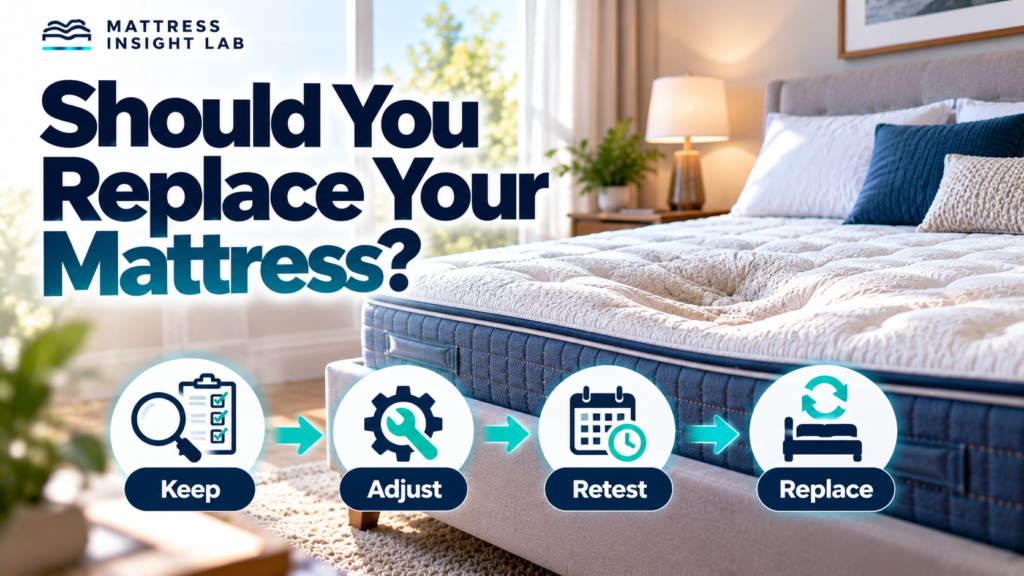
Should You Replace Your Mattress? A Practical Decision Checklist
Scope Note: This checklist is educational and focused on mattress-related decision support. It does not diagnose medical pain, sleep disorders, or health conditions.
Decision Note: The final “keep, adjust, retest, or consider replacement” result is a practical house method, not a certified engineering inspection or warranty ruling.
Evidence Honesty Note: This page separates mattress-condition signals, sleep-setup variables, and user-reported discomfort patterns. It does not claim that a checklist can prove the exact cause of pain or poor sleep.
Brand Method Note: The terms Replacement Decision Signal, Adjustment-First Filter, and Retest Window are MattressInsightLab house labels used for practical explanation.
What Evidence Does This Checklist Actually Use?
This checklist uses practical decision signals that a normal mattress owner can observe at home. It does not pretend to replace lab testing, professional evaluation, or manufacturer warranty rules.
Exact Evidence Lanes
- Lane 1 — User-observed mattress condition: visible sagging, lumps, uneven support, edge collapse, heat retention, odor, or worsening comfort pattern.
- Lane 2 — Sleep setup variables: pillow height, topper use, protector type, bedding heat load, foundation support, and room environment.
- Lane 3 — Discomfort pattern evidence: repeated discomfort, waking position, morning stiffness, heat timing, and whether symptoms improve away from the mattress.
- Lane 4 — MattressInsightLab Replacement Decision Method v1.0: the article-created keep / adjust / retest / consider-replacement decision logic used on this page.
Bridge to next step: once the evidence lanes are clear, the checklist can separate replacement signals from setup problems.
What Can This Replacement Checklist Decide?
This checklist can help you organize mattress-related signals into a practical next step. It can suggest whether replacement is becoming more reasonable, whether adjustment should be tested first, or whether more tracking is needed before making a decision.
Signal buildup
Whether repeated mattress-related signals are building up enough to justify closer review.
Medical cause
It cannot prove the exact medical cause of pain, poor sleep, numbness, or stiffness.
Practical decision filter
Use it before contacting a seller, replacing the bed, or assuming a warranty issue.
Setup separation
Whether pillow, topper, protector, bedding, or foundation should be tested first.
Warranty approval
It cannot decide whether a brand, retailer, or warranty provider must approve a claim.
Adjustment-first review
Use the result with a discomfort log, sagging check, or controlled setup test.
Bridge to next step: after setting boundaries, the checklist can identify the strongest replacement warning signs.
Which Warning Signs Point More Strongly Toward Replacement?
Replacement becomes more reasonable when the mattress itself shows repeated condition problems and those problems remain after simple setup variables have been checked.
Fig A: Replacement is stronger when mattress-condition signals remain after adjustment-first tests.
Higher-weight replacement signals
- Visible sagging, dips, lumps, or uneven surface feel.
- Discomfort repeats across multiple nights in the same body zones.
- Sleeping elsewhere noticeably reduces the problem.
- Foundation, pillow, bedding, and topper changes do not improve the issue.
- The mattress is older and shows worsening comfort or support behavior.
Bridge to next step: before replacement, the checklist should still force adjustment-first checks so users do not replace a mattress for a pillow, topper, or foundation problem.
What Should You Check Before Replacing the Mattress?
The adjustment-first filter prevents a rushed replacement decision. Many mattress complaints can be amplified by the sleep setup around the mattress, especially pillow height, toppers, protectors, room temperature, or foundation support.
Pillow height and firmness
A poor pillow can make a mattress feel misaligned even when the mattress surface is not the main issue.
Foundation support and sagging check
A weak base can exaggerate mattress sink and create a false mattress-failure signal.
Protector, topper, sheets, ventilation
Surface layers and room conditions can trap heat even on a breathable mattress.
Temporary topper or pressure log
A surface comfort issue may be adjustable without replacing the entire mattress.
Bridge to next step: after the adjustment-first checks, the user needs a simple decision tool that converts observations into an action path.
Interactive Mattress Replacement Decision Checklist
Use this simple house method to organize your evidence. Check every statement that is true for your current mattress. The result updates automatically and gives a practical next step.
Replacement Decision Signal
This is a practical decision aid, not a warranty ruling, engineering inspection, or medical diagnosis.
Step 1: check every statement that is true. Step 2: use the buttons below the checklist. Step 3: read the recommendation directly under the checklist.
Replacement checklist ready.
Adjustment-first review
Start by checking pillow height, foundation support, bedding heat load, and topper/protector effects before deciding on replacement.
Next action: complete the checklist above, then update the decision.
Bridge to next step: the checklist result should be interpreted with your logs, not alone. Stronger evidence comes from repeated patterns and failed adjustment tests.
How Should You Interpret the Decision Result?
Low replacement signal
Low score, no visible sagging, no repeated pattern, and mostly stable comfort. Keep monitoring and avoid deciding from one poor night.
Setup may be involved
Moderate discomfort, but pillow, topper, bedding, foundation, or room setup has not been tested. Change one variable at a time.
Mixed or unclear evidence
Use a 7–14 night discomfort log when the pattern is inconsistent, the cause is unclear, or sleep positions vary too much.
Stronger combined signal
Visible mattress problems plus repeated discomfort and failed adjustment tests. Document evidence before buying or filing a claim.
How Do You Separate Mattress Failure From Setup Problems?
The cleanest replacement decision comes from separating the mattress from nearby variables. A mattress can be blamed for problems caused by a weak foundation, poor pillow match, thick topper, hot protector, or room environment.
Fig B: Replacement decisions improve when nearby setup variables are separated before blaming the mattress.
Separation rule: change one variable at a time.
- Do not change pillow, topper, sheets, and foundation on the same night.
- Track at least a few nights before judging the change.
- If the same problem remains across setup changes, the mattress signal becomes stronger.
- If the problem improves after one setup change, replacement may not be the immediate next step.
Summary & Next Steps
This template gives you a practical way to decide whether mattress replacement is reasonable now or whether adjustment and tracking should come first. The strongest replacement case appears when mattress-condition problems, repeated discomfort patterns, and failed adjustment tests all point in the same direction.
Named Background References
- MattressInsightLab Replacement Decision Method v1.0. Used for the keep / adjust / retest / consider-replacement decision logic, the Replacement Decision Signal, and the Adjustment-First Filter.
- MattressInsightLab Sleep Setup Separation Method v1.0. Used for separating mattress, pillow, topper, bedding, foundation, and room environment variables before a replacement decision.
- Manufacturer care and warranty instructions. Should be checked separately for brand-specific sagging rules, foundation requirements, trial-period terms, and warranty claim requirements.
- Medical or clinical guidance. Should be used separately when pain, numbness, overheating, night sweats, or sleep disruption may be health-related rather than mattress-related.
Reference honesty: this page intentionally avoids pretending that a house checklist can prove exact mattress failure. It is a structured decision aid that helps organize observable signals before a user makes a replacement decision.