Why Warranty Length and Coverage Terms Matter Before Purchase
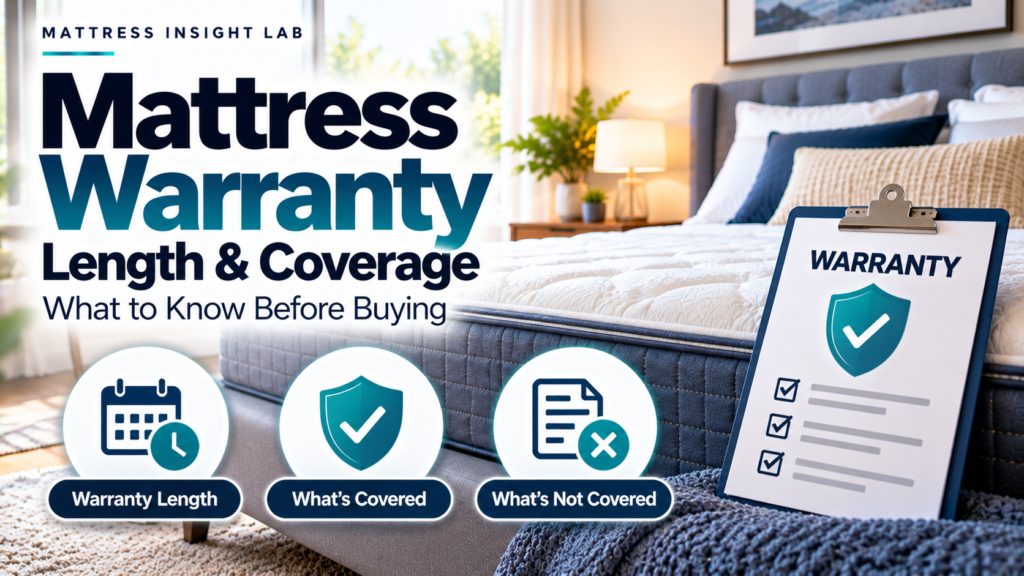
A mattress warranty is a contract-defined defect-protection policy. It is not a comfort guarantee, not a sleep trial, and not a durability estimate. Its practical value depends on the complete claim pathway—duration, commencement, covered defects, indentation thresholds, support requirements, eligibility, remedy, buyer cost, and post-replacement terms—not on the number of years alone. Policies and legal guidance checked September 15, 2026. [1] [2] [3] [5] [6]
Two mattresses can both advertise a 10-year warranty and still offer materially different protection. One may require a specific indentation depth before an indentation claim qualifies, place transportation costs on the buyer after a defined period, and continue the original warranty clock on any replacement. Another may use a different threshold, a different measurement method, a different remedy structure, and a different cost allocation. The number of years is one variable among many, and it is rarely the variable that decides whether a claim is approved or what the buyer pays.
This guide walks through the complete warranty claim pathway so you can audit a specific written warranty before purchase rather than ranking warranties by duration. Current warranties from Casper, Purple, Tempur-Pedic, and Saatva are used as illustrations of how duration, thresholds, eligibility, remedy, and cost interact. All manufacturer terms referenced here are current as of September 2026 and apply only to the specific warranty they come from.
What Does a Mattress Warranty Actually Protect?
A mattress warranty is a written contract that defines specific material or workmanship defects the manufacturer will remedy—it is not a satisfaction guarantee, a sleep trial, or a return policy. The written warranty is the primary source for the manufacturer's express warranty terms, subject to applicable federal and state law and any separate implied or statutory rights. FTC guidance expressly recognizes that written warranties can coexist with implied warranties and state-law rights. [1]
FTC guidance distinguishes two thresholds: written warranties on consumer products costing more than $10 must be designated “Full” or “Limited,” while FTC disclosure and pre-sale-availability rules apply to written warranties on products costing more than $15. Covered warranty terms must be available before purchase. [1] The written warranty is therefore the primary source for the manufacturer's express warranty terms, while applicable federal/state law and separate implied or statutory rights may provide additional protections.
What Is a Written Mattress Warranty?
A written mattress warranty is a contract in which the manufacturer commits to remedy specified material or workmanship defects under stated conditions, for a stated period, subject to eligibility and claim requirements. The designation “full” or “limited” carries different legal requirements, and the actual limits, exclusions, and remedies live inside the warranty text rather than in the designation alone.
“Full Replacement” is not the same thing as a federal “Full Warranty.” Tempur-Pedic has used the phrase “10-Year Full Replacement Limited Warranty”; “Full Replacement” describes the remedy wording, while the legal warranty designation remains Limited. FTC “Full” versus “Limited” terminology has a specific statutory meaning. [1] [8]
A warranty does not guarantee that the mattress will stay comfortable. Current warranties define specific defects, not satisfaction. Casper’s warranty, for example, is expressly a defects-in-materials/workmanship warranty, and Purple’s warranty expressly excludes comfort preference and localized firmness changes.
How Does Defect Coverage Differ From a Sleep Trial?
A sleep trial is an at-home fit-evaluation window; a warranty is a defect-remedy contract. They address different problems and are not interchangeable. Purple explicitly states that warranty replacements do not qualify for a new sleep trial or comfort exchange, which illustrates that the two protections are separate instruments.
Because a sleep trial addresses preference and a warranty addresses defined defects, a mattress can be uncomfortable without having a covered defect. The warranty does not protect you if you simply do not like the feel of the mattress.
How Does Warranty Protection Differ From a Return or Exchange Policy?
A return or exchange policy governs product exit and refund conditions; a warranty governs defect remedies during the coverage period. They are separate contractual instruments. Warranty replacements do not automatically receive new trial or return rights, so a buyer should evaluate both independently before purchase.
Warranty and voluntary return rights are different frameworks. A warranty replacement does not automatically restart a sleep-trial or return window; verify the applicable return/trial terms separately.
Why Can a Mattress Be Uncomfortable Without Having a Covered Defect?
Current warranties define coverage around specific material or workmanship defects. Comfort preference and localized firmness changes are excluded under at least one current warranty. Because comfort preference is a fit question rather than a defect question, it falls outside defect coverage.
If the mattress feels too firm, too soft, too warm, or otherwise unsuitable, that is not automatically a warranty matter. The warranty page’s job is to identify what the written warranty classifies as covered or excluded, not to explain why a mattress feels a particular way.
Why Should the Written Warranty Be Read Before Purchase?
FTC guidance requires pre-sale availability of written warranty terms for consumer products costing more than $15 and requires “Full” or “Limited” designation for written warranties on products costing more than $10. [1] Shoppers can therefore evaluate the actual express warranty terms before purchase rather than relying on a product-page warranty badge.
Because the warranty is a contract, its express terms should be reviewed before purchase. A product-page badge does not tell you the full defect definitions, exclusions, remedies, costs, or claim requirements; the written warranty is the primary source for those express terms, subject to applicable law.
Why Does Warranty Length Tell You Less Than the Complete Coverage Terms?
Warranty length is a contract variable; the protection it delivers depends on commencement, covered defects, eligibility, remedy, and buyer cost — not on the number of years alone. Current examples include 10-year limited warranties from Casper, Purple, and Tempur-Pedic, and ownership-based lifetime coverage from Saatva. Despite similar or longer durations, these warranties differ materially in thresholds, costs, and remedies.
How Long Does the Written Warranty Remain in Force?
Current examples include 10-year limited mattress warranties from Casper, Purple, and Tempur-Pedic, plus ownership-based Friends for Life coverage from Saatva. [2] [3] [5] [6] Duration is one contract variable among several; it does not by itself describe remedy, cost, or defect scope.
A 10-year warranty is not a standard. Durations are brand-specific and can change.
What Event Starts the Warranty Period?
Casper, Purple, and Tempur-Pedic currently tie their mattress warranty periods to the original purchase date. Because commencement determines when coverage begins and ends, record the exact trigger from the specific warranty rather than assuming a common industry practice.
Warranties do not universally start at delivery. The reviewed Casper, Purple, and Tempur-Pedic warranties use the original purchase date; use the exact commencement language in the applicable express warranty.
Does “Lifetime” Mean While the Original Purchaser Owns the Mattress?
Saatva’s current warranty applies for as long as the original purchaser owns the qualifying mattress, and currently limits warranty service to the continental United States at the time of claim. “Lifetime” can describe an ownership-based term while still carrying geographic and remedy conditions.
Lifetime warranty does not mean free replacement for life. Saatva’s lifetime warranty carries a $149 processing fee from year 3 and optional percentage-price replacement in later years. Because “lifetime” is defined by the contract, verify the exact definition rather than assuming free lifetime replacement.
Does the Remedy Change During Different Years of the Warranty?
Saatva's current Friends for Life mattress warranty provides no-charge replacement in years 1–2, then repair/re-cover with a $149 processing fee starting in year 3. Its optional Fairness Replacement route currently uses this separate schedule: years 3–5: 50% of original full retail price + $99 processing fee; years 6–10: 60% + $99; years 11–15: 80% + $99. The currently published mattress schedule does not list a percentage-price Fairness Replacement tier beyond year 15. [5]
Because remedy and buyer cost can change over time, map the full structure rather than labeling the warranty simply “prorated” or “non-prorated.” Saatva's standard route changes after year 2, while the optional Fairness Replacement route has explicit percentage tiers through year 15 plus a $99 processing fee. [5]
Can Claim Costs Increase Even While the Warranty Remains Active?
Yes. Saatva's standard mattress remedy carries a $149 processing fee from year 3. Purple places transportation costs for valid claims after the first 100 days on the purchaser, subject to its standard-freight cap. Tempur-Pedic can place associated transportation on the purchaser and can require an upfront inspection fee that is reimbursed when the claim is determined to be covered. [3] [5] [6]
Cost structures are contract-specific and can vary by year of claim. Because “covered” does not necessarily mean zero out-of-pocket cost, calculate those possible costs as part of the total purchase budget. An approved claim is not always free.
Why Does a 10-Year or Lifetime Label Not Establish Mattress Service Life?
Warranty duration is a contractual protection period, not a service-life or durability estimate. ASTM F1566 lists mattress/mattress-set measurements of firmness, firmness retention, durability, effect of impact, and height change and states that the resulting data are for comparative analysis with no pass/fail criteria applicable. [9]
Because the warranty is a contract and the test standard is comparative, neither can be converted into consumer service-life years. A 10-year warranty does not mean the mattress should last 10 years.
Which Mattress Problems Actually Count as Covered Defects?
Coverage depends on whether the specific problem matches the exact defect definition in the written warranty — including any measurable threshold, measurement method, and exclusion. Current warranties define coverage around specific material or workmanship defects, and the exact list of covered defects is contract-specific.
Which Material or Workmanship Failures Are Expressly Covered?
Current warranties define coverage around specific material or workmanship defects. Casper’s warranty is expressly a defects-in-materials/workmanship warranty. The exact list of covered defects is contract-specific, so match the claimed problem to the exact warranty language. A problem that is not listed is not automatically covered.
Does the Warranty Cover Cracking, Splitting, or Other Defined Structural Failure?
Express warranty coverage depends on whether the specific structural failure matches the written defect terms. Do not assume coils, seams, foam, cover, zipper, handles, or other components are covered unless the applicable express warranty says so.
What Visible Indentation Depth Must Be Exceeded for an Indentation Claim?
Current thresholds differ: Casper greater than 1 inch; Purple greater than 1 inch after full recovery from load; Saatva greater than 1.5 inches; and Tempur-Pedic uses two mattress thresholds—greater than 0.75 inch for qualifying non-quilted mattresses and greater than 1.5 inches for qualifying quilted-top mattresses. Tempur-Pedic instructs claimants to measure without applying weight or pressure, using a straightedge across the affected area. [2] [3] [4] [5]
Because thresholds are contract-specific, record the exact value and its surrounding conditions. There is no standard 1-inch threshold across warranties.
How Must the Indentation Be Measured?
The measurement method is warranty-specific. Do not assume a universal procedure or that the warranty measures indentation while someone is lying on the mattress. The warranty document specifies the required measurement conditions, and because measurement method affects whether a threshold is met, verify the exact procedure.
Which Body Impressions or Indentations Are Below the Coverage Threshold?
An indentation below the warranty’s stated threshold does not qualify for an indentation claim under that warranty. Because the threshold is a contract condition, an impression below it falls outside coverage. Any visible body impression is not automatically a covered defect; coverage depends on exceeding the stated threshold.
Are Localized Firmness Changes Excluded?
Purple explicitly excludes localized firmness changes. Do not assume firmness loss or surface softening is covered; verify the exact warranty language. Because at least one current warranty excludes localized firmness changes, verify the exact exclusion list for the specific warranty.
Is Comfort Preference Excluded?
Purple explicitly excludes comfort preference, and Casper’s warranty is expressly a defects-in-materials/workmanship warranty. Comfort preference is a fit question, not a defect question. Because comfort preference is excluded, a mattress that simply feels too firm, soft, warm, or otherwise unsuitable is not automatically a warranty matter.
Why Must Every Claimed Defect Be Matched to the Exact Warranty Language?
For an express-warranty claim, the alleged defect must match the applicable written terms—including threshold, measurement method, and exclusions. Different manufacturers define covered defects differently, so compare the claimed problem with the exact express-warranty language while recognizing that separate statutory or implied rights may also exist.
Why Should Indentation Thresholds Be Compared Carefully Rather Than Ranked Alone?
A lower indentation threshold may be noted as a contract-specific value, but it does not by itself establish that the entire warranty is more protective. Thresholds are embedded within different definitions, materials, measurement procedures, exclusions, support requirements, remedies, and claim costs.
Is the Threshold Greater Than 0.75, 1.0, 1.5 Inches, or Another Contract-Specific Value?
Current examples include Tempur-Pedic greater than 0.75 inch for qualifying non-quilted mattresses and greater than 1.5 inches for qualifying quilted-top mattresses; Casper greater than 1 inch; Purple greater than 1 inch after full recovery from load; and Saatva greater than 1.5 inches. [2] [3] [4] [5] Record both the threshold and the measurement conditions instead of treating the number alone as a warranty ranking.
Must the Mattress Fully Recover From Load Before Measurement?
The measurement conditions are warranty-specific. Verify the exact procedure in the specific warranty. Do not assume a universal recovery or measurement condition, because measurement conditions affect whether a threshold is met.
Is a Straightedge or Another Measurement Method Specified?
The measurement method is warranty-specific. Verify the exact procedure in the specific warranty. Do not assume a universal measurement instrument, because the method affects whether a threshold is met.
Does the Warranty Exclude Indentations Caused by an Inadequate Foundation?
Current warranties contain support-system requirements or exclusions tied to inadequate foundations or frames. Do not assume improper foundation use automatically defeats every unrelated claim; verify the exact exclusion language. Exclusion scope is warranty-specific.
Does the Threshold Apply to the Mattress Core, Cover Materials, or Both?
The scope of the threshold is warranty-specific. Verify the exact language in the specific warranty. Do not assume the threshold applies uniformly to all components.
Why Does a Smaller Number Not Automatically Make the Entire Warranty More Protective?
The reviewed evidence does not establish that a lower indentation threshold automatically provides better overall warranty protection. Thresholds are embedded within different definitions, materials, measurement procedures, exclusions, support requirements, remedies, and claim costs. A lower threshold is a contract-specific value, not a total-warranty ranking.
Which Support and Care Conditions Can Affect Warranty Eligibility?
Current warranties contain support-system requirements and care conditions that can affect eligibility; the exact specifications are warranty-specific. Because support conditions can affect eligibility, verify the exact requirements before use rather than assuming any firm base will satisfy the warranty.
What Foundation, Platform, Frame, or Adjustable-Base Requirements Apply?
Casper requires a structurally capable bed base; Purple requires adequate support; Tempur-Pedic specifies detailed foundation and frame requirements; Saatva imposes its own frame and platform requirements. Support requirements are warranty-specific, so verify the exact specifications in the specific warranty. Any firm base does not automatically satisfy the warranty.
Are Slat Width, Slat Spacing, Center Support, or Frame-Leg Requirements Specified?
Tempur-Pedic publishes detailed support specifications; the exact dimensions are warranty-specific. Do not create a universal slat-spacing, leg-count, or frame rule. Because dimensional requirements are warranty-specific, verify the exact specifications rather than assuming every Queen or King requires the same number of legs.
Can the Manufacturer Require Evidence of the Support System During a Claim?
Purple can require proof of consistent use of an appropriate foundation or frame during a claim. Support-system evidence is one of several documentation categories a claim may require. Because support evidence may be required, retain documentation of the support system.
Does the Warranty Require a Specific Branded Foundation—or Only Adequate Structural Support?
FTC warranty guidance generally prohibits tie-in provisions that require a consumer to use a particular branded article or service merely to preserve warranty coverage, unless the required item/service is provided free or the warrantor obtains an FTC waiver. [1] This is different from requiring a support system to meet functional or structural specifications and excluding damage caused by inadequate support.
Because the FTC limits brand-specific tie-in requirements, distinguish structural specifications from mandatory branded-accessory purchase. You do not necessarily have to buy the manufacturer’s foundation to keep your warranty.
Which Stains, Burns, Liquid Damage, Misuse, or Unsanitary Conditions Can Affect Eligibility?
Exclusion lists are warranty-specific. Verify the exact exclusions in the specific warranty. Do not create a universal list of warranty exclusions, and do not assume stains always or never affect coverage.
Can Removing the Mattress Cover Affect Coverage?
Express-warranty eligibility can depend on cover-use rules. Do not assume cover removal is permitted; verify the exact written term for the specific mattress.
What Product-Care Instructions Must Be Followed?
Care instructions are warranty-specific. Verify the exact requirements in the specific warranty. Do not assume protector use, rotation, or flipping is universally required.
Why Should the Exact Warranty Replace Generic Internet Rules About Rotation, Flipping, Protectors, and Foundations?
Because care and support requirements are warranty-specific, generic internet rules may not match the manufacturer's express warranty terms. Verify the exact written requirements rather than relying on generic advice.
Who Is Actually Eligible to Use the Mattress Warranty?
Eligibility depends on who bought the mattress, from whom, in what condition, and where warranty service is available — all of which are warranty-specific. Because eligibility is determined by the purchase transaction and the warranty terms, verify these factors before purchase rather than after a defect develops.
Is Coverage Limited to the Original Purchaser?
Casper, Purple, Tempur-Pedic, and Saatva currently use original-purchaser eligibility for the reviewed mattress warranties. [2] [3] [5] [6] Do not generalize that structure to every mattress warranty; verify the exact purchaser requirement.
Is the Warranty Transferable if the Mattress Is Sold or Gifted?
Purple and Casper expressly make their reviewed mattress warranties non-transferable. [2] [3] Do not assume all mattress warranties are non-transferable; verify the exact terms.
Must the Mattress Be Purchased New?
Purple covers the original purchaser of a new mattress purchased from Purple or an authorized retailer; Tempur-Pedic limits its current warranty to qualifying original purchasers buying new products. Do not assume used, returned, floor-model, or clearance mattresses receive full new-product warranty coverage. Because condition requirements are contract-specific, verify the exact terms.
Must It Be Purchased Directly or From an Authorized Retailer?
Casper, Purple, and Tempur-Pedic currently limit qualifying warranty coverage to purchases through the brand or authorized retailers. Do not assume every third-party seller is unauthorized; verify the exact seller requirements. Because seller authorization affects eligibility, verify the seller’s status before purchase.
How Are Unauthorized Marketplace Sellers Treated?
Purple excludes unauthorized resellers from warranty coverage. Do not assume marketplace or other purchase channels carry the same warranty rights; verify the exact seller terms. Because unauthorized sellers may be excluded, verify the seller’s status before purchase.
Do Used, Returned, Floor-Model, Demo, Clearance, or “As-Is” Products Have Different Coverage?
Express-warranty eligibility for floor models, clearance mattresses, used mattresses, comfort returns, or other non-new products varies by manufacturer and product. Verify the exact written eligibility terms rather than assuming full new-product coverage.
Is Warranty Service Limited to a Particular Country or Region?
Saatva’s current warranty limits warranty service to the continental United States at the time of claim. Do not assume warranty service is available outside the original sales territory. Because geographic limits are contract-specific, verify the exact service area.
Why Should Seller Identity and Product Condition Be Verified Before Checkout?
Key express-warranty eligibility facts—such as original-purchaser status, seller authorization, and whether the mattress was purchased new—may be impossible to cure after purchase. Verify them before checkout, while recognizing that missing documentation can sometimes be supplied later and separate legal rights may exist.
What Happens Financially When a Warranty Claim Is Approved?
An approved claim does not necessarily mean zero out-of-pocket cost. Current warranties place defined transportation, inspection, and processing costs on the purchaser in specific circumstances. “Covered” describes the defect remedy, not the complete cost allocation.
Does the Warrantor Choose Between Repair and Replacement?
In the reviewed Casper, Purple, and Tempur-Pedic warranties, the warrantor chooses between repair and replacement. [2] [3] [6] Do not assume the buyer selects the remedy; check the exact remedy clause in other warranties individually.
Is Replacement Free During Every Year of Coverage?
Saatva provides free replacement in the first two years, then repair or re-cover with a $149 processing fee from year 3, plus an optional later-year replacement program requiring a percentage of the original full retail price. Cost structures can change over the warranty period. Because replacement may not be free in every year, map the cost structure across the full period.
Can Later-Year Repair Carry a Processing Fee?
Saatva’s standard remedy from year 3 carries a $149 processing fee. Processing fees are contract-specific. Because processing fees may apply, verify the exact fee structure rather than assuming repairs are always free.
Can Later-Year Replacement Require a Percentage of the Original Price?
Saatva's optional Fairness Replacement route currently requires 50% + $99 in years 3–5, 60% + $99 in years 6–10, and 80% + $99 in years 11–15, calculated from the original full retail price at purchase. [5] Percentage-price replacement is one contract-specific structure, not a universal long-warranty model.
Who Pays Transportation or Freight?
Purple makes transportation costs for valid mattress warranty claims after the first 100 days the purchaser's responsibility, subject to its stated freight cap. Tempur-Pedic places associated warranty transportation on the purchaser, subject to its terms; Casper states the purchaser is not responsible for required warranty return shipping. [2] [3] [6] Transportation allocation is warranty-specific.
Can an Inspection Fee Be Charged Before Claim Approval?
Tempur-Pedic can require an inspection fee paid upfront and states that the fee is reimbursed when the claim is determined to be covered. [6] Inspection-fee rules are contract-specific.
Is an Approved Inspection Fee Reimbursed?
Tempur-Pedic states that an upfront inspection fee is reimbursed when the claim is determined to be covered. [6] Other warranties can use different inspection/reimbursement terms.
What Does an Upgrade Cost if the Buyer Chooses a More Expensive Replacement?
Upgrade costs are warranty-specific. Do not assume warranty upgrades are free; verify the exact express-warranty upgrade terms.
Why Does “Covered” Not Necessarily Mean Zero Out-of-Pocket Cost?
Current warranties place defined transportation, inspection, and processing costs on the purchaser in specific circumstances. “Covered” describes the defect remedy, not the complete cost allocation. Because cost allocation is contract-specific, calculate possible costs before purchase.
What Happens to the Warranty After a Mattress Is Repaired or Replaced?
In the reviewed Casper, Purple, and Tempur-Pedic warranties, ordinary repaired or replacement products continue under the original warranty clock; upgrade provisions can alter that result. [2] [3] [7] Other warranties should be checked individually rather than assuming either a reset or continuation.
Does the Replacement Continue the Original Warranty Clock?
Casper, Purple, and Tempur-Pedic currently state that ordinary repaired or replacement products remain tied to the original warranty period/purchase date. [2] [3] [7] That reviewed pattern should not be turned into a universal replacement rule.
Does Any Replacement Start a Fresh Warranty?
Casper states that a paid upgrade can receive a new warranty, and Tempur-Pedic states that an even warranty exchange continues the original warranty while an approved paid upgrade can receive a new 10-year warranty. [2] [7] Upgrade provisions can therefore alter the warranty clock.
Does Paying for an Upgrade Change the Warranty Start Date?
Casper and Tempur-Pedic both document upgrade pathways that can start a new warranty under stated conditions, while ordinary replacements remain tied to the original warranty clock. [2] [7] Verify the exact upgrade terms before assuming a reset.
Can a Discontinued Mattress Be Replaced With a Comparable Current Model?
Purple may use an equivalent model if the original model is unavailable. Do not assume the manufacturer must provide the identical discontinued mattress model. Because discontinued-model handling is contract-specific, verify the exact terms.
Who Decides Whether the Defective Mattress Is Repaired or Replaced?
In the reviewed Casper, Purple, and Tempur-Pedic warranties, the warrantor chooses between repair and replacement. [2] [3] [6] Remedy choice remains contract-specific, so check other warranties individually.
Must the Original Mattress Be Surrendered?
Surrender requirements are warranty-specific. Verify the applicable express-warranty terms rather than assuming you always keep the old mattress.
Does the Warranty Replacement Receive a New Sleep Trial?
Purple explicitly states that warranty replacement mattresses do not qualify for a new sleep trial or comfort exchange. [3] Do not assume a warranty replacement restarts trial or return rights.
Why Must Replacement Terms Be Checked Before Assuming “new mattress = new warranty”?
In the reviewed Casper, Purple, and Tempur-Pedic warranties, ordinary repaired or replacement products continue under the original warranty clock. A replacement therefore does not automatically receive a fresh warranty; check other warranties individually.
What Evidence Might Be Required to Prove a Warranty Claim?
Current claim processes can require documentation beyond the receipt, including law tags, defect images, condition images, and proof of adequate support. Because claim documentation may be required, retain records from the beginning rather than trying to reconstruct them later.
Is the Original Receipt or Order Confirmation Required?
Casper requires proof of the original purchase date for warranty service; Purple’s claim process can require receipt or order proof. Proof of purchase is one of several documentation categories a claim may require. Because proof of purchase may be required, retain the receipt or order confirmation.
Must the Mattress Law Tag Remain Attached?
Purple’s claim process can require intact law tags. Do not assume law tags are universally required; verify the exact warranty. Because law-tag requirements are contract-specific, verify the exact terms.
Are Defect Photos or Videos Required?
Purple’s claim process can require defect photos or videos. Do not assume photos alone prove a covered defect. Because image requirements are contract-specific, verify the exact terms; images are one documentation category among several.
Must the Mattress’s Overall Condition Be Documented?
Purple’s claim process can require mattress-condition photos or videos. Overall-condition documentation is one of several categories a claim may require. Because condition documentation may be required, retain relevant records.
Must the Support Foundation or Frame Be Shown?
Purple’s claim process can require proof of adequate mattress support. Support-system documentation is one of several categories a claim may require. Because support documentation may be required, retain relevant records.
Is an Exact Indentation-Measurement Procedure Required?
Measurement procedures are warranty-specific. Verify the exact express-warranty instructions rather than assuming any indentation-measurement method will be accepted.
Does the Manufacturer Require Inspection?
Tempur-Pedic can require an inspection fee paid upfront, reimbursed if the claim is determined to be covered. Inspection requirements are contract-specific. Because inspection requirements vary, verify the exact terms.
Which Claim Instructions Must Be Followed Before Repair or Replacement Is Authorized?
Claim instructions are warranty-specific; failure to follow required express-warranty procedures can affect the claim. Verify the stated process rather than assuming any submission method will be accepted.
Why Should Warranty, Receipt, Product Model, and Supporting Records Be Saved From the Beginning?
Tempur-Pedic recommends retaining warranty, purchase, model, size, serial or law-tag, and receipt information; Casper instructs original purchasers to retain their receipt. Because claim documentation may be required, retaining records from the beginning prevents gaps later. Because documentation requirements are contract-specific, retain the records the exact manufacturer requires.
What Does Warranty Length Not Tell You About Mattress Durability or Comfort?
Warranty length is a contractual protection period; it does not establish mattress service life, comfort retention, or material durability. ASTM F1566 provides comparative durability and firmness-retention test methods without universal pass/fail criteria.
Does a 10-Year Warranty Mean the Mattress Will Remain Comfortable for 10 Years?
The reviewed evidence does not establish that a 10-year warranty predicts ten years of comfort retention. Warranty duration is a contractual protection period; ASTM F1566 provides comparative durability and firmness-retention test methods without universal pass/fail criteria. A 10-year warranty should not be used to estimate how long the mattress will remain comfortable.
Does a Lifetime Warranty Mean the Mattress Has a Lifetime Service Life?
The reviewed evidence does not establish that a lifetime warranty predicts a lifetime service life. “Lifetime” is a contract-defined term; ASTM F1566 does not establish universal service-life years. A lifetime warranty should not be used to estimate mattress service life.
Does Warranty Length Predict When Foam, Latex, Springs, or Other Components Will Fatigue?
The reviewed evidence does not establish that warranty length predicts when specific components will fatigue. ASTM F1566 provides comparative durability and firmness-retention test methods without universal pass/fail criteria. Warranty length should not be used to predict component fatigue.
Can a Mattress Change in Feel Without Developing a Covered Defect?
Yes. A mattress can change in feel without developing a covered defect, because coverage depends on matching the exact defect definition, threshold, and exclusions in the warranty. Because coverage is contract-specific, a change in feel that does not match the warranty’s defect definition is not automatically covered.
What Can Standardized Mattress Durability Testing Evaluate That a Warranty Cannot?
ASTM F1566 includes mattress/mattress-set measurements of firmness, firmness retention, durability, effect of impact, and height change. It also describes a firmness-retention test/surface-deformation procedure, but “surface deformation” is not a separate top-level measurement category in the standard's summary. The data are intended for comparative analysis with no pass/fail criteria applicable. [9] The standard does not provide consumer service-life years.
Why Should Warranty Length Remain a Contract Variable Rather Than a Durability Estimate?
Because warranty duration is contractual and ASTM F1566 does not establish universal service-life years, warranty length should remain a contract variable rather than a durability estimate. The warranty document and the test standard address different questions. Because the two are separate, do not convert warranty years into a durability estimate.
How Should Warranty Terms Be Compared Between Similar Mattresses?
Warranty comparison should proceed through the complete claim pathway — duration, commencement, defect definitions, thresholds, support requirements, eligibility, exclusions, remedy, costs, replacement terms, and documentation — rather than stopping at duration. The dimensions below are drawn from the same evidence base used throughout this guide.
Compare Warranty Duration and Commencement Date
Current examples include 10-year limited warranties (Casper, Purple, Tempur-Pedic) and ownership-based lifetime coverage (Saatva), with commencement tied to the original purchase date in the cited warranties. Duration and commencement are separate variables to record. Because duration and commencement are contract-specific, record both for each candidate mattress.
Compare the Exact Covered-Defect Definitions
Covered-defect definitions are contract-specific; compare the express-warranty language for each candidate. Because definitions vary, do not assume all manufacturers cover the same defects.
Compare Indentation Threshold and Measurement Method
Current examples include Tempur-Pedic >0.75 inch for qualifying non-quilted mattresses and >1.5 inches for qualifying quilted-top mattresses, Casper >1 inch, Purple >1 inch after full recovery, and Saatva >1.5 inches. [2] [3] [4] [5] Compare the threshold together with its measurement method, exclusions, support requirements, remedy, and claim cost.
Compare Support-System Requirements
Support-system requirements are warranty-specific; compare the exact specifications for each candidate. Support requirements are contract-specific. Because requirements vary, compare the exact specifications rather than assuming all warranties require the same support.
Compare Owner, Seller, and Geographic Eligibility
Eligibility rules are contract-specific; compare original-purchaser, seller-authorization, and geographic terms for each candidate. Eligibility is determined by the purchase transaction and the warranty terms. Because eligibility varies, compare the exact terms.
Compare Exclusions and Care Conditions
Exclusions and care conditions are contract-specific; compare the exact lists for each candidate. Because exclusions and care conditions vary, compare the exact lists rather than assuming all warranties exclude the same things.
Compare Repair, Replacement, and Discontinued-Model Rules
Remedy rules are contract-specific; compare repair and replacement choice and discontinued-model handling for each candidate. Because remedy rules vary, compare the exact terms rather than assuming all warranties offer the same remedy.
Compare Transportation, Inspection, Processing, and Upgrade Costs
Cost structures are contract-specific; compare transportation, inspection, processing, and upgrade costs for each candidate. Because cost structures vary, compare the exact terms rather than assigning a global cost label.
Compare What Happens to the Warranty After Replacement
Post-replacement terms are contract-specific; compare clock continuation, reset provisions, and trial consequences for each candidate. Because post-replacement terms vary, compare the exact terms rather than assuming all replacements continue the original warranty.
Compare Claim Documentation Requirements
Documentation requirements are contract-specific; compare receipt, law-tag, image, and support-evidence requirements for each candidate. Because documentation requirements vary, compare the exact lists rather than assuming all warranties require the same documents.
Why Should Warranty Clarity and Practical Claim Cost Be Evaluated Alongside Duration?
Because duration alone does not reveal defect scope, eligibility, remedy, or cost, evaluate clarity and practical claim cost alongside duration. Duration is one variable among several. Because the complete claim pathway determines practical protection, evaluate all dimensions rather than assuming the longest warranty is the best warranty.
Sources and References
- Federal Trade Commission — Businessperson's Guide to Federal Warranty Law. Magnuson-Moss Full/Limited designation, pre-sale availability, implied warranties, and tie-in provisions.
- Casper — Mattress Warranty. 10-year limited warranty, original purchaser, authorized retailer, >1-inch indentation, remedy choice, replacement clock.
- Purple — Warranties. 10-year mattress warranty, >1-inch indentation after recovery, exclusions, transportation, remedy choice, replacement clock, no new trial.
- Tempur-Pedic — How do I know that my product is defective? Quilted >1.5-inch and non-quilted >0.75-inch thresholds plus straightedge/no-pressure measurement.
- Saatva — Friends for Life Warranty. Lifetime ownership structure, $149 repair/re-cover fee, Fairness Replacement percentages + $99 fee, support rules, >1.5-inch impressions.
- Tempur-Pedic — 10-Year Mattress and Flat Foundation Limited Warranty. Current 10-year limited warranty, transportation, inspection, support, remedy, eligibility.
- Tempur-Pedic — Warranty replacement clock. Even exchange continues original warranty; paid upgrade can receive new 10-year warranty.
- Tempur-Pedic — 10-Year Full Replacement Limited Warranty. Example showing “Full Replacement” wording within a legally Limited warranty.
- ASTM F1566-14(2021). Firmness, firmness retention, durability, effect of impact, height change; comparative analysis with no universal pass/fail criteria.
What Is the Best Way to Review Mattress Warranty Protection Before Purchase?
Review the complete written warranty for the exact mattress before paying, then audit duration, defect definitions, thresholds, exclusions, support requirements, eligibility, costs, remedy, replacement terms, and documentation. The steps below turn the warranty into a pre-purchase audit rather than a duration comparison.
Obtain the Written Warranty for the Exact Mattress Before Paying
FTC guidance states that written warranties for covered consumer products must be available for review before purchase. The Pre-Sale Availability Rule governs covered written warranties above the applicable price threshold. Because the warranty is a contract, obtain and review the complete document before paying; the product-page badge is not enough.
Confirm Whether the Warranty Is Full or Limited Where That Designation Applies
Under Magnuson-Moss, written warranties on consumer products costing more than $10 must be designated “Full” or “Limited.” FTC disclosure and pre-sale-availability rules apply to written warranties on products costing more than $15. [1] The designation carries legal significance but does not by itself rank mattress quality. Also, wording such as “Full Replacement” can describe a remedy while the warranty remains legally designated Limited.
Record the Warranty Duration and Commencement Date
Record the exact duration and the exact commencement event from the specific warranty. Duration and commencement are separate variables. Because both determine the coverage window, record both rather than recording duration alone.
Identify the Specific Defects the Warranty Covers
Identify the exact defect definitions in the specific warranty. Coverage is defined by the contract. Because coverage is contract-specific, identify the exact defect definitions rather than assuming all defects are covered.
Record Any Visible-Indentation Threshold and Measurement Method
Record the exact threshold and measurement method from the specific warranty. For example, current Tempur-Pedic guidance distinguishes >0.75 inch for qualifying non-quilted mattresses from >1.5 inches for qualifying quilted-top mattresses and uses a no-pressure straightedge measurement. [4] Threshold and measurement method must be read together.
Identify Comfort, Normal-Wear, and Other Key Exclusions
Identify the exact exclusions in the specific warranty, including comfort preference and localized firmness changes where applicable. Exclusions are contract-specific. Because exclusions determine what is not covered, identify the exact list rather than assuming normal wear is universally defined.
Verify Foundation, Frame, Slat, and Support Requirements
Verify the exact support requirements in the specific warranty. Support requirements are contract-specific. Because support conditions can affect eligibility, verify the exact requirements rather than assuming any foundation works.
Confirm Original-Purchaser, Authorized-Seller, and Geographic Rules
Confirm the exact original-purchaser, seller-authorization, and geographic terms in the specific warranty. Eligibility is determined by the purchase transaction and the warranty terms. Because eligibility is contract-specific, confirm the exact terms rather than assuming eligibility is the same everywhere.
Calculate Possible Transportation, Inspection, Processing, or Replacement Costs
Calculate possible costs using the exact terms in the specific warranty. Cost structures are contract-specific. Because “covered” does not necessarily mean zero cost, calculate possible costs rather than assuming approved claims are always free.
Determine Who Chooses Repair or Replacement
Determine the exact remedy-choice terms in the specific warranty. In the reviewed Casper, Purple, and Tempur-Pedic warranties, the warrantor chooses between repair and replacement; do not assume that structure applies universally.
Determine Whether a Replacement Gets the Remaining Warranty, a New Warranty, or No New Trial
Determine the exact post-replacement terms in the specific warranty. In the reviewed Casper, Purple, and Tempur-Pedic warranties, ordinary replacements continue the original clock, while paid upgrades can change the result in some programs. [2] [3] [7] Check other warranties individually.
Save the Receipt, Warranty, Product Information, Tags, and Required Support Evidence
Save the records the exact manufacturer requires, which may include receipt, warranty, model, serial or law-tag, and support-system evidence. Documentation requirements are contract-specific. Because claim documentation may be required, retain the records from the beginning rather than gathering them later.
Evaluate Warranty Protection Separately From Sleep-Trial and Return Rights
Warranty, sleep trial, and return policy are three distinct protections; evaluate each separately. Warranty replacements do not automatically receive new trial or return rights. Because the three protections address different events, evaluate each independently rather than assuming the warranty covers trial and return rights.
Never Use the Warranty Period as a Substitute for Product-Specific Durability Evidence
Warranty duration is a contractual protection period; ASTM F1566 provides comparative test data without universal pass/fail criteria. The warranty document and the test standard address different questions. Because the two are separate, do not use warranty period as a durability proxy.
Final synthesis. A mattress warranty is a contract-defined defect-protection policy, and its practical value depends on the complete claim pathway rather than on the number of years alone. Duration, commencement, covered defects, indentation thresholds, measurement methods, support requirements, eligibility, exclusions, remedy, buyer cost, post-replacement terms, and documentation requirements each shape what a warranty would actually protect if a covered defect develops after purchase. Current warranties from Casper, Purple, Tempur-Pedic, and Saatva illustrate how materially these structures can differ despite similar or longer durations. Warranty length is a contract variable, not a durability estimate, a comfort guarantee, or a sleep trial. Review the complete written warranty for the exact mattress before paying, and audit each stage of the claim pathway rather than ranking warranties by years alone.