How Bounce and Ease of Movement Affect Mattress Usability
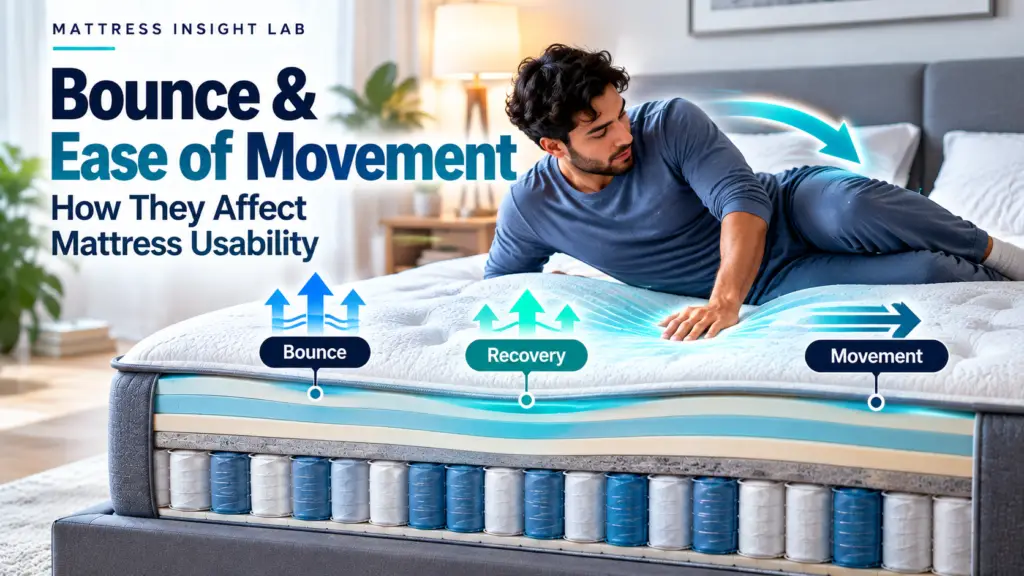
Bounce and ease of movement are related but distinct concepts. In technical testing, rebound resilience, recovery time, hysteresis loss, and spring rate describe different parts of mechanical response, while ease of movement describes a person’s practical experience of rolling, repositioning, sitting, and rising. ASTM D3574, for example, separates ball-rebound resilience, recovery time, and hysteresis loss into different tests rather than treating them as one property. [2] [3] [4] The reviewed evidence supports evaluating those mechanical variables separately from human movement usability and does not establish a universal material or construction ranking for movement ease.
This guide separates measurable mechanical properties from subjective human experience. It explains what the evidence supports, what remains unresolved, and how a shopper can meaningfully evaluate movement ease before purchase.
What Do “Bounce” and “Ease of Movement” Actually Mean?
Bounce and ease of movement are related buying concepts but are not the same technical property. Mechanical response can be described through recovery, resilience, hysteresis, and spring rate, while ease of turning or getting out of bed is a human usability outcome.
The reviewed standards and human studies measure several distinct physical and usability outcomes rather than treating them as one property. ASTM F1566-14(2021) lists mattress or mattress-set methods for firmness, firmness retention, durability, impact effects, and height change. [1] ASTM D3574 provides separate flexible-polyurethane-foam tests, including ball-rebound resilience, recovery time, and hysteresis loss. [2] [3] [4] Human research can rate ease of turning separately from comfort and interface pressure. [9]
What Does Mattress Rebound Describe After a Load Is Reduced?
In everyday mattress language, “rebound” is often used loosely, but ASTM D3574 separates rebound resilience from recovery time. Ball-rebound resilience describes elastic energy return by measuring the rebound of an impacting ball, whereas recovery time describes how long a slow-recovery foam takes to return after a defined compression procedure. [3] [4] Neither test is itself a human usability score.
Rebound resilience can therefore be discussed as one measurable material-level energy-return response without treating it as equivalent to shape-recovery speed or shopper movement ease. The reviewed ASTM mattress standard does not define a standardized consumer bounce score. [1] [3]
What Does Recovery Time Describe?
Recovery time describes how long a slow-recovery material takes to return after a defined compression-and-release procedure. ASTM D3574 Test M records that recovery in seconds under its specified method. [4] This is different from ball-rebound resilience and from the recovery percentage reported in the 2026 layered-composite study.
Recovery time is a material-level measurement, not a human movement score. The reviewed evidence does not establish a universal recovery-time threshold at which repositioning becomes difficult for every sleeper.
What Does Ease of Movement Describe From the Sleeper’s Perspective?
Ease of movement describes a person’s practical experience of rolling, repositioning, sitting, and rising on a mattress. It is a human usability outcome, not a material property. Human studies can rate ease of turning separately from comfort and pressure.
In one hospital-mattress study, ease of turning was assessed separately from interface pressure and comfort in 20 healthy adults testing five hospital mattresses. [9] This supports treating movement ease as a distinct evaluation dimension.
Why Are Firmness, Support, Bounce, and Movement Ease Different Evaluation Dimensions?
The reviewed standards and human studies measure several distinct physical and usability outcomes rather than treating firmness, material response, and human movement ease as a single property.
ASTM F1566 separately lists firmness, firmness retention, durability, impact effects, and height change. [1] ASTM D3574 separates multiple foam material tests. [2] [3] Human studies can rate ease of turning independently from comfort and pressure. [9] The reviewed evidence does not establish that any one of these measurements universally predicts the others.
Why Are Rebound Resilience, Recovery, and Hysteresis Different Properties?
Rebound resilience, recovery, and hysteresis are distinct mechanical properties. They describe different aspects of how a material responds to loading and unloading. The 2026 layered-foam study independently reports recovery percentage, hysteresis loss, support factor, and force–indentation behavior in the tested ~60-mm multilayer composites, demonstrating that these are distinct reported mechanical outcomes. [5] [6] [13]
What Does Recovery Measure After Foam Compression?
In the 2026 layered-composite study, recovery is reported as a percentage describing elastic return under that study’s indentation procedure; it should not be confused with ASTM D3574 Test M recovery time, which is measured in seconds for slow-recovery foam. [5] [6] [4] After compression, a foam sample returns partially or fully toward its original geometry. The recovery percentage reflects how much of the original dimensions are regained.
Recovery is a material-level measurement. Higher recovery does not automatically mean easier movement; no direct human evidence establishes that relationship.
What Does Hysteresis Loss Reveal About Energy Dissipation During Loading and Unloading?
Hysteresis loss reflects the energy difference between loading and unloading during a deformation cycle; graphically it corresponds to the area difference between the loading and unloading responses. [4] [5] Higher hysteresis loss indicates a larger fraction of input energy was not returned mechanically during that cycle. When a foam is compressed and released, some energy is returned and some is dissipated as heat or internal friction. Hysteresis loss quantifies the energy not returned.
Hysteresis is a material-level energy measurement. It should not be equated with sink depth or movement difficulty; these are distinct concepts without established equivalence.
Why Can Two Foam Systems Recover Differently Even at Similar Thickness?
Foam composition and layer sequence can change recovery behavior even when total thickness is similar. The 2026 study found materially different recovery values among tested three-layer composites. Some tested composites showed recovery around 64–66% while others showed recovery around 30–46%, despite similar total thickness. [5] [6] [13]
These samples were approximately 60-mm foam composites, not complete consumer mattresses. Similar thickness does not guarantee similar recovery.
Why Should None of These Measurements Be Called a Complete “Ease-of-Movement Score”?
Recovery, hysteresis, and related measurements describe material-level mechanical properties. They do not constitute a complete ease-of-movement score; the reviewed ASTM mattress standard does not define a standardized consumer ease-of-movement metric.
ASTM F1566-14(2021) does not list a consumer bounce or ease-of-movement score among its published mattress/mattress-set methods. [1] Material tests measure specific properties under specific conditions, and those results may differ from final-use behavior. No single mechanical measurement in the reviewed evidence should be presented as a complete human ease-of-movement score.
How Does Viscoelastic Foam Differ From Faster-Recovering Flexible Foam?
Viscoelastic polyurethane foam — often marketed as memory foam — is described as relatively low-resilience and slow to recover after compression compared with high-resilience or conventional flexible polyurethane foams. This is a material-level distinction, not a universal human-mobility outcome.
Why Is Viscoelastic Polyurethane Foam Described as Low-Resilience and Slow-Recovery?
Technical literature characterizes viscoelastic polyurethane foam by slow recovery and relatively low resilience compared with faster-recovering conventional or high-resilience flexible polyurethane foams. [7] [8] This is a material-level characterization. It does not establish that all memory-foam mattresses trap sleepers or prevent repositioning.
How Does High-Resilience Foam Differ Mechanically?
High-resilience flexible foam is characterized by greater rebound resilience than slow-recovery viscoelastic foam, and the cited technical literature also contrasts it with the slower recovery of viscoelastic formulations. [7] [8] Hysteresis loss remains formulation- and test-dependent and should not be inferred from the label alone. This does not establish that high-resilience foam is universally easier to move on.
Why Can Temperature Affect Viscoelastic Recovery Behavior?
The patent disclosure describes viscoelastic foam recovery time as temperature-sensitive. [8] Recovery behavior can vary with temperature. This is a material-level characteristic described in the technical disclosure. No specific temperature thresholds are supplied in the evidence.
Why Does Slow Recovery Not Automatically Prove That Every Sleeper Will Have Difficulty Repositioning?
The supplied verified evidence does not establish that slow recovery automatically causes repositioning difficulty for every sleeper. Viscoelastic foam is characterized as slow-recovering at the material level. Human studies can rate ease of turning separately from comfort and pressure. But no direct evidence connects one recovery value to a universal repositioning threshold.
The relationship between slow recovery and universal repositioning difficulty remains unresolved. Direct validation connecting recovery values to repositioning effort is lacking.
How Can Layer Order Change Mattress-Like Foam Recovery?
The 2026 layered-foam study found that foam composition and layer sequence can change recovery and hysteresis behavior in tested three-layer composites. This prevents a simple “foam type = movement feel” rule.
The samples were approximately 60-mm foam composites, not complete mattresses. One group showed recovery around 64.3–66.2% with hysteresis loss around 24.3–24.5%. Another group showed recovery around 30.0–45.9% with hysteresis around 33.0–34.7%. [5] [6] [13] Layer sequence influenced response in the more sequence-sensitive group.
What Happened to Recovery When Different Foams Were Rearranged?
In the tested composites, one group showed recovery around 64–66% while another showed recovery around 30–46%. Layer sequence influenced response in the more sequence-sensitive group. Different foam combinations and layer orders produced different recovery behavior in the tested three-layer composites.
How Did Hysteresis Loss Change Between the Tested Composite Groups?
One group showed hysteresis loss around 24.3–24.5% while another showed hysteresis around 33.0–34.7%. The group with lower recovery showed greater hysteresis loss. Hysteresis loss reflects energy dissipated during loading–unloading cycles. Higher hysteresis loss should not be equated with movement difficulty.
What Happened When High-Resilience Foam Was Placed Near the Surface?
High-resilience foam at the top partially improved recovery in the tested composites. [5] [6] Placing high-resilience foam near the surface contributed to improved recovery behavior in the tested configuration. This is specific to the tested composites and does not establish that high-resilience foam at the surface always improves recovery in all mattresses.
What Happened When Low-Resilience Foam Was Placed Near the Surface?
Low-resilience foam at the surface increased energy loss in the tested composites. [5] [6] Placing low-resilience foam near the surface contributed to increased energy loss in the tested configuration. This is specific to the tested composites and does not establish a universal rule.
Why Does This Prevent a Simple “Foam Type = Movement Feel” Rule?
Because foam composition and layer sequence can change recovery and hysteresis behavior, one material name does not uniquely determine a composite’s mechanical response. The tested composites showed different recovery and hysteresis depending on composition and layer order. A single foam label cannot predict the composite’s behavior.
What Does Spring Rate Tell You About a Spring Mattress’s Mechanical Response?
Spring rate describes how much force changes for a given change in spring deflection. For a locally linear spring response it can be treated as approximately constant over that range; in progressive systems the effective rate can change as additional spring elements engage. [12] This describes spring mechanics, not a universal human ease-of-movement score.
What Does Spring Rate Mean?
Spring rate is the change in force associated with a change in spring deflection. It describes the slope of the load–deflection response over the range being considered. A higher local spring rate means force rises more rapidly with additional deflection. [12] This describes spring mechanics, not human outcomes.
How Does Spring Compression Change as Load Increases?
As load increases, a spring generally deflects further according to its load–deflection curve. In a progressive design, the effective spring rate can change with deflection rather than remaining constant. Higher spring rate does not automatically mean better support or easier movement.
How Can Multiple Spring Rates Be Engaged at Different Compression Levels?
In the cited coil-in-coil patent, the inner and outer coils have different spring rates and the inner coil engages after additional compression, creating a progressive change in the combined load–deflection response. [12] This does not establish that progressive engagement automatically improves movement ease.
Why Does Spring Mechanics Not by Itself Prove Easier Repositioning on the Complete Mattress?
The supplied verified evidence does not establish that spring mechanics alone prove easier repositioning on the complete mattress. Spring rate describes coil component behavior. A complete mattress combines multiple layers and structural elements. Material recovery, hysteresis, spring rate, firmness, deformation depth, layer order, preload, and body movement can interact.
The relationship between spring mechanics and universal easier repositioning remains unresolved. No evidence establishes that coils or innersprings universally provide easier repositioning or better mobility than foam.
Does Faster Mattress Recovery Automatically Make Turning Easier?
The supplied verified evidence does not establish that faster post-compression recovery reliably reduces the effort needed to roll or reposition. Material studies establish different recovery and hysteresis properties. Human mattress studies separately evaluate subjective turning ease. Direct validation connecting one recovery value to repositioning effort is lacking.
What Can Recovery Measurements Establish Objectively?
Recovery measurements can objectively establish the extent to which a tested material or composite returns toward its original dimensions after compression. Recovery is a material-level percentage measurement. It describes the tested sample’s behavior under the test conditions. Recovery measurements should not be extended to human movement outcomes.
What Does a Human Ease-of-Turning Rating Measure Instead?
A human ease-of-turning rating measures a person’s subjective experience of turning on a mattress, which can be evaluated separately from pressure and comfort. In the hospital-mattress study, participants rated ease of turning as an independent variable. This captures the human experience of movement, not a material property.
Why Would Rolling Effort Also Depend on Indentation, Body Load, Posture, Friction, and Movement Strategy?
The supplied verified evidence does not establish which combination of factors determines rolling effort. Rolling effort plausibly involves multiple variables, but the reviewed evidence does not quantify their relationships. A complete mattress combines multiple layers and structural elements. Human movement involves body load, posture, friction, and movement strategy.
The relationship between specific factor combinations and quantified rolling effort remains unresolved.
What Evidence Would Be Needed to Quantify the Relationship Between Recovery Speed and Repositioning Effort?
The supplied verified evidence does not establish the relationship between recovery speed and repositioning effort. Quantifying it would require human biomechanical studies measuring standardized rolling or repositioning effort together with mattress recovery mechanics. Direct validation connecting one recovery value to repositioning effort is lacking.
What Has Human Mattress Research Found About Ease of Turning?
Direct human research has measured ease of turning on mattresses. One study of 20 healthy adults rated ease of turning separately from comfort and pressure. A clinical pressure-surface trial documented movement difficulties as an independent support-surface issue.
| Study | Population | Surface Type | Key Finding |
|---|---|---|---|
| New and worn hospital mattress study | 20 healthy adults | Five hospital mattresses | Ease of turning rated separately from comfort and pressure; mobility differences not statistically significant |
| Pressure-relieving support surfaces trial | Hospital patients | Clinical pressure-management systems | More than one-third reported movement difficulties in bed |
How Was Ease of Turning Rated in the New and Worn Mattress Study?
In a study of 20 healthy adults, participants lay on five new and worn standard and viscoelastic hospital mattresses and rated comfort and ease of turning after pressure mapping. [9] The study assessed interface pressure, comfort, and ease of turning as separate variables. This study used hospital mattresses, not ordinary consumer retail beds.
How Did Standard and Viscoelastic Mattresses Differ in the Reported Mobility Scores?
Viscoelastic mattresses received higher comfort ratings and standard mattresses higher ease-of-mobility ratings, but the mobility differences were not statistically significant. [9] Participants rated comfort and ease of turning separately. The numerical mobility ratings favored standard mattresses, but the difference did not reach statistical significance.
Why Is the Lack of Statistical Significance Important?
The lack of statistical significance means the observed mobility difference could be due to chance. The study does not demonstrate a reliable mobility advantage for one mattress category. Statistical significance indicates whether an observed difference is likely to reflect a real effect rather than random variation. A non-significant difference does not support a confident conclusion.
What Did the Pressure-Surface Trial Report About Difficulties Moving in Bed?
In the PRESSURE randomized evaluation of alternating pressure support surfaces, more than one-third of patients reported difficulties associated with movement in bed and getting into or out of bed. [10] The trial documented movement usability as an independently reported issue on clinical pressure-management surfaces. These were clinical pressure-management systems, not ordinary consumer mattresses.
Why Must Hospital-Surface Evidence Be Kept Separate From Ordinary Consumer Mattress Recommendations?
Hospital-surface evidence comes from clinical contexts with specific populations and surface types. It cannot be translated directly into ordinary consumer mattress rankings. The hospital-mattress study used hospital mattresses with 20 healthy adults. The pressure-surface trial used clinical pressure-management systems with hospital patients. Neither establishes universal consumer mattress rankings.
Is Getting Out of Bed Mainly a Bounce Question?
Getting out of bed involves total bed height and transfer mechanics, not just mattress bounce. Controlled sit-to-stand research identifies bed height as a meaningful transfer variable, but it does not establish mattress rebound as the mechanism responsible for easier rising.
What Did Bed-Height Research Find About Sit-to-Stand Movement in Older Adults?
In 24 older adults, increasing bed height reduced peak trunk angular velocity and trunk range of motion during sit-to-stand transfer. [11] Higher bed positions reduced peak trunk angular velocity and trunk range of motion, indicating altered transfer effort. The result concerns complete bed height, not mattress bounce.
Why Can a Higher Sleep Surface Reduce Transfer Demands for Some Users?
A higher sleep surface can reduce the vertical distance a person must rise, which can reduce transfer demands for some users. The study found that higher bed positions reduced peak trunk angular velocity and trunk range of motion during sit-to-stand. [11] This suggests reduced transfer effort for the tested older adults. The study tested a specific population and task.
Why Does That Finding Concern Total Bed Height Rather Than Mattress Bounce?
The study varied total bed height, not mattress bounce. The finding therefore concerns bed height as a transfer variable, not mattress rebound. The experimental manipulation was bed height. Mattress bounce was not the variable tested.
Why Should Mobility Limitations Not Be Addressed Through a Generic “More Bounce” Recommendation?
The supplied verified evidence does not establish that more mattress bounce improves mobility or makes rising easier. Bed height can affect sit-to-stand transfer. Mattress bounce is a separate variable. No direct evidence establishes that more bounce helps people with mobility limitations.
The relationship between more mattress bounce and easier rising or improved mobility remains unresolved. No recommendation that people with mobility limitations need more mattress bounce is supported.
Can Mattress Material Labels Predict Ease of Movement?
The supplied verified evidence does not establish that material labels such as memory foam, latex, or polyfoam can predict ease of movement on a complete mattress. Material labels can indicate some material-level properties, such as slow recovery for viscoelastic foam. But complete-mattress movement usability depends on the full assembly and must be tested directly.
What Can a Viscoelastic Foam Label Tell You About Recovery?
A viscoelastic foam label can indicate that the material is characterized as low-resilience and slow to recover after compression compared with higher-resilience flexible foams. This is a material-level characterization. A viscoelastic foam label does not predict movement ease on a complete mattress.
What Can a High-Resilience Foam Label Tell You at the Material Level?
A high-resilience foam label can indicate that the material is characterized by higher resilience and faster recovery after compression compared with viscoelastic foam. High-resilience foam returns toward its original shape more quickly than slow-recovering viscoelastic foam. A high-resilience foam label does not predict movement ease on a complete mattress.
Why Does “Latex” Not Automatically Prove Easier Movement?
The supplied verified evidence does not establish that latex automatically provides easier movement. Latex appeared in the tested foam composites, but the study did not rank latex as universally easier to move on. Complete-mattress movement usability depends on the full assembly. The relationship between latex material and universal easier movement remains unresolved.
Why Can Layer Sequence and Complete Construction Override a Simple Material Stereotype?
Because layer sequence and complete construction can change recovery and hysteresis behavior, a single material label does not determine the composite’s mechanical response. The 2026 study found that layer order influenced recovery and hysteresis in tested composites. This means the full assembly matters.
Why Should Whole-Mattress Movement Usability Be Tested Directly?
The supplied verified evidence does not establish that material labels predict whole-mattress movement usability. Material labels indicate some material-level properties, but they do not establish individual movement ease on the complete mattress. Direct personal testing is one of the most relevant ways for an individual shopper to determine whether movement feels easy on a specific mattress.
Can Construction Type Predict Bounce and Movement Ease?
The supplied verified evidence does not establish that construction type — all-foam, innerspring, hybrid, or air — can predict bounce and movement ease on a complete mattress. Construction type describes architecture. Mechanical response depends on the full assembly, including materials, layer order, spring geometry, firmness, and other factors.
Why Do Coils Provide a Spring Load–Deflection Mechanism Without Guaranteeing Human Movement Ease?
Coils provide a defined load–deflection mechanism, but that does not guarantee human movement ease on the complete mattress. Spring rate describes the force required to compress a spring a given distance. This is a mechanical property of the spring component. Human movement ease depends on the complete mattress assembly.
Why Does All-Foam Construction Not Specify One Recovery Profile?
All-foam construction can use many different foam formulations and layer orders, so it does not specify one recovery profile. The 2026 study found different recovery and hysteresis behavior among tested foam composites depending on composition and layer order.
Why Does Hybrid Construction Not Guarantee a Particular Balance of Bounce and Contouring?
The supplied verified evidence does not establish that hybrid construction guarantees a particular balance of bounce and contouring. Hybrid construction combines multiple elements, but the reviewed evidence does not establish a universal balance outcome. The relationship between hybrid construction and a guaranteed balance remains unresolved.
Why Does Air-Pressure Adjustment Not Automatically Establish Easier Repositioning?
The supplied verified evidence does not establish that air-pressure adjustment automatically makes repositioning easier. Air-pressure adjustment changes the mattress’s firmness or support state. It does not automatically establish easier repositioning. The relationship between air-pressure adjustment and easier repositioning remains unresolved.
What Complete-Mattress Test Would Be Needed for a Valid Construction Ranking?
The supplied verified evidence does not establish a valid construction ranking. A valid ranking would require standardized complete-mattress testing with matched human movement tasks and mechanical measurements. No universal construction ranking exists in the reviewed evidence.
Do Combination Sleepers Require More Responsive Mattresses?
The supplied verified evidence does not establish that combination sleepers require more responsive mattresses. Changing position frequently is a legitimate personal usability concern. But the reviewed evidence does not establish a universal recovery-time requirement for multi-position sleepers.
Why Is Changing Position Frequently a Legitimate Personal Usability Concern?
People who change position frequently have a legitimate interest in how easy it is to move on a mattress. Movement ease is a real usability dimension. Human studies can rate ease of turning separately from comfort and pressure. This supports treating frequent position change as a legitimate concern without prescribing a specific mattress response.
Why Does Frequent Position Change Not Establish a Universal Recovery-Time Requirement?
The supplied verified evidence does not establish that frequent position change requires a specific recovery time. Frequent position change is a legitimate concern. But no evidence establishes a universal recovery-time requirement for multi-position sleepers. The relationship between frequent position change and a specific recovery-time requirement remains unresolved.
Why Should Multi-Position Sleepers Test Their Actual Movements Rather Than Buy From a “Responsive” Label?
The supplied verified evidence does not establish that a “responsive” label predicts movement ease for multi-position sleepers. Testing actual movements can provide useful individual-fit information because the reviewed standards do not define “responsive” as a standardized consumer mattress metric. Direct personal testing is one of the most relevant ways for a shopper to compare movement ease on specific mattresses.
What Evidence Would Be Needed to Define an Optimal Movement-Response Range?
The supplied verified evidence does not establish an optimal movement-response range. Defining one would require human studies stratified by movement pattern, measuring repositioning effort and complete-mattress dynamic response. No optimal movement-response range exists in the reviewed evidence.
Does Body Weight Determine How Much Bounce a Sleeper Needs?
The supplied verified evidence does not establish that body weight determines how much bounce a sleeper needs. Different body loads can produce different mattress deformation. But the reviewed evidence does not establish a body-weight-to-bounce prescription.
Why Can Different Body Loads Produce Different Mattress Deformation?
Different body loads can produce different mattress deformation because compression depends on the applied load. Foam and spring systems respond to applied loads. Higher loads generally produce greater compression, though the exact relationship depends on the material and construction. This does not establish that higher load automatically requires stronger rebound.
Why Does That Not Establish “Heavier Sleeper = Stronger Rebound Required”?
The supplied verified evidence does not establish that heavier sleepers require stronger rebound. Different body loads produce different deformation. But no evidence establishes a body-weight-to-rebound prescription. The relationship between heavier body weight and stronger rebound requirement remains unresolved.
Why Can Two People of Different Weight Experience the Same Mattress Differently Without One Response Being Objectively Wrong?
Different people can experience the same mattress differently because body load, posture, movement strategy, and personal preference all contribute to the experience. Movement ease is a personal usability outcome. Different body loads produce different deformation, and different people have different preferences. No evidence establishes that one body weight is objectively better served by one mattress response.
What Measurements Would Be Needed for a Body-Weight-to-Movement Recommendation?
The supplied verified evidence does not establish a body-weight-to-movement recommendation. Defining one would require human studies stratified by anthropometry, measuring repositioning effort and complete-mattress dynamic response. No body-weight-to-movement recommendation exists in the reviewed evidence.
Is Bounce Necessarily a Trade-Off With Motion Isolation?
The supplied verified evidence does not establish that bounce is necessarily a trade-off with motion isolation. Local rebound and lateral motion transfer are separate dynamic outcomes. Different mattress components can control those properties. But no evidence establishes an automatic inverse relationship.
What Does Local Rebound or Recovery Measure?
Local rebound or recovery measures the extent to which a material or composite returns toward its original dimensions after compression at the point of loading. Recovery is a material-level percentage measurement describing the tested sample’s return toward original geometry. Local rebound should not be equated with lateral motion transfer.
What Does Lateral Motion Transfer Measure Instead?
The supplied verified evidence does not define a specific measurement protocol for lateral motion transfer in this article’s scope. Lateral motion transfer concerns how movement at one point on the mattress is transmitted to another point. It is a separate dynamic outcome from local rebound. The relationship between local rebound and lateral motion transfer remains unresolved.
Why Can Different Mattress Components Control Those Properties?
Different mattress components can be designed to address different performance outcomes. Local rebound and lateral motion transfer may be influenced by different parts of the mattress. A mattress combines multiple layers and structural elements. Different components can serve different functions. No evidence establishes that specific components definitely control specific outcomes.
Why Should “More Bounce = Worse Motion Isolation” Not Be Used as a Universal Buying Rule?
The supplied verified evidence does not establish that more bounce necessarily means worse motion isolation. Local rebound and lateral motion transfer are separate outcomes. No evidence establishes an automatic inverse relationship. The relationship between more bounce and worse motion isolation remains unresolved.
Is Ease of Movement Necessarily a Trade-Off With Pressure Relief?
The supplied verified evidence does not establish that ease of movement is necessarily a trade-off with pressure relief. Human mattress research has measured interface pressure, comfort, and ease of turning as separate variables. This supports independent evaluation rather than assuming one determines the others.
What Does Interface Pressure Measure?
Interface pressure measures the pressure distribution between the body and the mattress surface. It is a measurable outcome of body–mattress contact. It was assessed separately from comfort and ease of turning in the hospital-mattress study. Interface pressure should not be equated with movement ease.
What Does Ease of Turning Measure?
Ease of turning measures a person’s subjective experience of turning on a mattress. It was rated as an independent variable in the hospital-mattress study. Ease of turning is a human-rated outcome, not a material property.
Why Can the Two Outcomes Be Evaluated Separately on the Same Mattress?
Human mattress research has measured interface pressure, comfort, and ease of turning as separate variables on the same mattresses. The hospital-mattress study assessed these as independent outcomes. This supports evaluating them separately without assuming one outcome determines another.
Why Is There No Verified Rule That “More Pressure Relief = Harder Movement”?
The supplied verified evidence does not establish that more pressure relief necessarily means harder movement. Interface pressure and ease of turning are separate outcomes. No evidence establishes an automatic inverse relationship. The relationship between more pressure relief and harder movement remains unresolved.
How Should Edge Support Be Separated From Ease of Movement?
The supplied verified evidence does not establish that edge support determines ease of movement across the sleep surface. Edge compression is a different mechanical question from surface rebound. Sitting near the edge can be relevant to personal usability. But a stable-feeling perimeter does not automatically prove easier turning across the sleep surface.
Why Is Edge Compression a Different Mechanical Question From Surface Rebound?
Edge compression concerns how the mattress perimeter responds to load near the edge. Surface rebound concerns how the sleep surface recovers after load changes. These are different mechanical questions. The perimeter and the central sleep surface can have different structural characteristics.
Why Can Sitting Near the Edge Be Relevant to Personal Usability?
Sitting near the edge is a common activity, and how the mattress perimeter responds can affect that experience. Edge behavior can affect sitting comfort and stability near the perimeter. This is a general usability observation, not a verified mechanical claim.
Why Does a Stable-Feeling Perimeter Not Automatically Prove Easier Turning Across the Sleep Surface?
The supplied verified evidence does not establish that a stable-feeling perimeter automatically proves easier turning across the sleep surface. Edge behavior and central-surface movement are separate outcomes. No evidence establishes that edge support determines turning ease. The relationship between a stable perimeter and easier turning remains unresolved.
Why Should Bed Height, Perimeter Behavior, and Mattress Rebound Be Assessed Separately?
Bed height, perimeter behavior, and mattress rebound are separate variables that can each affect different aspects of usability. Bed height affects sit-to-stand transfer. Perimeter behavior concerns edge compression. Mattress rebound concerns surface recovery. These are distinct variables and should not be combined into one movement score.
How Should Bounce and Movement Claims Be Verified Before Purchase?
Bounce and movement claims should be verified by asking what was measured, on what, under what conditions, and with what comparator. Vague marketing adjectives are not mechanical measurements.
Movement Claim Audit Checklist:
- Does “responsive” mean recovery time, resilience, spring response, or a subjective tester rating?
- Was the claim measured on a material sample or the finished mattress?
- Was the mattress loaded before recovery was measured?
- Was movement usability measured with human participants?
- Is the comparator and test method disclosed?
- Are customer reviews treated as experience reports rather than mechanical measurements?
Does “Responsive” Mean Recovery Time, Resilience, Spring Response, or a Subjective Tester Rating?
The reviewed standards do not define “responsive” as a standardized consumer mattress metric. The term may refer to recovery time, rebound resilience, spring response, or a subjective tester rating, so the underlying measurement should be stated when a technical claim is intended. [1] [2] [3]
Was the Claim Measured on a Material Sample or the Finished Mattress?
Claims measured on material samples describe material-level properties. Claims about finished-mattress mechanical performance should be supported by evidence relevant to the finished product rather than assumed directly from a material-sample result. The 2026 study documents material-level properties of approximately 60-mm foam composites. These do not automatically describe complete mattresses.
Was the Mattress Loaded Before Recovery Was Measured?
Recovery measurements depend on the loading conditions used. A claim should disclose whether and how the mattress was loaded before recovery was measured. ASTM D3574 warns that results under a particular test condition may differ from behavior in other use environments. Recovery measurements should not be assumed to be load-independent.
Was Movement Usability Measured With Human Participants?
If a claim is framed as a human movement-usability outcome, human evidence is the most direct support; mechanical measurements alone do not establish how people will experience turning or repositioning. The hospital-mattress study documented that ease of turning was rated by human participants. This is direct human evidence.
Is the Comparator and Test Method Disclosed?
A movement or bounce claim should disclose its comparator and test method so the reader can evaluate it. The reviewed ASTM mattress standard does not define a standardized consumer bounce score. [1] Material tests are condition-specific. Disclosure is therefore necessary for interpretation.
Why Should Customer Reviews Be Treated as Experience Reports Rather Than Mechanical Measurements?
Customer reviews are personal experience reports. They are not standardized mechanical measurements. The reviewed standards do not define a universal consumer bounce-or-movement score within their cited scopes. Customer reviews reflect individual experience, not controlled measurement.
Sources and References
- ASTM F1566-14(2021) — Standard Test Methods for Evaluation of Innersprings, Boxsprings, Mattresses or Mattress Sets. ASTM record.
- ASTM D3574 — Standard Test Methods for Flexible Cellular Materials—Slab, Bonded, and Molded Polyurethane Foams. ASTM record.
- ZwickRoell — ASTM D3574 flexible foam testing. Test overview.
- TestResources — ASTM D3574 testing procedures. Test overview.
- Vlaović Z, et al. — Mechanical Properties of PUR and Latex Foams as Predictors for Seating or Lying Comfort. PMC full text.
- Vlaović Z, et al. — Mechanical Properties of PUR and Latex Foams as Predictors for Seating or Lying Comfort. Publisher article.
- Viscoelastic Polyurethane Foams for Use as Auxiliary Materials in Orthopedics. PMC full text.
- US20200399508A1 — Viscoelastic foam with slow recovery time. Google Patents record.
- Bredesen IM. — Interface Pressures of New and Worn Standard and Viscoelastic Hospital Mattresses: A Comparative Study. PubMed record.
- Nixon J, et al. — Pressure relieving support surfaces: a randomised evaluation. PubMed record.
- Lindemann U, et al. — Effect of bed height and use of hands on trunk angular velocity during the sit-to-stand transfer. PubMed record.
- US7908693B2 — Coil-in-coil springs and innersprings. Google Patents record.
- Vlaović Z, et al. — 2026 layered-foam study. PubMed record.
Final Synthesis
Bounce and ease of movement should not be collapsed into one mattress score. Rebound resilience concerns energy returned in an impact-style test, recovery time concerns how quickly a slow-recovery foam returns after a defined compression procedure, hysteresis loss concerns energy dissipated between loading and unloading, and spring rate describes the change in force per unit change in deflection. Human ease of turning is a separate usability outcome that can be studied directly with participants.
The reviewed evidence also shows why material and construction labels are insufficient. Layer order changed recovery and hysteresis in specific ~60-mm foam composites, viscoelastic foam is characterized by slow recovery and relatively low resilience at the material level, and nested springs can produce progressive load–deflection behavior. None of those component-level findings establishes a universal ranking of complete mattresses for movement ease.
For a shopper, use technical measurements to understand what a product or material was actually tested for, then use personal repositioning experience as an important individual-fit check. Compare the same rolling, position-change, sitting, and rising movements across candidate mattresses, while keeping bed height and edge behavior separate from surface rebound. The reviewed standards do not define a single standardized consumer “responsive,” bounce, or ease-of-movement score.
How Can a Shopper Test Ease of Movement Before Buying?
A shopper can test ease of movement by performing the same movements on each candidate mattress and comparing personal effort. This is a personal trial, not a standardized scientific test. Personal testing can provide useful comparative information. It cannot produce a universal bounce or movement score.
Test the Same Rolling and Position-Change Movements on Each Candidate Mattress
Perform the same rolling and position-change movements on each candidate mattress to compare personal effort. Repeating the same movements across candidates allows a direct personal comparison. This is a personal trial framework, not a standardized measurement.
Compare How Much Personal Effort the Same Movement Seems to Require
Compare how much personal effort the same movement seems to require on each candidate mattress. Personal effort is a subjective experience that can be compared across candidates. This is a personal trial framework.
Sit, Lie Down, and Rise Using the Same Technique on Each Candidate
Sit, lie down, and rise using the same technique on each candidate mattress to compare the experience. Using the same technique allows a direct personal comparison of sitting and rising. Differences in rising should not be attributed to mattress bounce alone because bed height and other factors also matter.
Evaluate Bed-Edge Use Separately From Rolling Across the Center
Evaluate bed-edge use separately from rolling across the center because they are different usability questions. Edge behavior and central-surface movement are separate outcomes. Edge behavior should not be assumed to predict central-surface movement.
Repeat Movement Checks After Remaining on the Mattress for a Period Rather Than Only at First Contact
Repeat movement checks after remaining on the mattress for a period because the experience can change with time. A mattress can feel different after sustained contact than at first contact. This is a personal trial framework.
Use an At-Home Trial to Assess Repeated Personal Usability Without Calling It a Standardized Bounce Test
Use an at-home trial to assess repeated personal usability, but do not call it a standardized bounce test. An at-home trial allows repeated personal testing in a real-use context. It is not a standardized scientific measurement.
How Should Bounce and Ease of Movement Influence the Final Mattress Decision?
Bounce and ease of movement should be treated as related but separate criteria. Mechanical rebound and personal movement ease are distinct, and both should be evaluated in the context of the complete mattress.
Final Evaluation Checklist:
- Treat mechanical rebound and personal movement ease as related but separate criteria.
- Compare recovery and rebound claims only when the measurement method is clear.
- Evaluate complete-mattress movement rather than assuming behavior from a material label.
- Keep bed height and edge use separate from surface bounce.
- Evaluate motion isolation and pressure comfort independently rather than assuming automatic trade-offs.
- Use personal repositioning experience as the final usability check.
Treat Mechanical Rebound and Personal Movement Ease as Related but Separate Criteria
Mechanical rebound and personal movement ease are related but separate criteria. Both should be evaluated, but neither predicts the other. Mechanical rebound describes material or system response. Personal movement ease is a human-rated outcome.
Compare Recovery and Rebound Claims Only When the Measurement Method Is Clear
Compare recovery and rebound claims only when the measurement method is clear. The reviewed ASTM mattress standard does not define a standardized consumer bounce score. [1] Material tests are condition-specific. Clear methods are necessary for meaningful comparison.
Evaluate Complete-Mattress Movement Rather Than Assuming Behavior From a Material Label
The supplied verified evidence does not establish that material labels predict complete-mattress movement. Evaluate the complete mattress directly. Material labels indicate some material-level properties. Complete-mattress movement depends on the full assembly. Direct testing is necessary.
Keep Bed Height and Edge Use Separate From Surface Bounce
Bed height and edge use should be evaluated separately from surface bounce. Bed height affects sit-to-stand transfer. Edge use concerns perimeter behavior. Surface bounce concerns recovery. These variables should not be combined into one movement score.
Evaluate Motion Isolation and Pressure Comfort Independently Rather Than Assuming Automatic Trade-Offs
The supplied verified evidence does not establish automatic trade-offs between bounce, motion isolation, and pressure comfort. Evaluate them independently. These are separate outcomes. No evidence establishes automatic inverse relationships.
Use Personal Repositioning Experience as the Final Usability Check
Use personal repositioning experience as the final usability check because movement ease is a personal outcome. Movement ease is a human-rated experience. Personal repositioning experience is an important final individual-fit check for a specific shopper. Personal experience should not be presented as a standardized measurement.