How Body Weight and Body Shape Change Mattress Fit Before Buying
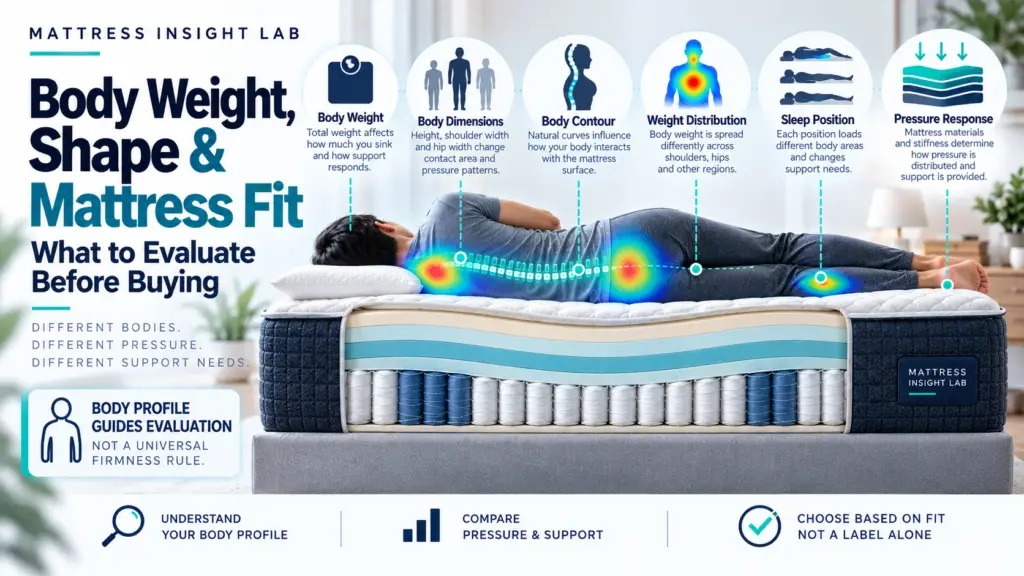
Body weight and body shape can alter body–mattress interaction, including measured pressure and modeled support response. Separately, one study found a weak association between higher BMI and sensitivity to objective-firmness changes. The reviewed evidence does not support converting body measurements into a universal retail mattress formula. This guide explains what changes, what remains unresolved, and how to evaluate fit for your own body profile before buying.
What Do Body Weight and Body Shape Change About Body–Mattress Interaction?
Body weight, body dimensions, body contour, and weight distribution can each change how a sleeper interacts with a mattress — but they change different things, and none of them alone determines the correct mattress. Research treats these as interacting variables rather than isolated predictors.
Weight affects measured pressure. Body dimensions and weight distribution interact with sleep-system stiffness. Body contour enters lateral-support modeling. These are distinct mechanisms, and they operate together.
How Can Body Weight Change Measured Interface Pressure?
In a biomechanical study of four mattresses, 18 men of similar height but three different weight groups showed increasing maximum interface pressure with increasing weight group. [1] The study measured supine interface pressure across four mattresses and found that maximum pressure increased with weight group. This is a measured relationship in the tested conditions, not a universal law.
This finding does not extend to firmness, comfort, or health outcomes. It is a pressure measurement, not a prescription.
How Can Body Dimensions and Weight Distribution Change Sleep-System Interaction?
Human–bed interaction modeling identifies body dimensions, distribution of body weight, and the stiffness distribution of the mattress/bed base as interacting factors affecting modeled human–bed interaction and support response. [3] The model combines individualized anthropometric data with standardized load–deflection characteristics rather than using body weight alone.
Within the reviewed modeling framework, support response depends on multiple interacting inputs rather than total body weight alone. The model should not be converted into a universal consumer support requirement.
How Can Body Contour Affect the Stiffness Distribution Used in Lateral-Support Modeling?
In the lateral-sleep study and modeling framework, four weight-dimensional body types were modeled with different required stiffness configurations; the authors specifically discussed heavier men with pronounced body contour within that scope. [2]
The study combined experimental lateral-sleep testing (25 men) with modeling of four weight-dimensional body groups. The modeling component generated different required stiffness distributions for the modeled weight-dimensional body groups. Within that framework, required stiffness configuration varied across the modeled groups. [2]
Why Does This Make Mattress Fit Individual Without Creating a Universal Body-Type Formula?
Weight-group experiments, anthropometric modeling, and lateral-alignment research all show body-dependent interaction, but none establishes one consumer rule based on body weight alone. The studies use different populations, postures, surfaces, and measurement methods — so their findings are complementary evidence of individual variation, not a single retail formula.
This does not mean no guidance is possible. The evidence does support evaluating pressure, support, firmness perception, and posture as body-specific variables.
Why Are Body Weight and Body Shape Different Mattress-Fit Variables?
Body weight describes total mass; body shape describes how that mass and body geometry are distributed. Mattress research treats them as related but distinct variables. Total weight is one loading variable; dimensions, contour, and weight distribution are additional variables.
Mattress research uses multiple anthropometric variables — including dimensions, distribution of body weight, height, BMI, and waist-to-hip ratio — rather than treating total weight as equivalent to body shape.
What Does Total Body Weight Describe?
Total body weight describes overall mass. It is one loading variable in mattress interaction, but it does not describe how that mass is distributed across the body or how body geometry interacts with a surface. Weight is a single aggregate measure; mattress research treats it as one input among several anthropometric variables.
What Do Height, Body Dimensions, Weight Distribution, and Waist-to-Hip Ratio Add?
Height, body dimensions, weight distribution, and waist-to-hip ratio describe how mass and geometry are arranged. Mattress research uses these variables alongside weight to model support and pressure outcomes. One study models body dimensions and weight distribution with sleep-system stiffness; another includes height, weight, and waist-to-hip ratio in pressure models.
These variables capture morphology that total weight alone does not. However, they do not fully predict mattress fit — one study found relatively modest overall morphology effects on some pressure metrics.
Why Can People With Similar Weight Still Have Different Anthropometric Profiles?
People with similar total weight can differ in height, dimensions, weight distribution, and contour. Since mattress research treats these as interacting variables, similar weight does not guarantee similar interaction. Total weight is an aggregate; two people can share it while distributing mass differently.
Why Should BMI Not Be Used as a Complete Description of Mattress Fit?
BMI is one anthropometric index used in mattress research, but it does not describe body shape, contour, or weight distribution. It should not be treated as a complete description of mattress fit. One study used BMI in a firmness-sensitivity analysis; another included BMI among multiple comfort variables. Neither treats BMI as equivalent to body shape or as a complete fit predictor.
How Does Body Weight Affect Measured Pressure on a Mattress?
One directly measured relationship in the reviewed evidence is between weight group and maximum interface pressure — but pressure is not the same as comfort, support, or alignment. Weight group connects to measured interface pressure without adding unsupported comfort conclusions.
What Did the Four-Mattress Study Find About Weight Group and Maximum Pressure?
In a biomechanical study of four mattresses, 18 men of similar height but three different weight groups showed increasing maximum interface pressure with increasing weight group. [1] The study measured supine interface pressure across four mattresses. Maximum pressure increased with weight group in the tested conditions.
This does not mean heavier people always have higher pressure on every mattress. The study tested 18 men on four specific mattresses; the result is study-specific.
Why Was Pelvic Pressure Different From Thoracic Pressure?
In the same four-mattress study, pelvic maximum pressure was higher than thoracic maximum pressure in the tested conditions. [1] This is a measured regional difference in the tested population and mattresses. Regional pressure can differ by body region, but this does not mean pelvic pressure is always highest for everyone.
What Did Extreme-Body-Build Testing Show About Individual Mattress Pressure Performance?
In a pressure-distribution study using eight hospital mattresses and four people representing extreme body builds, a mattress suitable under the study's criteria for three subjects was not suitable for the high/heavy subject. [8] The study applied pressure-distribution criteria to four subjects with extreme body builds across eight hospital mattresses.
Different body builds can produce different pressure-distribution performance on the same mattress in the tested conditions. This does not prove heavier people need different mattresses — the study used four subjects and clinical pressure-distribution criteria, not consumer comfort outcomes.
Why Does Higher Measured Pressure Not Automatically Identify the Correct Mattress Firmness?
Higher measured pressure is a pressure outcome, not a firmness prescription. The reviewed evidence does not establish that a specific pressure level identifies the correct mattress firmness for an individual. Pressure, firmness, and alignment are distinct outcomes.
How Do Body Dimensions and Weight Distribution Affect Mattress Support Requirements?
Mattress-support modeling can combine body dimensions, weight distribution, and sleep-system stiffness rather than body weight alone. The reviewed human–bed model is individualized and multi-variable; it does not establish universal consumer support requirements. [3]
Which Anthropometric Inputs Are Used in Human–Bed Interaction Modeling?
Human–bed interaction modeling uses body dimensions, distribution of body weight, and the stiffness distribution of the mattress/bed base as interacting inputs. [3] The model does not use body weight alone.
How Does Mattress and Bed-Base Stiffness Enter the Model?
The model combines body characteristics with the load–deflection characteristics of the mattress and bed base. Stiffness distribution across the sleep system is a contributing variable. The modeled support response arises from the interaction between anthropometry and sleep-system mechanical behavior rather than from body weight alone.
Why Can Weight Distribution Matter Separately From Total Weight?
Weight distribution describes how mass is arranged across the body. It is modeled as a separate input from total weight, meaning two people of similar weight can have different distributions. Distribution affects how load is applied to a surface.
Why Does Individualized Modeling Not Create a Universal Retail Firmness Chart?
The modeling research supports individualized interaction, not a universal retail firmness chart. [3] It does not establish that a specific body weight or shape maps to a specific firmness level. Individualized modeling leads to individualized evaluation; no universal chart is justified.
What Does Lateral-Sleep Research Show About Body Contour and Mattress Stiffness?
Lateral-sleep research shows that the stiffness configuration associated with the studied alignment response varied across modeled weight-dimensional body groups; those findings belong to the tested and modeled conditions. [2]
How Did Soft, Firm, and Customized Stiffness Conditions Change Lateral Spinal Alignment?
In lateral-sleep research involving 25 men, soft, firm, and customized stiffness arrangements produced different measured spinal alignments. [2] The study measured spinal alignment across three stiffness conditions in lateral lying. Alignment differed among the conditions in the tested population.
This does not mean firm mattresses always improve alignment. The study tested specific conditions and did not establish a universal superiority claim.
How Were Different Weight-Dimensional Body Groups Modeled?
The modeling component used four weight-dimensional body types and produced different required stiffness configurations for them. [2] Different body types required different stiffness configurations in the model. These four groups do not define all body types — the model used four specific groups, not a universal taxonomy.
What Role Did Pronounced Body Contour Have in the Authors’ Findings?
The authors specifically reported relevance for heavier men with pronounced body contour within their modeled/tested scope. The authors specifically discussed pronounced body contour within the scope of their tested/modelled population. The finding should remain limited to that framework. [2]
Why Does This Study Not Prove That Every Heavier Person Needs a Firmer Mattress?
The study does not prove that every heavier person needs a firmer mattress. Its sample was 25 men in lateral lying, and its conclusions belong to those tested and modeling conditions. The study found different alignment responses across stiffness conditions and generated different required stiffness distributions for modeled body types. It did not test all body types, postures, or mattresses.
Does Body Weight Determine How Firm a Mattress Feels?
Body weight does not reliably determine how firm a mattress feels. The available evidence shows only a weak association between BMI and sensitivity to firmness changes — not a universal directional rule.
How Were Objective and Perceived Firmness Compared in a Simulated Mattress-Purchase Study?
In a simulated mattress-purchase study, participants compared four mattresses through brief hand-pressure, sitting, supine, and lateral tests. [7] Objective firmness was related to perceived firmness in the tested conditions. This is a relationship, not a deterministic rule.
What Relationship Did the Study Find Between BMI and Sensitivity to Firmness Changes?
The study found a weak relationship between higher BMI and sensitivity to changes in objective firmness. [7] Higher BMI showed a weak association with greater sensitivity to objective-firmness changes in the tested conditions. This is a sensitivity finding, not a universal perception rule.
What Did the Study Not Establish About “heavier feels softer” and “lighter feels firmer”?
The study did not establish the popular rule that the same mattress necessarily feels softer to every heavier sleeper and firmer to every lighter sleeper. It found only a weak BMI sensitivity association. It did not test or validate universal directional perception rules by weight.
Why Should Perceived Firmness Be Tested Rather Than Predicted From Weight Alone?
Perceived firmness should be tested rather than predicted from weight alone because the evidence does not establish a reliable weight-to-perception rule. Individual perception depends on multiple factors beyond weight. Testing provides comparative information, though it does not guarantee long-term comfort prediction.
How Does Sleep Position Interact With Body Weight and Shape?
Sleep position changes which body regions and alignment variables are relevant to mattress fit — so body weight and shape cannot be evaluated independently of posture.
How Did Weight Affect Pressure in Supine Mattress Testing?
In the four-mattress biomechanical study, maximum interface pressure increased with weight group during supine testing across the four mattresses. [1] This is a study-specific finding, not a universal rule that supine pressure always increases with weight on every mattress.
How Did Body Contour Enter Lateral-Sleep Stiffness Modeling?
In lateral-sleep modeling, body contour was explicitly relevant, with different weight-dimensional body types producing different required stiffness configurations. This finding is model/test-scoped and does not mean lateral sleep always requires contour-specific zoning.
How Do Regional Pressure Patterns Change With Position and Anatomy?
A recent 20-participant pressure study found that surface-pressure patterns differed across body regions, sleep positions, and sexes, reinforcing that anatomy and posture can change measured body–surface loading. [6] The study evaluated 20 participants on three sleep surfaces in supine, prone, and side positions. Pressure varied by surface, position, body region, and sex.
This does not create sex-specific mattress prescriptions. Sex is not a complete proxy for body shape.
Why Does Combining Body Weight With Sleep Position Still Not Create a Universal Firmness Prescription?
Combining body weight with sleep position still does not create a universal firmness prescription because the evidence shows design-dependent and individual variation. Weight, contour, position, and anatomy interact differently across surfaces and conditions. The reviewed evidence does not establish a deterministic weight × position → firmness rule.
What Does Research on Body Morphology and Pressure Distribution Actually Establish?
Morphology research shows that height, weight, and body proportions can contribute to pressure-distribution differences — but the effects are not uniformly large, and the clinical context of some studies must not become consumer comfort rules.
How Were Height, Weight, and Waist-to-Hip Ratio Tested Against Pressure Metrics?
In 38 volunteers tested across three support surfaces, models incorporating height, weight, and waist-to-hip ratio were used to examine contact area, interface pressure, and pressure distribution. [4] These variables contributed to the models, but they do not fully predict pressure.
Why Were the Overall Morphology Effects Relatively Modest in One Study?
In the 38-participant morphology study, morphology had relatively modest overall effects on contact area, interface pressure, and pressure distribution across the tested surfaces. [4] Height, weight, and waist-to-hip ratio contributed, but the overall magnitude of their effects was modest across the tested metrics. This does not mean morphology never matters — it means the effects were modest, not absent.
Why Can Extreme Body Builds Still Produce Different Surface Interactions?
Separate studies suggest that body-build differences can matter in some tested conditions, but their populations, surfaces, and evaluation criteria differ. One study found that a mattress meeting the study's criteria for three subjects did not do so for the high/heavy subject. [8] Separately, the 38-participant morphology study found generally modest morphology effects while noting possible differences at body-size extremes. [4] Separate studies suggest that body-build differences can matter in some tested conditions, but their populations, surfaces, and evaluation criteria differ, so they should not be combined into a universal extreme-body-type rule.
Why Should Clinical Pressure-Prevention Findings Not Be Turned Into Consumer Comfort Prescriptions?
Clinical pressure-prevention findings should not be turned into consumer comfort prescriptions because they use clinical support surfaces, pressure-injury criteria, and small or specific populations. One study used eight hospital mattresses and four subjects. [8] Another used three clinical support surfaces and a pressure-ulcer prevention context. [4] Neither establishes ordinary consumer comfort outcomes.
Can Body Profile Tell You Which Mattress Material or Construction to Buy?
Body profile can inform which mattress characteristics to evaluate, but the reviewed evidence does not establish that body weight or shape prescribes a specific material or construction family — foam, latex, coils, or hybrid.
What Does Anthropometric Research Actually Specify About Sleep-System Stiffness?
Anthropometric research specifies that body dimensions, weight distribution, and sleep-system stiffness distribution interact — but it does not specify a material family. One study models stiffness distribution across the sleep system; another models required stiffness configurations. Neither study prescribes foam, latex, coils, or hybrid construction.
Why Does Stiffness Distribution Not Map Directly to Foam, Latex, Coil, or Hybrid Labels?
Stiffness distribution does not map directly to foam, latex, coil, or hybrid labels because those labels describe construction families, not specific load–deflection behavior. Two mattresses in the same material family can have different stiffness distributions. The research operates on measured or modeled stiffness, not on marketing labels.
Why Can Two Mattresses Using the Same Material Family Still Have Different Load–Deflection Behavior?
A material-family label does not specify the mattress's measured load–deflection behavior. The reviewed studies evaluate sleep-system stiffness or complete surface response rather than deriving performance from the material-family name alone.
What Additional Comparative Evidence Would Be Needed to Prescribe Construction From Body Profile?
The supplied verified evidence does not establish that body profile can prescribe mattress construction. Direct comparative trials across standardized construction types and well-defined body-morphology groups would be needed. The reviewed evidence supports evaluating stiffness distribution and complete mattress response, but it does not validate material-family prescriptions from body shape.
How Closely Are Body Measurements Related to Perceived Mattress Comfort?
Body measurements can contribute to perceived comfort, but comfort research treats them as interacting factors — not as a complete comfort predictor.
Which Body Variables Were Associated With Perceived Comfort in the Smart-Bedding Study?
In a 2024 smart-bedding study involving 400 participants, height, weight, BMI, sleep posture, and body-pressure variables were among factors associated with perceived comfort. [5] These variables show association, not deterministic prediction.
How Did Sleep Posture and Body Pressure Contribute Alongside Anthropometry?
Sleep posture and body-pressure variables contributed alongside anthropometry to perceived comfort in the smart-bedding study. Posture and pressure were identified as factors associated with comfort, alongside height, weight, and BMI. No comparative hierarchy is established.
What Did the Simulated Purchase Study Find About BMI and Firmness Sensitivity?
The simulated purchase study found a weak relationship between higher BMI and sensitivity to changes in objective firmness. [7] This is a weak association, not a determination of firmness perception.
Why Can Body Profile Inform Evaluation Without Predicting Personal Comfort Exactly?
Body profile can inform evaluation, but it cannot predict personal comfort exactly because comfort depends on multiple interacting variables. Anthropometry, posture, and pressure all contribute; only weak BMI sensitivity is established. No study establishes a complete body-measurement-to-comfort formula.
How Should a Shopper Test Mattress Fit for Their Own Body Profile?
A shopper can use their own body profile to evaluate mattress fit through whole-body lying, realistic positions, and separate assessment of pressure comfort, perceived firmness, support, and movement — but this is comparative personal evaluation, not a validated biomechanical certification.
Why Is Whole-Body Lying More Relevant Than Judging Firmness by Hand Alone?
Whole-body lying is more relevant than judging firmness by hand alone because firmness perception in one study involved whole-body contact (sitting, supine, and lateral tests), not hand pressure alone. Whole-body contact contributed to firmness perception in the tested conditions. Hand testing is not useless — whole-body testing adds information.
Why Should the Shopper Test the Positions They Actually Use?
The shopper should test the positions they actually use because sleep position changes which body regions and alignment variables are relevant. Supine pressure, lateral alignment, and regional pressure all vary by position. Position changes the body–surface relationship.
How Do Personal Pressure Comfort and Perceived Firmness Change Across Candidate Mattresses?
Personal pressure comfort and perceived firmness can change across candidate mattresses, so comparing them directly is part of personal fit evaluation. Objective firmness related to perceived firmness with individual sensitivity variation. Pressure performance can differ across surfaces for different body builds.
The mattress with the lowest pressure is not always the best — pressure is one outcome, not a complete fit measure.
Why Should Support, Pressure Comfort, and Ease of Movement Be Evaluated Separately?
Support, pressure comfort, and ease of movement should be evaluated separately because they are distinct outcomes that do not automatically determine each other. Pressure and spinal distortion are measured separately; objective and perceived firmness are distinct. Good pressure comfort does not automatically mean good support.
Why Is an At-Home Trial personal fit observations Rather Than a Validated Anthropometric Prescription?
An at-home trial provides personal observations about perceived firmness, pressure comfort, movement, and overall fit; it is not a validated anthropometric prescription. No reviewed study establishes a standardized consumer test duration that proves long-term fit. Personal testing can provide comparative observations about how a mattress feels and responds for your body. It is not a clinical or biomechanical certification.
How Should Body Weight and Body Shape Influence the Final Mattress Decision?
Body weight and body shape should influence what you evaluate — pressure, support, firmness perception, and position-specific fit — but they should not be converted into a rigid retail formula.
Treat Body Weight as One Loading Variable Rather Than a Mattress-Firmness Prescription
Treat body weight as one loading variable that can affect pressure and support interaction — not as a mattress-firmness prescription. Weight is relevant but not prescriptive. Heavier people do not automatically need firmer mattresses.
Treat Body Shape as a Combination of Dimensions, Contour, and Weight Distribution Rather Than a Single Label
Treat body shape as a combination of dimensions, contour, and weight distribution — not as a single label like “wide shoulders” or “heavy hips.” Body shape is multi-variable. Wide shoulders do not mean you need a specific mattress.
Evaluate Body Profile Together With Sleep Position and Complete Mattress Response
Evaluate body profile together with sleep position and the complete mattress response, because these variables interact. Supine pressure, lateral contour, and position-and-anatomy effects all show interaction. Do not evaluate body profile in isolation.
Compare Pressure, Perceived Firmness, Support, and Movement as Separate Fit Dimensions
Compare pressure, perceived firmness, support, and movement as separate fit dimensions, because they are distinct outcomes. Pressure and alignment are separate; objective and perceived firmness are distinct. One score does not determine fit.
Avoid Generic “Lightweight,” “Average-Weight,” and “Heavyweight” Mattress Rules Unless the Recommendation Has Direct Evidence
Avoid generic “lightweight,” “average-weight,” and “heavyweight” mattress rules unless the recommendation has direct evidence. The reviewed evidence does not establish such categories. Body weight is relevant to fit evaluation, but the evidence does not support converting weight ranges into mattress prescriptions.
Sources and References
- DeVocht et al. — Biomechanical evaluation of four different mattresses. PubMed record.
- Leilnahari et al. — Spine alignment in men during lateral sleep position: experimental study and modeling. PubMed record.
- Verhaert et al. — Modeling human-bed interaction: the predictive value of anthropometric models in choosing the correct bed support. PubMed record.
- Moysidis et al. — Prevention of pressure ulcer: interaction of body characteristics and different mattresses. PubMed record.
- Bai et al. — Determinants of Perceived Comfort: Multi-Dimensional Thinking in Smart Bedding Design. PubMed record.
- Mohamadi et al. — Sex-specific variations in body pressure distribution across different sleep surfaces and positions. PubMed record.
- López-Torres et al. — Objective firmness, average pressure and subjective perception in mattresses for the elderly. PubMed record.
- Nicol K, Rusteberg D. — Pressure distribution on mattresses. PubMed record.
Final Synthesis
Body weight, dimensions, contour, and weight distribution can change measured or modeled body–mattress interaction, but the reviewed evidence does not convert those variables into a universal retail mattress formula. One directly measured relationship is between weight group and maximum interface pressure in a four-mattress experiment, while human–bed modeling combines anthropometry with mattress and bed-base mechanical behavior rather than body weight alone.
Lateral-sleep research further shows that stiffness configurations and measured alignment responses can differ across tested or modeled body groups, but those results remain specific to the study framework. BMI likewise should not be treated as a body-shape substitute or mattress prescription: the simulated purchase study found only a weak association between higher BMI and sensitivity to changes in objective firmness.
For mattress evaluation, body profile is best used to decide what to compare—not to predetermine a material or firmness category. Compare pressure comfort, perceived firmness, modeled or perceived support response, movement, and position-specific fit as separate dimensions. Personal trials can provide useful observations about perceived fit, but they are not clinical or biomechanical certifications.