How Off-Gassing and Initial Odor Affect New Mattress Evaluation
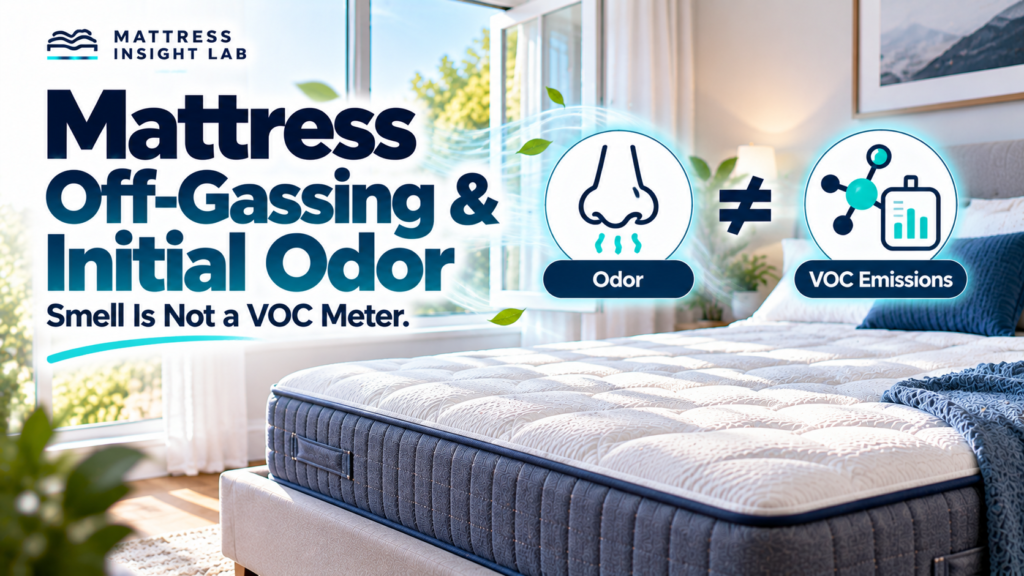
Off-gassing and initial odor are related but not interchangeable. Off-gassing is the release of volatile compounds from materials into air; initial odor is a human sensory response to particular airborne compounds at particular concentrations. Evaluate the chemical side with appropriate emissions evidence and certification scope, and evaluate the sensory side with personal tolerability and the seller’s policy—without using smell intensity as a VOC meter or inventing a universal smell-duration rule. [1] [2] [3]
Sources checked October 13, 2026. Program criteria and product listings can change. Verify current certification records and product-specific seller/manufacturer instructions when making a purchase or return decision.
Core rule: your nose can tell you whether an odor is noticeable or acceptable to you. It cannot, by itself, tell you the VOC concentration, identify the emitting compound, diagnose a health effect, or establish whether the mattress is defective.
| Evidence type | What it tells you | What it does not tell you by itself |
|---|---|---|
| Odor perception | Whether you notice an odor and how tolerable it feels | VOC concentration, chemical identity, or health risk [2] [3] |
| Laboratory emissions testing | Measured compounds/concentrations under defined conditions | How every user will perceive the odor [4] [5] |
| CertiPUR-US | Qualifying flexible polyurethane foam meets program content/emissions/durability criteria | Whole-mattress certification or zero emissions [7] [8] |
| GREENGUARD / Gold | The exact listed product meets defined chemical-emissions criteria | VOC-free, odor-free, organic, or chemical-free status [9] [10] |
| Sleep trial / return policy | Commercial time and remedy rules for the purchase | A toxicology or medical safety determination |
What Are Off-Gassing and Initial Mattress Odor—and Why Are They Not the Same Thing?
Off-gassing describes chemical emissions from materials; initial mattress odor describes what a sleeper perceives. They can occur at the same time, but they are not the same measurement. [1] [2] [3]
What Does Off-Gassing Mean When Materials Release Volatile Compounds Into Air?
Off-gassing describes the release of volatile chemicals from materials into air. VOC emissions are one important measurable category within that broader process. EPA discusses indoor organic pollutants across very volatile, volatile, and semi-volatile classifications, and notes that measurement method affects what can be detected and quantified. [17] [1]
What Does Initial Mattress Odor Describe From the Sleeper’s Perspective?
Initial mattress odor is the sleeper’s sensory perception of particular airborne compounds at particular concentrations — a human response, not an analytical measurement. Odor perception depends on the compound, its concentration, and the perceiver’s olfactory sensitivity. UL notes some VOCs can be smelled at low concentrations while many have no noticeable odor. [1] [2] [3]
Why Can Some VOCs Have Noticeable Odors While Others May Not?
Different VOCs have different odor thresholds; some are detectable at low concentrations, while many have no noticeable odor. Odor threshold is a property of the compound and the perceiver, not of total VOC concentration. [1] [2] [3]
Why Does Stronger Smell Not Automatically Mean Higher Health Risk?
Odor thresholds and health-based exposure criteria do not have one predictable relationship; a strong smell does not by itself establish higher health risk. Health significance depends on the specific compound, concentration, and duration of exposure. EPA explains odor thresholds and health-based thresholds can differ substantially. [1] [2] [3]
Why Does No Smell Not Prove Zero VOC Emissions?
Many VOCs have no noticeable odor; absence of smell does not establish zero emissions. Odor detection depends on the compound’s odor threshold, not on total emissions. UL notes many VOCs have no noticeable smell. [1] [2] [3]
What Has Direct Research Found About VOC Emissions From New Mattresses?
Direct mattress research shows that VOC emissions can be measured and can change with product design, environmental conditions, and elapsed time. Oz et al. and Beckett et al. studied different mattresses under different designs and reached different risk interpretations, so their results should remain separate rather than being combined into one universal mattress-safety profile. [4] [5]
| Study | What was tested | What it found | Boundary |
|---|---|---|---|
| Oz et al., 2019 | Eight polyurethane mattresses in controlled chambers | 18 VOCs quantified; emissions increased under tested sleeping-microenvironment conditions; elevated heat was the strongest evaluated contributor; covers and breathing-zone/room-air exchange were examined | Eight tested mattresses under specified chamber conditions [4] |
| Beckett et al., 2022 | Two new memory-foam mattresses in simulated consumer use over 32 days | Mattress-associated concentrations peaked during the first day and progressively declined over the following 31 days | Two products; not a universal odor or off-gassing clock [5] |
Why the two studies should not be collapsed into one safety verdict: Oz et al. found that sleeping-microenvironment conditions increased emissions in the eight polyurethane mattresses they tested and reported potentially concerning modeled exposure for a few compounds in child/infant scenarios. Beckett et al., using two different memory-foam mattresses and a different exposure model, found concentrations below the benchmarks it evaluated and judged health risk unlikely for those two products under its assumptions. Different products, conditions, analytes, and exposure models can produce different risk interpretations. [4] [5]
What VOCs Were Measured in the Eight Polyurethane Mattresses Studied in 2019?
Eight polyurethane mattresses were tested in controlled chambers and 18 VOCs were quantified under the study’s specified conditions. This establishes that emissions can be analytically measured for tested products; it does not imply that the same 18 VOCs occur in every mattress. [4]
How Did Environmental Conditions Change Emission Rates?
In the tested mattresses, emissions increased under sleeping-microenvironment conditions, and elevated heat appeared to be the major contributor compared with elevated relative humidity and CO₂. That finding belongs to the tested chamber conditions and should not be universalized to every mattress. [4]
What Happened to Emissions From the Two Memory-Foam Mattresses Followed for 32 Days?
For the two memory-foam mattresses tested over 32 days, mattress-associated concentrations peaked during the first day after installation and progressively declined over the following 31 days. The authors also reported that measured and model-estimated concentrations were below the health-based benchmarks they evaluated and concluded that use of those specific tested mattresses was unlikely to pose a consumer health risk under the study assumptions. That conclusion should not be generalized to every mattress. [5]
Why Do These Studies Not Establish One Emission Profile for Every Mattress?
The studies differ in product population, experimental conditions, analytes, and exposure assumptions; they demonstrate that emissions occur and can change over time and environment, but do not establish one universal profile. Study design and product selection limit generalization. Each study’s scope is bounded by its tested products and conditions. [4] [5]
Why Should Measured Mattress Emissions Be Kept Separate From Subjective Odor Reports?
Measured emissions are analytical; odor reports are sensory. They answer different questions. Odor thresholds and health-based thresholds are not universally aligned. Studies measure concentrations; sleepers report perception. [4] [5]
Is There a Universal “Normal” Amount or Duration of New-Mattress Odor?
The reviewed evidence does not establish one universal amount or duration of “normal” new-mattress odor. Product-specific research can show a time course for the mattresses studied without creating a smell clock for every mattress. [1] [2] [3]
What Does the 32-Day Memory-Foam Study Establish About Emission Decline?
For the two tested memory-foam mattresses, mattress-associated concentrations peaked during the first day after installation and progressively declined over the following 31 days. The same study found its measured/model-estimated concentrations below the selected exposure benchmarks and judged health risk unlikely for those specific models under its assumptions; it still does not establish a universal odor duration or universal mattress-safety conclusion. [5]
Why Does Declining VOC Emission Not Tell Us Exactly When Odor Will Disappear?
The 32-day study documented declining mattress-associated concentrations for two tested products, but it did not establish a fixed rule for when perceived odor disappears. Odor perception and analytical emissions are different measurements, so the emission decline should not be converted into a universal smell-disappearance timeline. [5] [2]
Why Can Different Compounds Have Different Emission and Odor Characteristics?
Different VOCs have different odor thresholds and different emission behaviors; some are noticeable at low concentrations while many have no noticeable odor. Compound-specific properties govern both emission and detectability. [1] [2] [3]
Why Can Individual Odor Perception Also Vary?
Odor perception is a sensory response that varies by individual; the same airborne compound at the same concentration may be perceived differently. Odor is a human sensory response, not an analytical measurement. [1] [2] [3]
Why Should a Product-Specific Manufacturer Instruction Override a Generic Internet Airing-Time Rule?
No universal mattress airing-time rule is established in the reviewed evidence. Follow the manufacturer’s product-specific setup instructions and use general ventilation principles without converting them into an invented 24-, 48-, or 72-hour clearance rule. EPA identifies ventilation as a general indoor-air strategy; no universal mattress-specific airing duration is established. [1] [2] [3]
Can Mattress Materials or Compressed Packaging Predict How Strong the Odor Will Be?
Material formulation and system components affected measured emissions in the tested mattresses, but the evidence does not support a universal odor ranking by mattress family, “natural” label, or delivery form. [1] [2] [3]
Why Can Material Formulation Affect Which VOCs Are Emitted?
Across the eight polyurethane mattresses tested in 2019, VOC emission profiles varied between products, supporting formulation and mattress-system design as relevant variables within that study. The result does not establish one emission profile for all polyurethane foams. [4]
How Can Mattress Covers Contribute to or Modify Measured Emissions?
The 2019 study separately examined the contribution of mattress covers to emission fluxes under its test conditions. That result supports treating the cover as a potentially relevant part of the measured mattress system, but it should not be converted into a universal rule about every cover material, design, or mattress. [4]
Why Does “polyurethane foam” Not Define One Odor Intensity?
The 2019 study found product-to-product differences among eight polyurethane mattresses, so the category label “polyurethane foam” does not define one measured emission profile. It also does not establish one universal odor intensity, because sensory odor was not the same measurement as the chamber emission data. [4]
Why Does “latex,” “natural,” or “organic” Not Automatically Mean Low Odor or Low Emissions?
The reviewed evidence does not establish that “latex,” “natural,” or “organic” labels predict low odor or low emissions. Those labels address material identity or production claims, not a universal finished-mattress emissions result. Emissions depend on formulation, covers, adhesives, other components, environment, and product-specific manufacturing. [1] [2] [3]
What Evidence Would Be Needed to Claim That Compression or Plastic Packaging Increases Off-Gassing?
The reviewed evidence does not establish compression or plastic packaging as a universal cause of stronger off-gassing. That claim would require controlled comparisons of otherwise comparable mattresses under defined packaging and emissions conditions. The reviewed mattress studies support early emissions for specific products, but do not establish compression itself as a universal cause of stronger off-gassing. [1] [2] [3]
Why Should Boxed and Non-Boxed Mattresses Not Be Given a Universal Odor Ranking?
The reviewed evidence does not establish a universal odor ranking for boxed versus non-boxed mattresses. Delivery form should not be used as a substitute for product-specific emissions evidence or the user’s own sensory experience. Emissions vary with formulation, covers, other components, environment, packaging, and product-specific manufacturing. [1] [2] [3]
How Do Temperature and Air Exchange Affect Mattress Emissions and Exposure?
In the 2019 chamber study, elevated temperature was the strongest evaluated contributor to increased VOC emissions, while modeled exposure depended strongly on air exchange between the breathing zone and bedroom air. [4] [6]
What Did Mattress Research Find When Temperature Increased?
In the 2019 chamber study, elevated heat appeared to be the major contributor to increased VOC emissions compared with elevated relative humidity and CO₂. This is a study-specific finding under the tested conditions, not a universal temperature rule for every mattress. [4]
How Did Relative Humidity and CO2 Compare With Temperature in the Tested Conditions?
In the 2019 test conditions, elevated heat appeared to be the major contributor to enhanced emissions compared with elevated relative humidity and CO₂. The comparison should remain limited to that experimental design. [4]
Why Does Air Exchange Between the Breathing Zone and Bedroom Air Matter?
In the 2019 mattress study, modeled exposure depended strongly on exchange between the breathing zone and room air. Separately, EPA identifies increased outdoor-air ventilation as a general strategy for lowering indoor pollutant concentrations. The study finding and the general ventilation principle are related but should not be treated as the same type of evidence. [4] [6]
Why Should Room Size Alone Not Be Used as an Off-Gassing Score?
Room size alone is not an evidence-based off-gassing score. Indoor concentration depends on the source, air volume, ventilation/air exchange, temperature, time, and the compounds being considered; the reviewed evidence does not reduce that system to room size alone. Air exchange affects indoor concentrations; room size alone is not a sufficient predictor. [4] [6]
Why Should “small rooms always smell stronger” Not Be Published as a universal mattress rule?
The reviewed evidence does not establish “small rooms always smell stronger” as a universal mattress rule. Air exchange and source behavior matter, and odor perception remains separate from analytical concentration. Air exchange and temperature are documented variables; room size alone is not. [4] [6]
What Can Ventilation Do During Initial Mattress Evaluation?
Ventilation can help lower indoor pollutant concentrations by increasing outdoor-air exchange when conditions permit. It does not certify the mattress, remove every emitted compound, or create a universal mattress airing duration. [6]
What ventilation can do: increase outdoor-air exchange and help lower indoor pollutant concentrations when outdoor conditions permit. What it cannot do: certify the mattress, guarantee zero emissions, or determine a universal airing time. [6]
Why Does Increasing Clean Outdoor-Air Exchange Lower Indoor Pollutant Concentrations?
EPA identifies increased outdoor-air ventilation as a way to lower concentrations of indoor pollutants. Outdoor-air exchange dilutes accumulated indoor contaminants. EPA identifies source control and ventilation as major indoor-air strategies. [4] [6]
When Can Open Windows or Doors Increase Outdoor-Air Ventilation?
EPA cites opening windows/doors as a method that can increase outdoor-air exchange when suitable. EPA identifies this as a method when conditions permit. [6]
When Can Exhaust Ventilation Help Remove Indoor Contaminants?
EPA cites appropriate exhaust ventilation as a method that can increase outdoor-air exchange when suitable. Exhaust ventilation moves indoor air outdoors. EPA identifies this as a method when conditions permit. [6]
Why Is Ventilation Different From Emissions Certification?
Ventilation lowers indoor concentrations; certification evaluates a product or component against specified emission criteria. They answer different questions. Ventilation is an indoor-air management action; certification is a product-scope evaluation. EPA identifies ventilation as an indoor-air strategy; CertiPUR-US and GREENGUARD evaluate products/components. [6]
Why Is There No Evidence-Based Universal Number of Hours Every Mattress Must Air Out?
The reviewed evidence does not establish one universal mattress airing duration. EPA supports ventilation as a general indoor-air strategy, but that does not translate into a fixed clearance time for every product and room. EPA identifies ventilation as a general indoor-air strategy; no universal mattress-specific airing duration is established. [6]
Why Should the Mattress Manufacturer’s Setup Instructions Still Be Followed?
Manufacturer setup instructions are product-specific; the supplied verified evidence does not establish a universal airing duration that would override them. [6]
Which Certifications Actually Help Verify Mattress Emissions Claims?
CertiPUR-US and UL GREENGUARD answer different emissions-related questions: CertiPUR-US certifies qualifying flexible polyurethane foam, while GREENGUARD evaluates the exact listed product against chemical-emissions criteria. [1] [3]
What Does CertiPUR-US Verify About Flexible Polyurethane Foam?
CertiPUR-US certifies flexible polyurethane foam using independent laboratory emissions/content/physical testing. The program uses controlled chamber testing. The program’s 2025 V1 guidelines specify a TVOC criterion under its protocol. [7] [8]
Why Does CertiPUR-US Certify the Foam Rather Than the Whole Mattress?
The program explicitly requires sellers to say that the foam — not the mattress or company — is certified. The program’s scope is flexible polyurethane foam. The program’s rules specify this scope. [7] [8]
What Does Its Current VOC Emissions Criterion Represent?
The current CertiPUR-US 2025 V1 slabstock technical guidelines specify a TVOC emissions criterion of <0.5 mg/m³ under the program’s chamber protocol. This is a program-specific threshold, not a zero-emissions guarantee or a whole-mattress certification. [8]
What Can GREENGUARD or GREENGUARD Gold Establish for a Specifically Certified Mattress?
GREENGUARD/Gold certifies low chemical emissions from certified products; mattresses are eligible; Gold uses stricter criteria. Certification applies to the exact product within UL’s certified scope. UL lists mattresses among eligible products. [9] [10]
Why Are GOTS and GOLS Organic Certifications Not Substitutes for Whole-Mattress Emissions Testing?
GOTS and GOLS address organic-material and production requirements within their respective scopes. They are not substitutes for a finished-mattress chemical-emissions test or a GREENGUARD product listing. CertiPUR-US and GREENGUARD are the emissions-relevant programs in the supplied evidence. [13]
Why Should OEKO-TEX STANDARD 100 Textile Certification Not Automatically Be Treated as Whole-Mattress VOC Certification?
OEKO-TEX STANDARD 100 evaluates the certified article or material against its harmful-substance criteria. The 2026 standard explicitly applies to textile products and accessory materials, textile and non-textile components, mattresses, foams, upholstery, and similar materials, with the certificate defining the exact scope. Even when a finished mattress is certified, STANDARD 100 should not be relabeled as a whole-mattress VOC-emissions certification because its testing purpose is different. [15]
Why Must the Exact Certified Product or Component Be Verified?
Certification applies to the exact certified component or product; broader claims require matching evidence. Certification scopes are defined by the certifying program. CertiPUR-US certifies foam; GREENGUARD certifies listed products. [1] [3]
Why Do “Low VOC,” “VOC-Free,” “Non-Toxic,” “Chemical-Free,” and “Odorless” Claims Need Separate Proof?
These phrases are not interchangeable. A threshold-based low-emissions result does not automatically support an absolute “VOC-free,” “chemical-free,” “non-toxic,” or “odorless” claim. [7] [11] [12]
Absolute-claim warning: FTC enforcement has challenged mattress advertising that made unsupported VOC-free, chemical-free, off-gassing, and odor claims. Treat each phrase as a separate proposition that needs evidence matching its exact wording. [11]
Why Is “Low VOC” Different From “VOC-Free”?
“Low VOC” is a threshold-based statement tied to a defined test or program. “VOC-free” is an absolute claim and therefore requires materially stronger claim-specific support. CertiPUR-US permits “low VOC emissions” wording within its criteria; absolute claims require claim-specific evidence. EPA cautions that low total VOC does not automatically establish safer indoor-air performance. [7] [11] [12]
Why Does Low Total VOC Not Automatically Mean Lower Risk for Every Individual Compound?
EPA cautions that a lower TVOC value does not automatically establish that one product is safer than another because individual compounds can differ greatly in toxicity and composition. TVOC is a sum; individual compounds have different toxicological properties. [7] [11] [12]
Why Does “Chemical-Free” Require More Than a Low-Emissions Certification?
A low-emissions certification does not mean a product contains no chemicals. CertiPUR-US explicitly prohibits using its certification to call foam “chemical-free,” and FTC mattress enforcement has challenged unsupported chemical-free claims. “Chemical-free” is an absolute claim distinct from a low-emissions criterion. Certification programs and enforcement precedent treat these as distinct. [7] [11] [12]
Why Does “Non-Toxic” Require Claim-Specific Substantiation?
“Non-toxic” is broader than a low-emissions threshold. It requires claim-specific scientific support for the represented safety scope; CertiPUR-US explicitly prohibits deriving a “non-toxic” claim from its foam certification. “Non-toxic” is an absolute claim requiring claim-specific substantiation. Certification programs and enforcement precedent treat these as distinct. [7] [11] [12]
Why Does “Odorless” Not Prove Zero Chemical Emissions?
An odorless experience does not prove zero chemical emissions because many VOCs have no noticeable smell. FTC mattress enforcement has also challenged unsupported odor/off-gassing claims when they conveyed broader chemical-absence messages. Odor detection depends on compound-specific thresholds. Absence of odor is not absence of emissions. [7] [11] [12]
Why Should Seller Claims Be Matched to the Actual Test Method and Certified Scope?
Claims should be matched to the test method, analyte, emission limit, product/component scope, certifier, and current status. Certification scopes and test methods define what a claim can support. CertiPUR-US and GREENGUARD define specific scopes; FTC requires substantiation. [7] [11] [12]
How Should Personal Odor Tolerance Be Separated From Mattress Safety Conclusions?
Personal odor tolerance is a legitimate user-experience issue, but it is not a chemical measurement or diagnosis. Safety conclusions require compound-, concentration-, exposure-, and individual-specific evidence beyond a smell rating. [1] [2] [3]
Why Can Different People Notice or Tolerate the Same Odor Differently?
Odor perception is a sensory response that varies by individual. Odor is a human sensory response. [1] [2] [3]
Why Can Odor Be Unacceptable Even When It Does Not Establish a Specific Hazard?
Odor can be personally unacceptable without establishing a specific hazard; the two are separate questions. Odor thresholds and health-based thresholds are not universally aligned. Sensory acceptability and toxicological assessment are distinct. [1] [2] [3]
Why Should Eye, Nose, Throat, Breathing, Dizziness, or Other Significant Symptoms Not Be Diagnosed Through a Mattress Guide?
A mattress guide cannot diagnose the cause, severity, or medical significance of symptoms. Odor and VOC information alone are not enough to assign a diagnosis to the mattress. EPA notes VOC effects depend on compound, concentration, and exposure and can include irritation and other symptoms; this does not permit an odor-based mattress diagnosis. [1] [2] [3]
When Should Exposure Be Stopped and Medical Advice Be Sought Rather Than Continuing a Mattress Experiment?
If symptoms occur, stop the exposure and move to fresh air when appropriate. Seek medical advice for concerning or persistent symptoms. Severe difficulty breathing, throat or facial swelling, fainting, or other signs of a severe allergic reaction require emergency medical care. This safety guidance does not establish that the mattress caused the reaction or identify the cause. [16] [1]
Why Should Pregnancy, Asthma, Allergy, or Chemical-Sensitivity Recommendations Not Be Generalized Without Individual Medical Guidance?
The reviewed evidence does not support one mattress-odor rule for pregnancy, asthma, allergy, or chemical sensitivity. Individual health questions should be handled with a clinician rather than generalized from mattress smell. Odor perception and medical susceptibility vary by person; individual clinical assessment is required for health questions. [1] [2] [3]
How Should Off-Gassing and Initial Odor Influence the Keep-or-Return Decision?
Use manufacturer instructions, personal tolerability, verified certification scope, and the seller’s actual trial/return terms—not a generic smell-duration rule—to guide the commercial keep-or-return decision. [1] [2] [3]
| Evaluation step | What to record or verify |
|---|---|
| Setup | Manufacturer setup and ventilation instructions |
| Sensory track | Whether odor feels better, stable, or worse—without converting that note into a VOC number |
| Claims track | Exact certified foam/product and current program listing |
| Mattress fit | Comfort, firmness, pressure relief, and support separately from odor |
| Policy track | When the trial/return window starts, condition rules, fees, and contact procedure |
| Documentation | Model, delivery date, odor concern, photos/records if useful, seller communications, certification claims |
Confirm the Mattress Manufacturer’s Setup and Ventilation Instructions
Follow the manufacturer’s setup and ventilation instructions; no universal airing duration is established. [6]
Track Whether the Personal Odor Experience Is Improving, Stable, or Worsening Without Converting It Into a VOC Measurement
Track personal odor experience as a subjective observation; do not convert it into a VOC measurement. Odor is a sensory response, not an analytical measurement. Sensory and analytical evidence are separate. [1] [2] [3]
Verify Any Low-Emission Claims Using the Correct Certification Scope
Verify the exact certified component or product against the certifying program’s scope. Certification scopes are defined by the certifying program. CertiPUR-US certifies foam; GREENGUARD certifies listed products. [1] [2] [3]
Evaluate Mattress Comfort, Firmness, Pressure Relief, and Support Separately From Odor
Evaluate comfort, firmness, pressure relief, and support as separate considerations from odor. Odor is a sensory response; comfort and support are separate evaluation factors. [1] [2] [3]
Check When the Sleep Trial or Return Window Actually Begins
Check the seller’s actual policy for when the trial or return window begins. Trial and return terms are seller-specific. Commercial policy is separate from toxicological assessment. [1] [2] [3]
Contact the Seller Early if Odor Prevents Normal Use Rather Than Waiting for an Unverified “normal” Number of Days
If odor prevents normal use, contact the seller while your commercial options are still open rather than waiting for an invented “normal” number of days. This is a policy-preservation step, not a scientific safety verdict. Persistent odor can make a product personally unacceptable and justify seller contact. [1] [2] [3]
Document the Product Model, Delivery Date, Odor concern, seller communications, and relevant certification claims
Document the product model, delivery date, odor concern, seller communications, and relevant certification claims. Documentation supports the evaluation and any seller contact. [1] [2] [3]
Use the Actual Return or Exchange Policy if the Mattress Remains Unacceptable for Normal Use
If the mattress remains unacceptable for normal use, use the seller’s actual return or exchange policy. The decision is commercial and personal; it does not prove the mattress is chemically unsafe. [1] [2] [3]
Do Not Treat Keeping or Returning the Mattress as a Scientific Verdict About Chemical Safety
Keeping or returning a mattress is not a toxicology test. It reflects personal tolerability, product fit, verified claims, and the seller’s policy rather than a universal scientific threshold. Keep/return decisions are policy- and user-specific; safety assessment requires compound- and exposure-specific evaluation. [1] [2] [3]
Final synthesis. Treat off-gassing, odor perception, certification, ventilation, and the commercial trial as separate evidence lanes. Use emissions tests and exact certification scope for chemical-emissions claims; use your own sensory experience only as sensory evidence; use ventilation as an indoor-air management step; and use the seller’s actual policy for the keep-or-return decision. None of those lanes, by itself, creates a universal mattress-safety verdict.
Sources and References
- [1] U.S. EPA — Volatile Organic Compounds’ Impact on Indoor Air Quality — https://www.epa.gov/indoor-air-quality-iaq/volatile-organic-compounds-impact-indoor-air-quality
- [2] U.S. EPA — Reference Guide to Odor Thresholds — https://www.epa.gov/sites/default/files/2020-08/documents/odorguide1992.pdf
- [3] UL Solutions — Chemicals That Affect Indoor Air — https://www.ul.com/resources/chemicals-affect-indoor-air
- [4] Oz et al. (2019) — Volatile Organic Compound Emissions from Polyurethane Mattresses under Variable Environmental Conditions — https://pubs.acs.org/doi/10.1021/acs.est.9b01557
- [5] Beckett et al. (2022) — Evaluation of VOC Emissions from Memory Foam Mattresses — https://www.sciencedirect.com/science/article/abs/pii/S0045653522014382
- [6] U.S. EPA — Improving Indoor Air Quality — https://www.epa.gov/indoor-air-quality-iaq/improving-indoor-air-quality
- [7] CertiPUR-US — Program Rules — https://certipur.us/for-manufacturers-retailers/program-rules/
- [8] CertiPUR-US — 2025 V1 Technical Guidelines — https://certipur.us/wp-content/uploads/2025/03/CertiPUR-US_Slabstock-Technical-Guidelines-2025-v1-3.24.25_final.pdf
- [9] UL Solutions — GREENGUARD Certification — https://www.ul.com/services/ul-greenguard-certification
- [10] UL Solutions — SPOT Product Database — https://www.ul.com/software/spot-product-database
- [11] U.S. FTC — Mattress VOC-Free / Chemical-Free / Odor Claims Enforcement — https://www.ftc.gov/news-events/news/press-releases/2013/11/ftc-approves-final-consents-settling-charges-mattress-sellers-lacked-scientific-evidence-prove
- [12] U.S. EPA — Does EPA Regulate VOCs in Household Products? — https://www.epa.gov/indoor-air-quality-iaq/does-epa-regulate-volatile-organic-compounds-vocs-household-products
- [13] GOTS — Key Features — https://global-standard.org/the-standard/gots-key-features
- [14] Control Union — Global Organic Latex Standard (GOLS) — https://usa.controlunion.com/certification-programs/gols-global-organic-latex-standard
- [15] OEKO-TEX — STANDARD 100, Edition 01.2026 — https://www.oeko-tex.com/fileadmin/user_upload/Marketing_Materialien/STANDARD_100/Standard/OEKO-TEX_STANDARD_100_Standard_EN.pdf
- [16] MedlinePlus — Anaphylaxis — https://medlineplus.gov/anaphylaxis.html
- [17] U.S. EPA — Technical Overview of Volatile Organic Compounds — https://www.epa.gov/indoor-air-quality-iaq/technical-overview-volatile-organic-compounds