Should You Buy a Mattress Online or In Store?
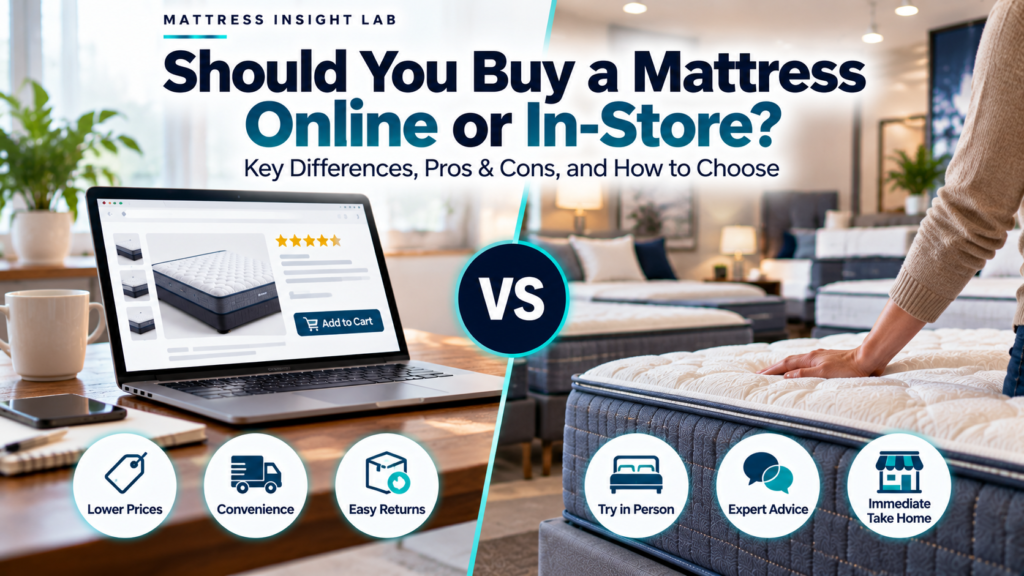
Neither channel is universally better. The useful question is which exact transaction—product, seller/purchase channel, applicable terms, and fulfillment—leaves the fewest important unresolved risks for this buyer. Modern mattress transactions can combine online research, physical testing, third-party retailing, marketplace payment systems, and delivered fulfillment, so the label “online” or “in store” is only one part of the transaction.
This guide does not rank online against in-store. Instead, it audits the exact product, testing opportunity, seller/purchase channel, applicable transaction terms, and fulfillment method. Policies and public guidance were checked September 15, 2026. Current Casper, Tempur-Pedic, Saatva, Purple, FTC, and RTI sources show why channel labels do not bundle all benefits or responsibilities into one category. [1] [3] [4] [5] [6] [7] [9]
What Does “Online vs In Store” Actually Change in a Mattress Purchase?
The channel label controls less than many shoppers assume. What actually differs is the exact product available, the testing opportunity, the seller and purchase channel, the applicable transaction terms, and the fulfillment method—and those variables can be combined in different ways.
Current examples show the overlap. Casper states that mattresses purchased through Casper stores receive its 100-night mattress trial, while Casper products bought through other retailers follow those retailers' return policies. Tempur-Pedic's 90-night trial applies to qualifying direct online, phone, and Flagship Store purchases but excludes ordinary retailer purchases. Saatva Viewing Rooms carry no take-home purchase inventory; displayed products are subsequently delivered. [1] [2] [3] [4] These are seller-specific examples, not universal channel rules.
| Channel role | What it can provide | What it does not determine |
|---|---|---|
| Information gathering | Product specifications, model identification, published policy text, comparison of exact products and total cost | Whether the final transaction will be cheaper, wider, or less pressured |
| Physical testing | Immediate perceptual information — perceived firmness, movement usability, height, edge feel | Whole-night fit, repeated-use response, or long-term satisfaction |
| Purchase transaction | Payment, order confirmation, written terms | Which seller type is involved, or which policy governs |
| Fulfillment | Parcel shipping, scheduled in-home delivery, White Glove service, local or same-day delivery | Whether the purchase was made online or in a store |
What Information Can You Gather Online Before Purchase?
Online research can facilitate comparison of exact products, models, and total transaction costs across sellers. The FTC recommends using online comparison tools and sellers’ sites to compare products, prices, and total transaction costs. That is a capability of online research, not proof that the final online transaction will be cheaper or better.
What Additional Information Can Physical Mattress Testing Provide?
Short physical testing can provide immediate perceptual information—for example, how the surface feels and your own immediate ease of repositioning or getting up. That repositioning observation is a practical shopper observation, not a standardized showroom outcome measured by the cited RTI experiment. The RTI research evaluated mattress selection under showroom-like conditions and later overnight sleep outcomes; “motion” in that research was measured overnight by actigraphy. [9] [10] [11]
Can You Test in Store and Still Complete a Delivered or Online-Style Purchase?
Yes. Saatva Viewing Rooms currently carry no inventory for direct in-store purchase and display every Saatva mattress except identified online-exclusive Bunk & Trundle and Murphy Bed models; displayed products are subsequently delivered. [4] Physical testing and delivered ordering can therefore belong to the same purchase path.
Can Brand-Owned Stores and Brand Websites Use the Same Trial or Warranty?
Yes for at least two current brands. Casper states that mattresses bought through its stores receive the 100-night trial, and Tempur-Pedic's 90-night trial covers qualifying direct online, telephone, and Flagship Store purchases. [1] [2] [3] These are brand-specific facts and should not be generalized.
Why Should the Exact Product, Seller, Policy, and Fulfillment Method Be Compared Separately From the Channel Label?
Because the same channel label can contain different sellers, policies, and fulfillment methods, and the same seller can operate across channels with different terms. Channel is one variable; product, seller, policy, and fulfillment are separate variables that must be audited independently. The four-variable audit replaces the binary channel comparison.
What Can You Learn by Testing a Mattress in a Showroom?
A showroom visit can provide direct short-contact observations—surface feel, your own ease of repositioning, mattress height, and edge feel—that online research cannot reproduce. Those are shopper observations; they should not all be attributed to the RTI experiment, and they do not validate whole-night fit.
| Observation | What it tells you | What it does not tell you |
|---|---|---|
| Perceived surface firmness | Immediate tactile impression during short contact | Whether the same firmness will feel right across full nights |
| Personal ease of repositioning | Direct shopper observation during the visit; not an RTI standardized showroom metric | Overnight ease of movement during normal sleep |
| Height and edge feel | Directly observable during a short test | Long-term edge behavior or repeated-use stability |
| Same-visit comparison | Sequential comparison of exact models on display | Whether the store carries more models than an online seller |
How Does the Surface Firmness Feel When You Lie Down?
The RTI study used a simulated mattress-shopping selection phase before participants completed repeated home-sleep testing. A shopper can make an immediate firmness judgment during a physical test, but the study's key validated comparison was between showroom selection and later overnight outcomes—not a universal short-contact comfort test. [9]
How Easy Is Repositioning or Getting Up?
A shopper can directly observe their own immediate ease of repositioning or getting up during a physical test. The cited RTI experiment did not validate a standardized short-contact “movement usability” measure. Its motion variable was overnight actigraphic motion recorded during home sleep. [10] [11]
How Do Height and Edge Feel Affect Immediate Usability?
Height and edge feel are directly observable during a short test. These are immediate observations, not predictions of overnight outcomes, and no evidence is supplied for long-term edge behavior.
Can You Compare Several Exact Models During the Same Visit?
Yes, when the store displays multiple exact models. Availability is seller-specific. Direct contact allows sequential comparison of exact models in one visit, but this is a capability of the visit, not a channel advantage.
Which Observations Are Immediate Impressions Rather Than Full-Night Outcomes?
Perceived firmness, personal ease of repositioning, height, and edge feel can all be observed during a brief visit. They are immediate shopper observations, not equivalent to overnight sleep outcomes or validated long-term predictions.
Why Is Showroom Testing Useful Without Being a Complete Mattress-Fit Test?
Because it provides immediate perceptual information that online research cannot reproduce, while extended home use provides different information that a short test cannot. Showroom testing and home testing are complementary, not competing.
What Can Repeated At-Home Sleep Reveal That Showroom Testing Cannot Fully Reproduce?
Repeated normal at-home use adds information that a short showroom test cannot reproduce—full-night response and whether an initial selection continues to perform well during ordinary sleep. The RTI evidence must be kept in scope: the underlying study used 128 healthy adults, seven innerspring mattress/box-spring sets from one manufacturer, and firmness as the primary deliberately varied mattress property; participants slept on each test mattress for roughly 3–4 weeks. [10] [11] It should not be generalized as proof that every foam, latex, hybrid, airbed, or modern showroom behaves identically.
| Information type | Showroom testing | Repeated at-home use |
|---|---|---|
| Timescale | Minutes of direct contact | Multiple full nights across weeks |
| Firmness | Immediate perceived firmness | Whether initial preference holds across repeated nights |
| Movement | Immediate repositioning usability | Interaction with normal sleep movement |
| Environment | Showroom setting | Own bedding and bedroom environment |
| Individual variation | Not captured | Documented as wide among participants |
How Does the Mattress Feel During Full-Night Use?
In the study, participants used mattresses at home for approximately four weeks each, and firmness affected multiple measured outcomes. Repeated overnight use yields information unavailable from a single short impression.
Does Your Perceived Firmness Preference Remain the Same After Repeated Nights?
In the study, the mattress associated with better outcomes varied widely among participants, and the simulated showroom-selection phase often failed to identify one of the mattresses that later performed best. Initial preference may not fully predict repeated overnight response.
How Does Normal Sleep Movement Affect Your Experience?
In the study, firmness affected multiple measured outcomes, and individual response varied widely. Repeated use captures movement interaction that a short test cannot. No evidence is supplied for a claim that movement problems appear only after hours.
How Does Your Own Bedding and Bedroom Environment Affect Subjective Comfort?
Home bedding and bedroom environment are part of the at-home experience and are not reproduced in a showroom. This is a general observation about context, not a performance claim.
Why Can Individual Mattress Response Differ Substantially?
In the 128-participant RTI study, mattress firmness affected multiple sleep-related outcomes and the mattress associated with better outcomes varied substantially among participants. [10] This documents individual variation within that study; it does not establish one universally best mattress or construction type.
Why Does At-Home Evaluation Still Not Guarantee a Perfect or Universally Best Mattress?
Because individual response varies widely, and the study’s findings are limited to the tested mattresses and population. At-home evaluation adds information but does not eliminate variation.
Does Buying Online Give You More Mattress Choices?
The reviewed evidence does not establish that online mattress sellers generally provide more usable product choice than physical stores. Saatva currently displays nearly its entire mattress range in Viewing Rooms, with only specific mattresses online-exclusive. This demonstrates that inventory breadth is seller-specific, not channel-determined.
Which Exact Mattresses Are Available Online?
The reviewed evidence does not establish a general online-selection advantage. Availability must be checked seller by seller. Saatva currently displays nearly its entire mattress range in Viewing Rooms, with identified online-only exceptions.
Which Exact Mattresses Are Displayed at the Relevant Store?
The reviewed evidence does not establish a general store-selection disadvantage. Display inventory is seller-specific. Saatva Viewing Rooms currently display nearly every Saatva mattress except identified online exclusives.
Are Any Models Online-Only?
Yes. Saatva currently retains specific online-exclusive mattresses not displayed in Viewing Rooms. Online-only models exist for at least one current seller, but this is a seller-specific fact and should not be generalized to other sellers.
Are Any Store-Specific Models or Configurations Offered?
The reviewed evidence does not establish a general pattern of store-specific models. Availability must be checked seller by seller.
Does the Store Display a Model Without Holding Purchasable Inventory?
Yes. Saatva Viewing Rooms currently display nearly every mattress but do not carry take-home inventory; orders are subsequently delivered. Display and take-home inventory can be decoupled, but this is a seller-specific model and should not be described as how all mattress stores operate.
Why Should Product Availability Be Checked Seller by Seller Instead of Assuming Online Has More Selection?
The reviewed evidence does not establish a general online-selection advantage. Saatva’s current Viewing Room model demonstrates that inventory breadth is seller-specific. Availability must be checked seller by seller.
Is It Easier to Compare Mattress Prices Online—and Does That Mean Online Is Cheaper?
Online tools can make like-for-like comparison faster, but easier comparison does not establish that the online offer is cheaper. Final cost depends on the exact configuration, seller, promotion, fulfillment, services, taxes, bundles, and return exposure.
| Comparison line | What to record |
|---|---|
| Exact configuration | Model, size, height, construction, required accessories |
| Advertised price | Listed price for that exact configuration |
| Tax | Applicable tax for the delivery destination |
| Delivery | Shipping or delivery charge, if any |
| Setup and removal | Whether setup and old-mattress removal are included or optional |
| Applicable discount | Promotion or bundle applied to this exact offer |
| Total | Sum of the above for the same configuration and date |
Can Online Search Make Cross-Seller Price Comparison Faster?
Yes. The FTC recommends using online comparison tools and sellers’ sites to compare products, prices, and total transaction costs. This is a capability of online research, not proof of price superiority.
Are You Comparing the Exact Same Model, Size, Height, and Configuration?
The FTC recommends comparing the exact product and model. Size, height, and configuration must match for the comparison to be valid. Non-identical configurations are not comparable.
Are Delivery, Setup, Removal, Tax, and Required Add-Ons Included in the Comparison?
The FTC recommends including shipping and other charges in the total-cost comparison. Advertised price alone is not the total cost.
Does the Retailer Match Its Online Price in Store—or Vice Versa?
The FTC notes that sellers may have policies matching their own or competitors’ online prices. Whether a specific seller does so must be verified with that seller. Price-matching is a seller policy, not a channel rule.
Are Promotions or Bundles Channel-Specific?
Promotions and bundles vary by seller and offer; they are not determined by the channel label. They must be verified for the exact offer.
Why Does Easier Online Price Comparison Not Prove That the Online Offer Is Cheaper?
The reviewed evidence does not establish that online mattress buying is universally cheaper. Final consumer cost depends on model, seller, promotion, fulfillment, services, taxes, bundles, and return exposure. The FTC recommends actual total-cost comparison rather than channel-based inference.
Does the Sleep Trial or Return Policy Depend on Online Versus In-Store Buying?
Trial and return rights follow the applicable seller, purchase-channel, product, and offer terms. Brand-owned physical and online channels can share one trial, while third-party retailers or marketplace transactions can use different policies or additional platform protections. [1] [3] [5] [7]
| Seller type | Trial | Return / exchange | Responsible party |
|---|---|---|---|
| Manufacturer website | Brand-direct trial terms | Brand-direct return terms | Manufacturer |
| Brand-owned store | Can share the same trial as brand-direct online (Casper, Tempur-Pedic examples) | Brand-direct return terms | Manufacturer |
| Authorized independent retailer | Retailer’s own terms | Retailer’s own terms | Retailer |
| Marketplace purchase | Check the individual seller's product/trial terms | Check both seller return terms and marketplace refund/buyer-protection rules | Responsibility may be split between seller and marketplace; verify payment, return/refund, delivery, and dispute roles [7] |
Does the Brand Give Its Own Online and Brand-Store Purchases the Same Trial?
Yes for at least two current brands. Casper currently extends its 100-night trial to Casper store purchases as well as direct online purchases. Tempur-Pedic’s current 90-night trial covers qualifying mattresses bought directly online, by telephone, or through Tempur-Pedic Flagship Stores. These are brand-specific facts and should not be generalized to other brands.
Does a Third-Party Retailer Use Its Own Return Policy?
Yes. Casper states that mattresses bought through other retailers are governed by those retailers’ policies. Tempur-Pedic excludes retailer purchases from its direct 90-night trial. Purple instructs customers with questions about products purchased at retail locations to contact the store directly. Brand-direct terms do not automatically apply to third-party retailers.
Does the Trial Start on the Same Event in Both Channels?
The reviewed evidence does not establish a general rule about trial-start events across channels. Trial-start conditions must be verified with the specific seller and read in the seller’s written policy.
Are Pickup, Return, Exchange, and Refund Terms the Same?
The reviewed evidence does not establish one general rule. Verify the exact seller terms, purchase-channel terms, product exclusions, promotion/final-sale conditions, and—where relevant—marketplace protections.
Are Final-Sale or Clearance Conditions Different for the Exact Offer?
Final-sale and clearance conditions are set by the seller for the exact offer and are not determined by the channel label. Final-sale status is an offer-level attribute and must be verified for the exact offer.
Why Should Policy Strength Be Compared Seller by Seller Rather Than Online Versus Store?
Because brand-owned physical and online channels can share one trial while third-party retailers or marketplace purchases can use different terms. Policy strength is transaction-specific: seller, purchase channel, product, offer, and platform protections can all matter. [1] [3] [5] [7]
Does Buying Online Mean You Avoid Sales Pressure?
Removing face-to-face selling does not remove all forms of purchase pressure. The FTC documents online practices including false countdown timers, fake scarcity claims, misleading discount claims, and hidden material information.
| In-person sales cues | Online urgency / interface cues |
|---|---|
| Salesperson interaction | Countdown timers |
| Time-limited verbal offers | Scarcity messages (“only a few left”) |
| Discount framing in conversation | Misleading discount claims |
| Bundle suggestions | Upsells and pre-checked add-ons |
| Verbal terms not in writing | Hidden material information |
Can Shopping Online Remove Face-to-Face Salesperson Interaction?
Yes, an online transaction need not involve a salesperson. This is a literal difference, not a pressure advantage. Removing a salesperson does not remove all pressure sources.
Can Online Sites Still Use Countdown Timers, Scarcity Messages, Upsells, or Other Urgency Cues?
Yes. FTC dark-pattern work documents false countdown timers, false limited-time/scarcity messaging, misleading discounts, hidden material information, and other interface tactics. [8] This does not imply that every mattress website uses deceptive practices.
Can Physical Sales Environments Also Create Time or Discount Pressure?
Physical sales environments can vary greatly; some may create time or discount pressure, and others may not. Pressure is not determined by the channel.
Why Should a Shopper Separate an Expiring Claim From the Actual Written Promotion Terms?
Because the FTC documents false countdown timers and misleading discount claims. The written promotion terms govern the offer. Expiring claims should be verified against written terms; the FTC documents that some are false, not that all are.
Why Is “Pressure-Free” Not a Reliable Online-or-store Classification?
The reviewed evidence does not establish that online buying is generally less pressured than in-store buying. Online eliminates face-to-face salesperson interaction but can introduce digital urgency, scarcity, and interface-based influence. Concrete pressure tactics can be identified in either channel.
Do Online and In-Store Buyers Need Different Mattress Evidence?
Buyers in both channels need the same core evidence: exact model identification, written specifications, verifiable material or certification claims, and specific firmness descriptions. A showroom conversation does not replace documentation, and an online page does not eliminate the value of physical testing.
| Evidence item | Why it matters | Channel-neutral? |
|---|---|---|
| Exact model identification | Without it, comparison is not valid | Yes |
| Written specifications | Supports like-for-like comparison | Yes |
| Verifiable material or certification claims | Confirms what is being claimed | Yes |
| Specific firmness descriptions | Supports meaningful comparison | Yes |
| Written policy terms | Governs the transaction | Yes |
Is the Exact Mattress Model Clearly Identified?
The exact model must be identified in writing regardless of channel. Without model identification, comparison is not valid.
Are Size, Height, Construction, and Relevant Support Requirements Available?
Written material and construction specifications should be available regardless of channel. Specifications support comparison and are channel-neutral.
Are Material or Certification Claims Verifiable?
Material and certification claims should be verifiable in writing regardless of channel. Verifiability is a documentation requirement, not a channel-specific one.
Are Firmness Descriptions Specific Enough to Compare Meaningfully?
Firmness descriptions should be specific enough to support comparison regardless of channel. Description quality is channel-neutral.
Does a Store Shopper Have Written Specifications Rather Than Only Verbal Descriptions?
A store shopper should use written specifications and written seller communications as the primary documented basis for comparison rather than relying only on verbal descriptions. Order confirmations, written promises, advertising representations, and applicable consumer law can also matter.
Does an Online Shopper Have Enough Information to Understand What Cannot Be Physically Tested Before Delivery?
An online shopper should understand which attributes cannot be physically tested before delivery and should verify trial and return terms accordingly. This is a documentation principle, not a channel advantage.
Why Should Product Evidence Complement Rather Than Compete With Physical Testing?
Written evidence and physical testing provide different information types; both are useful. Documentation and physical testing serve different verification functions, and neither replaces the other.
Does Delivery and Setup Depend on Where You Buy the Mattress?
Fulfillment method does not follow the channel label. Saatva Viewing Room purchases are delivered because stores do not carry take-home inventory; Casper stores can arrange local and sometimes same-day delivery.
| Fulfillment question | What to verify |
|---|---|
| Parcel carrier | Whether the exact mattress ships by parcel, and who arranges it |
| Scheduled in-home delivery | Whether scheduled delivery is offered for the exact mattress |
| White Glove service | Whether setup and placement are included or optional |
| Local or same-day delivery | Whether the seller can arrange local or same-day delivery |
| Old-mattress removal | Whether removal is included or optional |
| Delivery problems | Who handles issues if the delivery goes wrong |
Is the Exact Mattress Shipped by Parcel Carrier?
Whether the exact mattress ships by parcel carrier is a seller-specific fulfillment detail, not a channel attribute. Parcel shipping is not determined by the channel label.
Is Scheduled In-Home or White Glove Delivery Used?
Saatva Viewing Room purchases are delivered, including White Glove delivery for mattresses. White Glove delivery is a seller service, not a channel attribute, and can accompany a store-tested purchase.
Can a Physical Store Arrange Local or Same-Day Delivery?
Yes. Casper's current store locator says Casper Sleep Shops and partner locations can often arrange local delivery and, in many cases, same-day delivery. [2] This is a Casper-specific service example, not a universal store characteristic.
Can a Store-Tested Mattress Still Be Delivered From a Central Warehouse?
Yes. Saatva Viewing Room purchases are subsequently delivered because stores do not carry take-home inventory. Testing and fulfillment can be decoupled, and fulfillment method is independent of the testing location.
Are Setup and Old-Mattress Removal Included or Optional?
Whether setup and old-mattress removal are included or optional is a seller-specific service detail, not a channel attribute. Service inclusion is not determined by the channel label.
Why Should Delivery Be Compared as a Seller Service Rather Than an online/in-store Characteristic?
Because Saatva Viewing Room purchases are delivered rather than taken from store inventory, and Casper stores can arrange local and sometimes same-day delivery. Fulfillment is seller-specific and must be verified seller by seller.
Why Does the Actual Seller Matter More Than the Online-or-Store Label?
Seller and purchase channel strongly affect payment, voluntary return/exchange rights, and fulfillment, but they do not necessarily determine every responsibility. A marketplace may process payment or provide refund protection; a carrier may handle delivery; and manufacturer warranty coverage can separately come from the manufacturer under its warranty terms. [7] [12]
| Transaction question | What to identify | Why it matters |
|---|---|---|
| Seller of record | Manufacturer-direct, brand store, independent retailer, or marketplace seller | Anchors the product listing and many voluntary transaction terms |
| Payment processor / recipient | Who actually processes or receives payment | May be the seller, marketplace, or another payment provider; do not assume they are the same entity |
| Return / refund | Seller terms plus marketplace protections where applicable | FTC notes that some marketplaces leave refunds to sellers while others provide their own help process [7] |
| Delivery / fulfillment | Seller, platform, carrier, or delivery partner role | Identifies who handles shipment, scheduling, damage, or failed delivery |
| Manufacturer warranty | Manufacturer warranty eligibility and claim route | Can remain separate from voluntary retailer return rights; Casper, for example, supports warranty registration for mattresses bought from other retailers [12] |
Is the Seller the Manufacturer?
The seller may be the manufacturer, a brand-owned store, an authorized retailer, or a marketplace seller. Identify the seller of record, but also identify the purchase channel and any separate platform, payment, fulfillment, or manufacturer-warranty role.
Is It the Manufacturer’s Own Physical Store?
Tempur-Pedic Flagship Stores are an example of a manufacturer’s own physical store, and qualifying purchases there receive the same 90-night trial as direct online purchases. Brand-owned stores are distinct from third-party retailers.
Is It an Authorized Independent Retailer?
Purple instructs customers with questions about products purchased at retail locations to contact the store directly, indicating that independent retailers are distinct transactional entities. Brand-direct terms do not automatically apply to independent retailers.
Is It a Marketplace Seller?
Marketplace sellers are distinct from manufacturer-direct sellers. FTC marketplace guidance emphasizes verifying the individual seller and its terms. Marketplace purchases should not be grouped with manufacturer-direct purchases.
Who Takes Payment?
Identify both the seller of record and the entity processing payment; they may not be the same party. FTC marketplace guidance specifically notes that marketplaces use different payment structures. [7]
Who Controls the Return?
Verify the applicable voluntary return terms for the seller and purchase channel. Purple directs customers with questions about products purchased at retail locations to contact that store, while marketplaces can separately provide refund-help processes. [5] [7]
Who Handles Delivery Problems?
Delivery and shipping problems can involve the seller, marketplace, carrier, or delivery partner depending on the fulfillment structure. Verify who is responsible for scheduling, damage, non-delivery, and escalation before purchase.
Who Provides Manufacturer Warranty Coverage?
Manufacturer warranty coverage can be separate from the seller's voluntary return policy, subject to the warranty's eligibility requirements. The claim process may involve the manufacturer, seller, or both. Casper, for example, provides product registration for mattresses bought from another retailer to support warranty service. [12]
Why Can the Same Mattress Carry Different Transaction Terms From Different Sellers?
Because the same mattress can be sold through different sellers and purchase channels with different prices, voluntary returns, promotions, fulfillment, and marketplace protections, while manufacturer warranty coverage may remain a separate layer. Compare each layer rather than assigning all responsibility to one seller label.
When Does Combining Online Research With In-Store Testing Make Sense?
Combining online research with in-store testing makes sense when each channel reduces a different important uncertainty. Research the exact mattress, seller, price, policies, and specifications online; test the exact model in person when available; then recheck the exact seller’s terms before purchase.
Research the Exact Mattress, Seller, Current Price, Policies, and Specifications Online
Research the exact mattress, seller, current price, policies, and specifications online. Online research supports comparison and is a preparatory step, not a substitute for the full audit.
Test the Exact Mattress Model In Person When It Is Available
Test the exact mattress model in person when it is available. Exact-model testing provides immediate perceptual information and is preferred over testing a similar model.
Compare Multiple Exact Models During the Same Store Visit When Possible
Comparing multiple exact models during the same visit supports like-for-like comparison. This is a capability of the visit, not a channel advantage.
If Only a Similar Mattress Is Available, Which Observations Can Reasonably Transfer?
The reviewed evidence does not establish that testing a similar mattress reliably predicts the exact online mattress’s feel. Mattress firmness labels, layer specifications, fabrics, foams, springs, geometry, and finished feel can differ materially between models. Similar-model testing can be treated as approximate contextual information.
Which Feel or Performance Differences Cannot Safely Be Assumed to Transfer Between Models?
The reviewed evidence does not establish which specific feel or performance differences transfer between models. Differences in firmness labels, layer specifications, fabrics, foams, springs, geometry, and finished feel can materially affect the outcome. Similar-model testing should be labeled approximate.
After Testing, Recheck the Exact Seller’s Price, Trial, Return, Delivery, and Warranty Terms
Recheck the exact seller’s price, trial, return, delivery, and warranty terms in writing. Written terms govern the transaction, and verification is a required step.
Why Should Hybrid Shopping Improve Information Rather Than Automatically Determine Which Channel Gets the Sale?
Because each channel provides different information types; the final transaction should be chosen based on the exact product, seller, policy, and fulfillment, not the channel label. Hybrid shopping improves information, and the final transaction is chosen on transaction-level criteria.
Which Shopper Needs Can Legitimately Influence the Channel Decision?
Concrete decision needs — comparison efficiency, physical testing access, local availability, delivery and setup requirements, return protection, total cost, and exact-model availability — can legitimately influence the channel decision. Shopper labels such as “online shopper” or “store shopper” cannot.
| Concrete need | What to verify |
|---|---|
| Efficient comparison | Whether online tools can compare the exact products and total costs |
| Physical testing of the exact model | Whether the exact model is displayed for testing |
| Immediate local availability | Whether the seller can provide the exact mattress locally |
| Specific delivery or setup service | Whether the seller offers the required delivery or setup service |
| Return protection | Which seller’s written policy governs the exact transaction |
| Total cost | Same-configuration total cost including shipping and other charges |
| Exact-model availability | Whether the exact mattress is available through the relevant seller |
Do You Need to Compare Many Products or Sellers Efficiently?
Online tools can facilitate comparison of products, prices, and total transaction costs. This is a capability, not a channel prescription.
Do You Need Physical Testing of the Exact Mattress Before Purchase?
Physical testing provides immediate perceptual information. Whether it is available for the exact model must be verified seller by seller. This is a need, not a channel prescription.
Do You Need Immediate Local Availability?
Immediate local availability is a seller-specific capability, not a channel attribute. This is a need, not a channel prescription.
Do You Need a Specific Delivery or Setup Service?
Delivery and setup services are seller-specific. Saatva Viewing Room purchases are delivered with White Glove delivery for mattresses; Casper stores can arrange local and sometimes same-day delivery. This is a need, not a channel prescription.
Does One Seller Offer Materially Better Return Protection for the Exact Mattress?
Return protection is seller-specific. Brand-owned physical and online channels can share the same trial; third-party retailers can use their own terms. This is a need, not a channel prescription.
Is There a Meaningful Difference in Total Cost?
Total cost must be compared for the exact configuration, including shipping and other charges. Total cost is transaction-specific, and this is a need, not a channel prescription.
Is the Exact Mattress Available Through Both Channels?
The reviewed evidence does not establish a general rule about dual-channel availability. Availability must be verified seller by seller. Saatva currently displays nearly every mattress in Viewing Rooms with identified online-only exceptions.
Why Should These Concrete Needs Replace Labels Such as “online shopper” or “store shopper”?
The reviewed evidence does not establish that shopper categories can be reliably assigned to one channel. The useful channel depends on the exact unresolved task: testing, price, inventory, return protection, delivery or service, or seller access. Concrete decision needs can be matched to available channel capabilities.
Sources and References
- Casper — 100-Night Mattress Trial & Return Policy. Direct trial, other-retailer policy, exchanges and returns.
- Casper — Store Locator. In-store 100-night trial, inventory and local/same-day delivery examples.
- Tempur-Pedic — 90-Night Trial Period. Direct online/phone/Flagship eligibility and retailer exclusion.
- Saatva — Viewing Room FAQ (Seattle U District). No take-home inventory, mattress display scope and delivered fulfillment.
- Purple — Returns & Exchanges. Direct mattress return/exchange terms and retail-location direction.
- FTC Consumer Advice — Online Shopping. Product/price comparison, shipping, returns and total-cost considerations.
- FTC Consumer Advice — Buying From an Online Marketplace. Seller identity, payment, returns/refunds, delivery and marketplace buyer protection.
- FTC — Bringing Dark Patterns to Light / press release. Countdown timers, hidden terms, misleading discounts and other online pressure tactics.
- RTI Press — Choosing the Best Mattress. Showroom selection versus later overnight sleep outcomes.
- RTI Press — Choosing a Mattress: Using Actigraphy and Diary Reports. 128 healthy adults, mattress-firmness effects, individual variation.
- RTI Press — Full Research Report. Seven innerspring mattresses, one manufacturer, 3–4 weeks per mattress and overnight actigraphy methods.
- Casper — Product Registration. Warranty-service registration for mattresses bought from another retailer.
What Is the Best Way to Decide Whether to Buy the Mattress Online or In Store?
Choose the exact transaction that leaves the fewest important unresolved risks — not the channel with the strongest stereotype. Audit the exact product, every seller offering it, testing access, total cost, policy terms, fulfillment, and post-purchase responsibility.
| Audit step | What to confirm |
|---|---|
| Identify the exact model and configuration | Model, size, height, construction, required accessories |
| Identify every seller offering that exact mattress | Manufacturer-direct, brand-store, authorized retailer, marketplace |
| Determine whether the exact mattress can be tested in person | Whether the exact model is displayed for testing |
| Use showroom testing for immediate feel | Perceived firmness, personal ease of repositioning, height, edge feel — direct shopper observations, not all RTI-validated showroom metrics |
| Use at-home trial terms where available | Repeated-use information across full nights |
| Compare the same configuration on total transaction cost | Advertised price, tax, delivery, setup, accessories, discounts |
| Compare trial, return, exchange, and final-sale terms | Seller + purchase-channel + product/offer terms; marketplace protections where applicable |
| Compare delivery, setup, removal, and availability | Seller-by-seller fulfillment |
| Confirm who handles warranty and post-purchase problems | Map voluntary return, delivery, marketplace dispute, and manufacturer-warranty roles separately |
| Separate seller types | Manufacturer-direct, brand-store, independent retailer, marketplace |
Identify the Exact Mattress Model and Configuration
Identify the exact model and configuration in writing. Model identification is the foundation of the audit; without it, comparison is not valid.
Identify Every Seller Offering That Exact Mattress
Identify every seller and purchase channel offering the exact mattress—manufacturer-direct, brand store, authorized retailer, or marketplace. Seller identification is essential, but also record platform, payment, fulfillment, and warranty roles where they are separate.
Determine Whether the Exact Mattress Can Be Tested In Person
Determine whether the exact mattress is displayed for testing. Saatva Viewing Rooms currently display nearly every mattress except identified online exclusives. Testing availability is seller-specific and must be verified.
Use Showroom Testing for Immediate Feel Without Treating It as Full-Night Proof
Use showroom testing for direct observations such as perceived firmness, your own ease of repositioning, height, and edge feel—without treating those observations as full-night proof or as standardized RTI showroom metrics.
Use At-Home Trial Terms to Evaluate Repeated Sleep Where Available
Use at-home trial terms to evaluate repeated sleep where available. In the study, participants used mattresses at home for approximately four weeks each, and individual response varied widely. At-home evaluation is informative but not a guarantee.
Compare the Same Configuration on Total Transaction Cost
Compare the same configuration on total transaction cost, including shipping and other charges. Total cost is transaction-specific, and like-for-like comparison is required.
Compare Trial, Return, Exchange, and Final-Sale Terms
Compare trial, return, exchange, and final-sale terms for the exact seller, purchase channel, product, and offer. For marketplace purchases, check both seller terms and any marketplace protection process.
Compare Delivery, Setup, Removal, and Availability
Compare delivery, setup, removal, and availability seller by seller. Saatva Viewing Room purchases are delivered; Casper stores can arrange local and sometimes same-day delivery. Fulfillment comparison is seller-by-seller.
Confirm Who Handles Warranty and Post-Purchase Problems
Confirm who handles each post-purchase issue separately: voluntary return/exchange, delivery problem, marketplace dispute, and manufacturer warranty claim. Those roles can belong to different entities.
Separate Manufacturer-Direct, Brand-Store, Independent-Retailer, and Marketplace Offers
Separate manufacturer-direct, brand-store, independent-retailer, and marketplace offers, then map the seller, payment, return/refund, fulfillment, and manufacturer-warranty roles for each transaction.
Avoid Assuming That Online Means Cheaper, Wider, Less Pressured, or More Returnable
The reviewed evidence does not establish that online buying is universally cheaper, wider, less pressured, or more returnable. Each of these attributes must be verified for the exact transaction.
Avoid Assuming That Store Means Better Tested, Better Supported, or More Expensive
The reviewed evidence does not establish that store buying is universally better tested, better supported, or more expensive. Each of these attributes must be verified for the exact transaction.
Use Both Research and Physical Testing When Each reduces a different important uncertainty
Use both research and physical testing when each reduces a different important uncertainty. Each method provides different information types, and hybrid shopping improves information.
Choose the exact transaction that best satisfies the buyer’s requirements—not the channel with the strongest stereotype
Choose the exact transaction that best satisfies the buyer’s requirements — not the channel with the strongest stereotype. The transaction-level audit replaces the channel-level comparison, and the final decision is transaction-specific.
Final synthesis. The online-versus-store label is not the transaction. Audit the exact product, seller and purchase channel, testing access, total cost, applicable transaction terms, fulfillment, marketplace protections where relevant, and manufacturer warranty separately. Use showroom testing for immediate shopper observations without treating it as proof of overnight fit; use repeated at-home evidence for a different timescale. Retain written product, price, payment, shipping, return, marketplace, and warranty records, then choose the exact transaction that leaves the fewest important unresolved risks.