Why Bed Frame and Foundation Compatibility Matter Before Purchase
Compatibility is a structural support-matching question, not a style question. Before you buy a mattress, confirm that the frame and foundation you intend to use meet the mattress manufacturer's stated requirements. Current manufacturer warranties and support guides can specify slat spacing, slat width, center support, structural capacity, approved base types, adjustable-base compatibility, and warranty consequences. [1] [2] [3] [4] [5] Those product-level requirements are direct evidence for compatibility; broader claims about comfort, cooling, spinal alignment, or lifespan still require separate evidence.
What this page can and cannot tell you. Manufacturer documents directly establish that support-system requirements can affect warranty eligibility and that improper or unsupportive bases may be excluded when sagging, indentation, or structural damage is evaluated. [1] [2] [14] They do not quantify how much a particular base changes mattress lifespan, comfort, cooling, or spinal alignment. The evidence-safe task is therefore to verify the exact support requirements first, then keep broader performance claims separate.
Compatibility as Structural Support Matching, Not Just Bed Style
Compatibility is about whether the mattress rests on the support surface it was designed to use — not about whether the frame matches the room. That distinction matters because the two are evaluated differently. Style is a visual and spatial judgment. Structural support is a measurement question: what surface does the mattress sit on, and does that surface match what the manufacturer states the mattress requires?
How compatibility means the mattress rests on the support surface it was designed to use
In structural terms, compatibility means the mattress is placed on a support surface that matches what the mattress was designed to rest on. The definition is structural, not aesthetic. A mattress that sits on a surface it was not designed for is, by definition, not on a compatible setup — regardless of how the bedroom looks.
The reviewed evidence does not establish a mechanism for how the support surface affects mattress performance. That relationship is not something this page can assert. What the page can do is define the matching criterion and show you how to check it.
Why a stylish bed frame can still be structurally wrong for the mattress
Frame style and structural support are distinct properties. A frame can match a room’s design and still not match the mattress’s support requirements. Style and structure are different measurements; one does not uniquely determine the other.
This is not the same as saying the two are unrelated. A frame’s design can influence its structure — a decorative headboard may or may not come with a load-bearing rail system, for example. The point is that evaluating one does not automatically evaluate the other. You can love how a frame looks and still need to measure its slats, rails, and center support separately.
The reviewed evidence does not establish that a structurally unsuitable frame damages a mattress. Treat the mismatch as a verification gap to close, not as a predicted failure.
What bed frame and foundation compatibility can and cannot solve by itself
Compatibility addresses whether the support surface matches the mattress’s stated requirements. It does not, by itself, establish comfort, durability, cooling, or warranty approval. Compatibility is a matching criterion, not a performance guarantee.
Think of it as a necessary verification step rather than a promise. Confirming that your base matches the manufacturer’s stated requirements closes one specific question. It does not answer whether you will find the mattress comfortable, how long it will last, or whether a future claim will be approved. Those are separate questions with separate evidence requirements.
The Bed Frame, Foundation, and Mattress Work as One Support System
The frame or base is part of the load-bearing support system beneath the mattress. Tempur-Pedic, Purple, Casper, and Sealy each require structurally adequate support in their current product or warranty guidance, with some explicitly stating that the system must support the mattress and occupants. [1] [2] [4] [5] [14] These sources establish a structural-capacity requirement, but they do not by themselves provide a universal engineering load-path model for every mattress and frame.
The useful evidence boundary is therefore clear: manufacturer requirements can establish what support system is acceptable for a specific product, while claims about how that setup changes comfort, cooling, alignment, or long-term performance need separate evidence.
How the foundation carries mattress weight and sleeper weight together
The base or frame is part of the load-bearing setup and must be structurally capable of supporting the mattress and occupants according to several current manufacturer requirements. Tempur-Pedic explicitly permits slatted support only when the slats and bed are structurally sound and capable of supporting the mattress and occupants, while Purple and Casper use similar structural-capacity language. [4] [5] [14]
That supports a load-capacity requirement, not a universal detailed stress-distribution model. Do not infer precise force paths, comfort effects, or durability gains unless the evidence for those outcomes is separately established.
Can uneven support change comfort, firmness feel, or alignment?
The supplied verified evidence does not establish that uneven support changes comfort, firmness feel, or alignment. You should verify that the support surface is level and matches the manufacturer’s requirements. The relationship between uneven support and those outcomes is not established by the reviewed evidence.
What can manufacturer guidance establish about inadequate support?
Manufacturer guidance can establish that an inadequate or unapproved base falls outside the intended support setup and may affect warranty eligibility. Tempur-Pedic states that improper support can void warranty coverage and that its mattresses require an approved firm, solid, non-spring or qualifying slatted support system. [2] [4] That does not establish a universal amount of performance loss for every mattress.
Platform Beds, Slatted Bases, Box Springs, and Adjustable Bases Do Different Jobs
Platform beds, slatted bases, box springs, and adjustable bases are different categories of support system. The reviewed evidence does not establish performance differences between them. What follows describes each category in structural terms — what it is and how it is constructed — without asserting performance outcomes.
| Base category | Structural description | Verify with manufacturer |
|---|---|---|
| Platform bed | A bed with a solid or near-solid support surface | Whether the specific platform surface is approved for your mattress |
| Slatted base | A bed base with spaced slats | Required slat spacing, slat width, and center support |
| Box spring | A base containing springs | Whether a box spring is approved, and which type |
| Adjustable base | A base with articulating sections | Whether the mattress is approved for adjustable-base use |
| Low-profile foundation | A foundation with reduced height | Whether the specific foundation meets stated requirements |
| Bunkie board | A thin board placed over a base surface | Whether the manufacturer lists it as an approved solution |
How platform beds provide broad, firm support
A platform bed can provide an acceptable support surface when it meets the specific mattress manufacturer's requirements. Tempur-Pedic permits platform or slatted beds when the structure is sound and, for slats, when width and spacing requirements are met. [4] This does not mean every platform bed is automatically compatible with every mattress.
How slatted bases combine support gaps with airflow
The supplied verified evidence does not establish that slatted bases provide airflow. A slatted base can be described as a bed base with spaced slats. The spacing is a structural feature of the category; whether it produces an airflow outcome is a separate question the reviewed evidence does not answer.
How box springs add height and spring-like give
Traditional box springs contain a springing support structure, and some modern mattress manufacturers specifically prohibit them. Tempur-Pedic states that traditional box springs have too much “give” for its mattresses and that their use can void the warranty; Sealy likewise publishes current base/foundation guidance that excludes traditional box springs for applicable products. [4] [13] This is manufacturer-specific guidance, not a universal rule for every mattress.
How adjustable bases change mattress shape and movement requirements
An adjustable base changes the support geometry by articulating the mattress, so compatibility is product-specific. Saatva states that adjustable bases are intended for mattresses designed to flex without shifting internal materials or weakening the structure, and it lists specific compatible and excluded models/configurations. Tempur-Pedic states that its mattresses are compatible with its power bases. [9] [10] [11] Confirm the exact mattress/base pairing before purchase.
Does Mattress Type Change Which Foundation Is Compatible?
Compatibility rules are product-specific rather than safely inferred from a broad mattress construction category alone. Current Tempur-Pedic, Saatva, Purple, and Sealy guidance lists approved or prohibited base types and, for adjustable bases, can identify compatible models or configurations. [4] [9] [10] [11] [12] [13] The strongest instruction remains to verify the exact mattress manufacturer's requirements instead of applying a universal foam/hybrid/innerspring rule.
Why foam mattresses usually need flat, consistent support
The supplied verified evidence does not establish that foam mattresses need flat, consistent support. Check the specific foam mattress manufacturer’s foundation requirements. The foam-to-flat-support rule is not established by the reviewed evidence.
Why hybrids depend on both coil support and stable surface contact
The supplied verified evidence does not establish that hybrids depend on coil support and stable surface contact. Check the specific hybrid mattress manufacturer’s foundation requirements. The hybrid-to-support rule is not established by the reviewed evidence.
Why traditional innerspring mattresses may tolerate different base behavior than foam designs
The supplied verified evidence does not establish that innerspring mattresses tolerate different base behavior than foam designs. Check the specific innerspring mattress manufacturer’s foundation requirements. The comparative tolerance claim is not established by the reviewed evidence.
Why adjustable-base compatibility must be confirmed for the specific mattress
Adjustable-base compatibility is directly product-specific. Saatva says compatible mattresses must flex without shifting internal materials or weakening the structure and excludes particular mattress models/configurations from its adjustable base; Tempur-Pedic confirms compatibility of its mattresses with its power bases. [9] [10] [11] Manufacturer approval should therefore be checked before purchase.
Slat Width and Slat Spacing Can Decide Whether the Mattress Is Properly Supported
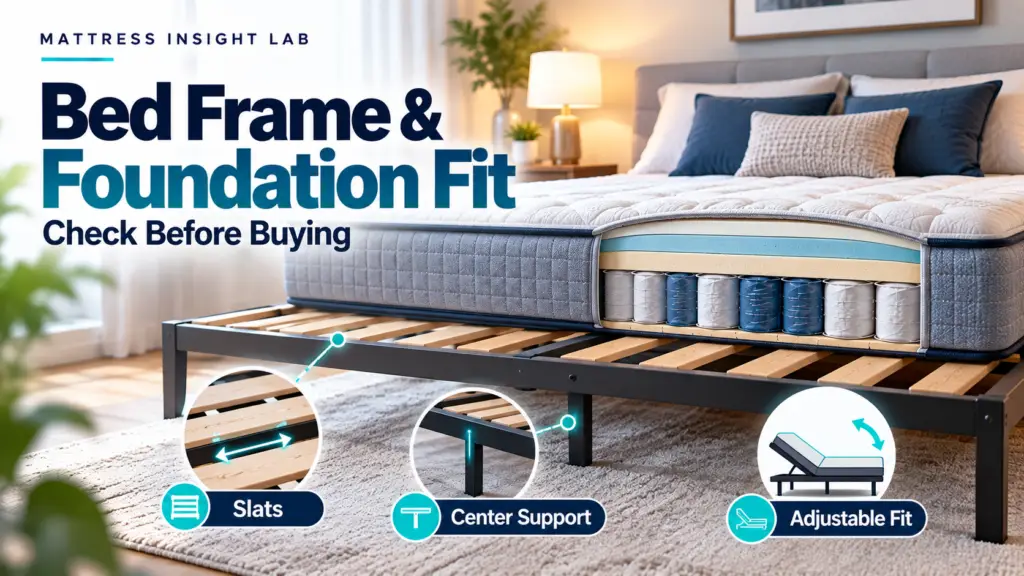
Slat spacing, slat dimensions, structural capacity, and center support can be explicit compatibility requirements, but the acceptable values are manufacturer-specific. Tempur-Pedic permits qualifying slatted frames when slats are at least 3 inches wide and no more than 4 inches apart. [4] Sealy publishes the same 3-inch-wide / maximum-4-inch-spacing requirement for qualifying slatted setups. [1] Purple requires slats no more than 3.5 inches apart, while Saatva requires platform slats less than 4 inches apart for warranty validity. [5] [3]
How wide gaps can let foam or hybrid layers dip between slats
The supplied verified evidence does not establish that wide slat gaps cause foam or hybrid layers to dip. Measure slat gaps and compare them against the manufacturer’s stated requirements. The slat-gap-to-dipping relationship is not established by the reviewed evidence.
Why slat strength, spacing, and width should match manufacturer requirements
Compare your frame's slat strength, spacing, and width against the exact mattress manufacturer's stated requirements. Tempur-Pedic, Sealy, Purple, and Saatva currently publish different product-level rules, so there is no single universal spacing value to apply to every mattress. [1] [3] [4] [5]
How a bunkie board or approved foundation can sometimes solve wide-slat support gaps
The supplied verified evidence does not establish that a bunkie board or approved foundation solves wide-slat support gaps. Check whether the mattress manufacturer lists a bunkie board or specific foundation as an approved solution. The solution claim is not established by the reviewed evidence.
Center Support and Leg Stability Matter More on Larger Mattress Sizes
Manufacturers commonly impose additional center-support requirements on Queen and larger sizes. Sealy requires additional rigid center support for Queen, King, and California King frames; Purple similarly requires center support and 5–6 legs for Queen, King and Cal King versus four legs for Twin and Full; Saatva requires vertical center support for Queen and larger standard frames. [1] [5] [3] These are product/warranty requirements, not proof of a universal amount of sag reduction.
How center rails and support legs reduce middle sagging risk
Center rails and support legs can be explicit requirements for larger mattress sizes. [1] [3] [5] Warranty documents establish that the requirement exists; they do not quantify how much a particular center rail reduces sagging risk.
Why larger mattresses place more load across the frame span
Rather than infer a universal mechanical load rule from size alone, use the manufacturer's size-specific support requirements. Current Sealy, Purple, and Saatva terms impose additional center-support conditions on Queen and larger sizes. [1] [3] [5]
How weak legs, loose joints, or bowed rails can affect mattress feel
The supplied verified evidence does not establish that weak legs, loose joints, or bowed rails affect mattress feel. Inspect the frame for these conditions before purchase. The frame-condition-to-feel relationship is not established by the reviewed evidence.
Can Foundation Compatibility Affect Sagging or Support Loss?
Manufacturer warranties recognize improper or unsupportive foundations as potential contributors to sagging, indentation, or structural damage. Sealy and Tempur-Pedic exclude or limit coverage for damage or indentation associated with inadequate support, and Casper excludes visible indentation or sag resulting from an improper or unsupportive foundation or adjustable base. [1] [2] [14] These warranty statements do not quantify how much a given foundation changes mattress lifespan.
How unsupported gaps can create uneven compression under the mattress
The supplied verified evidence does not establish that unsupported gaps create uneven compression under the mattress. Check the support surface for gaps and compare against manufacturer requirements. The gap-to-compression relationship is not established by the reviewed evidence.
Why foundation weakness can look like mattress failure
An unsupportive base can complicate a warranty evaluation because major manufacturers distinguish covered mattress indentation from sag or damage associated with improper support. [1] [2] [14] That is a warranty/diagnostic boundary, not proof that every visible depression originates in the base.
How proper support helps preserve comfort and alignment longer
The supplied verified evidence does not establish that proper support preserves comfort and alignment longer. Verify that the support surface meets the manufacturer’s stated requirements. The support-to-durability relationship is not established by the reviewed evidence.
Can Bed Frame Compatibility Change Firmness Feel or Pressure Comfort?
The supplied verified evidence does not establish that bed frame compatibility changes firmness feel or pressure comfort. Evaluate the mattress on the base you intend to use. The subsections below mark the specific feel-change relationships that are not established.
How rigid bases can make some mattresses feel firmer
The supplied verified evidence does not establish that rigid bases make some mattresses feel firmer. Evaluate the mattress on the base you intend to use. The rigid-base-to-firmer-feel relationship is not established by the reviewed evidence.
How flexible or springy bases can change contour and bounce
The supplied verified evidence does not establish that flexible or springy bases change contour and bounce. Evaluate the mattress on the base you intend to use. The flexible-base-to-contour relationship is not established by the reviewed evidence.
Why the same mattress may feel different on a showroom base and at home
The supplied verified evidence does not establish that the same mattress feels different on a showroom base and at home. Evaluate the mattress on the base you intend to use. The showroom-versus-home feel relationship is not established by the reviewed evidence.
Foundation Choice Affects Bed Height and Ease of Access
Base type contributes to total bed height, and bed height can affect transfer biomechanics in studied populations. In 24 older adults, increasing bed height reduced peak trunk angular velocity and trunk range of motion during sit-to-stand. [6] In a separate pilot study of adults older than 55, low bed height increased hip torque during bed entry and 50% of participants could not rise from the low bed without assistance. [7] Research in 116 ADL-impaired older adults also found greater rise difficulty as task height was lowered. [8] These findings do not establish one universal ideal bed height for everyone.
How box springs, platforms, adjustable bases, and low-profile foundations change final height
Different base types have different heights. Total bed height is the sum of mattress thickness, foundation height, frame height, and any topper. This is height arithmetic, not a claim about how the bed feels to use.
Total bed-height checklist. Add these together before ordering:
- Mattress thickness
- Foundation or base height
- Frame height (if the frame adds height beyond the foundation)
- Topper height (if you use one)
Compare the total against your own needs. The reviewed evidence does not establish a universal target height.
Why tall mattresses on tall bases can make entry and exit harder
Bed height can change transfer demands, but the relationship is not simply “taller is always harder.” Studies in older and mobility-limited populations show that very low surfaces can increase biomechanical effort or rise difficulty. [6] [7] [8] Measure the complete bed height and compare it with the user's mobility and transfer needs rather than assuming one universal optimum.
How shorter sleepers, taller sleepers, children, and mobility-limited users may need different height checks
Population-specific universal targets are not established for all sleepers, but transfer research shows that bed or task height can matter for older and mobility-limited users. [6] [7] [8] Evaluate total bed height individually, especially when mobility, balance, hand use, or transfer assistance is relevant.
Can Foundation Design Affect Airflow Under the Mattress?
The supplied verified evidence does not establish that airflow under the mattress depends on the foundation design. Slatted and solid bases can be described as categories, and you should check the mattress manufacturer’s guidance on base type. Airflow outcomes are not established by the reviewed evidence.
How slatted bases can allow more underside ventilation
The supplied verified evidence does not establish that slatted bases allow more underside ventilation. Check the mattress manufacturer’s guidance on base type. The slatted-base-to-ventilation relationship is not established by the reviewed evidence.
How solid platforms may reduce airflow unless the mattress design allows it
The supplied verified evidence does not establish that solid platforms reduce airflow. Check the mattress manufacturer’s guidance on base type. The solid-platform-to-airflow relationship is not established by the reviewed evidence.
Why airflow matters more in humid rooms, foam mattresses, and enclosed bed frames
The supplied verified evidence does not establish that airflow matters more in humid rooms, foam mattresses, or enclosed bed frames. Check the mattress manufacturer’s guidance on base type. The airflow-importance relationship is not established by the reviewed evidence.
Adjustable Bases Require Mattress Flexibility and Manufacturer Approval
Adjustable-base compatibility is directly product-specific and should be confirmed with the mattress manufacturer. Saatva states that adjustable bases work with mattresses designed to flex without shifting internal materials or weakening the structure and lists specific incompatible models/configurations; Tempur-Pedic confirms that its mattresses can be used with its power bases; Purple also publishes adjustable-base compatibility requirements. [9] [10] [11] [12]
How bending affects foam, hybrid, latex, and innerspring designs differently
The evidence supports product-specific flexibility and design requirements rather than a universal foam-versus-hybrid-versus-latex rule. Saatva explicitly ties adjustable-base use to the mattress's ability to flex without shifting internal materials or weakening the structure and excludes particular models/configurations. [9] [10]
Why mattress thickness, coil design, and layer flexibility affect adjustable-base fit
Manufacturer compatibility lists can be model- and configuration-specific. Saatva, for example, excludes the 14.5-inch Saatva Classic, Saatva Youth, and Crib Mattress from its adjustable base while allowing other listed models. [10] Use the exact model approval rather than inferring compatibility from material type alone.
Why adjustable-base approval should be checked before purchase
Verify adjustable-base approval with the specific mattress manufacturer before purchase. Saatva and Tempur-Pedic both publish explicit compatibility guidance, and Purple publishes its own product requirements. [9] [10] [11] [12] Approval confirms intended compatibility; it does not prove a universal comfort or durability benefit.
Warranty Coverage Can Depend on the Right Frame or Foundation
Warranty coverage can depend on the frame or foundation. Sealy, Tempur-Pedic, Saatva, Purple, and Casper publish support-system requirements or exclusions tied to their mattress warranties. [1] [2] [3] [5] [14] Requirements vary by manufacturer, so read the exact warranty for the specific mattress.
How manufacturers may define improper support in warranty terms
Manufacturers can define improper support through explicit base, frame, slat, center-support, or structural-capacity requirements. Tempur-Pedic, Sealy, Purple, and Saatva each publish current examples. [1] [3] [4] [5] Use the requirements that apply to the exact product and purchase date.
Why slat spacing, center support, and box spring use can affect claim approval
Slat spacing, center support, and prohibited base types can affect warranty eligibility or claim evaluation when they are written into the manufacturer's terms. Tempur-Pedic states that improper support can void warranty coverage; Saatva and Purple tie warranty validity to specified support conditions; Sealy publishes comparable support requirements. [1] [2] [3] [5]
How to document your frame or foundation setup before filing a sagging claim
Document your frame and foundation setup before filing a sagging or defect claim. Manufacturer claim processes can require this information: Sealy's claim workflow can request proof of purchase, mattress/defect photographs, and support-system documentation, while Tempur-Pedic's current claim guidance requests proof of purchase, mattress/defect photos, and a photo of the mattress support system. [15] [2] Documentation is therefore not merely generic advice; it can be part of the claim-review process.
Existing Frames Should Be Audited Before Buying a New Mattress
Before buying a new mattress, audit your existing frame. Measure slat spacing and width, confirm center support and overall structural capacity, inspect the frame condition, and compare the setup with the mattress manufacturer's stated requirements. Current Tempur-Pedic, Sealy, Purple, and Saatva guidance shows why those measurements can be product-level compatibility requirements. [1] [3] [4] [5]
Measure slat spacing, slat width, frame size, and center support
Measure slat spacing, slat width, frame size, and center support. These measurements are the inputs to the comparison step. The measurements themselves do not determine support; they are values you compare against the manufacturer’s stated requirements.
Check for bowed slats, loose joints, weak legs, or uneven surfaces
Inspect the frame for bowed slats, loose joints, weak legs, and uneven surfaces. These conditions are observable. The reviewed evidence does not establish that they cause mattress problems, so treat the inspection as condition reporting rather than outcome prediction.
Compare your current base against the mattress brand’s support requirements
Compare the measured values against the specific mattress manufacturer’s stated support requirements. This is a comparison instruction. Matching the requirements does not, by itself, establish a support outcome.
Replace, reinforce, or add an approved foundation before delivery if needed
If the base does not meet the manufacturer's stated requirements, change the setup before delivery using an approved frame, foundation, or manufacturer-accepted solution. Product-specific support rules differ, so do not assume that a bunkie board, plywood sheet, traditional box spring, or other add-on is universally acceptable. [1] [3] [4] [5] [13]
Common Compatibility Mistakes Before Mattress Purchase
Common compatibility mistakes include assuming any frame works with any mattress, reusing an old box spring without checking, ignoring slat gaps, and forgetting that the base contributes to bed height. The reviewed evidence does not establish specific outcomes from these mistakes. Each item below is framed as a caution about verification.
Assuming any frame works with any modern mattress
Do not assume any frame works with any mattress. Verify the manufacturer’s stated requirements. The assumption is risky because it skips the verification step, not because a specific outcome is established.
Reusing an old box spring without checking compatibility
Do not reuse an old box spring without checking the new mattress manufacturer's requirements. Tempur-Pedic explicitly prohibits traditional box springs for its mattresses because their springing action does not meet the required support specification, and Sealy also publishes current base/foundation restrictions for applicable products. [4] [13]
Ignoring slat gaps because the mattress feels fine at first
Do not ignore slat gaps just because the mattress feels fine at first. Verify slat requirements with the manufacturer. Initial feel is not a substitute for the stated requirement check.
Forgetting that the base changes bed height, airflow, and warranty risk
Do not forget that the base contributes to total bed height and can also be part of the warranty requirements. [1] [2] [3] [5] Airflow claims remain separate: the reviewed evidence does not justify a universal claim that one base category automatically cools every mattress better.
Sources and References
- Sealy — Mattress and Flat Foundation Warranty Information. Manufacturer warranty.
- Tempur-Pedic — 10-Year Mattress and Flat Foundation Limited Warranty. Manufacturer warranty.
- Saatva — Warranty. Manufacturer warranty.
- Tempur-Pedic — What base/foundation can I use to support my mattress? Manufacturer support guidance.
- Purple — Warranty / frame and foundation requirements. Manufacturer warranty.
- Lindemann U, et al. — Effect of bed height and use of hands on trunk angular velocity during the sit-to-stand transfer. PubMed record.
- Merryweather AS, et al. — Effects of bed height on the biomechanics of hospital bed entry and egress. PubMed record.
- Alexander NB, et al. — Chair and bed rise performance in ADL-impaired congregate housing residents. PubMed record.
- Saatva — Adjustable Bed Bases. Manufacturer compatibility guidance.
- Saatva — Adjustable Base. Manufacturer compatibility guidance.
- Tempur-Pedic — Which mattresses can be used with your adjustable base? Manufacturer compatibility guidance.
- Purple — Adjustable Bases. Manufacturer compatibility guidance.
- Sealy — What base/foundation can I use to support my mattress? Manufacturer support guidance.
- Casper — Mattress Warranty. Manufacturer warranty.
- Sealy — Warranty claim/request process. Manufacturer claim process.
Final Synthesis
Bed-frame and foundation compatibility is not merely a style question. Current manufacturer requirements can directly define acceptable slat spacing, slat width, center support, structural capacity, prohibited base types, adjustable-base compatibility, and warranty eligibility. Those requirements are product-specific rather than universal, so the exact mattress warranty and support instructions should control the buying decision.
The evidence also supports separating manufacturer compatibility rules from broader mechanical or comfort claims. Improper or unsupportive bases are recognized in multiple warranties as potential contributors to excluded sagging, indentation, or damage, but those documents do not quantify how much a particular base changes mattress lifespan. Likewise, current evidence does not justify universal claims that slatted bases cool every mattress better, rigid bases always make mattresses firmer, flexible bases always increase contouring, or proper support automatically improves spinal alignment.
Total bed height is a separate usability variable with direct human evidence, particularly in older or mobility-limited populations. Studies show that bed height can change sit-to-stand effort and bed-entry/egress biomechanics, but they do not establish one ideal height for every sleeper. Measure the complete bed system, verify the manufacturer's structural requirements, and evaluate mobility needs separately from mattress comfort or support claims.
The Best Way to Verify Bed Frame and Foundation Compatibility Before Purchase
The strongest verification process is to start with the exact mattress manufacturer's foundation requirements, then confirm structural capacity, slat spacing/width where relevant, center support, adjustable-base approval, total bed height, and warranty terms before purchase. Current primary sources show that these requirements can be explicit and manufacturer-specific. [1] [2] [3] [4] [5] [9] [10] [11] [12]
Start with the mattress manufacturer’s foundation requirements
Start with the specific mattress manufacturer's stated foundation requirements because those documents define the accepted support system for that product. [1] [2] [3] [4] [5] Then compare the actual frame/base measurements and configuration with those requirements.
Match the base type to mattress construction, size, weight, and flexibility
The supplied verified evidence does not establish specific match rules between base type and mattress construction, size, weight, or flexibility. Verify each factor with the specific mattress manufacturer. The match-rule claim is not established by the reviewed evidence.
Confirm slat spacing, center support, bed height, airflow, and warranty terms before purchase
Confirm slat spacing and width where applicable, center support, structural capacity, adjustable-base compatibility, total bed height, and warranty terms before purchase. [1] [2] [3] [4] [5] [9] [10] [11] [12] Keep airflow claims separate unless the manufacturer provides product-specific ventilation requirements or evidence.
Final verification checklist. Before you order:
- Read the mattress manufacturer’s stated foundation requirements.
- Measure slat spacing and slat width on your frame.
- Confirm center support requirements for your mattress size.
- Calculate total bed height and compare it against your own needs.
- Read the specific warranty document for support-related terms.
- Verify adjustable-base approval if you plan to use one.
- Document your setup with measurements, photos, and receipts.
- Replace, reinforce, or add an approved foundation before delivery if the base does not match.
Compatibility is a verification process, not a performance promise. The reviewed evidence does not establish that a compatible base improves durability, comfort, cooling, or support, and it does not establish that an incompatible base causes sagging or failure. What the evidence does support is a clear process: read the manufacturer’s stated requirements, measure your frame, compare the two, and act before delivery if they do not match. That process closes the compatibility question without overstating what compatibility can do.