How Mattress Size Dimensions Affect Comfort, Space, and Fit
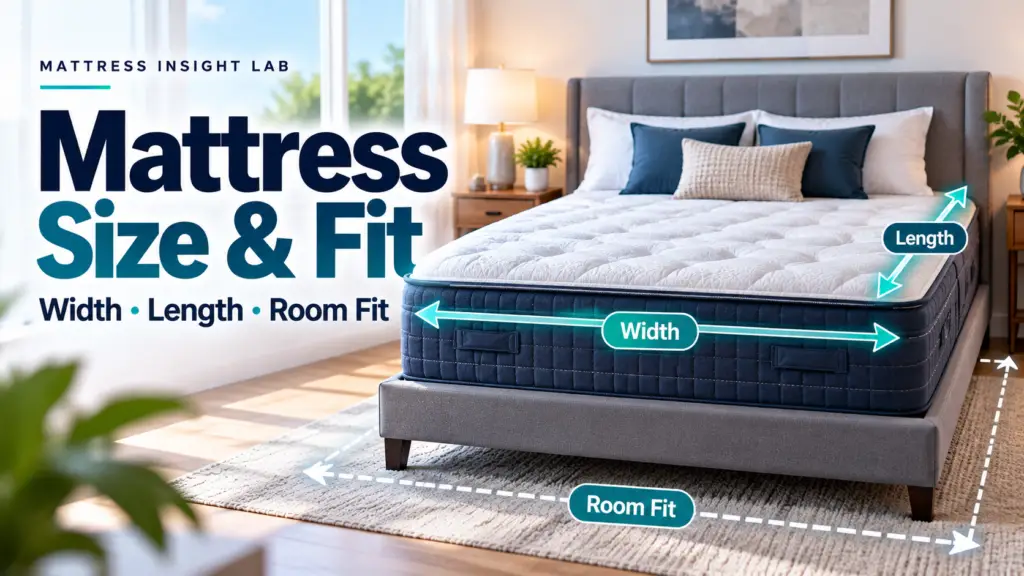
Mattress width and length define the physical surface available to a sleeper and the footprint the bed occupies in a room. They affect space and fit directly; they do not by themselves determine comfort, motion isolation, or edge support. Common U.S. size labels are useful conventions, while measurement and dimensional guidance also exists: ISO 24975:2026 specifies measurement methods and recommended tolerances for adult mattresses and related bed components, and ISPA publishes voluntary U.S. bedding dimensional guidance. Exact product dimensions should still be verified before purchase. [1] [2]
This guide treats mattress size as a measurement problem rather than a comfort score. The goal is to help you compare exact width and length against your actual body and movement space, your room, your frame or base, your bedding, and your delivery route — and to recognize where the evidence stops short of prescribing a size for any particular sleeper.
What Do Mattress Width and Length Actually Tell You?
Mattress width and length describe physical surface geometry — lateral and longitudinal space — not a comfort rating. They are measurable quantities that can be compared against a room, a frame, a bedding product, and a delivery path. They are not a score that predicts how a mattress will feel.
Because the same nominal label can carry slightly different published measurements across manufacturers, the label alone is not a reliable substitute for the exact product specification. ISO 24975:2026 addresses how adult mattresses and related bed components are measured and provides recommended tolerances based on nominal dimensions; it does not turn U.S. market names such as Twin or Queen into one mandatory worldwide finished dimension. [1] The sections below define each dimension, separate depth from the width/length classification, and explain why surface geometry does not guarantee comfort.
What Does Mattress Width Measure?
Width is the side-to-side lateral dimension of the mattress surface. It describes how far the sleeping surface extends from one side to the other. A wider surface provides more lateral space, and a body occupies part of that space — both are elementary geometric facts.
Width does not, by itself, establish comfort. Comfort is not a dimensional property, and the reviewed evidence does not link greater width to greater comfort. Width tells you how much lateral surface exists; it does not tell you how that surface will feel.
What Does Mattress Length Measure?
Length is the head-to-foot longitudinal dimension of the mattress surface. It describes how far the sleeping surface extends from the head end to the foot end. A longer surface provides more longitudinal space, and a body occupies part of that space.
Length does not, by itself, establish suitability for any particular sleeper. No universal height-to-length rule is established in the reviewed evidence, so length should be treated as a measurable dimension rather than a sleeper-suitability score.
Why Is Mattress Thickness a Separate Dimension From the Size Label?
Thickness — also called depth — is a third dimension, independent of the width/length size label. Size labels describe width and length; depth is specified separately and affects fitted-bedding pocket depth. Because fitted bedding must match mattress width, length, and applicable depth, depth must be checked as its own variable rather than assumed from the size name.
Why Does Width and Length Describe Available Surface Geometry Rather Than Guarantee Comfort?
Width and length describe physical surface area. Comfort depends on additional factors that the reviewed evidence does not reduce to size alone. Geometry defines available space; it does not define how a sleeper will experience that space.
The reviewed evidence does not establish that greater width or length produces greater comfort. Treating surface geometry as a comfort guarantee would go beyond what the evidence supports.
Why Should Exact Product Measurements Be Checked Before Purchase?
Because nominally identical labels can carry slightly different measurements across manufacturers. Saatva and Tempur-Pedic, for example, publish different values under the same Twin and Full labels. If the same label can carry different measurements, the exact model specification is the authoritative source for a purchase decision.
Practical rule: Record the exact width and length from the product specification, and check depth separately. Do not rely on the size label alone.
Are Twin, Full, Queen, King, and California King Exact Universal Dimensions?
Common U.S. size labels are useful market conventions, but the label alone does not guarantee identical finished dimensions across every manufacturer. Measurement and tolerance standards or guidelines do exist: ISO 24975:2026 specifies methods of measurement and recommended tolerances based on nominal dimensions, while ISPA publishes voluntary dimensional guidance for bedding products and components. [1] [2] Current manufacturer specifications still show small dimensional differences under some shared U.S. size labels, so the exact product specification remains important.
What Dimensions Does Saatva Currently Use for Its Common U.S. Sizes?
Saatva currently lists the following dimensions for its common U.S. sizes: [3]
| Size | Width (in.) | Length (in.) |
|---|---|---|
| Twin | 38 | 75 |
| Twin XL | 38 | 80 |
| Full | 54 | 75 |
| Queen | 60 | 80 |
| King | 76 | 80 |
| California King | 72 | 84 |
These are current Saatva dimensions, useful as a manufacturer-specific reference example. [3] They should not be presented as the dimensions every manufacturer uses.
How Do Tempur-Pedic’s Twin and Full Measurements Demonstrate Small Manufacturer Variation?
Tempur-Pedic currently publishes Twin at approximately 38 × 74 inches and Full at approximately 53 × 74 inches. Compared with Saatva's 38 × 75 and 54 × 75, the same labels carry slightly different published measurements. [3] [4]
ISO 24975:2026 now provides recommended tolerances based on nominal dimensions, so the manufacturer variation should not be framed as evidence that dimensional standards do not exist. [1] The practical point remains that the same U.S. market label can appear with slightly different published dimensions, which is why the exact model specification should be verified.
Why Should “Standard Size” Be Treated as a Common Market Convention Rather Than Permission to Skip Measurement?
“Standard size” is a market convention rather than permission to assume identical finished dimensions across every product. ISO 24975:2026 provides measurement methods and recommended dimensional tolerances, and ISPA publishes voluntary U.S. dimensional guidance. [1] [2] The shopper should still verify the exact model dimensions because market labels and finished product specifications are not interchangeable.
Which Exact Dimensions Should Be Recorded From the Product Specification Before Ordering?
Record the exact width and length from the product specification, and check depth separately. Because labels vary, the exact specification is the authoritative source. Recording exact dimensions prevents label-based purchase mistakes.
How Do the Common U.S. Mattress Sizes Differ Geometrically?
Using one attributed convention, the common U.S. sizes differ in width, length, or both. The differences below are geometric; they do not assign sleeper types to any size.
How Do Twin and Twin XL Differ Mainly by Length?
In the current Saatva specifications, Twin and Twin XL share a 38-inch width but differ by 5 inches in length — 75 inches versus 80 inches. The difference is longitudinal, not lateral. [3]
How Do Full and Queen Differ in Both Width and Length?
In the current Saatva specifications, Full is 54 × 75 inches and Queen is 60 × 80 inches. Queen is wider and longer. The difference is both lateral and longitudinal. [3]
How Do King and California King Trade Width for Length?
In the current Saatva specifications, King is 76 × 80 inches and California King is 72 × 84 inches. King is wider and shorter; California King is narrower and longer. This is a geometric trade of width for length, not a comfort ranking. [3]
Why Should These Differences Be Described Geometrically Before Assigning a Sleeper Type?
The supplied verified evidence does not establish that any named size is required for any sleeper category. The sizes differ geometrically; sleeper-category prescriptions are not established. The relationship between sleeper type and required named size remains an open research question, and it should not be taught as a rule.
What Does Greater Mattress Width Actually Change?
Greater width increases the lateral surface available; it does not by itself guarantee greater comfort. The sections below explain the geometric effect of width, the fact that a body occupies part of that surface, and the movement-envelope principle documented in hospital-bed research.
How Does Increasing Width Increase Available Side-to-Side Surface?
Greater width increases the lateral, side-to-side surface area. This is elementary geometry: more width means more lateral surface.
How Does Body Width Occupy Part of That Available Space?
A body occupies part of any available surface. The remaining lateral space is what is unoccupied. Available width minus occupied width equals unoccupied lateral space — again, elementary geometry.
How Can Turning or Repositioning Require a Larger Lateral Movement Envelope?
A laboratory motion-capture study of 47 adults evaluated multiple anthropometric variables and found BMI strongly correlated with the space required to turn from supine to side lying (R = .88). [5] The study was designed for hospital-bed sizing rather than residential mattress selection, so its BMI-based hospital guidance should not be converted directly into consumer mattress-size prescriptions.
The study also measured body dimensions, but BMI was its strongest reported predictor of turning space. All three authors were Hill-Rom employees, and one author disclosed Hill-Rom stock ownership; that industry affiliation should be considered when weighing the evidence. [5] The study does not establish a consumer mattress-width prescription.
Why Does Additional Width Not Guarantee Greater Comfort for Every Sleeper?
The supplied verified evidence does not establish that greater width produces greater comfort. Width increases lateral surface; comfort is a separate outcome not established by size alone. The relationship between width and comfort remains an open research question.
What Does Mattress Length Actually Change?
Greater length increases the longitudinal surface available; it does not by itself establish a required length for any sleeper. The sections below present the length values from the Saatva convention, distinguish standing height from occupied length, and explain the posture-dependent spatial envelope documented in travel-ergonomics research.
How Much Physical Length Does Each Common Size Provide?
In the current Saatva specifications, length varies by size: Twin 75 inches, Twin XL 80 inches, Full 75 inches, Queen 80 inches, King 80 inches, and California King 84 inches. [3] Exact values should still be verified for the specific model being considered.
Why Is a Sleeper’s Standing Height Not Necessarily Identical to Their Occupied Length in Every Sleep Position?
Vink et al. was published online in 2024 and appears in the January 2025 issue of Applied Ergonomics. The study observed 189 participants: 74% used a side-sleeping posture and 49% slept on the side with both legs flexed. [6] Those observations show that sleep posture can change the body's spatial envelope; standing height alone is therefore not identical to occupied length in every posture.
The study was designed around sleeping space while travelling. It reported that 200 × 90 cm accommodated all participants in the study and discussed 171 × 76 cm as potentially sufficient for a single night of travel; those travel-oriented findings should not be converted into universal residential mattress-size rules. [6]
How Can Flexed Versus Extended Postures Change the Space a Body Occupies?
The same Vink et al. study, published in the January 2025 issue after 2024 online publication, documented multiple sleeping postures among 189 participants, including flexed side-lying. [6] Flexed and extended postures occupy different spatial envelopes, but the study does not establish residential mattress-size prescriptions.
Why Is There No Verified Universal Number of Extra Inches Every Sleeper Must Have Beyond Their Height?
The supplied verified evidence does not establish a universal extra-inches rule. Posture changes occupied length; no universal extra-inches figure is established. The relationship between standing height and required mattress length remains an open research question.
Why Should Taller Shoppers Compare Their Actual Posture With the Exact Product Length?
Because posture changes occupied length and exact product lengths vary, the shopper should compare their actual posture with the exact product length. Direct comparison is more reliable than a generic height rule. No universal height-to-size rule is established.
How Do Body Dimensions and Movement Change the Space a Sleeper Uses?
Body dimensions and movement patterns affect the space a sleeper uses; the reviewed evidence does not convert those findings into named-size prescriptions. Two people can use the same nominal area differently.
What Did Motion-Capture Research Find About Body Dimensions and Turning Space?
The 47-adult motion-capture study evaluated anthropometric predictors of supine-to-side-lying turning space and found BMI strongly associated with the required space (R = .88). [5] It was conducted to inform hospital-bed sizing, and the authors were employed by hospital-bed manufacturer Hill-Rom, with one author also reporting Hill-Rom stock ownership. Those hospital-specific thresholds should not be converted directly into consumer mattress-size prescriptions.
Why Can Shoulder Breadth, Torso Dimensions, and Movement Pattern Matter Separately From Body Weight?
The study examined multiple anthropometric characteristics, but BMI — which combines body mass and height — was the strongest reported predictor of turning space (R = .88). [5] That does not make body weight alone a residential mattress-size selector, and the study's hospital-bed context should be preserved.
Why Does Body Shape Not Translate Into a Universal Mattress-Size Category?
The supplied verified evidence does not establish a body-shape-to-size rule. Body dimensions affect the space a sleeper uses; no universal size category follows. The relationship between body shape and required named size remains an open research question.
Why Is Personal Movement Space Best Evaluated Directly Rather Than From a Generic Body-Type Table?
Because anthropometric characteristics relate to the movement envelope, and no universal body-type table is established, direct evaluation is more reliable. Direct evaluation avoids relying on an unestablished body-type table.
Does Sleep Position Determine Which Mattress Size Someone Needs?
The supplied verified evidence does not establish that sleep position determines a required mattress size. Posture changes the spatial envelope a body occupies; this does not establish a named-size prescription. The relationship between sleep position and required named size remains an open research question.
How Can Flexed and Extended Postures Occupy Different Width and Length Envelopes?
Vink et al. (2025 final issue; 2024 online publication) documented different sleeping postures and spatial envelopes in 189 participants, including flexed side-lying. [6] The study was conducted in a travel/vehicle context and does not establish residential mattress-size prescriptions.
Why Does Side Sleeping Not Establish One Minimum Mattress Width?
The supplied verified evidence does not establish a side-sleeping minimum width. Side-lying occupies a spatial envelope; no minimum width follows. The relationship between side sleeping and minimum width remains an open research question.
Why Does Back or Prone Sleeping Not Establish One Minimum Mattress Length?
The supplied verified evidence does not establish a back- or prone-sleeping minimum length. Posture changes the spatial envelope; no minimum length follows. The relationship between back or prone sleeping and minimum length remains an open research question.
Why Does Changing Positions Frequently Not Automatically Require a Larger Named Size?
The supplied verified evidence does not establish that frequent repositioning requires a larger named size. Repositioning can require a movement envelope; no named-size requirement follows. The relationship between movement frequency and required named size remains an open research question.
How Should a Shopper Use Their Actual Sleep Posture Instead?
Use posture to understand the spatial envelope the body occupies, then compare that envelope with the exact product dimensions. Direct comparison is more reliable than a posture-to-size rule. No posture-to-size rule is established.
How Does Sharing a Mattress Change the Meaning of Width?
Sharing a mattress divides the same total width among multiple occupants; no universal couple minimum is established. The sections below explain shared-width geometry and the reasons a universal couple rule is not supported by the reviewed evidence.
How Does Adding a Second Sleeper Change the Amount of Unoccupied Lateral Space?
A second body occupies additional lateral surface, reducing unoccupied lateral space. Total width minus two occupied widths equals unoccupied lateral space — elementary geometry. No universal couple minimum follows.
Why Can Two People With Different Body Dimensions Use the Same Total Width Differently?
Because body dimensions affect the space a person uses, two pairs with different body dimensions can use the same total width differently. Same total width, different occupied widths, different unoccupied space. No body-shape-to-size rule is established.
How Do Children or Pets Further Change the Available Physical Surface?
Additional occupants occupy additional surface, reducing unoccupied surface. Each occupant reduces unoccupied surface. No fixed additional-width requirement is established.
Why Is There No Universal Rule That Every Couple Requires the Same Minimum Mattress Size?
The supplied verified evidence does not establish a universal couple minimum. Sharing divides the same total width; no universal minimum follows. The relationship between couple status and required minimum named size remains an open research question.
Why Should Both Sleepers Evaluate the Candidate Width Together?
Because body dimensions affect occupied space, both sleepers should evaluate the candidate width together. Direct joint evaluation is more reliable than a generic couple rule. No couple-minimum rule is established.
Does a Wider Mattress Solve Partner Motion Disturbance?
The supplied verified evidence does not establish that greater width reduces mattress-mediated motion disturbance. Greater width increases physical separation between sleepers; motion isolation is a separate mattress property. The relationship between width and motion disturbance remains an open research question.
How Can Greater Width Increase Physical Separation Between Sleepers?
Greater width increases the lateral distance available between two sleepers. More width means more potential separation — elementary geometry. More separation does not, by itself, establish less disturbance, because motion isolation is a separate property.
Why Is Physical Separation Different From the Mattress’s Lateral Motion-Transfer Properties?
The supplied verified evidence does not establish that physical separation and motion isolation are the same variable. Physical separation is a geometric quantity; motion isolation is a mattress property. The relationship between separation and reduced motion disturbance remains an open research question.
Why Can a Wider Mattress Still Have Poor Motion Isolation?
The supplied verified evidence does not establish that width determines motion isolation. Motion isolation is a separate mattress property; width does not determine it. The relationship between width and motion isolation remains an open research question.
Why Should Mattress Width and Motion Isolation Be Compared Independently?
The supplied verified evidence does not establish that width and motion isolation are interchangeable; they should be evaluated independently. Width is a geometric dimension; motion isolation is a mattress property. The relationship between width and motion isolation remains an open research question.
Does Edge Support Determine the Mattress’s Usable Width?
The supplied verified evidence does not establish that edge support determines the mattress’s usable width. Published width is a physical dimension; edge support is a perimeter property; perceived usable width is a subjective experience. The relationship between edge support and usable width remains an open research question.
What Does the Published Mattress Width Measure?
Published width is the physical lateral dimension of the mattress surface. It is a physical measurement. Published width is not the same as usable width, which is a separate, subjective variable.
What Does Edge Compression Describe Instead?
The supplied verified evidence does not establish what edge compression determines about usable width. Edge compression describes a perimeter response; it is a separate variable from published width. The relationship between edge compression and usable width remains an open research question.
Why Can a Sleeper’s Willingness to Lie Near the Edge Differ Even When Physical Width Is Unchanged?
The supplied verified evidence does not establish what determines a sleeper’s willingness to lie near the edge. Perceived usable width is a subjective experience; physical width is a measurement. The relationship between edge support and perceived usable width remains an open research question.
Why Should Edge Support and Size Be Evaluated as Separate Buying Criteria?
The supplied verified evidence does not establish that edge support and size are interchangeable; they should be evaluated separately. Size is a physical dimension; edge support is a perimeter property. The relationship between edge support and usable width remains an open research question.
How Should Mattress Dimensions Be Checked Against the Bedroom?
Room fit is a measurement exercise: bed-system footprint plus doors, fixed furniture, and household circulation preferences. The sections below present room fit as a measurement checklist rather than a universal clearance rule.
What Floor Area Will the Mattress and Bed Frame Occupy?
The bed-system footprint is the mattress footprint plus the frame footprint. Frame dimensions may exceed mattress dimensions, so the frame footprint should be used. Using mattress dimensions alone can underestimate the occupied area.
Where Are the Doors, Closets, Drawers, and Fixed Furniture Relative to That Footprint?
Doors, closets, drawers, and fixed furniture define the usable space around the bed. There is no single consumer bedroom-clearance recommendation that applies universally; applicable accessibility, building, and local requirements must be considered separately.
How Much Circulation Space Does the Individual Household Want Around the Bed?
For an ordinary private-bedroom buying decision, preferred circulation space is partly a household choice. That does not override applicable accessibility, building, fire-safety, or local requirements, which must be considered separately where they apply.
Why Are Retailer “Minimum Room Size” Recommendations Not Universal Technical Standards?
The supplied verified evidence does not establish retailer room-size recommendations as universal technical standards. Room functionality depends on actual bed-frame footprint, doors, fixed furniture, accessibility needs, circulation preferences, and local requirements. The relationship between retailer recommendations and universal technical standards remains an open research question.
Why Should the Exact Frame Footprint Be Used Rather Than Mattress Dimensions Alone?
The frame may extend beyond the mattress; the frame footprint defines the actual occupied area. Using the frame footprint avoids underestimating occupied area.
How Should Mattress Dimensions Be Matched to the Frame, Foundation, or Adjustable Base?
Mattress and base dimensions should be verified against one another at the exact product level as part of frame and foundation compatibility. The sections below present the base specifications from one manufacturer and explain why label matching is not sufficient.
Why Should Mattress and Base Width and Length Be Checked Together?
Because base dimensions must correspond to mattress dimensions. Checking both prevents dimensional mismatch. Assuming label matching is sufficient can leave a mismatch undetected.
How Do Adjustable Base Specifications Use Corresponding Mattress Sizes?
Saatva currently publishes product-level adjustable-base dimensions including Twin XL 38 × 80, Full 54 × 75, Queen 60 × 80, and King/Split King 76 × 80. [7] These are manufacturer-specific specifications rather than universal base dimensions.
Why Might Split King or Split California King Require Special Component Verification?
Saatva identifies a Split King as two separate Twin XL mattress units placed side by side, while its Split King adjustable base occupies King dimensions overall. [7] Split configurations involve multiple components that should be verified individually. Assuming split sizes behave like single sizes can leave a component mismatch undetected.
Why Should “King” on Both Products Not Replace Checking the Manufacturer’s Actual Dimensions?
Because labels can carry slightly different measurements, the exact specifications should be checked even when labels match. Label matching does not guarantee dimensional matching.
Why Must Bedding Fit Be Verified Separately for King and California King?
King and California King fitted sheets are dimensionally different and should be matched to the mattress width, length, and applicable pocket depth. [8] [9] Flat sheets and comforters have more dimensional flexibility, but their published dimensions can also vary by size and manufacturer.
Why Are King and California King Fitted-Sheet Dimensions Different?
Because King and California King mattresses differ in width and length, fitted sheets should match the intended mattress dimensions and pocket depth. Saatva publishes different fitted King and California King dimensions, and Tempur-Pedic likewise publishes distinct fitted-sheet dimensions in its current product lines. [8] [9]
Why Can the Same Flat-Sheet or Comforter Category Behave Differently From a Fitted Sheet?
Fitted sheets need close matching to mattress width, length, and pocket depth. Flat sheets and comforters allow more drape and dimensional flexibility, but they are still sold with size-specific published dimensions that can differ by manufacturer. For example, Saatva currently lists different King and California King flat-sheet dimensions, while some comforter categories share one size across both. [8] Tempur-Pedic also publishes explicit flat-sheet dimensions for its sheet sets. [9]
Why Does Mattress Depth Need a Separate Pocket-Depth Check?
Because fitted bedding must match mattress width, length, and applicable depth, and depth is a separate dimension from the size label. Depth must be checked separately from width and length.
Why Should Protectors and Encasements Also Be Checked Against Exact Dimensions?
Because protectors and encasements are dimension-specific products that must match mattress width, length, and depth. Dimension-specific products require exact dimensional matching. Protectors are not one-size-fits-all.
How Can Delivery Access Limit a Mattress Size Choice?
Delivery access should be checked against the dimensions and handling requirements of the actual mattress and base being purchased. The sections below present the doorway, staircase, and component checks, and explain why compressed packaging does not automatically remove access constraints.
Which Doorways and Narrow Passages Should Be Measured?
Tempur-Pedic advises clearing delivery paths and measuring doorways or other narrow areas before White Glove Delivery. [10] Measuring narrow passages identifies potential constraints; a simple mattress-width comparison does not guarantee deliverability.
How Can Staircases and Hallway Turns Create Different Constraints From a Straight Doorway?
Saatva states that its sleep guides can walk customers through stairway and hallway measurements when delivery fit is uncertain. [11] Turns and staircases create different geometric constraints than straight passages. Turns and staircases require separate measurement; fitting the doorway does not mean fitting everywhere.
Why Should the Mattress and Base Be Considered Separately During Delivery Planning?
Because mattress and base are separate products with separate handling requirements. Separate products may have separate delivery constraints. Assuming identical constraints can leave a delivery problem undetected.
Why Does Mattress Flexibility or Compressed Packaging Not Remove the Need to Verify the Actual Delivery Method?
Compressed or boxed delivery does not remove the need to check the actual product's handling instructions and route. Tempur-Pedic, for example, ships TEMPUR-Cloud compressed and separately instructs that compressed items be opened within 30 days; other products may use different delivery methods. [12] Delivery planning should therefore be based on the actual product and packaging method rather than the assumption that boxed delivery removes all access constraints.
Why Should Delivery Feasibility Be Checked Before Ordering Very Large Sizes?
Because delivery access should be checked against the dimensions and handling requirements of the actual mattress and base. Checking feasibility before ordering prevents delivery problems. Large sizes do not always fit.
Does Mattress Size Predict the Total Cost of the Bed Setup?
The supplied verified evidence does not establish a predictable percentage cost increase from one size to another. Size can change the set of products to compare; pricing is manufacturer-, model-, promotion-, accessory-, and time-dependent. The relationship between size and predictable cost increase remains an open research question.
Which Items May Need to Change When Mattress Size Changes?
Mattress, base, frame, fitted sheets, protectors, and other accessories may each be size-specific. Size-specific products must be matched to the chosen size. A total cost cannot be predicted from the size label alone.
Why Can the Mattress, Base, Frame, Fitted Sheets, Protectors, and Other Accessories Each Have Size-Specific Pricing?
The supplied verified evidence does not establish a universal pricing relationship by size. Size-specific products may have size-specific pricing; the relationship is product-specific. The relationship between size and predictable price increase remains an open research question.
Why Is There No Universal Percentage Increase From Queen to King or Another Size Change?
The supplied verified evidence does not establish a universal percentage increase. Pricing is manufacturer-, model-, promotion-, accessory-, and time-dependent. The relationship between size change and predictable percentage cost increase remains an open research question.
Why Should Total Setup Cost Be Calculated From the Actual Products Being Considered?
Because pricing is product-specific, total cost should be calculated from the actual products being considered. Actual products give actual costs. A total cost cannot be predicted from a size label.
How Should a Shopper Verify Mattress Size Before Ordering?
Verify exact dimensions, compare with actual body and movement space, measure the frame and base, plot the footprint, verify bedding and depth, measure the delivery route, and check return and exchange terms. The sections below present the workflow as a checklist.
Record the Exact Mattress Width and Length From the Product Specification
Record the exact width and length from the product specification. Because labels can carry slightly different measurements, exact dimensions are the authoritative source. Relying on the label alone can leave a mismatch undetected.
Compare Those Measurements With the Sleeper’s Required Physical Space Rather Than a Generic Sleeper Label
Compare exact dimensions with the sleeper’s actual physical space, not a generic sleeper label. The hospital motion-capture study found BMI strongly correlated with turning space, while the travel-sleep study documented posture-dependent spatial envelopes. [5] [6] Neither study establishes a residential consumer size prescription, so compare the actual product dimensions with the sleeper's own movement and posture needs rather than applying the studies' hospital or travel thresholds directly.
Measure the Actual Bed Frame or Base
Measure the actual bed frame or base dimensions. Frame and base dimensions must correspond to mattress dimensions. Assuming label matching is sufficient can leave a mismatch undetected.
Plot the Full Bed-System Footprint in the Bedroom
Plot the full bed-system footprint — mattress plus frame — in the room. The frame footprint defines the occupied area. Using mattress dimensions alone can underestimate the occupied area.
Verify Fitted Bedding and Mattress Depth Separately
Verify fitted bedding against mattress width, length, and applicable depth. Fitted bedding must match all three dimensions. Bedding is not interchangeable across sizes.
Measure the Delivery Route
Measure doorways, narrow passages, staircases, and hallway turns. Measuring the route identifies potential constraints. Boxed delivery does not automatically eliminate constraints.
Check Whether the Size Is Returnable or Exchangeable if the Physical Fit Fails
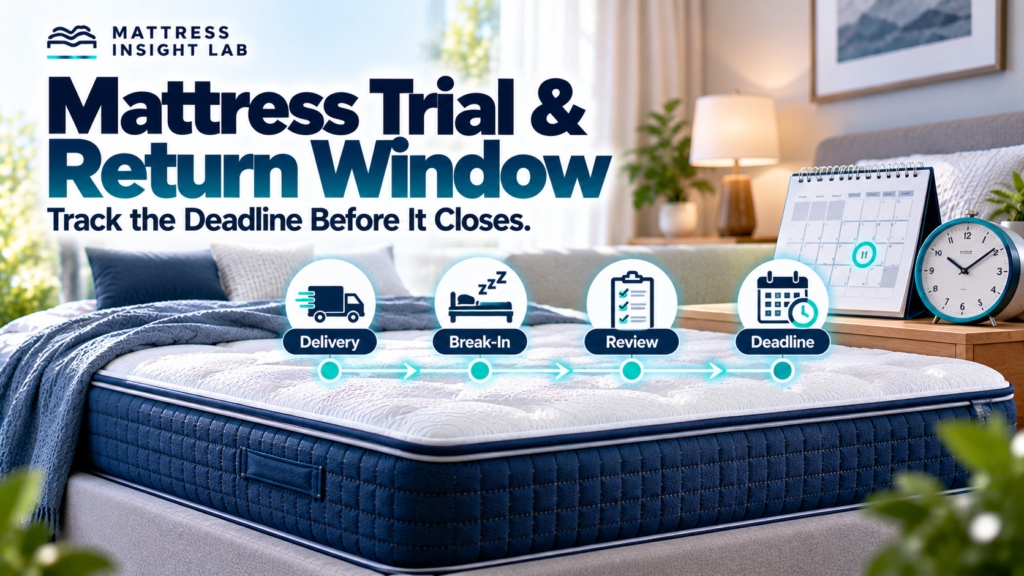
Check the return and exchange terms for the specific size and product. Return terms are product-specific and should be verified. Return terms are not identical across all sizes.
How Should Mattress Dimensions Influence the Final Buying Decision?
Choose the size that fits the complete physical system — exact dimensions, actual body and movement space, room footprint, frame and base, bedding, and delivery route — rather than the largest size that can technically enter the room. The sections below synthesize the workflow.
Start With Exact Width and Length Rather Than the Size Label Alone
Start with exact width and length from the product specification. Because labels can carry slightly different measurements, exact dimensions are the authoritative source. Relying on the label alone can leave a mismatch undetected.
Compare Those Dimensions With the Body and Movement Space Actually Needed
Compare exact dimensions with the body and movement space actually needed. The hospital motion-capture study found BMI strongly correlated with turning space, while the travel-sleep study documented posture-dependent spatial envelopes. [5] [6] Neither study establishes a residential consumer size prescription, so compare the actual product dimensions with the sleeper's own movement and posture needs rather than applying the studies' hospital or travel thresholds directly.
For Shared Beds, Evaluate Both Sleepers on the Same Surface Rather Than Applying a Universal Couple Rule
Evaluate both sleepers on the same surface rather than applying a universal couple rule. Shared-width geometry and anthropometric dimensions both support direct joint evaluation. Direct joint evaluation is more reliable than a couple-minimum rule, which is not established.
Verify the Complete Bed Footprint in the Room
Verify the complete bed-system footprint — mattress plus frame — in the room. The frame footprint defines the occupied area. Using mattress dimensions alone can underestimate the occupied area.
Confirm Frame, Base, Bedding, and Delivery Compatibility
Confirm frame and base compatibility, bedding compatibility, and delivery compatibility. Each compatibility check is product-specific. Assuming label matching is sufficient can leave a mismatch undetected.
Evaluate Motion Isolation and Edge Support Separately From Mattress Size
The supplied verified evidence does not establish that motion isolation or edge support are determined by mattress size. Motion isolation and edge support are separate buying criteria from size. The relationship between size and motion isolation or edge support remains an open research question.
Choose the Size That Fits the Complete Physical System Rather Than the Largest Size That Can Technically Enter the Room
Choose the size that fits the complete physical system — exact dimensions, actual body and movement space, room footprint, frame and base, bedding, and delivery route. Complete-system fit is more reliable than a single-criterion choice. No evidence supports a larger-is-better rule.
Sources and References
- ISO 24975:2026 — Furniture — Beds and mattresses — Methods of measurement and recommended tolerances. ISO record.
- International Sleep Products Association — Voluntary Dimensional Guidelines for Bedding. ISPA guidance.
- Saatva — Current mattress size specifications. Manufacturer specifications.
- Tempur-Pedic — Current mattress-size listings. Manufacturer specifications.
- Wiggermann N, Smith K, Kumpar D. — What Bed Size Does a Patient Need? The Relationship Between Body Mass Index and Space Required to Turn in Bed. PubMed record.
- Vink P, et al. — How do we sleep? Towards physical requirements for space and environment while travelling. ScienceDirect article.
- Saatva — Adjustable Base specifications. Manufacturer specifications.
- Saatva — Bed Sheet Sizes and Dimensions. Bedding specifications.
- Tempur-Pedic — Sheet Sets. Bedding specifications.
- Tempur-Pedic — Preparing for White Glove Delivery. Delivery guidance.
- Saatva — White Glove Mattress Delivery. Delivery guidance.
- Tempur-Pedic — TEMPUR-Cloud mattress. Product/delivery information.
Final Synthesis
Mattress size is primarily a geometry and compatibility decision. Width and length define physical surface area, while depth is a separate dimension that affects bedding and overall bed-system fit. Common U.S. size names are useful conventions, but they should not replace the exact product specification. ISO 24975:2026 now provides adult mattress and bed-component measurement methods plus recommended tolerances, and ISPA publishes voluntary U.S. dimensional guidance; neither fact makes every product carrying the same market label dimensionally identical.
Human-space research is useful only when its scope is preserved. The 47-person hospital-bed study found BMI strongly correlated with turning space, but it was designed for hospital equipment selection and had disclosed Hill-Rom industry affiliation. The Vink et al. travel-sleep study documented posture-dependent space use in 189 participants and was published in the January 2025 issue after appearing online in 2024. Neither study establishes a universal residential Twin/Queen/King prescription.
For a buying decision, verify exact mattress dimensions, frame or base dimensions, fitted-bedding compatibility, room footprint, applicable clearance requirements, and the actual delivery route. Evaluate motion isolation and edge support separately from mattress size. The best size is the one that fits the complete physical system and the sleepers' actual space needs—not simply the largest named size that can be placed in the room.
Bottom line: Verify the exact width, length, and depth of the specific mattress; compare those dimensions with the sleepers' real movement space; and confirm room, frame/base, bedding, and delivery compatibility. Treat common size names as useful conventions, not substitutes for the product specification, and keep comfort, motion isolation, and edge support as separate buying criteria.