What Edge Support Should You Check Before Buying a Mattress?
Mattress edge support describes how the perimeter responds under load — especially when you sit or lie near the side. Because no universal edge-support score is established in the reviewed mattress standards and evidence, the practical check is to evaluate how the edge compresses under the specific ways you actually use it, while keeping sitting response, lying response, bed height, and foundation support as separate considerations.
What Does Mattress Edge Support Actually Describe?
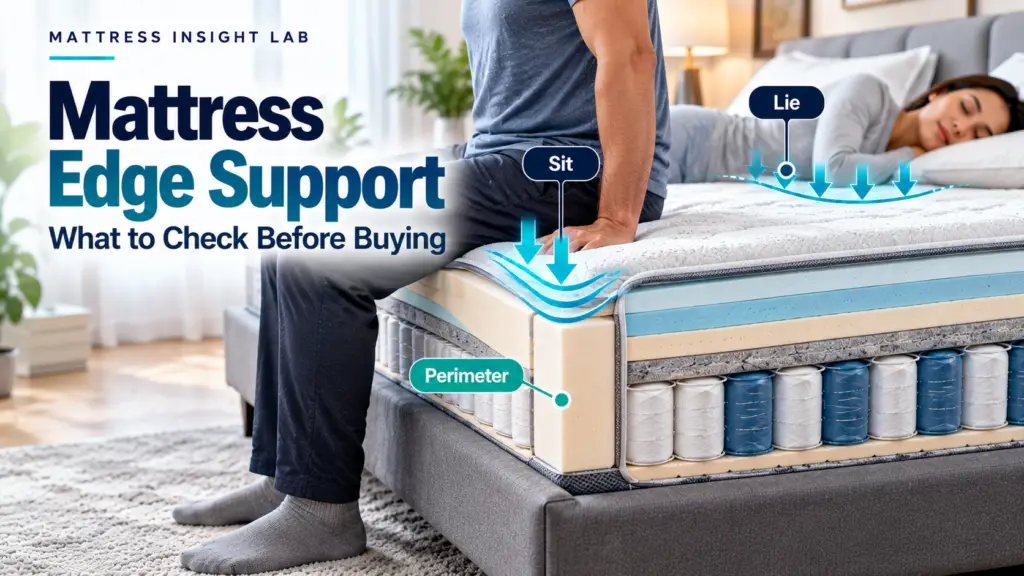
Edge support describes how the mattress perimeter responds to applied load — particularly concentrated loads like sitting — and it can be engineered independently of the mattress center. The perimeter is the border region around the mattress, where the edge construction meets the sleeping surface. Documented designs deliberately alter perimeter construction while leaving central regions different, which is why edge support is best treated as a local response rather than a single mattress-wide quality score.
What Is the Mattress Perimeter?
The mattress perimeter is the border region around the mattress — the area near the long sides and ends where the edge construction meets the sleeping surface. Documented designs place firmer foam around the edge (US6360390B1) or use foam side and end rails around a core (US7631381B2), showing the perimeter can be a distinct construction zone. [1] [2] Because manufacturers can alter perimeter construction independently of the center, the perimeter is a distinct region worth evaluating separately.
How Can the Perimeter Respond Differently From the Center Under Load?
The perimeter can respond differently because it can use different materials and structures than the center. US6360390B1 describes a firmer foam perimeter surrounding a softer central foam region. US7631381B2 describes foam side and end rails around a core and states that those rails may have different firmness characteristics from the top panel. [1] [2] If the edge and center use different constructions, their response to load can differ.
Why Is Edge Support Different From Overall Firmness?
Edge support is a localized perimeter response, while overall firmness describes the general feel of the sleeping surface. A mattress can have a firmer perimeter while the central region remains different (US6360390B1). [1] This means one mattress can feel different at the edge than in the middle, so edge support and overall firmness are distinct concepts.
Why Is Edge Support Better Treated as a Local Response Than a Single Mattress-Wide Quality Score?
Edge support is better treated as a local response because documented designs deliberately alter perimeter construction while leaving other mattress regions different (US6360390B1), and because ASTM F1566 does not list a dedicated consumer edge-support score among its published test methods. [3] The perimeter can be engineered independently, meaning its behavior does not necessarily represent the whole mattress.
Is There One Standardized Mattress Edge-Support Score?
The reviewed ASTM F1566 standard covers several mattress performance measures, but its public scope does not identify a dedicated consumer edge-support score. ASTM F1566 identifies mattress and mattress-set tests for firmness, firmness retention, durability, impact effects, and height change. Its published scope does not list a dedicated edge-support test or consumer edge score. [3]
Which Mattress Performance Measures Are Listed in ASTM F1566?
ASTM F1566 identifies mattress and mattress-set tests for firmness, firmness retention, durability, impact effects, and height change. This is the published scope of the standard as reviewed. The standard covers these listed measures; it does not publicly list a dedicated edge-support test.
Does Its Public Scope Identify a Dedicated Edge-Support Test?
The reviewed public scope of ASTM F1566 does not identify a dedicated edge-support test or consumer edge score. [3] The standard lists firmness, firmness retention, durability, impact, and height change, but not a dedicated edge-support measure. The absence of a dedicated edge-support test in this standard’s public scope means edge-support claims should not be assumed to use one universal ASTM score.
Why Can Different Retailers Use Different Loads, Positions, or Scoring Scales?
The reviewed evidence does not establish one universal standardized edge-support score. ASTM F1566 lists firmness, firmness retention, durability, impact effects, and height change but does not list a dedicated consumer edge-support score. [3] Commercial or editorial edge scores should therefore be interpreted within their disclosed methods. Without a disclosed method, scores from different sources cannot be assumed comparable.
Why Should Edge Scores From Different Sources Not Be Treated as Automatically Interchangeable?
The supplied verified evidence does not establish that edge scores from different sources use the same method, so they should not be treated as automatically interchangeable. Commercial testing methods can differ in applied load, contact area, position, deflection method, and scoring. Without a disclosed method, scores are not automatically comparable.
Why Is Sitting on the Edge Mechanically Different From Lying Near It?
Sitting at the perimeter concentrates body weight over a relatively small area, while lying distributes load across a larger surface — so the two conditions place different demands on the edge. US6568014B1 explicitly distinguishes a person’s weight being distributed among relatively few perimeter coils while sitting from a more even distribution across the coil array while lying. [4]
Why Does Sitting Concentrate Body Load Over a Smaller Perimeter Area?
Sitting at the perimeter concentrates a person’s weight over relatively few springs, unlike lying across a larger spring area. US6568014B1 explicitly distinguishes a person’s weight being distributed among relatively few perimeter coils while sitting from a more even distribution across the coil array while lying. [4] A concentrated load over a small area creates different local demands than a distributed load over a larger area.
How Is That Different From Load Distributed Across the Body While Lying?
Lying distributes body weight across a larger area of the mattress, creating a different loading pattern than sitting. US6568014B1 describes the more even coil-array loading associated with lying compared with the more concentrated perimeter-coil loading of sitting. [4] Different load distributions create different demands on the perimeter.
Why Can a Mattress Perform Differently in Sitting and Lying Edge Tests?
Because sitting and lying create different loading patterns, a mattress can respond differently under each condition. The concentrated load of sitting and the distributed load of lying place different demands on the perimeter structure. Different loading conditions can produce different responses in the same structure.
Why Should Both Conditions Be Checked if the Buyer Uses the Edge in Both Ways?
If the buyer sits and lies near the edge, both conditions should be checked because they place different demands on the perimeter. Sitting concentrates load; lying distributes it. Each condition tests a different aspect of edge response. To evaluate how the edge performs under the ways you actually use it, test both loading conditions.
How Can Foam Perimeter Reinforcement Change Edge Response?
A mattress can use firmer foam around its perimeter to change edge response independently of the central cushioning. US6360390B1 describes a firmer perimeter foam surrounding a softer central region. [1] US7631381B2 describes side and end foam rails around a core and allows those rails to differ in firmness from the top panel. [2]
How Can Firmer Foam Be Placed Around the Mattress Perimeter?
Firmer foam can be placed around the mattress perimeter to create a different edge response. US6360390B1 describes a foam construction in which the perimeter foam is firmer than the central foam region. [1] If the perimeter uses firmer foam than the center, the edge can respond differently under load.
How Can the Edge Foam Differ From the Central Cushioning Material?
The edge foam can have different compression characteristics from the central cushioning material. US7631381B2 states that the side and end rails may have greater firmness than the top panel. [2] US6360390B1 describes firmer perimeter foam with different central regions. If the edge and center use different foam, their response to load can differ.
How Can Side and End Rails Form a Continuous Encasement Around a Core?
Side and end foam rails can be placed around a mattress core to form a continuous encasement. US7631381B2 describes two side rails and two end rails forming a foam perimeter around a mattress core, and states that the core may be an innerspring, a firm foam block, or an air bladder. [2] A continuous foam border around the core is one documented way to modify perimeter response.
Why Does Foam Encasement Not Guarantee the Same Edge Performance in Every Mattress?
Foam encasement is one documented architecture, but edge performance depends on the specific design. The patents describe specific constructions. Perimeter behavior can depend on border geometry, foam firmness, rail width, cushioning above the edge system, and other design variables. Because many variables affect perimeter response, the presence of foam encasement alone does not determine performance.
How Can Springs and Border Components Reinforce a Mattress Edge?
Beyond foam perimeter systems, innerspring edges can be reinforced with edge-support inserts fitted around the upper and lower border wires or with dedicated edge springs around an inner coil unit. US6568014B1 documents a continuously extruded C-shaped polymeric/foam edge-support insert that overlaps the upper and lower border wires. [4] US7287291B2 documents a foam border extending around inner coil springs, with spaced slits containing additional edge springs. [5]
What Role Can Upper and Lower Border Wires Have Around an Innerspring Unit?
In US6568014B1, the innerspring coils are secured to upper and lower border wires, and a C-shaped edge-support insert overlaps those border wires around the mattress perimeter. [4] The insert—not the border wire alone—is the added reinforcement component described in that design.
How Can Edge-Support Inserts Reinforce the Perimeter?
Edge-support inserts can be added around the perimeter to reinforce the edge. US6568014B1 describes a C-shaped continuously extruded edge-support insert fitted around the upper and lower border wires and presents repeated concentrated edge loading as part of the design background. [4] Inserts are a documented method of adding structural support around the mattress border.
How Can Additional Edge Springs Be Added Around an Inner Coil Unit?
Additional edge springs can be placed around an inner coil assembly within a perimeter foam border. US7287291B2 documents a foam border extending around inner coil springs, with spaced slits containing additional edge springs. [5] Dedicated edge springs are one documented method of increasing perimeter reinforcement.
Why Does Reinforcement Architecture Not by Itself Prove Superior Whole-Mattress Edge Performance?
Reinforcement architecture is one factor, but whole-mattress edge performance depends on the complete design. Technical disclosures document edge-support inserts fitted around border wires and additional perimeter spring systems, but they do not establish a universal ranking of all mattresses using those designs. Because many variables affect perimeter response, the presence of a reinforcement component does not determine whole-mattress performance.
Should Sitting-Edge and Sleeping-Edge Performance Be Evaluated Separately?
Sitting-edge and sleeping-edge performance should be evaluated separately because they involve different loading conditions and answer different questions about how the edge responds. A sitting test reveals how the perimeter responds to a concentrated load over a small area. Lying near the edge reveals how the perimeter responds to a distributed load across a larger area.
What Does a Sitting Test Reveal About Concentrated Perimeter Compression?
A sitting test reveals how the perimeter responds to a concentrated load over a small area. Sitting concentrates body weight over relatively few perimeter coils (US6568014B1). Observing how much the edge compresses when sitting shows how it handles a concentrated load.
What Does Lying Near the Edge Reveal About Distributed Perimeter Response?
Lying near the edge reveals how the perimeter responds to a distributed load across a larger area. Lying distributes body weight across a larger area than sitting (US6568014B1). Observing how the edge feels when lying shows how it handles a distributed load.
Why Can a Firm Sitting Edge Still Feel Different When a Sleeper Lies Across It?
Because sitting and lying create different loading patterns, a firm sitting edge can feel different when lying across it. The concentrated load of sitting and the distributed load of lying place different demands on the perimeter. Different loading conditions can produce different perceived responses.
Why Should Corners, Long Sides, and Other Locations Not Be Assumed to Respond Identically?
Different locations on the perimeter may respond differently because of construction variations. Perimeter behavior can depend on border geometry, spring connection, and rail width. Corners and long sides may use different constructions. If the perimeter is not uniform, different locations can respond differently.
Does Strong Edge Support Automatically Create More Usable Sleep Surface?
The supplied verified evidence does not establish that strong edge support automatically creates more usable sleep surface. Perimeter deflection can change the experience of lying near the side, but “usable sleep surface” is a consumer concept without a verified universal threshold.
How Can Perimeter Deflection Change the Experience of Lying Near the Side?
The supplied verified evidence does not establish a universal relationship between perimeter deflection and lying experience. When a mattress edge compresses under load, a sleeper lying near the side may notice the change in surface shape. Clinical pressure-surface research has recorded patient acceptability complaints about mattresses being too soft or having soft/sloping edges, although the evidence quality for that acceptability outcome was rated very low. [6] [7] However, this does not establish a universal consumer rule.
What Does “Usable Sleep Surface” Mean as a Consumer Concept?
The supplied verified evidence does not establish a standardized definition of “usable sleep surface.” “Usable sleep surface” is a consumer concept describing the area where a sleeper feels comfortable and stable lying near the edge. It is not a standardized measurement in the reviewed evidence.
Why Is There No Verified Universal Edge-Deflection Threshold That Defines Usable Width?
The supplied verified evidence does not establish a universal edge-deflection threshold that defines usable width. Technical edge-support patents focus on reinforcement and deformation control, while clinical observations establish subjective edge insecurity. No reviewed evidence establishes a universal deflection threshold for usable sleep width.
Why Should “More Usable Surface” Be Reported as a Product-Specific or Subjective Finding Unless Measured Directly?
The supplied verified evidence does not establish a universal usable-surface metric, so “more usable surface” should be reported as product-specific or subjective unless measured directly. Without a disclosed measurement method, “more usable surface” is a subjective or product-specific claim, not a standardized finding.
What Does “Roll-Off Feeling” Tell You About Edge Support?
The supplied verified evidence does not establish a standardized mechanical measurement for a “roll-off feeling.” A sleeper can subjectively notice edge compression when lying close to the side, and clinical pressure-surface evidence records patient acceptability complaints about mattresses being too soft or having soft/sloping edges, with very low evidence quality. [6] [7] However, this is not a standardized measurement or a universal fall-risk claim.
What Can a Sleeper Subjectively Notice When Lying Close to a Compressing Edge?
The supplied verified evidence does not establish a universal description of what a sleeper notices when lying close to a compressing edge. Clinical pressure-surface research has recorded patient acceptability complaints about mattresses being too soft or having soft/sloping edges, although the evidence quality for that acceptability outcome was rated very low. [6] [7] A sleeper may notice edge compression, but the specific experience is subjective and not universally quantified.
Why Is a “Roll-Off Feeling” Not a Standardized Mechanical Measurement?
The supplied verified evidence does not establish a standardized mechanical measurement for a “roll-off feeling.” No reviewed evidence establishes a universal deflection threshold for roll-off perception. The reviewed clinical evidence concerns patient acceptability complaints rather than a standardized mechanical roll-off measurement, and its quality for that outcome was very low. [6] [7]
Why Should It Not Be Converted Into a Claim That the Mattress Will Cause a Person to Fall?
The supplied verified evidence does not establish that edge compression causes a person to fall. Clinical observations describe subjective edge insecurity, but no reviewed evidence establishes a causal link between edge compression and falls.
How Can Personal Edge Confidence Still Be Useful During a Trial?
Personal edge confidence can be useful during a trial as subjective comparative observation, but it is not a standardized measurement. During an at-home trial, a sleeper can observe how the edge feels under their own weight and sleeping position. This is personal comparative observations, not a universal edge-support score.
Does Repeated Sitting Create a Special Durability Challenge at the Perimeter?
Repeated sitting at the perimeter is a documented engineering concern for edge components, but it does not establish a universal lifespan prediction. US6568014B1 explains that sitting can concentrate a person’s weight over relatively few perimeter coils and describes increased loads and loading cycles at the mattress edge as a design concern. [4]
Why Are Perimeter Springs Subjected to Concentrated Sitting Loads?
Sitting at the perimeter concentrates body weight over relatively few springs. US6568014B1 explains that a seated person’s weight can be concentrated over relatively few perimeter coils. A concentrated load over a few springs places more demand on those specific components.
Why Can Edge Components Experience Repeated Load Cycles Different From Central Regions?
Edge components can experience repeated load cycles that differ from central regions because of concentrated sitting loads. US6568014B1 describes increased loads and loading cycles at the mattress edge and presents its edge-support insert as a response to perimeter-support concerns. [4] If the edge receives concentrated repeated loads, its components may experience different wear patterns than the center.
What Types of Edge Wear Were Discussed in Innerspring Technical Literature?
The patent discusses perimeter wear as a design motivation for adding structural support around mattress borders. US6568014B1 identifies repeated perimeter loading and perimeter wear as reasons manufacturers add edge-support inserts. The patent documents edge wear as a design concern, not as a measured consumer outcome.
Why Does This Not Establish a Universal Number of Years Before Edge Softening?
The supplied verified evidence does not establish a universal number of years before edge softening. Repeated perimeter loading is a documented engineering concern, but reinforcement architecture, materials, load cycles, user behavior, and construction vary. ASTM also evaluates durability separately rather than defining it from initial edge firmness.
Does Perimeter Softening Mean the Whole Mattress Has Lost Support?
The supplied verified evidence does not establish that perimeter softening means the whole mattress has lost support. Local perimeter deformation is distinct from center-surface deformation. Edge wear can occur without proving equivalent degradation across the entire mattress.
What Is Local Perimeter Deformation?
Local perimeter deformation is a change in the edge region’s shape or response under load. The perimeter is a distinct construction zone that can use different materials than the center. Its deformation is a local response.
How Is It Different From Center-Surface Deformation?
Center-surface deformation is a change in the middle region’s shape or response, which is a different zone than the perimeter. The perimeter and center can use different constructions, so their deformation patterns can differ. Different construction zones can degrade differently.
Why Can Edge Wear Occur Without Proving Equivalent Degradation Across the Entire Mattress?
The supplied verified evidence does not establish that edge wear proves equivalent degradation across the entire mattress. Edge components can experience different load cycles than central regions. ASTM evaluates durability separately from initial edge firmness. Local edge change does not prove global support loss.
Which Additional Measurements Would Be Needed to Establish Whole-Mattress Durability Loss?
The supplied verified evidence does not establish which measurements would define whole-mattress durability loss. ASTM F1566 evaluates durability as a separate measure. Establishing whole-mattress durability loss would require measuring deformation across multiple regions, not just the perimeter.
Is Edge Support the Main Factor That Makes Getting Out of Bed Easier?
Edge support is not established as the main factor that makes getting out of bed easier; total bed height is a separate transfer variable with direct evidence. A soft or sloping perimeter may influence perceived stability while sitting at the bed edge, although the reviewed clinical evidence does not quantify that relationship; bed-height evidence does not prove that more mattress edge stiffness improves standing.
How Can Perimeter Feel Affect Perceived Stability While Sitting at the Bed Edge?
A soft or sloping perimeter may influence perceived stability while sitting at the bed edge, although the reviewed clinical evidence does not quantify this relationship. [6] [7]
What Does Direct Research Establish About Bed Height and Sit-to-Stand Effort?
In 24 older adults, increasing bed height reduced peak trunk angular velocity and trunk range of motion during sit-to-stand transfer. [8] Bed height is a relevant transfer variable in the studied population.
Why Does Bed-Height Evidence Not Prove That More Mattress Edge Stiffness Improves Standing?
The supplied verified evidence does not establish that more mattress edge stiffness improves standing. Bed-height research found sit-to-stand differences in older adults, but this is a separate variable from mattress edge stiffness. No reviewed evidence links edge stiffness to standing ease.
Why Should Mobility Limitations Not Be Addressed With a Generic Reinforced-Edge Prescription?
The supplied verified evidence does not establish a generic reinforced-edge prescription for mobility limitations. Mobility limitations involve multiple factors including bed height and personal transfer mechanics. No reviewed evidence validates a universal edge-stiffness prescription.
How Should Mattress Height and Edge Support Be Evaluated Together Without Confusing Them?
Mattress height and edge support are separate variables that should be evaluated together when bed access matters, but they should not be confused with each other. Total bed height can influence trunk motion during sit-to-stand transfer. Mattress perimeter compression changes the shape of the seating contact area when sitting at the edge.
What Does Total Bed Height Change During Sit-to-Stand?
Total bed height can influence trunk motion during sit-to-stand transfer. In 24 older adults, increasing bed height reduced peak trunk angular velocity and trunk range of motion. [8] Bed height is therefore a documented transfer variable in that tested population.
What Does Mattress Perimeter Compression Change at the Seating Contact Area?
Mattress perimeter compression changes the shape of the seating contact area when sitting at the edge. Sitting concentrates load over a small perimeter area, causing local compression. The seating contact area changes as the edge compresses under load.
Why Can a Comfortable Edge Height Still Have a Soft Perimeter—or Vice Versa?
Bed height and perimeter compression are separate variables that can vary independently. Bed height is a transfer variable. Perimeter compression is a local response to concentrated load. They are distinct characteristics.
Why Should Both Be Tested Separately When Bed Access Matters?
Both should be tested separately because they are distinct variables that both affect bed access. Bed height affects sit-to-stand mechanics. Edge compression affects the seating contact area. To evaluate bed access, the reader should assess both variables independently.
Can the Bed Frame or Foundation Affect Edge-Support Evaluation?
The bed frame or foundation can affect how a mattress performs, so the mattress should be evaluated on the manufacturer-required support system. Sealy’s current warranty requires an appropriate support system and specifies structural requirements for bed frames and slatted systems. [9] The support system should therefore be considered when evaluating a Sealy mattress under intended-use conditions.
Why Should the Mattress Be Placed on the Manufacturer-Required Support System?
The mattress should be placed on the manufacturer-required support system because the base can affect how the mattress performs. Sealy’s current warranty requires a proper support system and specifies frame requirements. [9] If the base is part of the intended setup, evaluating the mattress on a materially different or inadequate base may not reflect the supported configuration.
What Types of Frame or Slat Requirements Can a Mattress Warranty Specify?
A mattress warranty can specify structural support requirements for certain mattress sizes and slatted systems. Sealy’s current warranty specifies center support for Queen, King, and Cal King frames and states that, when a slatted frame is used without a foundation, cross slats must be at least 3 inches wide and no more than 4 inches apart. [9]
Why Can an Inadequate Base Confound Evaluation of Mattress Deformation?
An inadequate base can confound evaluation of mattress deformation because the support underneath the mattress affects how it responds to load. Sealy’s warranty can exclude coverage when the support system is considered inadequate. [9] An inadequate base can confound an evaluation because observed movement or deformation may involve both the mattress and its underlying support system.
Why Should Foundation Requirements Be Checked for the Exact Mattress Rather Than Generalized Across Brands?
Foundation requirements should be checked for the exact mattress because they are manufacturer-specific. Sealy’s warranty defines its own support requirements. [9] Other manufacturers may specify different requirements. Because requirements vary by manufacturer, the reader must check the exact product’s requirements.
Does Body Weight Determine How Much Edge Support Someone Needs?
The supplied verified evidence does not establish that body weight determines how much edge support someone needs. Applied load can affect perimeter compression, but load position, contact area, mattress geometry, and reinforcement design also matter. The reviewed evidence does not establish a universal weight-to-edge-support formula.
Why Does Applied Load Affect Perimeter Compression?
Applied load affects perimeter compression because the edge responds to the force placed on it. Sitting concentrates body weight over a small perimeter area, creating a concentrated load. A greater load over a small area can produce more compression.
Why Does That Not Establish a Universal “Heavier Sleeper = Stronger Edge Required” Rule?
The supplied verified evidence does not establish a universal “heavier sleeper = stronger edge required” rule. Applied load can affect compression, but contact area, sitting posture, lying posture, perimeter design, mattress size, and personal preference also affect edge experience. No reviewed evidence validates a weight-to-edge-support formula.
How Can Load Position, Contact Area, Mattress Geometry, and Reinforcement Design Also Matter?
The supplied verified evidence does not establish that load magnitude alone determines edge experience. Perimeter behavior can depend on border geometry, spring connection, foam firmness, rail width, cushioning above the edge system, mattress preload, support underneath the mattress, and the location/type of applied load.
Why Should Each Sleeper Test the Edge Under Their Own Normal Use Rather Than Follow a Universal Weight Table?
The supplied verified evidence does not establish a universal weight table, so each sleeper should test the edge under their own normal use. Because no weight-based formula exists, the most reliable personal check is to test the edge under your own weight, posture, and normal use.
Do Couples Require Stronger Edge Support?
The supplied verified evidence does not establish that couples require stronger edge support. Two sleepers may choose to evaluate the perimeter more carefully, but sharing a mattress does not mechanically change its intrinsic edge structure. Mattress size, motion isolation, and edge response are separate shared-bed variables.
Why Might Two Sleepers Choose to Evaluate the Perimeter More Carefully?
The supplied verified evidence does not establish that couples require stronger edges, but two sleepers may choose to evaluate the perimeter more carefully for personal reasons. If both partners use the edge, they may want to check how it responds under each person’s weight and position. This is a personal evaluation choice, not a mechanical requirement.
Why Does Sharing a Mattress Not Mechanically Change Its Intrinsic Edge Structure?
The supplied verified evidence does not establish that sharing a mattress changes its intrinsic edge structure. The mattress’s edge construction is a physical property of the product. Sharing it does not alter that construction.
Why Are Mattress Size, Motion Isolation, and Edge Response Separate Shared-Bed Variables?
The supplied verified evidence does not establish that these variables are linked. Mattress size, motion isolation, and edge response are distinct characteristics that may each matter to couples, but they are separate variables.
Why Should Couples Test the Positions Each Person Actually Uses Instead of Assuming Stronger Edges Are Automatically Required?
The supplied verified evidence does not establish that couples automatically require stronger edges, so couples should test the positions each person actually uses. Because no couple-specific edge rule exists, the most reliable check is for each person to test the edge under their own weight and position.
Can Mattress Construction Type Predict Edge Support?
The supplied verified evidence does not establish that mattress construction type predicts edge support. Foam reinforcement can be used around different mattress cores, and edge springs can be integrated into spring-based constructions. Architecture details matter more than the broad type label.
How Can Foam Reinforcement Be Used Around Different Mattress Cores?
Foam reinforcement can be used around different mattress cores. US7631381B2 notes the foam encasement concept can surround an innerspring or other types of mattress cores. Foam rails are not limited to one core type in the disclosed design.
How Can Edge Springs Be Integrated Into Spring-Based Constructions?
Edge springs can be integrated into spring-based constructions as additional perimeter reinforcement. US7287291B2 documents a foam border extending around inner coil springs, with spaced slits containing additional edge springs. [5] Dedicated edge springs are one documented method of reinforcing a spring-based mattress edge.
Why Does “Hybrid” Not Automatically Mean Reinforced Edge Support?
The supplied verified evidence does not establish that “hybrid” automatically means reinforced edge support. “Hybrid” is a broad category label. The actual perimeter system determines edge response, not the label.
Why Does “All Foam” Not Automatically Mean Weak Edge Support?
The supplied verified evidence does not establish that “all foam” automatically means weak edge support. Foam rails can be used to reinforce edges. The actual perimeter system determines edge response, not the broad label.
What Direct Complete-Mattress Testing Would Be Needed for a Construction-Type Ranking?
The supplied verified evidence does not establish what testing would define a construction-type ranking. A construction-type ranking would require standardized complete-mattress comparisons across representative construction families using identical sitting and lying perimeter loads.
What Should an “Edge-to-Edge Support” or “Reinforced Edge” Claim Actually Tell You?
An “edge-to-edge support” or “reinforced edge” claim should tell you what component reinforces the edge, which sides are reinforced, how performance was measured, and what outcome is being claimed. Documented options include firmer foam, foam rails around a core, and edge springs in a foam border.
What Component Actually Reinforces the Edge?
The claim should specify which component reinforces the edge. Documented options include firmer foam (US6360390B1), foam rails around a core (US7631381B2), and edge springs in a foam border (US7287291B2). Different components can reinforce edges, so the claim should name the specific one.
Is the Reinforcement Used on All Four Sides or Only Selected Sides?
The claim should specify whether reinforcement is on all four sides or only selected sides. Foam rails can form side and end encasement, but not all designs may use full encasement. Coverage can vary, so the claim should state which sides are reinforced.
Was Edge Performance Measured Under Sitting, Lying, or Another Loading Method?
The claim should specify whether edge performance was measured under sitting, lying, or another loading method. Sitting and lying create different loading patterns. Because loading conditions differ, the claim should state which was used.
What Load, Contact Area, Deflection Metric, and Test Location Were Used?
The supplied verified evidence does not establish a universal measurement protocol, so the claim should disclose its specific load, contact area, deflection metric, and test location. Without a disclosed method, a claim cannot be compared to others. The claim should specify these details.
Is the Claim About Initial Stiffness, Permanent Deformation, Subjective Stability, or Long-Term Durability?
The supplied verified evidence does not establish that these outcomes are interchangeable, so the claim should specify which one it addresses. Initial stiffness, permanent deformation, subjective stability, and long-term durability are distinct outcomes. A claim should state which one it measures.
Why Should “Edge-to-Edge Support” Not Be Treated as a Standardized Certification Without a Disclosed Method?
The supplied verified evidence does not establish “edge-to-edge support” as a standardized certification. The reviewed ASTM F1566 scope does not provide a dedicated edge-support score. Absent a disclosed test or certification basis, “edge-to-edge support” should be treated as a product claim rather than assumed to be a standardized certification.
How Can a Shopper Compare Edge Support Before Buying?
A shopper can compare edge support by testing the same locations and positions on each mattress, treating the results as personal comparative observations rather than a universal score. These are personal comparative observations, not a standardized test.
Sit in a Comparable Location on Each Mattress and Observe Relative Perimeter Compression
Sit in a comparable location on each mattress and observe how much the perimeter compresses. Sitting concentrates load over a small perimeter area. Comparing the same sitting position across mattresses shows relative compression differences.
Lie Near the Side in a Normal Sleep Position and Compare Personal Stability and Comfort
Lie near the side in a normal sleep position and compare personal stability and comfort. Lying distributes load across a larger area. Comparing the same lying position across mattresses shows relative distributed-load response.
Compare the Edge With the Center Rather Than Judging the Edge in Isolation
Compare the edge with the center rather than judging the edge in isolation. The perimeter can be engineered independently of the center. Comparing edge to center shows how the perimeter differs from the main sleeping surface.
Test More Than One Long-Side Location if the Mattress Uses Zoned or Asymmetric Construction
Test more than one long-side location if the mattress uses zoned or asymmetric construction. Perimeter behavior can depend on border geometry and construction. If construction varies by location, response can vary.
Evaluate Bed Height Separately When Sitting and Standing From the Edge
Evaluate bed height separately when sitting and standing from the edge. Bed height is a separate transfer variable. Because height and edge stiffness are distinct, both should be assessed independently.
Repeat the Comparison During the At-Home Trial Under the Correct Foundation Conditions
Repeat the comparison during the at-home trial under the correct foundation conditions. The base can affect mattress performance. To evaluate the mattress as intended, use the manufacturer-required support system.
Why Should These Observations Be Treated as Personal Comparative Evidence Rather Than a Universal Edge-Support Score?
The supplied verified evidence does not establish a universal edge-support score, so personal observations can support an individual comparison but are not a standardized measurement. Personal observations are useful for comparing mattresses under your own weight and use, but they are not a universal score.
Sources and References
- US6360390B1 — Edge support for a mattress. Google Patents record.
- US7631381B2 — Mattress having foam encasement and method of making the same. Google Patents record.
- ASTM F1566-14 — Standard Test Methods for Evaluation of Innersprings, Boxsprings, Mattresses or Mattress Sets. ASTM record.
- US6568014B1 — Edge support on a mattress. Google Patents record.
- US7287291B2 — Mattress with improved edge support. Google Patents record.
- NICE/NCBI — Pressure redistributing devices evidence review. NCBI Bookshelf.
- NICE — Pressure ulcer management draft guideline evidence material. NICE record.
- Lindemann U, et al. — Effect of bed height and use of hands on trunk angular velocity during the sit-to-stand transfer. PubMed record.
- Sealy — Mattress and Flat Foundation Warranty Information. Manufacturer warranty.
How Should Edge Support Influence the Final Mattress Decision?
Edge support should influence the final decision based on how you actually use the perimeter, with sitting and lying checked separately, reinforcement architecture verified, foundation requirements confirmed, and bed height kept separate.
Give Edge Response More Weight if You Regularly Sit or Lie Near the Perimeter
Give edge response more weight if you regularly sit or lie near the perimeter. Sitting and lying near the edge place demands on the perimeter. If you use the edge regularly, its response matters more to your experience.
Check Sitting and Lying Edge Performance Separately
Check sitting and lying edge performance separately. Sitting and lying create different loading patterns. Because the conditions differ, both should be checked.
Look for the Actual Reinforcement Architecture Rather Than Trusting a Mattress-Type Label
Look for the actual reinforcement architecture rather than trusting a mattress-type label. Documented architectures include firmer foam, foam encasement, and edge springs. The actual perimeter system determines response, not the broad label.
Verify Foundation Requirements Before Judging Edge Performance
Verify foundation requirements before judging edge performance. The base can affect mattress performance. To judge the mattress fairly, use the manufacturer-required support system.
Keep Bed Height and Transfer Usability Separate From Edge Stiffness
Keep bed height and transfer usability separate from edge stiffness. Bed height is a separate transfer variable. Because they are distinct, each should be evaluated independently.
Treat Usable-Area, Roll-Off, Body-Weight, Couple, and Durability Claims as Product-Specific Unless Directly Measured
The supplied verified evidence does not establish universal usable-area, roll-off, body-weight, couple, or durability rules, so these claims should be treated as product-specific unless directly measured. These outcomes are not universally quantified. Treat any such claim as product-specific or subjective unless a disclosed measurement supports it.
Final synthesis: Edge support is a localized perimeter response that can be engineered independently of the mattress center. The reviewed ASTM mattress standard does not define a dedicated consumer edge-support score, so compare the same sitting and lying conditions on candidate mattresses, verify the actual reinforcement architecture, confirm the manufacturer’s foundation requirements, and keep total bed height as a separate transfer variable. Treat usable-area, roll-off, body-weight, couple, and durability claims as product-specific unless a disclosed measurement or applicable evidence supports them.