What Safety Labels and Certifications Should You Verify Before Buying?
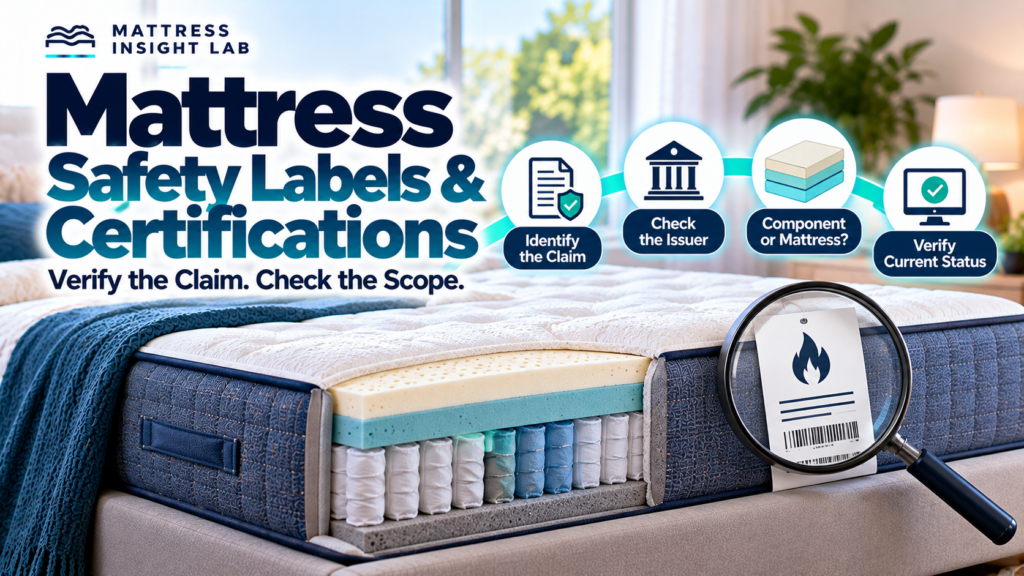
There is no single mattress “safety certification.” In the United States, federal flammability requirements, state bedding labels, voluntary certifications, and marketing seals answer different questions. Before buying, match each label to the exact claim it supports, identify whether the certified scope is a component or finished mattress, and verify the issuer, number, scope, and current status through the appropriate official source. [1] [3] [5] [8] [10] [12] [14] [16]
Sources checked October 12, 2026. Certification criteria and directories can change, and a current program does not prove that a specific mattress model remains certified today. Verify the exact product record at purchase.
Use one question throughout this guide: “Exactly what claim does this label support, exactly what product or component is covered, and can I verify that scope with the regulator or certification program?” A logo by itself is not enough.
| Evidence system | What it can establish | What to verify |
|---|---|---|
| Federal mattress flammability rules | Performance and labeling against 16 CFR Parts 1632/1633 | Permanent label + applicable compliance documentation [1] [2] |
| State bedding law label | Jurisdiction-specific filling/status information | Rules for the state where the product is regulated/sold [3] [4] |
| CertiPUR-US | Qualifying flexible polyurethane foam | Foam producer / participating company records and current program status [5] [6] [7] |
| OEKO-TEX STANDARD 100 | Certified textile article tested under program criteria | Label number, Label Check result, and exact certified article [8] [9] |
| GOTS | Qualifying organic textile goods, including a finished mattress when certified at that scope | Label grade, certifier, certification number, Scope Certificate [10] [11] |
| GOLS | Qualifying organic natural-rubber-latex products, including listed mattress/bedding products | Company/product record, certificate scope, validity [12] [13] |
| UL GREENGUARD / Gold | Chemical-emissions performance of the listed product | Exact product listing in UL SPOT and certification tier [14] [15] |
What Can a Mattress Label or Certification Actually Prove?
A mattress label or certification proves only what its issuing system actually evaluates, for the specific product or component within its scope. Start by separating mandatory regulatory evidence, state bedding labels, voluntary third-party certifications, and seller-created marketing seals. [1] [5] [8] [10] [12] [14] [16]
What Is a Legally Required Compliance Label?
A legally required compliance label documents that a product satisfies a specific regulatory requirement; in the U.S. mattress context, this includes federal flammability compliance labeling under 16 CFR Parts 1632 and 1633. Federal standards impose performance and labeling requirements; compliance is documented through physical labels and, where applicable, a written General Certificate of Conformity. Compliance labels are evidence of tested performance against a defined standard — not evidence of broader safety, chemical content, or organic origin. [1] [5] [8] [10] [12] [14] [16]
What Is a State Bedding Law Label?
A bedding “law label” is a state-level labeling requirement, not a single federal mattress label. California and Utah publish their own requirements, demonstrating jurisdiction-specific rules. States maintain their own bedding labeling regimes covering filling content, material status, and related information. Law labels can provide useful material/status information, but requirements are jurisdiction-specific. [3] [4]
What Is a Voluntary Third-Party Certification?
A voluntary third-party certification is issued by an independent program that evaluates a defined product, component, or attribute against its own criteria. CertiPUR-US is foam-specific; OEKO-TEX STANDARD 100 can cover textile materials, components, or finished textile articles including mattresses; GOTS can cover qualifying finished textile goods including mattresses; GOLS can cover qualifying organic-latex materials, components, and mattress/bedding products; and GREENGUARD evaluates chemical emissions of the certified product. Each program defines its own scope, criteria, and verification route. Certification is evidence about the specific certified item within the program’s stated scope. [1] [5] [8] [10] [12] [14] [16]
What Is a Manufacturer Marketing Seal?
A manufacturer marketing seal is created by the seller or brand itself; it is not independent third-party certification. FTC enforcement has addressed a company-created “Green Safety Shield” that implied independent authority without adequate substantiation. Self-created seals can resemble independent certifications without providing independent verification. The question to ask is who owns the program and what standard or test method is behind the seal. [16] [17]
Why Must Every Label Be Matched to the Exact Claim It Supports?
Each label or certification supports a specific claim within a specific scope. Matching the label to the exact claim prevents scope inflation — for example, treating a foam certification as a mattress certification, or a textile certification as an organic certification. Different programs evaluate different attributes; a label’s meaning is defined by its issuing system. Ask: what claim is being proved, what product or component is covered, and can the scope be independently verified? [1] [5] [8] [10] [12] [14] [16]
Why Does No Single Mattress Certification Prove Every Safety, Comfort, Organic, and Emissions Attribute?
No single program here evaluates every mattress attribute. CertiPUR-US addresses flexible polyurethane foam; OEKO-TEX STANDARD 100 addresses the certified textile article; GOTS addresses qualifying organic textile goods; GOLS addresses qualifying organic natural-rubber-latex products; and GREENGUARD addresses chemical emissions. A program may cover a finished mattress when its certificate says so, but that still does not turn the certificate into proof of unrelated comfort, support, fit, durability, or every safety question. Certification programs are designed around specific attributes and materials. One certification does not extend another program’s scope. [16] [17]
Which Federal Flammability Requirements Apply to U.S. Mattresses?
For ordinary U.S. consumer mattresses within scope, 16 CFR Part 1632 addresses smoldering ignition and Part 1633 addresses open-flame performance of mattress sets. These are performance standards; they do not make a mattress fireproof and do not prescribe one fire-barrier chemistry. [1] [2] [18]
Performance, not composition: Part 1632 and Part 1633 test defined fire scenarios. CPSC rulemaking materials make clear that manufacturers can use different means of compliance; the standards do not identify the barrier material from the compliance result alone. [1] [18]
What Does 16 CFR Part 1632 Test?
Part 1632 addresses smoldering ignition from a lighted cigarette. The standard tests resistance to a smoldering ignition source. Compliance is evidence of tested performance against this specific ignition scenario. [1] [2] [18]
What Does 16 CFR Part 1633 Test?
Part 1633 addresses open-flame behavior of mattress sets, with defined heat-release limits over a specified test duration. The standard tests open-flame performance of the mattress set. Compliance is evidence of tested performance against this specific open-flame scenario. [1] [2] [18]
Why Are Smoldering Ignition and Open-Flame Performance Separate Requirements?
Smoldering ignition and open-flame performance represent different fire scenarios; the standards address them separately. Different ignition sources and fire behaviors require different test methods. Compliance with one does not substitute for compliance with the other. [1] [2] [18]
Why Does Compliance Reduce a Fire Hazard Without Making a Mattress Fireproof?
Compliance demonstrates tested performance against defined ignition scenarios; it does not establish that a mattress cannot ignite or burn under all conditions. Performance standards define test conditions; real-world fire conditions vary. Compliance reduces hazard within the tested scenario; it is not a fireproof guarantee. [1] [2] [18]
What Information Should the Federal Mattress Flammability Label Contain?
Under Part 1633, each mattress set must carry a permanent, conspicuous, legible label identifying specified information; Part 1632 also requires permanent manufacture-date and factory-location labeling. [1] [2] [18]
Where Should the Manufacture Month and Year Appear?
Part 1632 requires permanent manufacture-date labeling; Part 1633 label elements include manufacture date. The label is a compliance document, not a quality indicator. [1] [2] [18]
What Manufacturer or Importer Information Is Required?
The Part 1633 label must identify manufacturer/importer information. Identification supports traceability and accountability. This is a compliance element. [1] [2] [18]
What Are the Model and Prototype Identifiers Under Part 1633?
The Part 1633 label must identify model identification and prototype identification. Model and prototype identifiers link the product to its tested prototype. These identifiers support compliance traceability. [1] [2] [18]
Where Does the Compliance Certification Statement Appear?
The Part 1633 label includes a compliance certification statement. The statement documents compliance with the standard. The statement is a compliance element, not a quality or safety guarantee. [1] [2] [18]
How Does the Label Identify Whether the Mattress Is Intended for Sale Alone or With a Foundation?
The Part 1633 label identifies whether the mattress is intended for sale alone or with a foundation. Sale configuration affects the tested prototype. This is a compliance element. [1] [2] [18]
Is the General Certificate of Conformity the Same as the Mattress Label?
No. The General Certificate of Conformity is a written compliance document; the Part 1633 label is a physical tag on the mattress set. [1] [2] [18]
What Is a General Certificate of Conformity?
A GCC is a written compliance document required for applicable general-use mattresses, based on testing or a reasonable testing program. The GCC documents compliance with applicable regulations. The GCC is a compliance document, not a voluntary quality certification. [1] [2] [18]
Which Mattress Flammability Regulations Can Be Listed on the GCC?
Applicable mattress flammability regulations, including Parts 1632 and 1633, can be listed on the GCC. The GCC documents compliance with applicable regulations. The GCC is a compliance document. [1] [2] [18]
Who Issues the GCC?
The manufacturer or importer issues the GCC based on testing or a reasonable testing program. The responsible party documents compliance. The GCC is issued by the responsible party, not an independent certifier. [1] [2] [18]
Why Is the GCC Not a Voluntary Mattress Quality Certification?
The GCC documents regulatory compliance; it is not a voluntary program evaluating quality, comfort, or other attributes. The GCC’s purpose is compliance documentation. [1] [2] [18]
Why Should the Physical Mattress Label and Compliance Documentation Not Be Treated as the Same Thing?
The physical label is a permanent tag on the mattress set; the GCC is a written compliance document. They serve different functions. Different compliance mechanisms serve different purposes. [1] [2] [18]
Are Mattress “Law Labels” a Federal Requirement Everywhere in the United States?
Do not treat the familiar bedding “law label” as one federal mattress label. California and Utah each publish their own bedding-label rules and formats, which is enough to show why a shopper must treat these labels as jurisdiction-specific rather than assume one nationwide format. [3] [4]
What Does California Require on Mattress Bedding Labels?
California requires mattress bedding labels describing filling content and other information under its state system. California maintains its own bedding labeling regime. This is a state-specific requirement. [3] [4]
How Does Utah Demonstrate That States Can Maintain Their Own Bedding-Label Rules?
Utah publishes state-required law-label formats including “All New Material” and secondhand-material labeling. Utah maintains its own bedding labeling regime. This is a state-specific requirement. [3] [4]
How Can “All New Material” or Secondhand Status Appear Under State Requirements?
State requirements can include “All New Material” and secondhand-material labeling formats. Material status is a state-specific labeling element. [3] [4]
Why Should a Shopper Not Assume Every State Uses the Same Label Format?
California and Utah demonstrate differing jurisdiction-specific rules; requirements therefore need to be treated as jurisdiction-specific. States maintain their own regimes. [3] [4]
Why Should State Bedding Labels Be Separated From Federal Part 1633 Labels?
Federal Part 1633 labels document flammability compliance; state bedding law labels document state-specific material/status information. They serve different purposes. [3] [4]
What Can a State Mattress Law Label Tell You?
A state mattress law label can disclose filling materials, percentages or net filling weight where required, new/secondhand/renovated status, and registry or manufacturer information — but the exact state’s rules control interpretation. [3] [4]
How Can Filling Materials Be Listed?
State requirements can require filling materials to be listed on the law label. Filling disclosure is a state-specific element. [3] [4]
How Can Percentages or Net Filling Weight Appear Where Required?
Where required by state rules, percentages or net filling weight can appear on the law label. This is a state-specific element. [3] [4]
How Can New, Secondhand, or Renovated Status Be Identified?
State requirements can include new, secondhand, or renovated status labeling. This is a state-specific element. [3] [4]
What Registry or Manufacturer Information May Appear?
State requirements can include registry or manufacturer information on the law label. This is a state-specific element. [3] [4]
Why Should the Exact State’s Label Rules Control the Interpretation?
Because requirements vary by jurisdiction, the exact state’s rules control interpretation. [3] [4]
What Does CertiPUR-US Actually Certify?
CertiPUR-US certifies flexible polyurethane foam — including memory foam — not the mattress, company, latex, textile cover, spring system, or finished product. [5] [6] [7]
Scope lock: CertiPUR-US says the foam is certified—not the mattress, company, latex, spring system, fabric, or finished product. Its current technical guidelines are 2025 V1. [5] [6]
Which Type of Foam Is Covered by CertiPUR-US?
Flexible polyurethane foam. The program defines the scope in its own rules and records. CertiPUR-US certification itself is limited to qualifying flexible polyurethane foam. [5] [6] [7]
Does the Program Include Memory Foam?
Yes — memory foam is a type of flexible polyurethane foam covered by the program. Memory foam falls within the covered foam category. Memory foam coverage does not extend to other components. [5] [6] [7]
Which Content, Emissions, and Durability-Related Criteria Are Evaluated?
The program evaluates foam for content, emissions, and durability-related criteria. The program defines its criteria. Criteria categories are program-specific. [5] [6] [7]
Why Does CertiPUR-US Not Certify Latex, Springs, Fabrics, or the Finished Mattress?
The program’s scope is flexible polyurethane foam; it does not certify latex, springs, fabrics, or the finished mattress. Program scope is defined by the program. [5] [6] [7]
Why Must Marketing Say the Foam Is Certified Rather Than the Mattress?
The program explicitly instructs marketers to say the foam is certified, not the mattress. Program scope defines correct wording. Correct wording prevents scope inflation. [5] [6] [7]
Which Claims Does CertiPUR-US Not Support?
CertiPUR-US explicitly prohibits using its certification to claim the foam is “chemical-free,” “non-toxic,” “safe,” or universally “made without flame retardants.” [5] [6] [7]
Why Should CertiPUR-US Not Be Described as “Chemical-Free”?
The program explicitly prohibits using its certification to claim the foam is “chemical-free.” Program scope does not support this claim. Use the program’s actual criteria wording. [5] [6] [7]
Why Does It Not Support a General “Non-Toxic” Claim?
The program explicitly prohibits using its certification to claim the foam is “non-toxic.” Program scope does not support this claim. Use the program’s actual criteria wording. [5] [6] [7]
Why Does It Not Mean the Foam Is Free of Every Flame Retardant?
The program explicitly prohibits using its certification to claim the foam is universally “made without flame retardants.” Program scope does not support this claim. Use the program’s actual criteria wording. [1] [2] [18]
Why Does It Not Make the Mattress Organic?
CertiPUR-US certifies flexible polyurethane foam; it does not certify organic content or the mattress. Organic certification is a separate evidence system. [5] [6] [7]
Why Must the Actual CertiPUR-US Criteria Be Quoted Instead of Replacing Them With Broader Marketing Language?
The program’s actual criteria define what the certification supports; broader marketing language exceeds the program’s scope. Program scope defines supported claims. Use the program’s wording. [5] [6] [7]
How Should CertiPUR-US Certification Be Verified?
CertiPUR-US maintains registered foam-producer information and participating company/brand directories; if a company or brand is not in the directory, the program cannot verify that the company is using certified foam. [5] [6] [7]
Is the Foam Producer Listed by CertiPUR-US?
The program maintains registered foam-producer information. Producer listing is a verification route. Check the program’s records. [5] [6] [7]
Is the Mattress Brand or Company Listed as a Participating Company Where Relevant?
The program maintains participating company/brand directories. Company listing is a verification route. Check the program’s records. [5] [6] [7]
Is the Foam’s Certification Current?
Certification status should be checked for currency. Verify current status. [5] [6] [7]
Why Does Company Participation Still Not Mean CertiPUR-US Certifies the Entire Mattress?
The program certifies flexible polyurethane foam, not the mattress. Program scope defines what is certified. [5] [6] [7]
What Should Be Done if a Seller Uses the Logo but Cannot Be Found in the Program Directory?
The program says that if a company or brand is not in its directory, it cannot verify that the company is using certified foam. Directory presence is the program’s verification route. Treat unverifiable claims as unverified. [5] [6] [7]
What Does OEKO-TEX STANDARD 100 Verify?
OEKO-TEX STANDARD 100 evaluates certified textile products and accessories against its harmful-substance criteria. The 2026 standard can include a finished mattress when the certificate covers that article, but a certificate for a cover or component should not be expanded beyond that named scope. [8] [9]
Which Textile Articles Can Receive STANDARD 100 Certification?
OEKO-TEX STANDARD 100 can certify textile products and accessories from upstream materials through qualifying finished articles. The 2026 standard explicitly includes mattresses among direct-skin-contact articles. The exact certificate determines whether the certified item is a finished mattress, a cover, another component, or another textile article. Program scope defines covered articles. Only textile articles are covered. [8] [9]
What Does Testing for Harmful Substances Mean Within the Program?
Within STANDARD 100, the certified textile article is tested against the program’s current harmful-substance criteria and limits. This is program-scoped testing, not a blanket guarantee of every possible safety or performance attribute. Program scope defines testing purpose. Testing is program-specific. [8] [9]
Why Do Requirements Vary With Intended Skin Contact?
OEKO-TEX STANDARD 100 uses product classes tied to intended use and skin contact; requirements become stricter as skin contact becomes more intensive or the user group more sensitive. Product class matters. [8] [9]
Why Does an OEKO-TEX-Certified Cover Not Automatically Certify the Foam, Latex, Springs, or Adhesives?
Because certification follows the exact article named in the certificate. A cover-only certificate does not automatically extend to foam, latex, springs, adhesives, or the mattress assembly; conversely, a certificate that explicitly covers the finished mattress should be read at that finished-product scope. Program scope defines what is certified. [8] [9]
Why Does STANDARD 100 Not Mean “Organic”?
STANDARD 100 tests textile articles for harmful substances; it does not certify organic origin. Organic certification is a separate evidence system. [8] [9]
How Should an OEKO-TEX STANDARD 100 Claim Be Verified?
OEKO-TEX provides a public Label Check specifically for validating label numbers; the certified article description and product class should be confirmed. [8] [9]
Find the OEKO-TEX Certificate or Label Number
The certificate or label number is the verification key. The number links to the certificate. Locate the number first. [8] [9]
Use the Official Label Check
OEKO-TEX provides a public Label Check for validating label numbers. Label Check is the program’s verification route. Use the official tool. [8] [9]
Confirm the Certified Article Description
The certified article description should be confirmed. Scope is defined by the certificate. Match the article to the advertised component. [8] [9]
Check the Relevant Product Class Rather Than Assuming One
Requirements vary with intended use/skin contact; the relevant product class should be checked. [8] [9]
Why Should the Certified Article Match the Mattress Component Being Advertised?
Certification applies to the certified article; the advertised component should match. Match article to advertised component. [8] [9]
What Does GOTS Certification Establish for Organic Textile Claims?
GOTS establishes requirements for qualifying organic textile goods and their processing. Version 8.0 was released in March 2026 and can include finished mattresses within its product scope; the shopper still needs the exact label grade, approved certifier, certification number, and applicable Scope Certificate. [10] [11]
2026 update: GOTS Version 8.0 was released in March 2026. Its implementation materials preserve the 95% “Organic” and 70% “Made with … organic materials” fibre thresholds, and finished mattresses can be certified when the whole product is within scope. [10]
What Does the GOTS “Organic” Label Grade Require?
Under GOTS Version 8.0, the “Organic” or “Organic in-conversion” label grade requires at least 95% certified organic fibre content, excluding accessories. Version 8.0 was released in March 2026; buyers should still verify the applicable certificate and label because certification records and transition timing are product-specific. GOTS 8.0 defines the grade. State the percentage as documented. [10] [11]
What Does “Made With Organic Materials” Mean?
Under GOTS Version 8.0, the “Made with … organic materials” label grade starts at 70% certified organic fibre content, excluding accessories. The exact percentage, label grade, approved certifier, and certification number should be checked on the applicable GOTS documentation. GOTS 8.0 defines the grade. State the percentage as documented. [10] [11]
Why Are Certified Fibre Content and Processing Requirements Both Part of GOTS?
GOTS addresses both certified fibre content and processing requirements. The standard defines both dimensions. Both are part of GOTS scope. [10] [11]
Which Label Elements Must Appear on GOTS Goods?
The GOTS logo, label grade, approved certification body, and certification number. GOTS 8.0 requires these elements. State as documented. [10] [11]
Why Does Certified Organic Cotton in One Component Not Automatically Make the Entire Mattress a GOTS-Certified Product?
A GOTS-certified cotton component does not automatically make the whole mattress GOTS-certified. GOTS Version 8.0 can cover a qualifying mattress as a whole, but whole-product status must be shown by the applicable GOTS labeling and certification scope rather than inferred from one certified textile input. Scope is defined by the certificate. [10] [11]
How Should a GOTS Claim Be Verified?
GOTS explicitly says database presence alone is not definitive proof that every product is certified and directs users to the Scope Certificate. [10] [11]
Check the GOTS Label Grade
The label grade should be checked. Check the grade. [10] [11]
Identify the Approved Certification Body
The approved certification body should be identified. Identify the body. [10] [11]
Record the Certification or License Number
The certification or license number should be recorded. Record the number. [10] [11]
Check the Certified Entity in the GOTS Database
The certified entity can be checked in the GOTS database. Database is a verification route. Check the entity. [10] [11]
Inspect the Scope Certificate When Product Coverage Needs Confirmation
GOTS directs users to the Scope Certificate when product coverage needs confirmation. Inspect the Scope Certificate. [10] [11]
Why Does GOTS Warn That Not Every Product Sold by a Certified Entity Is Necessarily Certified?
GOTS explicitly says database presence alone is not definitive proof that every product is certified. Entity certification ≠ product certification. [10] [11]
What Does GOLS Certification Establish for Organic Latex?
GOLS applies to products made with organically grown natural-rubber latex and can cover multiple scopes—from latex material or a core to qualifying mattress and bedding products. The exact Control Union record or certificate determines which one applies. [12] [13]
What Type of Latex Raw Material Does GOLS Address?
Organically grown natural-rubber latex. GOLS scope defines the raw material. Only organically grown natural-rubber latex is covered. [12] [13]
Can GOLS Cover Latex Mattress and Bedding Products?
Yes. Control Union’s GOLS materials explicitly include mattress and bedding products, and current certified-product records show finished latex mattresses as well as latex cores and other latex products. The certificate or product record must still identify the exact scope. GOLS scope includes these products. Coverage is defined by the certificate. [12] [13]
What Does “Made With >95% Certified Organic” Mean in Current GOLS Product Listings?
Current Control Union GOLS records can identify specific mattresses, mattress cores, latex sheets, and other products as “Made with >95% Certified Organic.” That wording belongs to the listed certified product; it should not be transferred to a different model or component without its own record. State as documented. [12] [13]
How Do Processing, Traceability, and Supply-Chain Requirements Extend Beyond the Latex Plantation?
GOLS includes processing, traceability, and supply-chain requirements beyond the plantation. The standard defines these requirements. State as documented. [12] [13]
Why Is GOLS Different From GOTS?
GOLS addresses organically grown natural-rubber latex products; GOTS addresses organic textile goods. They are separate standards. Different standards for different materials. [10] [11]
How Should a GOLS Claim Be Verified?
Control Union records distinguish certified latex materials, mattress cores, and finished mattress products; the scope certificate should be checked to confirm exactly what is certified. [12] [13]
Identify the GOLS Registration or Certificate Information
GOLS registration or certificate information should be identified. Registration is the verification key. Identify the registration. [12] [13]
Check the Certified Company in Control Union’s Records
The certified company can be checked in Control Union’s records. Records are a verification route. Check the records. [12] [13]
Confirm Whether the Scope Lists Centrifuged Latex, a Latex Core, or a Finished Mattress
Control Union records distinguish certified latex materials, mattress cores, and finished mattress products. Scope defines what is certified. Confirm the scope. [12] [13]
Check Certification Validity
Certification validity should be checked. Check validity. [12] [13]
Why Should a GOLS-Certified Latex Component Not Automatically Be Presented as Certification of Every Other Mattress Component?
Because GOLS scope can stop at a latex material or core, or it can extend to a qualifying finished mattress. A certified latex component does not automatically certify unrelated textiles, springs, adhesives, or other components; use the exact GOLS product listing or certificate to determine the actual scope. Scope is defined by the certificate. [12] [13]
What Does GREENGUARD Gold Certification Actually Tell You?
UL GREENGUARD is a chemical-emissions certification for the product listed in the program. GREENGUARD Gold uses lower VOC-emission limits and additional criteria for sensitive environments, but neither tier means VOC-free, organic, chemical-free, or odor-free. [14] [15] [16]
What Are Chemical Emissions Tests Measuring?
Chemical emissions tests measure emissions from the certified product. Emissions testing measures emission rates. Emissions testing is distinct from content or origin testing. [14] [15] [16]
How Does GREENGUARD Gold Differ From Standard GREENGUARD Certification?
GREENGUARD Gold applies lower VOC-emission limits and additional criteria intended for sensitive indoor environments than standard GREENGUARD certification. Gold is a stricter tier. State as documented. [14] [15] [16]
Can Mattresses Be Certified Under the Program?
Yes. UL lists mattresses among the product groups eligible for GREENGUARD certification. Verification still belongs at the exact product-listing level. State as documented. [14] [15] [16]
Why Does GREENGUARD Gold Not Mean VOC-Free?
GREENGUARD Gold is threshold-based emissions certification, not a zero-emissions claim. Passing lower VOC limits does not mean the certified product emits no VOCs. Gold is a threshold-based certification. Low ≠ zero. [14] [15] [16]
Why Does It Not Mean Organic, Chemical-Free, or Odor-Free?
GREENGUARD Gold evaluates chemical emissions under its program criteria. It is not an organic-material standard, a chemical-absence certification, or an odor guarantee. Emissions certification addresses emissions, not origin, content, or odor. [14] [15] [16]
Why Must Certification Scope Be Checked Before You Trust the Logo?
Certification applies to the specific component, material, or product within the program’s scope; the logo alone does not establish what is certified. [5] [7] [9] [11] [13] [15] [16]
Is the Foam Certified?
Flexible polyurethane foam can be certified under CertiPUR-US. Foam certification is component-level. [5] [7] [9] [11] [13] [15] [16]
Is the Textile Cover Certified?
Textile articles can be certified under OEKO-TEX STANDARD 100; organic textile goods can be certified under GOTS. Textile certification is component-level. [8] [9]
Is the Latex Core Certified?
Organic natural-rubber latex products can be certified under GOLS. Latex certification is component-level. [5] [7] [9] [11] [13] [15] [16]
Is the Finished Mattress Certified?
Sometimes. OEKO-TEX STANDARD 100, GOTS, GOLS, and GREENGUARD can reach finished-product scope when the exact certificate or program listing covers the mattress. CertiPUR-US does not: its certification remains limited to qualifying flexible polyurethane foam. Program scope defines finished-product coverage. Confirm the certificate scope. [5] [7] [9] [11] [13] [15] [16]
Is the Manufacturer Certified Only for Certain Operations?
Entity certification can be limited to certain operations; GOTS warns that database presence does not prove every product is certified. Entity certification ≠ product certification. Check the scope certificate. [5] [7] [9] [11] [13] [15] [16]
Why Does Certification of One Component Not Automatically Extend to the Complete Mattress?
Certification scope follows the exact item named by the program. A certified foam, cover, or latex core does not automatically extend to the entire mattress. If the program permits finished-product certification, look for a certificate or official product listing that explicitly names the finished mattress. [5] [7] [9] [11] [13] [15] [16]
Are “Organic,” “Natural,” “Non-Toxic,” and “Chemical-Free” Equivalent Claims?
These are not equivalent claims; each addresses a different attribute and requires separate substantiation. [16] [17]
Why Is “Organic” Primarily an Origin/Production Claim Rather Than an Emissions Claim?
Organic certification addresses origin/production (e.g., GOTS for textiles, GOLS for latex); it does not address emissions. Organic standards define production and content requirements. Organic ≠ emissions. [16] [17]
Why Does “Natural” Not Automatically Establish Organic Certification?
“Natural” is not a certification; it does not establish organic certification. Organic certification requires a defined standard. “Natural” ≠ organic. [16] [17]
What Evidence Does the FTC Expect for a “Non-Toxic” Claim?
FTC Green Guides say a marketer making a “non-toxic” claim needs competent and reliable scientific evidence supporting safety for both people and the environment within the represented scope. FTC guidance defines substantiation requirements. “Non-toxic” requires its own evidence. [16] [17]
Why Is “Chemical-Free” an Especially Problematic Mattress Claim?
“Chemical-free” is broader than the certification scopes discussed here and should not be inferred from a foam, textile, organic, or emissions certificate. CertiPUR-US explicitly prohibits using its certification to claim its foam is chemical-free. “Chemical-free” is a broad claim requiring substantiation. [16] [17]
Why Should Each Claim Be Evaluated Independently?
Each claim addresses a different attribute and requires separate substantiation. Different claims, different evidence systems. Evaluate each claim independently. [16] [17]
Do Low-VOC or Emissions Certifications Mean a Mattress Has No VOCs?
No. Both CertiPUR-US and GREENGUARD Gold define low-emission criteria rather than universal zero-emission conditions; odor and total emissions are also different outcomes. [14] [15] [16]
What Does CertiPUR-US Mean by Low VOC Emissions for Certified Foam?
CertiPUR-US permits specific claims such as low VOC emissions under its criterion. The program defines its criterion. Low VOC is a threshold-based claim. [5] [6] [7]
What Does GREENGUARD Gold Mean by Low-Emitting Product Certification?
GREENGUARD Gold applies lower VOC emission limits and additional criteria for sensitive environments. The program defines its criteria. Low-emitting is a threshold-based claim. [14] [15] [16]
Why Is “Low VOC” Different From “VOC-Free”?
Low VOC is a threshold-based claim; VOC-free is a zero-emission claim requiring separate evidence. Low ≠ zero. [14] [15] [16]
Why Does Low Emission Not Predict Whether a New Mattress Will Have No Odor?
Odor and total emissions are different outcomes; low-emission certification does not establish odor-free conditions. Odor perception and emissions measurement are different. [14] [15] [16]
Why Should Zero-VOC or Odor-Free Claims Require Their Own Evidence?
Zero-emission and odor-free claims are separate from low-emission certification and require their own substantiation. Require separate evidence. [14] [15] [16]
What Does Federal Flammability Compliance Tell You About the Mattress Fire Barrier?
Federal flammability compliance is a performance requirement; CPSC has expressly stated that its mattress flammability performance standard does not prescribe the use of flame-retardant chemicals. [1] [2] [18]
What Does Part 1633 Prove About Open-Flame Performance?
Part 1633 proves tested open-flame performance of the mattress set against defined heat-release limits. Compliance is performance evidence. [1] [2] [18]
Does the Rule Require One Specific Fire-Barrier Material?
No. Part 1633 is a performance standard. CPSC rulemaking materials describe multiple compliance approaches, including inherently flame-resistant materials, barriers, and flame-retardant treatments. Different designs can comply. [1] [2] [18]
Does Compliance Prove That Chemical Flame Retardants Were Used?
No. Federal flammability compliance does not prove that chemical flame retardants were used; manufacturers may use different compliant material or barrier systems. Compliance does not establish chemical use. [1] [2] [18]
Does Compliance Prove That No Chemical Flame Retardants Were Used?
No. The same compliance result also does not prove that chemical flame retardants were absent. Barrier composition is a separate product-specific claim. Compliance does not establish absence. [1] [2] [18]
Why Must Barrier Composition Be Verified Separately?
Because federal standards are performance-based and do not prescribe one barrier system, barrier composition requires product-specific documentation. Separate verification required. [1] [2] [18]
How Should “No Chemical Flame Retardants,” “Fiberglass-Free,” or Similar Barrier Claims Be Verified?
These are separate claims requiring separate product-specific documentation; federal compliance does not substitute for either. [1] [2] [18]
Ask What Exact Fire-Barrier Material or Assembly Is Used
Barrier composition requires product-specific documentation. Performance standard does not identify material. Ask for the exact material or assembly. [1] [2] [18]
Ask Whether the Claim Applies to Every Model or Only a Specific Mattress
Barrier claims should be scoped to the specific mattress or model. Ask about scope. [1] [2] [18]
Why Is “No Chemical Flame Retardants” Not the Same Claim as “Fiberglass-Free”?
They are different composition claims. A statement about chemical flame retardants does not, by itself, establish whether fiberglass is present, and a fiberglass-free claim does not establish the absence of every chemical flame-retardant treatment. Treat as separate claims. [1] [2] [18]
Why Should “Natural Fire Barrier” Be Matched to an Identified Material?
“Natural” is not a defined material; the claim should be matched to an identified material. “Natural” is not a certification. Require material identification. [1] [2] [18]
Why Should Federal Compliance Not Be Used as Substitute Evidence for Any of These Composition Claims?
Because federal flammability compliance demonstrates performance under defined fire tests, not the exact composition of the mattress barrier. Composition claims need product-specific documentation. Require separate composition evidence. [1] [2] [18]
How Can Certification Numbers and Official Databases Be Used Correctly?
Each program has its own verification route; the verification method differs between programs. [5] [7] [9] [11] [13] [15] [16]
Use CertiPUR-US’s Own Foam-Producer and Participating-Company Records
Use CertiPUR-US’s foam-producer and participating-company records. Use the program’s records. [5] [6] [7]
Use OEKO-TEX Label Check for an OEKO-TEX Label Number
Use OEKO-TEX Label Check. Use the program’s tool. [8] [9]
Use GOTS Records and Scope Certificates for GOTS Claims
Use GOTS records and Scope Certificates. Use the program’s records and Scope Certificates. [10] [11]
Use Control Union Certification Records for GOLS Claims
Use Control Union certification records. Use the program’s records. [12] [13]
Use UL’s Certification Records for GREENGUARD Claims Where Available
Use UL’s certification records where available. Use the program’s records. [14] [15] [16]
Why Does the Verification Method Differ Between Programs?
Each program defines its own verification route; do not imply every issuer provides identical product-level public records. Use the correct route for each program. [5] [7] [9] [11] [13] [15] [16]
How Should Brand-Created Seals and Unclear Certification Logos Be Treated?
A brand-created seal is not independent third-party certification; FTC mattress enforcement has specifically addressed a company-created “Green Safety Shield” that implied independent authority without adequate substantiation. [16] [17]
Who Owns or Operates the Certification Program?
Identify who owns or operates the program. Ask who owns the program. [16] [17]
Is the Seal Issued by the Seller Itself?
A self-issued seal is not independent certification. Independence requires a separate issuer. Ask who issued the seal. [16] [17]
What Standard or Test Method Is Behind the Seal?
Identify the standard or test method behind the seal. The basis defines the claim. Ask what standard applies. [16] [17]
Is the Basis of the Certification Clearly Disclosed?
The basis of the certification should be clearly disclosed. Check disclosure. [16] [17]
Why Can a Self-Created Safety or Green Seal Mislead Consumers if It Looks Independent?
FTC mattress enforcement has specifically addressed a company-created “Green Safety Shield” that implied independent authority without adequate substantiation. Self-created seals can resemble independent certifications. [16] [17]
What Should You Do When a Mattress Certification Claim Is Hard to Trace?
The less traceable the certification claim, the greater the need for issuer-level verification, regardless of sales channel. [5] [7] [9] [11] [13] [15] [16]
Ask Which Exact Mattress Model the Claim Covers
Ask which exact mattress model the claim covers. Ask about the model. [5] [7] [9] [11] [13] [15] [16]
Ask Which Component or Finished Product Is Certified
Ask which component or finished product is certified. Scope is component- or product-specific. Ask about scope. [5] [7] [9] [11] [13] [15] [16]
Request the Certificate Number, Scope Certificate, or Relevant Program Record
Request the certificate number, scope certificate, or relevant program record. Request documentation. [10] [11]
Verify the Claim Directly With the Certification Program When Possible
Verify the claim directly with the certification program when possible. Program records are the verification route. Verify directly. [5] [7] [9] [11] [13] [15] [16]
Why Should an Untraceable Logo Be Treated as an Unverified Claim Regardless of Where the Mattress Is Sold?
The less traceable the certification claim, the greater the need for issuer-level verification, regardless of sales channel. Treat untraceable logos as unverified. [5] [7] [9] [11] [13] [15] [16]
Should Product-Page Certification Claims Match the Delivered Mattress Documentation?
Save the product page when a certification is material to the purchase; record the model and version; photograph relevant physical labels after delivery; save certificate numbers or scope documents. [5] [7] [9] [11] [13] [15] [16]
Save the Product Page When a Certification Is Material to the Purchase
Save the product page when a certification is material to the purchase. Save the page. [5] [7] [9] [11] [13] [15] [16]
Record the Mattress Model and Version
Record the mattress model and version. Record model/version. [5] [7] [9] [11] [13] [15] [16]
Photograph Relevant Physical Labels After Delivery
Photograph relevant physical labels after delivery. Photograph labels. [5] [7] [9] [11] [13] [15] [16]
Save Certificate Numbers or Scope Documents
Save certificate numbers or scope documents. Save documentation. [5] [7] [9] [11] [13] [15] [16]
Contact the Seller When the Delivered Label or Model Does Not Match the Advertised Certification Claim
Contact the seller when the delivered label or model does not match the advertised certification claim. Contact the seller. [5] [7] [9] [11] [13] [15] [16]
Why Should Documentation Be Preserved Without Assuming Every Certificate Must Appear on the Mattress Tag?
Documentation should be preserved; not every certificate must appear on the mattress tag. Different programs have different disclosure routes. Preserve documentation. [5] [7] [9] [11] [13] [15] [16]
Which Certification Mistakes Should Shoppers Avoid?
The most consequential mistakes are scope errors: treating a component certification as a mattress certification, treating one attribute as another, or treating a self-created seal as independent certification. [5] [7] [9] [11] [13] [15] [16]
Calling CertiPUR-US a Mattress Certification
CertiPUR-US certifies flexible polyurethane foam, not the mattress. Correct the mistake. [5] [6] [7]
Treating OEKO-TEX STANDARD 100 as Organic Certification
STANDARD 100 tests textile articles for harmful substances; it does not certify organic origin. Correct the mistake. [8] [9]
Treating GOTS-Certified Fabric as Proof That Every Mattress Component Is Organic
GOTS applies to certified textile goods/entities within exact scope; one certified component does not extend to the whole mattress. Correct the mistake. [10] [11]
Treating GOLS-Certified Latex as Automatic Certification of the Entire Mattress
GOLS applies to products specifically listed under a valid GOLS certification; certification of one latex layer does not extend to every mattress component. Correct the mistake. [12] [13]
Treating GREENGUARD Gold as VOC-Free or Chemical-Free
GREENGUARD Gold applies lower VOC emission limits; it does not establish zero emissions or absence of chemicals. Correct the mistake. [14] [15] [16]
Treating Federal Flammability Compliance as Proof of Fire-Barrier Composition
Federal compliance is performance evidence; it does not establish barrier composition. Correct the mistake. [1] [2] [18]
Treating a Company Logo as Independent Third-Party Certification
A company logo is not independent third-party certification. Independence requires a separate issuer. Correct the mistake. [5] [7] [9] [11] [13] [15] [16]
Treating Any Certification as Proof of Comfort, Support, or Mattress Fit
No certification program evaluates comfort, support, or fit. Correct the mistake. [5] [7] [9] [11] [13] [15] [16]
| Common shortcut | Why it fails | Better verification |
|---|---|---|
| “CertiPUR-US mattress” | CertiPUR-US certifies flexible polyurethane foam | Verify the foam source and participating company [5] [7] |
| “OEKO-TEX means organic” | STANDARD 100 is a harmful-substance textile certification, not an organic standard | Check the exact certified article and Label Check record [8] [9] |
| “GOTS cotton means whole mattress is GOTS” | Component status does not automatically become whole-product status | Check whole-product label and Scope Certificate [10] [11] |
| “GOLS latex means every mattress component is GOLS” | GOLS scope may be latex material/core or a qualifying finished mattress | Check the exact Control Union product scope [12] [13] |
| “GREENGUARD Gold means zero VOC” | It is a low-emissions threshold certification | Verify the exact product listing and certification tier [14] [15] |
| “Part 1633 tells me the fire barrier material” | The federal rule is performance-based | Request product-specific barrier composition documentation [1] [18] |
What Is the Best Way to Verify Mattress Safety Labels and Certifications Before Buying?
Verify one claim at a time using the correct evidence source: separate mandatory compliance from voluntary certification, confirm the federal flammability label where applicable, treat state law labels according to the applicable jurisdiction, identify the exact component or finished product covered by each certification, and match each claim to its correct program. [5] [7] [9] [11] [13] [15] [16]
First Separate Mandatory Compliance From Voluntary Certification
Mandatory compliance and voluntary certification are different evidence systems. Separate first. [5] [7] [9] [11] [13] [15] [16]
Confirm the Federal Mattress Flammability Label Where Applicable
Confirm the federal mattress flammability label where applicable. Confirm the label. [1] [2] [18]
Treat State Law Labels According to the Applicable Jurisdiction
Treat state law labels according to the applicable jurisdiction. Apply the correct jurisdiction. [3] [4]
Identify the Exact Component or Finished Product Covered by Each Certification
Identify the exact component or finished product covered by each certification. Identify scope. [5] [7] [9] [11] [13] [15] [16]
Match Polyurethane-Foam Claims to CertiPUR-US
Match polyurethane-foam claims to CertiPUR-US. Match claim to program. [5] [6] [7]
Match Textile Harmful-Substance Claims to OEKO-TEX STANDARD 100
Match textile harmful-substance claims to OEKO-TEX STANDARD 100. Match claim to program. [8] [9]
Match Organic Textile Claims to the Exact GOTS Scope and Label Grade
Match organic textile claims to the exact GOTS scope and label grade. Match claim to program. [10] [11]
Match Organic Latex Claims to the Exact GOLS Scope
Match organic latex claims to the exact GOLS scope. Match claim to program. [12] [13]
Match Chemical-Emissions Claims to GREENGUARD or the Actual Emissions Program
Match chemical-emissions claims to GREENGUARD or the actual emissions program. Match claim to program. [14] [15] [16]
Verify Numbers, Issuers, Scope, and Current Status
Verify numbers, issuers, scope, and current status. Verify all four. [5] [7] [9] [11] [13] [15] [16]
Require Separate Evidence for “Non-Toxic,” “Chemical-Free,” “VOC-Free,” “Natural,” and Fire-Barrier Composition Claims
These claims require separate evidence; certifications do not support them. Require separate evidence. [16] [17]
Save the Evidence That Materially Influenced the Purchase
Save the evidence that materially influenced the purchase. Save evidence. [5] [7] [9] [11] [13] [15] [16]
Final decision rule. Do not buy a certification logo; verify a claim. Identify the regulator or program, the exact product or component covered, the certificate or label number where applicable, the scope and validity, and the attribute actually tested. If the seller’s broader claim—such as “non-toxic,” “chemical-free,” “VOC-free,” “natural,” or a specific fire-barrier composition—extends beyond that verified scope, treat the extra wording as a separate claim requiring separate evidence.
Sources and References
- [1] CPSC — Mattresses, Mattress Pads & Mattress Sets — https://www.cpsc.gov/FAQ/Mattresses-Mattress-Pads-Mattress-Sets
- [2] CPSC — GCC Example: Mattress — https://www.cpsc.gov/Business–Manufacturing/Testing-Certification/General-Certificate-of-Conformity/GCC-Example-Mattress
- [3] California BHGS — Official Law Label Requirements — https://bhgs.dca.ca.gov/forms_pubs/labeling_req_faq.pdf
- [4] Utah Department of Agriculture and Food — Bedding, Upholstered Furniture, and Quilted Clothing — https://ag.utah.gov/regulatory-services/bedding-upholstered-furniture-and-quilted-clothing/
- [5] CertiPUR-US — Program Rules — https://certipur.us/for-manufacturers-retailers/program-rules/
- [6] CertiPUR-US — Technical Guidelines — https://certipur.us/technical-guidelines/
- [7] CertiPUR-US — How Do You Know If a Company Is Using Certified Foam? — https://certipur.us/how-do-you-know/
- [8] OEKO-TEX — STANDARD 100 — https://www.oeko-tex.com/en/our-standards/oeko-tex-standard-100/
- [9] OEKO-TEX — Label Check — https://www.oeko-tex.com/en/label-check
- [10] GOTS — Manual for the Implementation of Version 8.0 — https://global-standard.org/images/resource-library/documents/standard-and-manual/Manual_for_the_Implementation_of_GOTS_v8.0_signed.pdf
- [11] GOTS — Certified Suppliers Database — https://global-standard.org/find-suppliers-shops-and-inputs/certified-suppliers/database/search_result/30234
- [12] Control Union — Global Organic Latex Standard (GOLS) — https://cucpublications.controlunion.com/subprogram.aspx?Program_ID=101&Subprogram_ID=259
- [13] Control Union — Example Current GOLS Certified Product Record — https://cucpublications.controlunion.com/Projects.aspx?Project_ID=813274&Project_VC=Latex+Green+Private+Ltd.&WebsiteUser=Papas
- [14] UL Solutions — GREENGUARD Certification — https://www.ul.com/services/ul-greenguard-certification
- [15] UL Solutions — SPOT Product Database — https://www.ul.com/software/spot-product-database
- [16] FTC — Environmental Claims: Summary of the Green Guides — https://www.ftc.gov/business-guidance/resources/environmental-claims-summary-green-guides
- [17] FTC — Mattress Environmental-Claim Enforcement — https://www.ftc.gov/news-events/news/press-releases/2013/11/ftc-approves-final-consents-settling-charges-mattress-sellers-lacked-scientific-evidence-prove
- [18] CPSC — Final Rule for Open-Flame Flammability of Mattress Sets — https://www.cpsc.gov/s3fs-public/pdfs/foia_matt.pdf