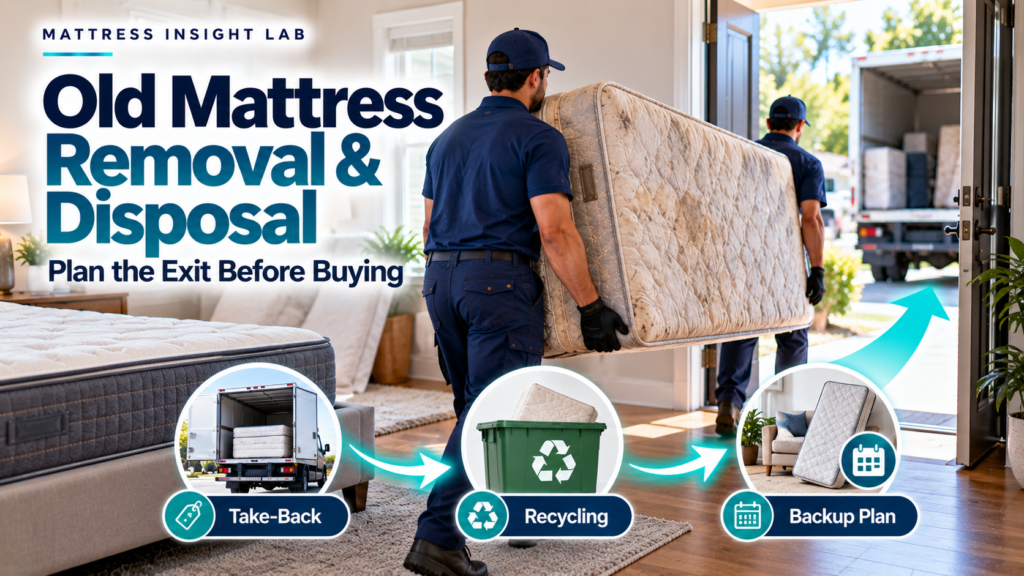
Why Old Mattress Removal and Disposal Should Be Planned Before Buying
Old-mattress removal is not one standardized service. Whether the new-mattress seller will take the old item, whether local law changes that duty, whether recycling or donation is available, and what the buyer will actually pay depend on the seller, delivery location, item type, item condition, and local disposal system. Current examples range from California's statutory retailer take-back duty to seller-specific haul-away and local recycling/donation rules. [1] [2] [7] [8] [10] [11] Planning the exit path before checkout reduces the risk of a rejected item, missed pickup, or unexpected fee.
This guide treats removal as a pre-purchase logistics factor rather than a recycling-law analysis. It separates two decisions that are often blurred together: the physical exit of the old item from the home, and the destination where that item is accepted. It also keeps retailer service terms distinct from state law, and keeps a purchase-time recycling assessment distinct from any pickup charge.
Core distinction: Removal is the physical act of getting the item out of the home. Destination is where the item is accepted. A retailer, a recycler, a charity, a municipality, and a private hauler are separate mechanisms with separate rules. No single route is universally available, and no single route is universally best.
What Does an Old-Mattress Removal Plan Need to Decide Before the New Mattress Arrives?
A removal plan has to answer five questions: which items leave, who moves them, where they can go, what conditions or fees apply, and when the exit happens relative to delivery. Answering those five questions before checkout is what turns a vague intention into a workable plan.
The first question is item scope. The second is the mover. The third is the destination. The fourth is the requirement set — conditions, fees, and scheduling. The fifth is timing. Each of these can be resolved independently, and each can fail independently, which is why a backup path belongs in the plan from the start.
Which Existing Mattress, Foundation, Box Spring, Base, or Frame Must Leave?
List every item being replaced: mattress, foundation, box spring, adjustable base, and bed frame. Each may follow different removal rules. Retailer and recycling programs demonstrate item-scope differences, so the mattress is not automatically the only item that matters.
Who Will Physically Move Each Item Out of the Home?
Possible movers include the new-mattress retailer’s delivery team, the resident carrying the item to a recycling drop-off, a charity if pickup is offered, a municipal collection crew, or a private hauler. Physical removal is a separate task from destination. Retailer teams may remove items under seller-specific terms, recycling programs may rely on resident drop-off, charity pickup varies, and municipal collection follows local rules.
Which Destination Will Accept Each Item?
Possible destinations include retailer take-back, a mattress recycling program, charity donation, municipal collection, and a private hauler. Each has its own acceptance rules. Destination acceptance is separate from physical removal, and no route is universally best.
What Conditions, Fees, or Scheduling Requirements Apply?
Conditions such as item type, quantity, and sanitation; fees that may be included, optional, assessment-funded, or quoted; and scheduling such as an appointment, a bulk-waste day, or delivery-day coordination all vary by destination. Each destination imposes its own requirements, so removal is not automatically free.
When Must Removal Occur Relative to New-Mattress Delivery?
Timing options include during delivery, before delivery, or after delivery. Each has trade-offs in room readiness, backup sleeping, and storage. Timing is a coordination decision, not a universal rule, and same-day removal is not established as universally best.
Why Should a Backup Disposal Path Be Identified Before Checkout?
A primary route can fail: the retailer may refuse the item, the charity may not accept it, the municipality may reject improper preparation, or the recycling site may refuse a contaminated mattress. A verified backup prevents a stranded mattress. Eligibility limits and refusal conditions exist across multiple removal routes, so confirm acceptance criteria for the exact primary and backup options.
Will the Mattress Retailer Take Away the Old Mattress?
Whether the new-mattress seller will take the old mattress depends on the seller, purchase location, selected delivery service, item type, item quantity, and item condition. The service can be included, optional, legally required in a specific jurisdiction, or unavailable. Tempur-Pedic, Saatva, and Casper currently publish different item, quantity, and condition rules. [7] [8] [9] Verify the exact seller and purchase channel before relying on haul-away.
Is Removal Included, Optional, Legally Required, or Unavailable?
Removal may be included when a qualifying service is selected, optional for a fee on selected products, arranged per state law in one state, or unavailable. Seller service terms determine the status, and the range is demonstrated across current seller policies.
Must Removal Be Selected Before Checkout or Delivery?
Some sellers require selection at checkout for the qualifying removal service, and others require selecting the applicable service. Selection timing is seller-specific, so removal should not be assumed to be addable later.
Is the Service Mattress-Only or Does It Include a Foundation or Box Spring?
Item scope is defined by the seller's service terms. Tempur-Pedic uses like-for-like (or fewer) removal and includes a foundation/box spring when a corresponding foundation is delivered; Saatva removes qualifying mattresses and foundations/box springs when selected; Casper's in-home service can remove one used mattress for one mattress and one used foundation/box spring for one foundation. [7] [8] [9] Do not assume every haul-away service covers the same support components.
Is Removal Limited to Like-for-Like, One-for-One, or Another Quantity Rule?
Quantity rules are seller-specific. Tempur-Pedic uses like-for-like (or fewer), while Casper describes one-for-one eligibility for its in-home removal service. [7] [9] These examples do not establish one universal industry quantity rule.
Are Bed Frames, Adjustable Bases, or Other Furniture Excluded?
Exclusions are seller-specific. Tempur-Pedic does not dispose of existing furniture/non-Tempur-Sealy products, while Saatva excludes listed items such as standard metal bed frames, waterbed bases, Sleep Number bases, and stained/damaged mattresses or foundations. [7] [8] Verify frame/base eligibility instead of assuming it follows mattress eligibility.
Can the Carrier Refuse an Item Because of Its Condition?
Some sellers reserve the right to refuse items based on condition. Tempur-Pedic says unsanitary or heavily soiled items may be refused at carrier discretion, while Saatva excludes stained or damaged mattresses/foundations. [7] [8] Condition rules remain seller-specific.
Why Should the Exact Seller and Purchase Location Control the Answer?
One brand can use different removal rules by state and product collection, and different sellers use different policies. Neither brand-wide nor nationwide assumptions are safe. Seller terms and state law both affect the answer.
When Can Local Law Change the Retailer’s Mattress Take-Back Duties?
California generally requires qualifying retailers delivering a new included mattress or foundation to offer no-additional-charge take-back of a corresponding used item. For common-carrier delivery, the retailer must offer to arrange pickup within 30 days. A retailer or delivery contractor may refuse a used mattress that it determines is contaminated and poses a risk to personnel, new products, or equipment. Connecticut, Oregon, and Rhode Island do not impose the same retailer take-back mandate. [1] [2] No nationwide retailer take-back requirement is established by these programs.
What Take-Back Obligation Applies to Qualifying California Retail Deliveries?
California currently requires qualifying retailers that deliver a new included mattress/foundation to offer no-additional-charge take-back. Retailer/contractor delivery generally triggers take-back at delivery, while common-carrier delivery requires an offer to arrange pickup within 30 days. The statutory contamination-risk exception still applies. [1] [2]
How Do Connecticut, Oregon, and Rhode Island Differ?
Connecticut, Oregon, and Rhode Island participate in MRC-operated statewide mattress stewardship programs but do not impose California's same retailer take-back requirement. [2] [3] Program participation and a retailer pickup mandate are separate questions.
What Does a State Mattress-Recycling Assessment Fund?
The recycling assessment funds the applicable stewardship program and is collected at sale on covered mattress/foundation units. Assessment funding and retailer pickup are separate mechanisms. For example, California's fee increased to $18 per unit on April 1, 2026, while Oregon's 2026 stewardship assessment is $22.50 per unit. [4] [15]
Does Paying the Assessment Automatically Mean the Retailer Must Pick Up the Old Mattress?
No. The assessment funds the stewardship program; it does not itself create a retailer pickup right. Among the four MRC-operated state programs reviewed here, California has the specific retailer take-back obligation described above, subject to its statutory conditions and contamination exception. [2] [3]
Why Should Other States Be Checked Separately Rather Than Inferred From These Four Programs?
As of September 2026, MRC-operated statewide mattress EPR/stewardship programs are active in California, Connecticut, Oregon, and Rhode Island. Other states may have local public or private recycling but are not covered by these programs. Universal recycling availability is not established, so each state’s law and retailer obligations should be checked separately.
How Should the Old Mattress’s Condition Affect the Removal Plan?
Condition can affect acceptance, but the criteria differ by retailer, recycler, charity, and municipality. There is no single universal refusal rule, so one destination’s rule should not be applied to every route.
Is the Mattress Heavily Soiled or Unsanitary?
Some sellers reserve the right to refuse unsanitary or heavily soiled items, and recycling guidance identifies some heavily contaminated mattresses as unacceptable. Each destination defines its own sanitation threshold, so a soiled mattress should not be assumed to be refused everywhere.
Is There Known Bed-Bug or Other Pest Infestation?
Recycling handling rules can distinguish consumer drop-off from what enters the recyclable stream. Oregon's consumer program says mattresses and box springs in any condition can be dropped off at participating sites/events, while MRC's Oregon collection requirements direct operators not to place severely wet/moldy, soiled, severely damaged, or infested units in recycling containers. [5] [6] Retailer sanitation rules are separate again. Verify the exact route rather than transferring one program's rule to another.
Is There Significant Moisture or Mold Contamination?
Oregon's consumer-facing program accepts mattresses/box springs in any condition for participating drop-off, but operational collection requirements keep severely wet/moldy units out of the recycling container. [5] [6] Other programs may use different handling rules. “Accepted for drop-off” and “placed into the recyclable stream” are therefore not always the same thing.
Is the Mattress Structurally Damaged?
One seller excludes stained or damaged mattresses or foundations from its included removal. Damage may affect acceptance at some destinations, and criteria are destination-specific.
Which of These Conditions Does the Exact Retailer, Recycler, Charity, or Municipality Restrict?
Each destination defines its own restrictions. Retailer, recycler, charity, and municipal rules differ, so restrictions should be verified with the exact destination rather than assumed from another route.
Why Should One Service’s Condition Rule Not Be Applied to Every Disposal Route?
Retailer, recycler, charity, and municipal rules differ. Applying one rule to all routes can lead to a rejected mattress. No universal condition-refusal rule is established.
Is Mattress Recycling Available Where You Live?
Mattress recycling availability depends on location. As of September 2026, MRC-operated statewide mattress EPR/stewardship programs are active in California, Connecticut, Oregon, and Rhode Island; other areas may have local public or private recycling options. Universal recycling availability or price is not established, so recycling should be treated as a location-specific verification task.
Does Your State or Local Area Have a Mattress-Recycling Program?
As of September 2026, MRC-operated statewide mattress EPR/stewardship programs are active in California, Connecticut, Oregon, and Rhode Island. Other areas may have local public or private recycling options. Availability must be checked by location.
Is Drop-Off Available?
Oregon's Bye Bye Mattress program currently offers no-cost household drop-off for mattresses and box springs at participating sites/events. [5] Site availability remains location-specific.
Is Curbside or Retailer Take-Back Connected to the Program?
California’s retailer take-back obligation is documented. Curbside and retailer take-back connections vary by program and jurisdiction, and retailer take-back is not part of every program.
Are Mattress and Box Spring Both Accepted?
Oregon's consumer guidance accepts mattresses and box springs for no-cost household drop-off, regardless of condition, while operational handling rules separate certain severely contaminated/damaged units from the recyclable stream. [5] [6]
Are Other Bed Components Excluded?
The Oregon program is structured around covered mattresses and box springs/foundations rather than general bedding/furniture; operational materials list many non-program items such as metal bed frames, loose bedding, toppers, water beds, and furniture. [6] Verify site-specific acceptance.
Is Household Drop-Off Free or Is Another Fee Charged?
Oregon currently offers no-cost household drop-off for mattresses and box springs at participating locations/events. [5] This is separate from the $22.50 stewardship assessment collected when covered products are sold in Oregon. [15]
Why Should the Exact Collection Site Be Contacted Before Transporting the Mattress?
Item scope, condition rules, and fee structures vary. Contacting the exact site prevents a rejected load, because site-specific rules determine acceptance.
Can Donation Be Relied on as the Old-Mattress Plan?
Donation cannot be assumed. Habitat for Humanity's national ReStore guidance says mattresses and box springs are not accepted; Goodwill says donation rules vary by local organization and many local Goodwill organizations do not accept mattresses; The Salvation Army says acceptance varies by location. [10] [11] [12] Confirm the exact recipient before donation becomes the primary plan.
Does the Exact Organization Accept Used Mattresses?
Habitat's national ReStore guidance says mattresses and box springs are not accepted; Goodwill says many local organizations do not accept mattresses; Salvation Army donation rules vary by location. [10] [11] [12] Acceptance is organization- and location-specific.
Does the Local Branch Use Different Rules From the National Organization?
Goodwill explicitly says donation rules vary by local organization, and The Salvation Army likewise directs donors to local policies because accepted items vary by location. [11] [12]
What Condition Standards Apply?
Salvation Army policies vary by location, including locations that conditionally accept mattresses. Condition standards are organization- and location-specific, so a clean mattress should not be assumed to meet the standard.
Is Home Pickup Available?
Pickup availability varies by organization and location. Pickup should not be assumed.
Are Mattresses Accepted but Box Springs Excluded—or Vice Versa?
Habitat's national ReStore guidance states that mattresses and box springs are not accepted. [10] Other organizations can use different item rules, so acceptance of one bed component does not imply acceptance of another.
Why Should Donation Never Be the Only Plan Until Acceptance Is Confirmed?
Acceptance varies materially across organizations and locations. Relying on donation without confirmation can leave the buyer with a rejected mattress. No universal donation standard is established.
What Should You Check Before Using Municipal Mattress Collection?
Municipal mattress collection rules vary by jurisdiction. New York City currently instructs residents to place mattresses and box springs out on a trash-only day and requires them to be fully sealed in plastic to limit bed-bug spread; incorrect set-out can result in fines. [13] This is a New York City example, not a nationwide procedure.
Does the Municipality Collect Mattresses or Box Springs?
New York City currently collects residential mattresses and box springs with trash when they are prepared according to DSNY rules. [13] Availability and procedure vary by municipality.
Is an Appointment Required or Is Collection Tied to a Normal Bulk-Waste Day?
New York City places mattresses according to bulk-trash timing rules. Scheduling varies by municipality.
Must the Mattress Be Wrapped, Bagged, Tagged, or Otherwise Prepared?
New York City currently requires mattresses and box springs to be fully sealed in plastic before set-out. [13] Preparation requirements vary elsewhere.
Where and When Can the Mattress Be Placed Out?
New York City places mattresses according to bulk-trash timing rules. Placement rules vary by municipality.
Are There Quantity Limits?
Quantity limits vary by municipality. A specific limit should not be assumed.
Is Collection Free or Fee-Based for Your Address?
NYC DSNY's current mattress-disposal guidance does not list a separate mattress-specific curbside pickup charge for ordinary residential trash collection; the item must instead follow the city's set-out/preparation rules. [13] Other municipalities may use different fees or programs.
What Happens if Preparation or Placement Rules Are Not Followed?
New York City states that mattresses/box springs must be sealed in plastic and that incorrect disposal can result in fines. [13] Consequences and fine structures are local.
When Does a Private Mattress or Junk-Removal Service Make Sense?
Private removal is an alternative service whose access, destination, timing, and price must be verified. It is not automatically superior to other routes, and the reviewed evidence does not establish that private haulers recycle.
Will the Service Remove the Mattress From Inside the Home?
Verify whether the service removes from inside the home or requires the item to be placed outside. Service scope varies by provider.
Will It Handle Stairs or Other Carrying Requirements?
Verify whether the service handles stairs, elevators, or other carrying requirements. Access handling varies by provider.
What Is the Quoted Price for the Exact Items?
Request a quote for the exact items. Pricing varies by provider and item, so a fixed price should not be assumed.
Does the Price Include a Foundation, Box Spring, or Frame?
Verify whether the quote includes the foundation, box spring, or frame. Item scope varies by provider.
Where Does the Service Say the Mattress Will Go?
Ask the service where the mattress will go. Destination varies by provider, and recycling should not be assumed.
Does It Recycle, Donate, Transfer, or Dispose of the Mattress?
Verify whether the service recycles, donates, transfers, or disposes. Destination varies by provider and is not established by the service category.
Why Should “Junk Removal” Not Automatically Be Described as Mattress Recycling?
“Junk removal” describes a service category, not a destination. The service may landfill rather than recycle. Destination must be verified.
Which Removal and Disposal Costs Belong in the Mattress Budget?
Only costs the buyer will actually incur belong in the mattress budget. Some disposal costs are zero, some are included in state programs or retailer services, and some occur only if the buyer selects a private service. Universal recycling price is not established.
Is Retailer Haul-Away Free, Included, or a Paid Upgrade?
Cost status is seller-specific. Saatva currently includes qualifying old mattress/foundation removal when selected; Tempur-Pedic's eligible direct haul-away follows like-for-like/fewer rules; Casper currently allows optional old mattress/foundation removal with its in-home service. [7] [8] [9] Verify the exact order rather than assuming one standard removal fee.
Is a State Mattress Recycling Assessment Charged With the New Mattress Purchase?
MRC-operated stewardship programs are funded through point-of-sale recycling assessments on covered products. The assessment is a purchase-time program charge, not itself a pickup fee. As of September 2026, California's fee is $18 per covered unit and Oregon's stewardship assessment is $22.50 per covered unit. [4] [15]
Is Local Recycling Drop-Off Available Without an Additional Disposal Charge?
The Oregon program offers free household drop-off for mattresses and box springs. Availability and cost vary by program.
Does Municipal Collection Carry a Fee?
NYC DSNY's current mattress-disposal guidance does not list a separate mattress-specific curbside pickup charge for ordinary residential trash collection; the item must instead follow the city's set-out/preparation rules. [13] Other municipalities may use different fees or programs.
What Does a Private Hauler Quote?
Request a quote for the exact items. Pricing varies by provider, so a fixed amount should not be assumed.
Are Mattress and Foundation Removal Priced Separately?
Verify whether the mattress and foundation are priced separately. Item pricing varies by provider.
Why Should Only Costs the Buyer Will Actually Incur Be Added to the Purchase Budget?
Some costs are zero, some are included, and some are optional. Adding hypothetical fees distorts the budget, and costs vary by destination and jurisdiction.
How Should Removal Timing Be Coordinated With New-Mattress Delivery?
Timing is a coordination decision, not a universal rule. The old mattress can be removed during delivery, before delivery, or after delivery; each option has trade-offs in room readiness, backup sleeping, and storage. The reviewed evidence does not establish that same-day removal is universally best.
Is the Old Mattress Being Removed During the New-Mattress Delivery?
If the seller’s service includes removal, the old mattress may be removed during delivery. Timing depends on the seller’s service and should be verified.
If Removed Earlier, What Will Be Used Until the New Mattress Arrives?
If the old mattress is removed earlier, the household needs an acceptable sleep surface until the new mattress arrives. Earlier removal creates a gap.
If Removed Later, Where Can It Be Stored Without Blocking the Room or Route?
If the old mattress is removed later, it needs storage that does not block the room or delivery route. Storage depends on the household.
Must Bedding Be Removed Before the Haul-Away Team Arrives?
Verify with the seller whether bedding must be removed before the haul-away team arrives. Preparation requirements vary by seller.
Does the Support Surface Need to Remain for the New Mattress?
Verify whether the foundation, box spring, or base needs to remain for the new mattress. Support-surface requirements vary by product.
Are Other Items Being Replaced at the Same Time?
If other items such as a foundation, frame, or base are being replaced, coordinate their removal with the new-mattress delivery and mattress removal. Other items may need separate plans.
Why Should the Exit and Arrival Sequence Be Planned Rather Than Assuming Same-Day Removal Is Always Best?
Same-day removal is one option, not a universal rule. The sequence should be planned around room readiness, backup sleeping, storage, and the seller’s service terms.
Do the Old Mattress, Foundation, and Bed Frame Need Separate Disposal Plans?
Mattress, foundation, box spring, adjustable base, and bed frame may follow different removal rules. Each item should be matched to a valid removal path, and no item-scope rule should be treated as universal.
Will the Retailer Take the Mattress?
Retailer mattress removal is seller-specific. Scope is defined by the seller’s service terms.
Will It Also Take the Foundation or Box Spring?
One seller excludes box springs, another includes qualifying foundation or box-spring removal, and another uses like-for-like matching. Foundation scope is seller-specific.
Is an Adjustable Base Eligible?
One seller uses like-for-like matching that can include adjustable-base deliveries, and another excludes certain other bases. Eligibility is seller-specific.
Is a Metal or Upholstered Bed Frame Eligible?
One seller excludes existing general furniture, and another excludes standard metal frames. Frame eligibility is seller-specific.
Can the Local Mattress Recycler Accept These Non-Mattress Items?
The Oregon program accepts mattresses and box springs; other bedding and furniture is outside the free mattress-program scope. Recycler scope is program-specific.
What Separate Plan Is Needed for Anything the Primary Removal Service Rejects?
Item scope varies across retailer and recycling programs. A separate plan is needed for anything the primary service rejects.
Should the Old Mattress Be Kept During the New Mattress Trial?
The reviewed evidence does not establish a universal trial-retention rule. Whether to keep the old mattress during the new mattress trial is a personal logistics decision that depends on storage space, sanitation, and the seller’s delivery terms.
Is There Safe and Practical Space to Store the Old Mattress?
Retention requires safe and practical storage space. Storage availability is household-specific.
Is the Old Mattress Clean Enough to Retain Temporarily?
Retention requires the mattress to be clean enough to store safely. An infested or contaminated mattress should not be stored in the home for trial backup.
Would Keeping It Obstruct the Bedroom, Hallways, or Delivery Route?
Retention may obstruct the bedroom, hallways, or delivery route. Obstruction depends on the household layout.
What Happens if the New Mattress Is Returned and the Old Mattress Is Already Gone?
If the new mattress is returned and the old mattress is already gone, the household needs an alternative sleep surface. Return terms are seller-specific.
Does the New Mattress Seller Require the Old Mattress to Be Removed During Delivery?
Verify with the seller whether removal during delivery is required. Requirements are seller-specific.
Why Is Retaining the Old Mattress a Personal Logistics Decision Rather Than a Standard Trial Recommendation?
No universal trial-retention rule is established. Retention depends on storage, sanitation, obstruction, return terms, and seller requirements.
What Should Be Documented When Retailer Haul-Away Is Part of the Purchase?
Documentation is most useful for a paid or contractually promised service. Save the order, the removal fee or included-service description, the agreed item scope, any condition restrictions, and relevant seller communication. Documentation is not a universal disposal requirement.
Save the Order Showing the Haul-Away Service
Save the order showing the haul-away service. Order documentation verifies that the service was purchased.
Save Any Removal Fee or Included-Service Description
Save any removal fee or included-service description. Fee documentation verifies what was paid or included.
Record Which Items the Seller Agreed to Remove
Record which items the seller agreed to remove. Item-scope documentation verifies the agreed scope.
Record Any Condition Restrictions
Record any condition restrictions the seller disclosed. Condition-restriction documentation verifies the agreed terms.
Save Relevant Seller Communication When the Scope Is Unclear
Save relevant seller communication when the scope is unclear. Communication documentation clarifies ambiguous scope.
When Can a Condition Photo Be Useful?
Photographs are optional but can be useful when condition eligibility may matter, when a paid or promised removal service is involved, or when you want a baseline record of the item's condition before pickup. They are documentation aids, not a universal disposal requirement.
Why Is Documentation Most Useful for a Paid or Contractually Promised Service Rather Than as a Universal Disposal Requirement?
Documentation is most useful for a paid or contractually promised service. It is not a universal disposal requirement.
Sources and References
- CalRecycle — Mattress EPR Enforcement / Used Mattress Take-Back. California enforcement guidance.
- Mattress Recycling Council — Reporting & Collection FAQs. California take-back exception, foundation scope, and state-program differences.
- Mattress Recycling Council — Program States. Current MRC program states.
- MRC — 2026 California Mattress Recycling Fee Adjustment. $18 California fee effective April 1, 2026.
- Bye Bye Mattress — Oregon. No-cost household drop-off and consumer acceptance wording.
- MRC — Oregon Collection Event Agreement / Requirements. Operational handling of severely wet, moldy, damaged, soiled, or infested units.
- Tempur-Pedic — Mattress/Base Haul-Away Process. Like-for-like/fewer and sanitation rules.
- Saatva — Help / Mattress & Foundation Removal. Qualifying free removal and exclusions.
- Casper — Shipping & Delivery. In-home one-for-one mattress/foundation removal rules.
- Habitat for Humanity — ReStore Donation Guidance. Mattress and box-spring acceptance policy.
- Goodwill — Donate Goods. Local donation policies and mattress variation.
- The Salvation Army — Donation Center Guidance. Location-specific acceptance.
- NYC Department of Sanitation — Furniture, Mattresses & Rugs. Mattress/box-spring set-out and sealing rules.
- Mattress Recycling Council — Who We Are. MRC program model and current operating states.
- MRC Oregon — 2026 Budget. $22.50 Oregon stewardship assessment.
What Is the Best Way to Plan Old Mattress Removal Before Buying?
The best plan is one that has a verified primary route and a verified backup route, with all items, conditions, fees, and timing coordinated before checkout. The reviewed evidence does not establish a universally best route or a universal trial-retention rule.
List Every Mattress, Foundation, Base, or Frame That Must Leave
List every item being replaced. Item identification is the first step, and support components may need separate plans.
Check Whether the New-Mattress Seller Will Take Any of Those Items
Check the seller’s removal status, item scope, quantity rule, and condition rules. Seller policies are seller-specific, so the seller should not be assumed to take everything.
Verify Whether Local Law Changes the Retailer’s Take-Back Duty
California requires qualifying retailer take-back; Connecticut, Oregon, and Rhode Island do not impose the same requirement. Check the delivery state’s law, because no nationwide requirement is established.
Check Condition and Item-Eligibility Rules
Destination-specific condition and item rules apply. One rule should not be assumed to apply everywhere.
If Retailer Removal Does Not Work, Check Local Mattress Recycling
Check local recycling availability, item scope, and fee structure. Universal recycling availability is not established.
Use Donation Only After the Exact Recipient Confirms Acceptance
Confirm acceptance with the exact recipient before relying on donation. No universal donation standard is established.
Check Municipal Collection Rules Before Putting a Mattress Outside
Check local preparation, scheduling, placement, and fee rules before placing a mattress outside. No national municipal procedure is established.
Compare Private Removal When Its Convenience, Access, Timing, or Item Scope Fits the Household
Compare private removal whenever its convenience, access handling, timing, or item scope better fits the household's needs. Verify the exact quoted price, what items are included, whether inside-home carrying is provided, and where the service says the items will go. Private removal is one valid route, not merely a last resort.
Add Only Actual Removal or Disposal Costs to the Mattress Budget
Add only costs the buyer will actually incur. Costs vary by destination and jurisdiction.
Coordinate the Old-Mattress Exit With the New-Mattress Delivery and Room Setup
Coordinate the old-mattress exit with the new-mattress delivery and room setup. Timing is a coordination decision, and no universal timing rule is established.
Create a Separate Plan for Rejected Foundations, Frames, or Other Bed Components
Item scope varies across retailer and recycling programs. Create a separate plan for rejected items.
Keep a Backup Disposal Path in Case the Primary Service Refuses the Mattress
Refusal is possible across multiple removal routes when item, condition, scheduling, or eligibility requirements are not met. Keep a verified backup path so an ineligible or rejected item does not become stranded.
Evidence boundary: The reviewed evidence does not establish a nationwide retailer take-back requirement, universal mattress recycling availability or price, a universal used-mattress donation standard, one national municipal mattress-disposal procedure, a universally best disposal route, a universal trial-retention rule, guaranteed recycling by private haulers, universally best same-day removal, one universal condition-refusal rule, standardized “White Glove” haul-away scope, or an industry-wide one-for-one removal rule. California's statutory take-back obligation is a specific legal requirement with defined conditions/exceptions; other seller, program, charity, and municipal policies are date- and location-sensitive.