What Delivery Access and Path Clearance Should You Check First?
Check the exact delivered object first — its form, dimensions, and weight — then trace the entire route from vehicle access to the final bed location, then confirm what the delivery team will and will not do, then verify building rules and fit-failure terms. Delivery access is a sequence of checks, not a single clearance number.
Delivery-access problems can arise from more than doorway width alone. Important planning risks include checking the wrong delivered object, overlooking part of the route, or assuming a service includes something it does not. The checks below are ordered so that each one narrows the next.
What Does Mattress Delivery Access Actually Mean?
Delivery access is not the same as delivery availability. It is whether the actual ordered object can travel the full path from the delivery point to the bedroom. Three separate questions are often collapsed into one, and separating them is the first useful step.
Tempur-Pedic's current White Glove preparation guidance tells customers to clear walking paths and measure doorways or narrow areas, while Saatva's delivery guidance offers pre-purchase stairway/hallway measurement review when fit is uncertain. [4] [5] Neither source publishes a universal clearance rule.
What Is Shipping Availability?
Shipping availability means the seller will dispatch the order to the address. It says nothing about whether the object can reach the bedroom. Dispatch is a commercial and logistics step; route feasibility is a physical and policy step. A scheduled delivery is not a promise of in-home placement.
What Is Physical Delivery-Route Feasibility?
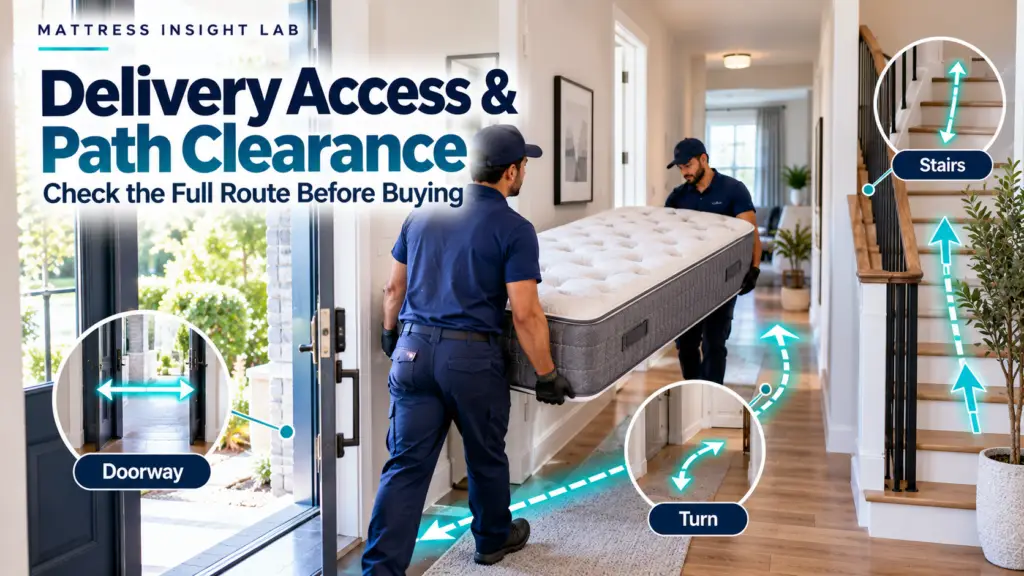
Route feasibility is whether the actual delivered object, in its actual form, can travel the full sequence from vehicle access to the final bed location. Feasibility depends on object geometry, form, weight, route sequence, and carrier procedures — not on one measurement. The narrowest straight opening may be a limiting constraint, but passing it does not by itself establish that the complete route is feasible because turns, landings, overhead restrictions, and orientation changes can independently fail.
What Is Final Room Placement?
Final room placement is the last segment: the path to the bed location and the space needed to complete the purchased service. Tempur-Pedic currently instructs customers to clear walking paths and remove obstructing decorative items before installation. [5] That guidance is service-specific and should not be assumed to apply to every carrier.
Why Can a Mattress Be Available for Delivery but Still Fail the In-Home Route?
Saatva explicitly addresses mattresses that cannot fit up a staircase and offers pre-purchase stairway/hallway measurement assistance. [4] Route geometry, delivered form, and component rigidity can prevent completion even when delivery is scheduled. Under Saatva's current policy, a stair-fit failure can lead to exchange for another size/height or return for a refund less a $99 processing fee; other sellers can differ. [4]
Why Should Delivery Access Be Verified Before Ordering Rather Than Only on Delivery Day?
Tempur-Pedic instructs customers to measure doorways or narrow areas before delivery, and Saatva offers pre-purchase stairway/hallway measurement review when fit is uncertain. [4] [5] Reviewing access before ordering preserves more options for changing size, height, or configuration. Seller review is not a universal fit guarantee.
What Exact Object Will Be Carried Through the Home?
The route must be measured against the object actually being carried, which may be a compressed package, an expanded mattress, a split or one-piece foundation, an adjustable base, or a frame. Measuring against the wrong object or dimensions is a planning error this workflow is designed to avoid.
Is the Mattress Delivered Expanded or Compressed?
Tempur-Pedic currently ships TEMPUR-Cloud compressed in a bag via UPS, while its other mattresses generally use White Glove delivery and arrive in normal mattress form. [1] That split exists within one manufacturer's line, so confirm the delivered form for the exact product.
What Are the Shipping Package Dimensions?
For packaged delivery, use the published shipping dimensions and shipping weight rather than assuming finished-mattress dimensions describe the carried package. Purple currently lists its Queen at 60 × 80 × 9.25 inches and 88 lb product weight, with shipping dimensions of approximately 60 inches × 16 inches diameter and a 98-lb shipping weight. [2] Those figures are Purple-specific.
Is the Foundation One Piece or Split?
Saatva offers a split Queen foundation specifically to make delivery easier in homes with especially narrow staircases or hallways, and states that a split foundation is standard on King and California King sizes. [3] Dividing a large rigid component into smaller sections can improve access in some routes, but it does not guarantee that every route becomes feasible.
Is an Adjustable Base Being Delivered Separately?
An adjustable base is a separate delivered object and must be inventoried and measured on its own. Different components can have different rigidity, packaging, and dimensions. No supplied evidence establishes specific adjustable-base dimensions, weight, or delivery form, so those must be confirmed with the seller.
Is a Bed Frame or Furniture Item Included in the Order?
Any frame or furniture item in the order is a separate delivered object with its own geometry and service terms. Tempur-Pedic currently states that its teams do not dispose of, move, assemble, or disassemble existing furniture or non-Tempur-Sealy products. [7] Do not assume those tasks are included unless the seller's service description says so.
Why Must Each Component Be Checked Separately?
Because the delivered objects can differ in form, dimensions, rigidity, and segmentation, each must be checked against the route separately. One manufacturer can use different delivery forms across its own line, package and finished dimensions can diverge substantially, and a rigid foundation can be the limiting object even when the mattress passes. If the mattress fits, it does not follow that everything fits.
Why Should the Full Delivery Route Be Mapped Before Measuring Individual Openings?
Map the whole route as a sequence first; individual openings only make sense inside that sequence. A single minimum measurement cannot represent turns, landings, overhead restrictions, or orientation changes.
Where Does the Delivery Team First Unload the Product?
The route begins at the vehicle. Tempur-Pedic currently requires White Glove delivery addresses to be accessible by a large box truck. That requirement is Tempur-Pedic-specific and should not be assumed to apply to every carrier.
Which Exterior and Building Entrances Must It Pass?
Tempur-Pedic instructs customers to clear sidewalks, hallways, and stairwells before installation. Exterior paths and building entrances are part of the prepared route. No supplied evidence establishes building-specific entry rules, so the actual entrance used should be confirmed with the property.
Which Hallways, Stairways, Elevators, and Turns Follow?
Tempur-Pedic documents hallway and stairwell preparation, and Saatva documents stairway and hallway measurement review. Each interior transition is a separate segment with its own constraint. A wide hallway does not guarantee the route works, because turns and landings can be limiting.
Which Bedroom Door Is the Final Restricted Opening?
The bedroom door is the last restricted opening before the setup area. Tempur-Pedic documents measuring doorways or narrow areas as part of preparation. Passing the bedroom door does not prove the route works; it is the last opening, not the only constraint.
Why Can a Turn or Landing Be More Restrictive Than the Narrowest Straight Opening?
A turn requires the object to change orientation, which can demand more usable space than passing a straight opening. Orientation change is a distinct geometric problem from straight passage. No universal formula or threshold is established for how much extra space a turn requires.
Why Should the Route Be Evaluated as a Sequence Rather Than as One Minimum Measurement?
Because the route must be completed end to end. A single minimum cannot represent turns, landings, overhead restrictions, or orientation changes. Tempur-Pedic documents preparation across sidewalks, hallways, stairwells, and doorways, while Saatva offers stairway/hallway measurement review. [4] [5] The narrowest point may be a limiting constraint, but passing it does not prove the complete route is feasible.
What Exterior Access Should Be Checked Before the Product Reaches the Door?
Route feasibility can begin outside the building, at the point where the delivery vehicle must reach the address. Vehicle access is the first constraint, before any building entry.
Can the Delivery Vehicle Reach the Address Under the Seller’s Requirements?
Tempur-Pedic currently states that the delivery address must be accessible by a large box truck for its White Glove service. That requirement is Tempur-Pedic-specific. Other carriers may publish different requirements, and those should be confirmed with the actual carrier.
Is the Sidewalk or Path to the Building Clear?
Tempur-Pedic instructs customers to clear walking paths, including sidewalks, before installation. [5] Exterior paths are therefore part of that service's prepared route.
Are Exterior Steps, Gates, Railings, or Porches Part of the Route?
Any exterior feature the object must pass is part of the route and should be recorded. No supplied evidence establishes who may alter property or whether the carrier will, so railings and similar features should be recorded as constraints rather than treated as removable.
Does the Building Use a Separate Service Entrance?
Whether a separate service entrance is required is a property-specific question to verify with the building. No universal rule is established, and a mattress guide cannot answer it for a specific property.
Why Should Exterior Access Be Confirmed With the Actual Carrier When Conditions Are Unusual?
Because the carrier's actual requirements govern. Tempur-Pedic, for example, requires large-box-truck access and a clear in-home route. [6] Unusual conditions should be confirmed with the carrier handling the order rather than assumed from a generic mattress guide.
What Should Be Measured at Exterior and Interior Doorways?
Record usable opening dimensions, not nominal ones, and treat each opening as one segment of the route. No required door width is established, and passing one door does not prove the route works.
What Is the Clear Width With the Door in Its Normal Fully Open Position?
Record the usable clear width with the door positioned as it will be during delivery, not merely the nominal frame width. Tempur-Pedic specifically instructs customers to measure doorways or narrow areas before delivery. [5] No universal minimum-width value is supplied by that guidance.
What Is the Clear Height?
Clear height matters because the object may need to be tilted or carried at an angle through the opening. No minimum-height value is established. Height can become relevant even when width appears sufficient, because orientation changes can change the effective cross-section.
Do Handles, Stops, Trim, or Other Projections Reduce the Usable Opening?
Projections reduce the usable opening below the nominal frame dimension. The nominal frame width is not the usable width. Recording usable dimensions rather than nominal ones keeps the route map accurate.
Is There Enough Space Immediately Before and After the Door to Change Orientation?
Passing a door may require changing orientation immediately before or after it, which needs usable space on both sides. Orientation change is a separate constraint from straight passage. No numerical rotation-space value is established.
Why Does Passing One Door Not Prove the Rest of the Route Works?
Because the route is a sequence. Tempur-Pedic and Saatva both treat multiple segments as requiring preparation and measurement. Each segment has its own constraint, and no single controlling opening is established.
Why Should You Not Assume the Delivery Team Will Remove Doors or Furniture?
Do not assume the delivery team will remove doors, move furniture, or disassemble an existing frame. Tempur-Pedic currently states its teams do not. Route preparation is the customer’s responsibility under that service.
What Does Tempur-Pedic Currently Say About Moving Existing Furniture?
Tempur-Pedic states its delivery teams do not move, dispose of, assemble, or disassemble existing furniture or non-Tempur-Sealy products. The service covers the delivered products, not the existing room contents.
What Does It Say About Assembly or Disassembly of Non-Tempur-Sealy Products?
Tempur-Pedic states the teams do not assemble or disassemble existing furniture or non-Tempur-Sealy products. The service scope is limited to the delivered products. Existing items should be prepared in advance.
Why Should Door Removal Never Be Assumed to Be Included?
Tempur-Pedic’s documented limits on moving, assembling, and disassembling existing items mean door removal should not be assumed. Door removal is an alteration of existing property, outside the documented service scope. No supplied evidence establishes that a carrier will remove a door if needed.
Who Should Confirm Whether Property Alterations Are Permitted if an Opening Is Tight?
The owner or property manager should confirm whether an alteration is permitted, while the carrier should confirm whether door removal or another alteration is within its service scope. Tempur-Pedic states that its teams do not move, assemble, or disassemble existing furniture/non-Tempur-Sealy products, so door removal should not be assumed to be included. [7]
Why Should the Route Be Made Ready Before the Carrier Arrives?
Tempur-Pedic instructs customers to clear the delivery path before arrival and separately states that its delivery teams do not move existing furniture or non-Tempur-Sealy products. [5] [7] Those documented limits make advance route preparation important without requiring the broader claim that the team will never address any route issue on arrival.
How Should Hallways, Corners, and Pivot Points Be Evaluated?
Straight width alone is insufficient. Identify every point where the object must change direction. No universal clearance formula is established, so the goal is a complete list of constraints rather than a single number.
What Is the Clear Hallway Width Along Each Segment?
Record the clear width of each hallway segment separately, since width can vary along the route. One hallway width does not represent the whole route. No minimum-width value is established.
Where Must the Mattress or Package Change Direction?
Identify every point where the object must rotate, including corners and doorway approaches. Orientation change is a distinct geometric problem. Corners are not only a problem when the hallway is narrow.
What Obstacles Project Into the Turn?
Record projections such as fixtures, trim, or furniture that reduce usable turning space. No supplied evidence establishes who may alter property, so projections should be recorded as constraints rather than treated as removable.
Is the Ceiling Height Reduced at the Pivot?
Record reduced overhead height at pivots, since tilting the object may be needed. No minimum-height value is established. Ceiling height can become relevant when the object must be tilted.
Why Can a Route With Wide Doorways Still Fail at a 90-Degree Turn?
Because a turn requires orientation change, which can demand more usable space than straight passage through a wide opening. No threshold or ratio is established for how much clearance a 90-degree turn requires.
Why Is There No Universal “Doorway Width + Hallway Width = Guaranteed Fit” Formula for Flexible Mattress Products?
The supplied verified evidence does not establish a universal clearance formula. Mattresses and components differ in rigidity, flexibility, packaging, orientation, geometry, and carrier handling rules. The relationship itself is unresolved, so no formula, ratio, or threshold should be published.
What Should Be Checked on Stairways and Landings?
Treat stairs as a multi-dimensional constraint: width, overhead height, landing space, and rotation points all matter. Stair width alone does not determine stair fit.
What Is the Clear Width Between Walls, Rails, or Posts?
Record the clear width between walls, rails, or posts. Saatva documents that it reviews stairway and hallway measurements with concerned customers. No minimum-width value is established.
Where Does Overhead Height Reduce?
Record points where overhead height reduces, since the object may need to be tilted. No minimum-height value is established. Overhead height can become relevant on stairs when tilting is required.
What Space Is Available on Intermediate Landings?
Record usable landing space, since landings are where the object is often repositioned. No minimum-area value is established. Landings are not always large enough, and that should be verified rather than assumed.
Where Must the Product Rotate to Enter the Next Flight?
Identify every point where the object must rotate to continue up or down. Rotation on stairs is not always possible even when the width appears adequate, because turns are independent constraints.
Are Fixed Railings, Light Fixtures, or Wall Projections Inside the Carrying Envelope?
Record fixed projections that reduce usable stair space. No supplied evidence establishes who may alter property, so railings and similar features should be recorded as constraints rather than treated as removable.
Why Should Difficult Stairways Be Discussed With the Seller Before Ordering?
Saatva documents that it offers customers assistance reviewing stairway and hallway measurements before ordering when access is uncertain. Pre-purchase review allows changes while they are still possible. The review is a review, not a guarantee that the route will work.
How Should Elevator Access Be Verified?
Verify elevator access in two parts: physical fit and permission to use it. No universal elevator dimensions, weight limits, or building rules are established, so both parts must be answered by the specific property.
What Are the Elevator Door Opening Dimensions?
Record the clear elevator door opening dimensions for the specific building. Standard elevators do not have standard door dimensions for planning purposes. The actual building’s dimensions are the only relevant ones.
What Are the Interior Car Dimensions?
Record the interior car dimensions for the specific building. No universal car dimensions are established. Any elevator car does not fit any mattress, and the actual car must be measured.
Can the Delivered Object Change Orientation Inside the Car?
Check whether the object can be rotated inside the car, since orientation change is a separate constraint. Fitting the car does not automatically mean the object can be rotated inside it.
What Load Limit Is Posted for the Actual Elevator?
Record the posted load limit for the actual elevator. Posted limits are property-specific, and no universal limit is established. A standard value should not be assumed.
Is a Service Elevator Required?
Whether a service elevator is required is a property-specific question to verify with building management. No universal requirement is established. Apartment buildings do not universally require a service elevator.
Must It Be Reserved in Advance?
Whether an elevator or loading dock must be reserved is a property-specific question. No universal reservation requirement is established. Every building does not require an elevator reservation.
Why Should Building Management—not a Generic Mattress Guide—Control These Policy Answers?
Building management owns these answers because they are property-specific operational policies, not mattress-industry standards. Policy authority follows the property, not the product category. A mattress guide cannot tell a reader their building’s rules.
How Does Compressed Delivery Change the Clearance Problem?
Compression changes the package geometry, but it does not guarantee easy handling or access. The package and the finished mattress are different objects with different dimensions.
How Can Shipping Dimensions Differ From Finished Mattress Dimensions?
A compressed package can have a much smaller cross-section than the expanded mattress, so the two sets of dimensions describe different objects. Purple currently lists its Queen shipping package at approximately 60 inches × 16 inches diameter versus a finished 60 × 80 × 9.25-inch mattress. [2] That divergence is product-specific.
What Are the Current Purple Queen Shipping Dimensions Compared With Its Finished Dimensions?
Purple currently lists its Queen at 60 × 80 × 9.25 inches and 88 lb product weight, with shipping dimensions of approximately 60 inches × 16 inches diameter and a 98-lb shipping weight. [2] The shipping-weight difference includes packaging; it is not caused by compression itself.
Why Can a Compact Package Still Be Heavy?
Purple lists its Queen at 88 lb product weight and 98 lb shipping weight. [2] Compression reduces package volume without materially reducing the mattress's mass; the additional shipping weight reflects packaging and associated shipping materials. A compact package can therefore still be heavy.
Why Should Packaged Dimensions Be Used for Route Planning Before Unboxing?
Because the object travels the route in its package, the package dimensions describe the geometry that must pass. Purple’s package and finished dimensions differ substantially. Finished dimensions still matter after unboxing and for other components, so they should not be dismissed entirely.
Why Does Compressed Packaging Not Guarantee Easy Stairs or Manual Handling?
The supplied verified evidence does not establish that compressed packaging guarantees easier or successful home access. Compression changes geometry, but packages can still be long and heavy, and stairs and turns can remain difficult. Boxed mattresses are not established as fitting tighter routes.
How Does Non-Compressed or White Glove Delivery Change the Clearance Problem?
An expanded mattress creates a different route-planning problem from a shipping package, so the delivery form must be confirmed before measuring. Boxed-delivery logic should not be applied to all mattresses.
Which Tempur-Pedic Mattress Currently Ships Compressed?
Tempur-Pedic currently states that TEMPUR-Cloud ships compressed in a bag by UPS. That is a product-level statement, not a category rule. Not all Tempur-Pedic mattresses ship compressed.
How Are Most Other Current Tempur-Pedic Mattresses Delivered?
Most other Tempur-Pedic mattresses are delivered and set up through its White Glove service. White Glove is not the same everywhere; service terms are seller-specific.
Why Does an Expanded Mattress Create a Different Route-Planning Problem From a Shipping Package?
An expanded mattress presents its full footprint and thickness to the route, while a compressed package presents a smaller cross-section. Purple’s figures show how different the two geometries can be. No universal comparison is established between the two forms, so neither should be ranked as easier or harder in general.
Why Should the Seller Confirm the Delivery Form for the Exact Mattress Before Purchase?
Because one manufacturer can use different delivery forms across its own line, the form must be confirmed at the exact product level. Route planning depends on the form actually delivered. The delivery form cannot be inferred from the brand.
Can Mattress Size, Thickness, or Weight Alone Predict Delivery Difficulty?
Size, thickness, and weight alone are insufficient to predict delivery difficulty. They can matter, but delivered form, component segmentation, route geometry, orientation changes, and carrier rules also affect feasibility.
Why Does a Larger Finished Mattress Not Tell You Its Shipping Form?
Finished size does not reveal the shipping form. Purple’s package and finished dimensions differ substantially for the same product. A larger mattress does not always ship in a larger package, and no size-based ranking is established.
Why Does Mattress Thickness Not Establish Its Flexibility Around a Corner?
The supplied verified evidence does not establish that thickness determines flexibility around a corner. Flexibility depends on construction and materials, which the supplied evidence does not quantify. Thicker mattresses are not established as less flexible.
Why Does Package Weight Matter for Handling Without Defining a Universal Delivery-Service Threshold?
Package weight matters for handling, and Purple’s Queen package is listed at 98 lb. However, no supplied evidence establishes a weight threshold that determines the required delivery service. Weight is a handling variable, not a service rule, and no threshold should be published.
Why Can Split Components Change Delivery Feasibility Even When Total Bed Size Remains the Same?
Saatva offers a split Queen foundation specifically for homes with particularly narrow staircases or hallways and uses split foundations for King and California King sizes. Dividing a large rigid component into smaller sections can improve access in some routes. Splitting does not solve every delivery problem.
Which Actual Specifications Should Replace Assumptions Based on Twin, Queen, King, or California King Labels?
Use the published shipping or delivered dimensions and weight for each component, plus the delivered form, instead of inferring from the size label. Purple’s package and finished specifications differ, and the label does not carry route information. King and California King are not established as harder to deliver.
Why Should Foundations, Bases, and Frames Be Checked Separately From the Mattress?
The mattress is only one delivered object. Foundations, bases, and frames can have different geometry and must be checked separately. Mattress-only route planning misses the components that can be limiting.
Is the Foundation One Piece or Split?
Saatva offers a split Queen foundation for narrow staircases or hallways and uses split foundations for King and California King sizes. Segmentation changes the size of each delivered component. Not all foundations are split, and the option is product-specific.
Does the Adjustable Base Arrive as One or More Components?
Ask the seller how the base arrives and record the dimensions of each delivered piece. No supplied evidence establishes specific base dimensions or delivery form. An adjustable base should not be assumed to follow the mattress route.
Is the Bed Frame Assembled in the Bedroom or Delivered as a Rigid Item?
Ask whether the frame is assembled in the bedroom or delivered as a rigid item. Tempur-Pedic states its teams do not assemble or disassemble existing furniture or non-Tempur-Sealy products. Assembly location changes the geometry that must pass the route.
Why Can the Mattress Pass a Stairway While Another Component Does Not?
Because components can differ in rigidity, segmentation, and dimensions. Saatva offers a rigid foundation in split form specifically to ease access. Each component presents its own geometry to the route, and if the mattress fits, the foundation does not automatically fit.
How Can a Split Foundation Reduce the Size of Individual Delivered Components?
Splitting divides a large rigid component into smaller sections, which can improve access in some routes. Saatva documents the offering and its stated purpose for narrow staircases or hallways. A split foundation does not guarantee the route works.
What Must Be Ready in the Bedroom Before Delivery?
Separate route clearance from installation-area readiness; both must be prepared according to the service purchased. The team must be able to complete the service that was bought.
Is the Route to the Bed Location Clear?
Tempur-Pedic instructs customers to clear walking paths before installation. The final segment is part of the prepared route. The team will not clear the path on arrival under that service.
Are Pictures, Lamps, Tables, and Fragile Objects Removed From the Carrying Path?
Tempur-Pedic instructs customers to remove obstructing decorations before installation. Obstructions reduce usable route space. The team will not move fragile items under that service.
Is the Installation Area Clear Enough for the Service Purchased?
The installation area must be clear enough for the in-home setup service purchased. Tempur-Pedic’s service covers the delivered products, not existing room contents. The team will not rearrange the room under that service.
Are Pets and Children Away From the Active Delivery Area?
Tempur-Pedic instructs customers to secure pets and children before installation. The active delivery area should be kept clear during the service. This instruction should not be extended into injury-prevention or safety-outcome claims.
Has the Buyer Prepared Existing Furniture According to the Carrier’s Rules?
Tempur-Pedic states its teams do not move, dispose of, assemble, or disassemble existing furniture or non-Tempur-Sealy products, so preparation is the buyer’s responsibility under that service. Other sellers’ rules should be confirmed separately, because service terms are seller-specific.
Will the Delivery Team Move the Existing Bed Frame or Bedroom Furniture?
Do not assume the team will move the existing bed frame or bedroom furniture. Tempur-Pedic currently states its teams do not. Anything that must be moved should be moved before arrival.
What Existing Items Does Tempur-Pedic Exclude From Its Moving/Assembly Responsibilities?
Tempur-Pedic states the teams do not move, dispose of, assemble, or disassemble existing furniture or non-Tempur-Sealy products. The service covers the delivered products only. The team will not move the old frame under that service.
Why Should Furniture Be Repositioned Before the Delivery Appointment When Required?
Because the team will not move existing furniture, any repositioning needed for access must happen before arrival. The service scope excludes existing furniture, so preparation is the customer’s task. No supplied evidence establishes that the team will wait while furniture is moved.
Why Should a Shopper Verify Whether Another Seller Has Different Service Rules?
The supplied verified evidence does not establish that service rules are standardized across sellers. Tempur-Pedic’s limits are Tempur-Pedic-specific, so other sellers’ rules must be verified separately. Other sellers are not established as having the same limits.
Why Is “White Glove” Not Enough Information Without the Actual Service Description?
Do not assume the phrase “White Glove” guarantees the same service scope across sellers. Tempur-Pedic's current service includes in-home setup for qualifying products but separately states that its teams do not move existing furniture or non-Tempur-Sealy products. [1] [7] Read the actual seller's service description rather than relying on the label alone.
How Should Old Mattress and Foundation Removal Be Verified?
Verify old mattress and foundation removal separately from delivery: whether it is included, what it covers, and what condition rules apply. Removal is not automatic, and eligibility is defined by the seller’s policy.
Is Removal Included, Optional, or Required to Be Selected at Checkout?
Saatva documents that removal is provided when selected, so removal is not automatic. Removal is a service selection, not a default. Removal is not always included.
Is Removal One-for-One, Like-for-Like, or Defined Another Way?
Tempur-Pedic currently limits haul-away to like-for-like or fewer items, with examples tied to what is being delivered. [8] That is a Tempur-Pedic policy, not a universal removal standard.
Which Products Are Eligible for Removal?
Saatva currently excludes waterbed bases, standard metal bed frames, Sleep Number bases, and stained or damaged mattresses and foundations/box springs from its removal service. [9] Eligibility is defined by the seller's current policy.
Can Condition, Damage, Soiling, or Sanitation Affect Acceptance?
Tempur-Pedic states that unsanitary or heavily soiled items may be refused at the carrier's discretion, while Saatva excludes stained or damaged mattresses and foundations/box springs. [8] [9] Condition rules therefore belong to the seller's removal policy.
Must Bedding Be Removed Before Arrival?
Confirm with the seller what preparation the removal service requires before arrival. Removal policies define their own preparation requirements. Bedding removal is not established as universally required.
Why Should Old Bed Frames and Other Furniture Not Be Assumed to Be Included?
Saatva excludes standard metal bed frames and other specified items from mattress/foundation removal, and Tempur-Pedic separately states that its teams do not move or dispose of existing furniture or non-Tempur-Sealy products. [7] [9] Do not assume old frames or furniture are included.
How Can Building Rules Block a Physically Possible Delivery?
A route can be physically possible and still be blocked by building rules, so verify property authorization separately from measurements. No universal building requirement is established.
Is a Service Elevator Required?
Whether a service elevator is required is a property-specific question to verify with building management. No universal requirement is established. Apartment buildings do not universally require a service elevator.
Must the Elevator or Loading Dock Be Reserved?
Whether an elevator or loading dock must be reserved is a property-specific question. No universal reservation requirement is established. Every building does not require a reservation.
Are There Delivery-Hour Restrictions?
Whether delivery hours are restricted is a property-specific question. No universal restriction is established. Buildings do not universally restrict delivery hours.
Does the Building Require Advance Notice, Security Registration, Gate Access, or Other Documentation?
Whether advance notice, registration, gate access, or documentation is required is a property-specific question. No universal requirement is established. Every building does not require a certificate of insurance.
Are There Restrictions on Large Delivery Vehicles?
Whether large delivery vehicles are restricted is a property-specific question. No universal restriction is established. All properties do not restrict large trucks.
Why Must These Answers Come From the Actual Property Manager or Building Rules?
The property manager or building rules own these answers because they are property-specific operational policies, not mattress-industry standards. Policy authority follows the property. A mattress guide cannot answer a specific building’s policy questions.
What Should Happen if You Already Know the Route Is Difficult?
Escalate uncertain geometry to the seller before dispatch, while changes are still possible. Disclosure and measurement review are the tools available before ordering.
Which Stairway, Hallway, Elevator, or Doorway Restrictions Should Be Disclosed?
Saatva documents that it reviews stairway and hallway measurements with concerned customers, so those restrictions should be disclosed. Disclosure enables the seller to assess the specific route. Disclosure does not guarantee a solution.
Should Photos and Measurements Be Shared When the Seller Will Review Them?
Saatva documents that it reviews stairway and hallway measurements, so measurements are the relevant input. Measurement review requires measurements. Photo requirements are not established as universal.
Can a Different Mattress Size or Height Be Considered Before Delivery?
Saatva’s fit-failure remedy includes exchanging for a different size or height, which shows size and height are variables the seller can address. Size and height are order variables that can be changed before delivery. Changing size does not always solve the route.
Can a Split Foundation or Different Base Configuration Reduce the Access Problem?
Saatva offers a split Queen foundation specifically for homes with particularly narrow staircases or hallways, which shows configuration can reduce individual component size. Segmentation changes the geometry of the delivered component. A split foundation does not solve every access problem.
Why Should the Seller’s Assessment Be Treated as Product/Service-Specific Rather Than a Universal Fit Guarantee?
Saatva’s review and remedy process applies to its own products and policies, so the assessment applies to that seller’s products and services, not as a universal fit guarantee. The assessment is scoped to the seller’s products and terms. A seller review does not guarantee the route will work.
What Should You Verify About Failed-Delivery, Exchange, and Rescheduling Policies?
Make fit-failure, exchange, and return consequences visible before purchase, because they are seller-specific. Delivery-access problems should not create unexpected costs.
What Happens if the Mattress Cannot Reach the Bedroom?
Saatva currently states that if a mattress cannot fit up the staircase, it can be exchanged for a different size or height or returned for a refund less a $99 processing fee. [4] That remedy is Saatva-specific.
Is a Different Size or Height Exchange Allowed?
Saatva's current stair-fit remedy includes exchange for a different size or height. [4] Do not generalize that remedy to other sellers.
Is a Processing, Redelivery, or Return Fee Charged?
Saatva's current stair-fit return remedy deducts a $99 processing fee. [4] Other sellers may use different fees or remedies, so the current terms for the actual order should be checked.
Who Decides That the Route Is Not Serviceable?
The seller or carrier handling the order determines serviceability; this should be confirmed before purchase. Serviceability is a service determination, not a customer measurement. The customer’s measurement is not established as determining serviceability.
Are Custom, Foundation, Adjustable-Base, or Furniture Policies Different?
The supplied verified evidence does not establish whether custom, foundation, adjustable-base, or furniture policies match the mattress fit-failure remedy. These must be verified with the seller. The same remedy is not established as applying to every component.
Why Should the Current Terms Be Checked Before Ordering Rather Than Assumed From Another Mattress Company?
The supplied verified evidence does not establish standardized failed-delivery, exchange, or rescheduling terms across sellers. Saatva’s policy is Saatva-specific, so current terms must be checked for the actual order. Another company’s policy is not established as applying.
Sources and References
- Tempur-Pedic — What is White Glove Delivery? Manufacturer guidance.
- Purple — The Purple Mattress specifications. Manufacturer specifications.
- Saatva — Does Saatva offer a split queen foundation? Manufacturer help center.
- Saatva — Free White Glove Mattress Delivery. Manufacturer delivery policy.
- Tempur-Pedic — How to prepare for your White Glove Delivery. Manufacturer preparation guidance.
- Tempur-Pedic — How to Prepare for Delivery Day. Manufacturer delivery-day guidance.
- Tempur-Pedic — Will you move my existing bed frame or furniture? Manufacturer service-scope guidance.
- Tempur-Pedic — Mattress/base haul-away process. Manufacturer haul-away guidance.
- Saatva — Help / mattress and foundation removal policies. Manufacturer help center.
Final Synthesis
Delivery access should be treated as a route-feasibility problem involving the actual delivered object, not as a single doorway-width test. The object may be compressed, expanded, split, rigid, or separately packaged; each large component should be checked against the full route from vehicle access to the final setup area.
A narrow opening can be the controlling constraint for a rigid object, but passing that opening does not prove the route works. Turns, stair landings, ceiling restrictions, elevator interiors, and orientation changes can independently prevent delivery. Service scope and building authorization are separate questions: a product may physically fit while the carrier or property rules still prevent the planned delivery method.
Current manufacturer policies also show why service assumptions matter. Tempur-Pedic's White Glove guidance assigns route preparation to the customer and excludes moving existing non-Tempur-Sealy furniture, while Saatva publishes a specific stair-fit remedy and split-foundation option. Purple's package specifications demonstrate why finished-mattress dimensions and shipping-package dimensions must be treated as different objects. Verify the current product, route, carrier, property, haul-away, and fit-failure terms before ordering.
How Should Delivery Access and Path Clearance Be Verified Before Purchase?
Run the audit component by component, against the actual route and the actual service. The steps below are ordered so that each one narrows the next.
List Every Mattress, Foundation, Base, and Furniture Component Being Delivered
Inventory every large component before measuring anything. Each component is a separate delivered object. The mattress is not the only object that matters.
Record the Shipping or Delivered Dimensions and Weight of Each Component
Record the published shipping or delivered dimensions and weight for each component. Purple's current Queen specifications demonstrate why package and finished dimensions should not be treated as interchangeable. [2] Use current product-specific figures where available rather than estimating.
Confirm Which Components Arrive Compressed, Expanded, Split, or Unassembled
Confirm the delivered form for each component. Tempur-Pedic uses different delivery forms across its mattress line, while Saatva offers a split Queen foundation for narrow routes. [1] [3] Components in one order should not be assumed to share the same form or rigidity.
Trace the Complete Route From Vehicle Access to Final Bed Location
Trace the route from vehicle access to the bed location. Tempur-Pedic documents large-box-truck access plus in-home path preparation. [5] [6] The route therefore begins before the front door.
Record Clear Doorway, Hallway, Stairway, Landing, and Elevator Constraints
Record clear dimensions at each constraint. Tempur-Pedic documents measuring doorways or narrow areas, and Saatva documents stairway and hallway measurement review. Each constraint is a separate segment measurement. One measurement does not represent the route.
Identify Every Location Where the Item Must Turn or Change Orientation
Identify every pivot point, since orientation change is a separate constraint from straight passage. No formula is established for how much space a turn requires. Turns are not covered by the opening measurements.
Check Property Access Rules Separately From Physical Measurements
Verify property access rules separately, since physical fit and building authorization are different questions. Policy authority follows the property. If it fits physically, the building is not established as required to allow it.
Clear Existing Furniture and Obstacles According to the Delivery-Service Requirements
Clear the route and setup area according to the service requirements. Tempur-Pedic instructs customers to clear walking paths before delivery and states that its teams do not move existing furniture or non-Tempur-Sealy products. [5] [7]
Verify Haul-Away Eligibility
Verify eligibility, quantity limits, and condition rules. Tempur-Pedic currently documents like-for-like-or-fewer limits and possible refusal of unsanitary/heavily soiled items, while Saatva publishes specific removal exclusions. [8] [9]
Confirm Fit-Failure and Rescheduling Terms
Confirm the current fit-failure and rescheduling terms for the actual order. Saatva currently publishes a stair-fit remedy involving size/height exchange or return less a $99 processing fee. [4] Other sellers can differ.
Contact the Seller Before Ordering if Any Route Segment Remains Uncertain
Contact the seller before ordering when any segment is uncertain. Saatva documents that it offers pre-purchase measurement review. Pre-purchase review allows changes while they are still possible. Seller review does not guarantee the route will work.
What Should Be Checked First When Delivery Access Is the Main Buying Concern?
Identify the exact delivered form and dimensions of every large component first, then trace the entire route, then confirm service scope, then verify removal and building rules, then check fit-failure terms. The sequence below is the prioritized answer.
First Identify the Exact Delivered Form and Dimensions of Every Large Component
Identify the delivered form and dimensions of every large component first, because the route must be measured against the object actually carried. Tempur-Pedic, Purple, and Saatva documentation show that delivery form, dimensions, and segmentation vary by product and component. [1] [2] [3] Checking only the narrowest doorway is insufficient as a first-pass route analysis.
Second Trace the Entire Route Rather Than Checking Only the Bedroom Door
Trace the entire route from vehicle access to the bed location. Tempur-Pedic and Saatva both treat the route as a set of segments. The route is a sequence, not a single opening. The bedroom door is not the only check.
Third Inspect Turns, Stair Landings, Elevators, and Other Orientation Changes
Inspect every orientation-change point. Saatva documents stairway and hallway measurement review. Orientation change is a separate constraint from straight passage. Turns are not covered by opening widths.
Fourth Confirm What the Delivery Team Will and Will Not Move or Disassemble
Confirm the service scope. Tempur-Pedic states its teams do not dispose of, move, assemble, or disassemble existing furniture or non-Tempur-Sealy products. [7] Preparation responsibility therefore depends on the actual seller's service terms.
Fifth Verify Old-Mattress Removal and Building Access Rules
Verify removal eligibility and building access rules. Tempur-Pedic and Saatva document seller-specific removal limits/exclusions, while building authorization remains property-specific. [8] [9] Removal and property permission are separate from physical route geometry.
Sixth Check What Happens if the Product Cannot Complete the Route
Check the current fit-failure terms. Saatva currently publishes a stair-fit remedy that can involve exchange or return less a $99 processing fee. [4] Consequences are seller-specific.
Treat Delivery Feasibility as Product-, Route-, Carrier-, and Property-Specific Rather Than Applying One Universal Clearance Formula
The supplied verified evidence does not establish a universal clearance formula. Feasibility depends on the product, the route, the carrier’s service, and the property’s rules. A single clearance number is not established as predicting delivery success.
The short version: Start with the exact object being carried, then map the complete route. A narrow opening may be the limiting constraint, but passing it does not prove the rest of the route works. Confirm the seller's service scope, removal rules, building requirements, and fit-failure terms before ordering.